
Case Background
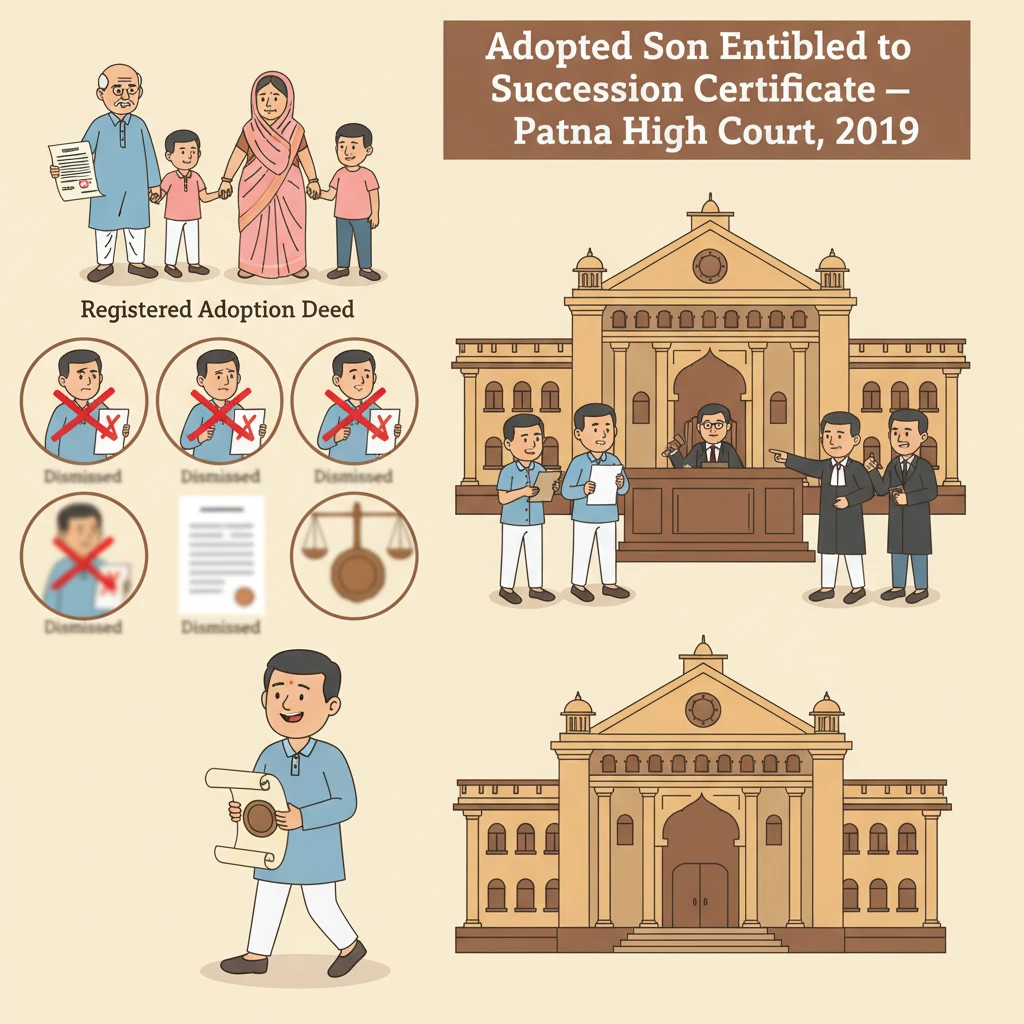
The dispute arose over the movable and immovable property of one Late Ganesh Poddar of village Bhithi, P.S. Sabour, District Bhagalpur. He and his wife, Smt. Shobhagayabati (also written as Sobhagyawati), had no biological children.
The appellant claimed that he had been adopted by Late Ganesh Poddar and his wife through a registered adoption deed dated 22.10.1975. On that basis, he applied for a succession certificate to inherit the deceased’s property.
Before the case that led to this appeal, the appellant had already filed three separate applications for a succession certificate regarding the same estate. These were registered as Succession Case No. 48 of 2000, Succession Certificate Case No. 58 of 2001, and Succession Case No. 18 of 2003. All three were dismissed, either for non-payment of court fee or for non-prosecution. In each of those petitions, he described himself as the “son” of Late Ganesh Poddar.
In Succession Case No. 34 of 2005 before the Fast Track Court-1st, Bhagalpur, the appellant again sought a succession certificate over the assets of Late Ganesh Poddar. This time, however, two relatives, arrayed as respondent nos. 5 and 6 (objectors, second set), contested his claim.
The objectors argued that the appellant had never been adopted by Late Ganesh Poddar or his wife. They pointed out that, despite filing three earlier applications for succession, the appellant had not mentioned adoption specifically. They also asserted that the last rites of Late Ganesh Poddar were performed by his nephew, and not by the appellant.
The Fast Track Court framed five issues, including whether the application was maintainable, whether the objectors had locus standi, whether the appellant was a duly and legally adopted son, whether limitation applied, and whether he was entitled to the succession certificate.
While deciding issue nos. (iii) and (v) together, the Fast Track Court concluded that the appellant was not the adopted son of Late Ganesh Poddar. It therefore refused to grant the succession certificate by order dated 30.11.2010 in Succession Case No. 34 of 2005.
Aggrieved, the appellant approached the Patna High Court in Miscellaneous Appeal No. 192 of 2011.
What the Court Examined and Decided
The Patna High Court, through Hon’ble Mr. Justice Birendra Kumar, heard both sides and examined the reasons given by the Fast Track Court for rejecting the adoption and the claim to succession.
The core dispute was whether the appellant was in law the adopted son of Late Ganesh Poddar and thus entitled to a succession certificate for his estate.
The lower court had placed heavy reliance on two points. First, that in his earlier succession petitions, the appellant had not specifically described himself as an “adopted” son. Second, that there was no detailed evidence of the adoption ceremony, such as the date of the ceremony, the name of any priest, or the names of persons present at the time. On this basis, the lower court treated the registered adoption deed as insufficient and rejected the claim.
Before the High Court, the appellant’s counsel argued that this approach was legally wrong. He relied on Section 12 of the Hindu Adoptions and Maintenance Act, 1956. This section states that from the date of adoption, an adopted child is deemed to be the child of the adoptive parents for all purposes, and all ties with the biological family are severed and replaced by ties with the adoptive family.
On this basis, counsel submitted that once adopted, the appellant rightly described himself simply as the “son” of Late Ganesh Poddar in his earlier petitions. There was no legal requirement that he must keep repeating that he was an “adopted” son instead of just “son”.
The High Court accepted this reasoning. It held that the Fast Track Court should not have dismissed the succession claim merely because the appellant had not always used the word “adopted” when describing his relationship with Late Ganesh Poddar. The Court found that this omission, by itself, could not defeat his claim, especially in light of Section 12.
The appellant’s counsel then focused on the adoption deed itself. He pointed out that there was a registered adoption deed dated 22.10.1975 (Exhibit 1). The deed clearly showed that the appellant had been taken in adoption by Shobhagayabati Devi, wife of Late Ganesh Poddar. Importantly, the biological father of the appellant, Gyandeo Poddar, had signed the deed and made a written statement that the adoption deed was correctly executed by him.
The High Court then examined Section 16 of the Hindu Adoptions and Maintenance Act, 1956. This provision states that when a registered document recording an adoption, signed by both the person giving and the person taking the child, is produced before a court, the court shall presume that the adoption has been made in compliance with the Act unless disproved.
The Court emphasised this legal presumption. Once a registered adoption deed is produced, the burden lies on those challenging the adoption to rebut the presumption by strong and convincing evidence.
Here, the objectors relied mainly on oral testimonies to say that no adoption had taken place. The High Court noted that there was no substantial material to disprove the registered adoption deed, apart from these oral statements. It reiterated the settled principle that oral evidence cannot override solid documentary evidence.
On the other hand, the respondent’s counsel highlighted Section 11(vi) of the Act. That clause states that, for a valid adoption, there must be actual giving and taking of the child by the parents or guardians, along with the other statutory conditions. He argued that the registered deed did not explicitly mention that the child was “given” in adoption. According to him, it only recorded that the adoptive mother “took” the child in adoption, and therefore the requirement of actual “giving and taking” was not satisfied.
The High Court rejected this technical objection. It reasoned that the biological father had signed the registered adoption deed and, in his own handwriting, stated that he had signed the adoption deed. For the Court, this was sufficient to show that he had agreed to and participated in giving the child in adoption, especially in view of the statutory presumption under Section 16.
Further, the natural father had been examined in the trial court as A.W. 4. In his testimony, he clearly stated that he had given the appellant in adoption to Sobhagyawati Devi, wife of Late Ganesh Poddar. He also stated that at the time of adoption the appellant was aged about 9 to 10 years and that he (the biological father) had other sons as well.
In such circumstances, the High Court held that a third party (like the objectors) could not be allowed to dispute the actual giving and taking in adoption when the person who had given the child and the adoptive side had never denied it. The Court observed that mere technicalities should not be allowed to defeat substantial justice.
The Court also examined other documentary evidence produced by the appellant. These included a certificate issued by the Bihar School Examination Board on 29.07.1980, which described the appellant as the son of Ganesh Poddar. The voter identity card issued by the Election Commission of India similarly recorded that Shobhakant Poddar @ Shobhakant Singh was the son of Ganesh Poddar.
Moreover, in an insurance policy taken by Ganesh Poddar prior to 31.03.1997, the nominees were his wife and the present appellant. These documents, in the Court’s view, strongly supported the claim that the appellant had been accepted and treated as the son of Late Ganesh Poddar from the time of adoption.
In light of this cumulative evidence, the High Court concluded that the Fast Track Court had committed an “error of record” in holding that there was no date of adoption and in ignoring the materials on record. The law does not require any particular ceremony or presence of witnesses beyond the essential act of giving and taking of the child. Here, the best witness to that act—the biological father—had confirmed it, and the registered deed and other documents backed it up.
Accordingly, the Patna High Court held that the impugned order dated 30.11.2010 suffered from both misreading of law and misreading of evidence. It set aside the order, allowed the miscellaneous appeal, and directed that the succession certificate be issued in favour of the appellant “at once”.
Why This Judgment Matters
This judgment is important for families in Bihar and elsewhere where adoption within the extended family is common but not always fully documented beyond a registered deed.
First, the Patna High Court has clarified that once there is a registered adoption deed signed by the person giving and the person taking the child, the court must start with the presumption that the adoption is valid. Opponents cannot easily unsettle such adoption based only on oral denial.
Second, the Court made it clear that an adopted child is, in law, simply a “son” or “daughter” of the adoptive parents. The child is not obliged to keep stating “adopted son” in every application. Failure to use the word “adopted” cannot by itself be used to deny inheritance rights.
Third, the judgment lowers the risk of technical objections being used to deprive an adopted child of property. The Court stressed that minor wording gaps in the deed or lack of details about rituals cannot override the main fact of giving and taking, especially when the natural parent confirms the adoption.
For laypersons, this decision shows that if a valid registered adoption deed exists, supported by consistent documents such as school records, voter cards, and insurance nominations, the adopted child’s right to seek a succession certificate is strong. It also indicates that relatives cannot easily prevent issuance of a succession certificate by raising late-stage disputes about adoption without strong proof.
Legal Issues and Answers
- Issue: Whether the appellant was the duly and legally adopted son of Late Ganesh Poddar under the Hindu Adoptions and Maintenance Act, 1956.
Answer: Yes. The Patna High Court held that the registered adoption deed dated 22.10.1975, supported by the testimony of the biological father and other documentary records, proved a valid adoption. The statutory presumption under Section 16 applied and was not rebutted. - Issue: Whether the appellant’s failure to describe himself as an “adopted” son in earlier succession applications could be a reason to deny his claim.
Answer: No. The Court held that, in view of Section 12, an adopted child is legally the son of the adoptive parents for all purposes. Describing himself simply as “son” of Late Ganesh Poddar in earlier applications could not be used to throw out the present petition. - Issue: Whether the appellant was entitled to a succession certificate for the estate of Late Ganesh Poddar.
Answer: Yes. After recognising the adoption as valid, the Court set aside the impugned order and directed that the succession certificate be issued in favour of the appellant immediately.
Cases Cited by the Court
- The judgment does not mention or rely upon any prior case law by name or citation. It primarily interprets and applies Sections 11, 12, and 16 of the Hindu Adoptions and Maintenance Act, 1956.
Case Details
Case Number: Miscellaneous Appeal No. 192 of 2011
Case Title: Shobhakant Kumar @ Poddar vs. Rani Devi & Ors.
Court: High Court of Judicature at Patna
Coram: Hon’ble Mr. Justice Birendra Kumar
Date of Judgment: 14-03-2019
Citation: 2019(3) PLJR 284
Advocates:
- For the Appellant: Mr. Ganpati Trivedi, Senior Advocate; Mr. Indeshwari Pd. Mandal, Advocate
- For the Respondents: Mr. Ranjan Kumar Dubey, Advocate; Mr. Rajiv Ranjan Singh, Advocate; Mr. Shanti Bhushan Singh, Advocate
Nature of the Case: Miscellaneous appeal against an order in a succession case refusing grant of succession certificate.
Impugned Order: Order dated 30.11.2010 passed in Succession Case No. 34 of 2005 by the Fast Track Court-1st, Bhagalpur.
Final Outcome: Appeal allowed; impugned order set aside; direction to issue succession certificate in favour of the appellant.
Link to Judgment: Patna High Court Judgment in Miscellaneous Appeal No. 192 of 2011
If you found this explanation helpful and wish to stay informed about how legal developments may affect your rights in Bihar, you may consider following Samvida Law Associates for more updates.







