
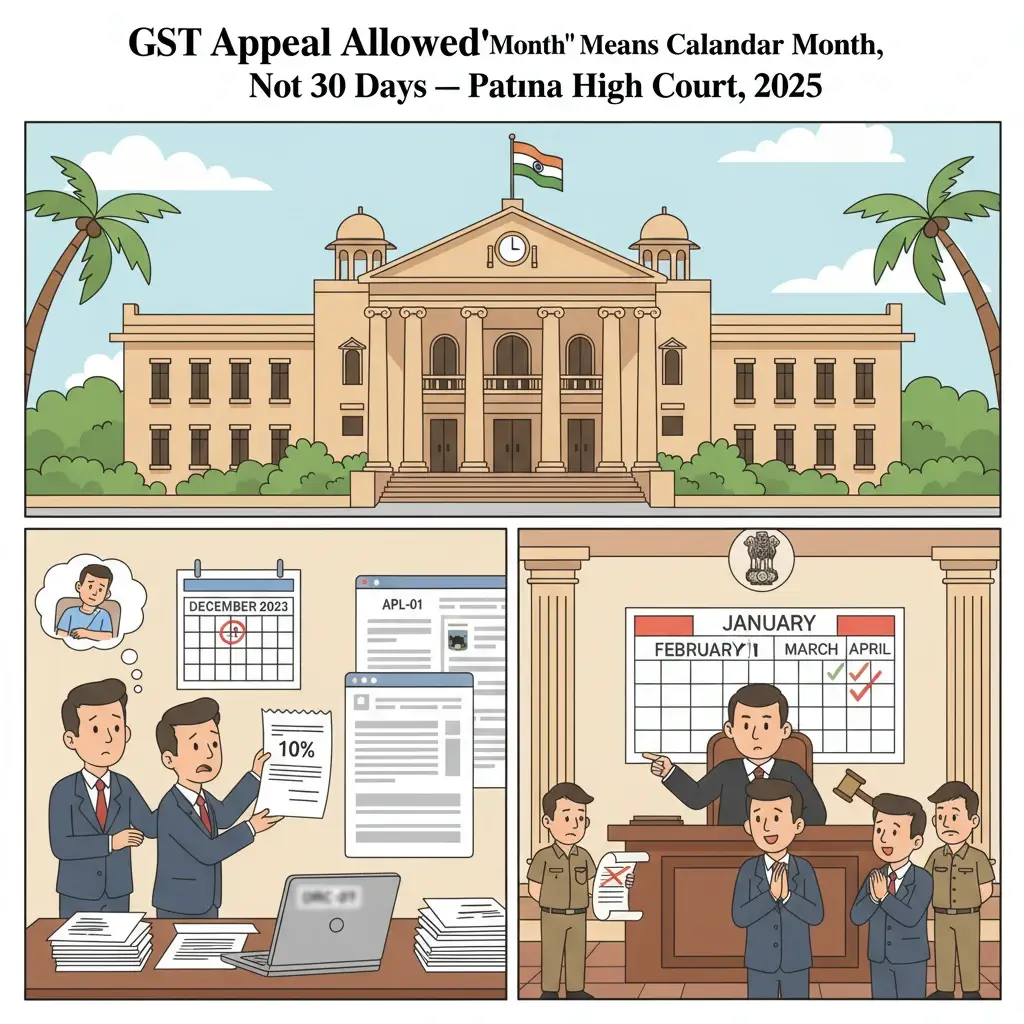
Case Background
The petitioner, a private limited company registered under the Companies Act, 1956, and under the CGST and BGST Acts in Bihar, faced a GST proceeding for the period from July 2017 to March 2018.
The Assistant Commissioner of State Tax issued a show-cause notice under Section 73(1) of the CGST/BGST Act, 2017, demanding tax of Rs. 81,21,878/-, interest under Section 50 of Rs. 77,97,004/-, and a penalty of Rs. 8,12,187/-. The petitioner was directed to respond by 27.09.2023, and a personal hearing was scheduled for 10.10.2023.
Subsequently, two reminder notices were issued, requesting the petitioner to submit its reply by 08.12.2023. The petitioner responded, seeking an additional fifteen days to reconcile purchase details, citing the unavailability of one supplier. A further reminder, dated 22.10.2023, called upon the petitioner to submit a reply by the next day. These reminder correspondences were not fully placed on record, as the petitioner considered them not central to the issue in this writ.
On 27.12.2023, the Assistant Commissioner passed a final demand order under Section 73(9) of the CGST/BGST Act, 2017, along with a summary order in Form DRC-07. The demand reiterated the tax of Rs. 81,21,878/- along with interest and penalty for the period of July 2017 to March 2018.
The petitioner chose to exercise its statutory right to appeal under Section 107 of the CGST/BGST Act. It filed an online appeal in Form GST APL-01 on 26.04.2024 before the Additional Commissioner of State Tax (Appeals), Central Division, Patna.
While the appeal was filed beyond the initial three-month limitation period under Section 107(1), the petitioner argued that it fell within the additional one-month period allowed for condonation of delay under Section 107(4). The petitioner attributed the delay to the ill health of its Director and provided reasons for the delay in the appeal form. It also deposited ten per cent of the disputed tax as a pre-deposit under Section 107(6).
However, the appellate authority rejected the appeal at the admission stage on 18.05.2024, via order in Form APL-02 (Memo No. 529), stating that the appeal was time-barred. This rejection led to the writ petition before the Patna High Court.
What the Court Examined and Decided
The Patna High Court addressed a single core question: how to correctly calculate the “three months” and “further one month” mentioned in Section 107 of the CGST/BGST Act, 2017, for the purpose of limitation.
The petitioner argued that the appellate authority had incorrectly equated “three months + one month” with “90 days + 30 days = 120 days.” According to the petitioner, this calculation was contrary to the statutory language and established Supreme Court authority, which clarifies that a “month” means a calendar month, not a block of thirty days.
The petitioner relied on Supreme Court judgments, including:
- State of Himachal Pradesh and Anr. v. Himachal Techno Engineers and Anr., (2010) 12 SCC 210
- Bibi Salma Khatoon v. State of Bihar, (2001) 7 SCC 197
- Econ Antri Limited v. Rom Industries Limited and Anr., (2014) 11 SCC 769
- State of West Bengal v. Rajpath Contractors and Engineers Ltd., 2024 7 SCR 1 : 2024 INSC 477
- State of Bihar v. Kalika Kuer @ Kalika Singh & Ors., (2003) 5 SCC 448
The petitioner submitted that these judgments establish that:
- the starting day is excluded when computing limitation; and
- a “month” is to be understood as a calendar month, not 30 days.
The State, through learned GP-7, opposed the writ and supported the appellate authority’s view that “month” should be treated as 30 days for this purpose. The State relied on a Patna High Court judgment in M/s Vaishnavi Enterprises v. State of Bihar (CWJC No. 11172 of 2024), where the Court had treated three months as 90 days and then added a further 30 days for condonation.
The State argued that, consistent with that approach, the appeal in this case was filed beyond the combined period of 120 days from the communication of the assessment order, and so was rightly rejected.
The Division Bench, speaking through Hon’ble Mr. Justice Rajeev Ranjan Prasad, reproduced Section 107 of the CGST Act in full. The Court then analyzed sub-section (1) (prescribing filing “within three months”) and sub-section (4) (permitting condonation “within a further period of one month”).
The Court then turned to Supreme Court case law on how to compute such periods. In Econ Antri Limited, the Supreme Court upheld the earlier decision in Saketh India Ltd. v. India Securities Ltd., (1999) 3 SCC 1, which had relied on Section 9 of the General Clauses Act, 1897, and Section 12 of the Limitation Act, 1963. The settled rule is that where a period is counted “from” a date, that date is excluded, and the last day is included.
In Bibi Salma Khatoon, the Supreme Court interpreted “three months” in Section 16(3) of the Bihar Land Reforms (Fixation of Ceiling Area and Acquisition of Surplus Land) Act, 1961. With reference to the Bihar and Orissa General Clauses Act, 1917, and Halsbury’s Laws of England, it held that “month” means a calendar month and that the date from which limitation starts is excluded.
In Himachal Techno Engineers, dealing with Section 34(3) of the Arbitration and Conciliation Act, 1996, the Supreme Court specifically held that “three months” in that provision does not mean 90 days. Instead, a month has to be read as a calendar month as per Section 3(35) of the General Clauses Act, 1897.
The Patna High Court also cited the recent decision in State of West Bengal v. Rajpath Contractors and Engineers Ltd. In that case, the Supreme Court treated a three-month limitation period under Section 34(3) as expiring on 30th September 2022 (starting from 1st July 2022), which, when counted in days, would be 92 days. This reinforced that “three months” is not a fixed 90-day block.
Applying these principles, the Patna High Court concluded that in this GST context:
- The date on which the adjudicating authority’s order was received is excluded while counting limitation by virtue of Section 9 of the General Clauses Act.
- The “three months” under Section 107(1) is a period of three calendar months, not 90 days.
- The “further period of one month” under Section 107(4) is similarly a calendar month, not 30 days.
Based on the facts, the Court found that three months from the date of receipt of the order expired on 27.03.2024. The appellant was then entitled to file an appeal within a further period of one month up to 27.04.2024, provided sufficient cause for delay was shown.
Since the appeal was actually filed on 26.04.2024, it fell within this further condonable month. The appellate authority was therefore required to consider the reasons for delay and decide whether to condone it, rather than dismissing the appeal outright as time-barred.
The Court then examined the earlier Patna High Court judgment in M/s Vaishnavi Enterprises. It noted that in that case, the appeal had admittedly been filed even beyond the one-month condonable period. However, the calculation in that judgment, equating three months with 90 days, was inconsistent with the statute and with binding Supreme Court precedents.
Relying on State of Bihar v. Kalika Kuer, the Court explained that a decision rendered in ignorance of a binding statute or higher court decision can be regarded as per incuriam. It held that the observation in M/s Vaishnavi Enterprises treating three months as 90 days was made in ignorance of the legislative scheme and Supreme Court law and therefore could not be followed.
In conclusion, the Court held that the appellate authority had “completely erred in appreciating the legislative scheme” under Section 107 of the CGST/BGST Act by wrongly converting the statutory “three months + one month” structure into “90 days + 30 days,” which is unsupported by law.
The Bench, therefore:
- Set aside the impugned appellate order dated 18.05.2024 (Annexure P/4);
- Allowed the writ petition; and
- Directed the appellate authority to restore the appeal to its original file.
The appellate authority has now been ordered to consider the reasons given by the petitioner for not filing within the initial three months and to decide the appeal on merits, after properly dealing with the condonation of delay. The Court expressly declared that the appeal filed on 26.04.2024 is within the further one month allowed under Section 107(4).
Why This Judgment Matters
This judgment is important for all GST-registered businesses in Bihar and beyond who may need to file appeals under Section 107 of the CGST/BGST Acts.
The Patna High Court has clearly held that “three months” and “one month” in Section 107 cannot be mechanically converted into 90 and 30 days; they refer to calendar months. This distinction can significantly affect the last date for filing an appeal.
For taxpayers, this means that if they receive an adverse GST order, they have:
- Three full calendar months from the day after receipt to file an appeal as a matter of right; and
- One additional calendar month, within which the appellate authority may condone delay upon showing sufficient cause.
The decision also serves as a reminder to GST appellate authorities that they must apply the law as written and as clarified by the Supreme Court, rather than relying on a rigid “90+30 days” formula.
Practically, this judgment can assist taxpayers whose appeals were rejected solely due to such miscalculation of limitation, demonstrating that such rejection orders can be challenged before the High Court.
Legal Issues and Answers
Issue: Should “three months” and “one month” in Section 107 of the CGST/BGST Act be interpreted as 90 days and 30 days respectively, resulting in a total period of 120 days from the communication of the order?
Answer: No. The Court clarified that “three months” and “one month” refer to calendar months. The appeal filed on 26.04.2024 was within the additional one month allowed under Section 107(4), and the appellate authority was obligated to consider condonation of delay instead of rejecting the appeal as time-barred.
Cases Cited by the Court
- State of Himachal Pradesh and Anr. v. Himachal Techno Engineers and Anr., (2010) 12 SCC 210
- Bibi Salma Khatoon v. State of Bihar, (2001) 7 SCC 197
- Econ Antri Limited v. Rom Industries Limited and Anr., (2014) 11 SCC 769
- Saketh India Ltd. v. India Securities Ltd., (1999) 3 SCC 1
- SIL Import, USA v. Exim Aides Silk Exporters, (1999) 4 SCC 567 (referred to in context, held not laying down correct law)
- Haru Das Gupta v. State of W.B., (1972) 1 SCC 639
- Tarun Prasad Chatterjee v. Dinanath Sharma, (2000) 8 SCC 649
- Assam Urban Water Supply & Sewerage Board v. Subash Projects & Mktg. Ltd., (2012) 2 SCC 624
- State of West Bengal v. Rajpath Contractors and Engineers Ltd., 2024 7 SCR 1 : 2024 INSC 477
- State of Bihar v. Kalika Kuer @ Kalika Singh & Ors., (2003) 5 SCC 448
- M/s Vaishnavi Enterprises v. State of Bihar & Ors., Patna High Court, CWJC No. 11172 of 2024 (considered and not followed on limitation computation)
Case Details
Case Number: Civil Writ Jurisdiction Case No. 14957 of 2024
Case Title: M/s Brand Protection Services Private Limited v. The State of Bihar & Ors.
Court: High Court of Judicature at Patna
Coram: Hon’ble Mr. Justice Rajeev Ranjan Prasad, Hon’ble Mr. Justice Ramesh Chand Malviya
Date of Judgment: 04-02-2025
Advocates:
- For the Petitioner: Mr. Anubhav Khowala, Advocate
- For the Respondents: Mr. Vivek Prasad, GP-7
Respondents: State of Bihar through Principal Secretary-cum-Commissioner, Commercial Tax Department; Assistant Commissioner of State Tax, Patna Special Circle; Additional Commissioner of State Tax (Appeals), Central Division, Patna
Nature of the Case: Writ petition under Article 226 challenging rejection of GST appeal as time-barred and seeking direction to entertain and decide the appeal on merits, with interim protection against coercive recovery.
If you found this explanation helpful and wish to stay informed about
how legal developments may affect your rights in Bihar,
you may consider following Samvida Law Associates for more updates.







