
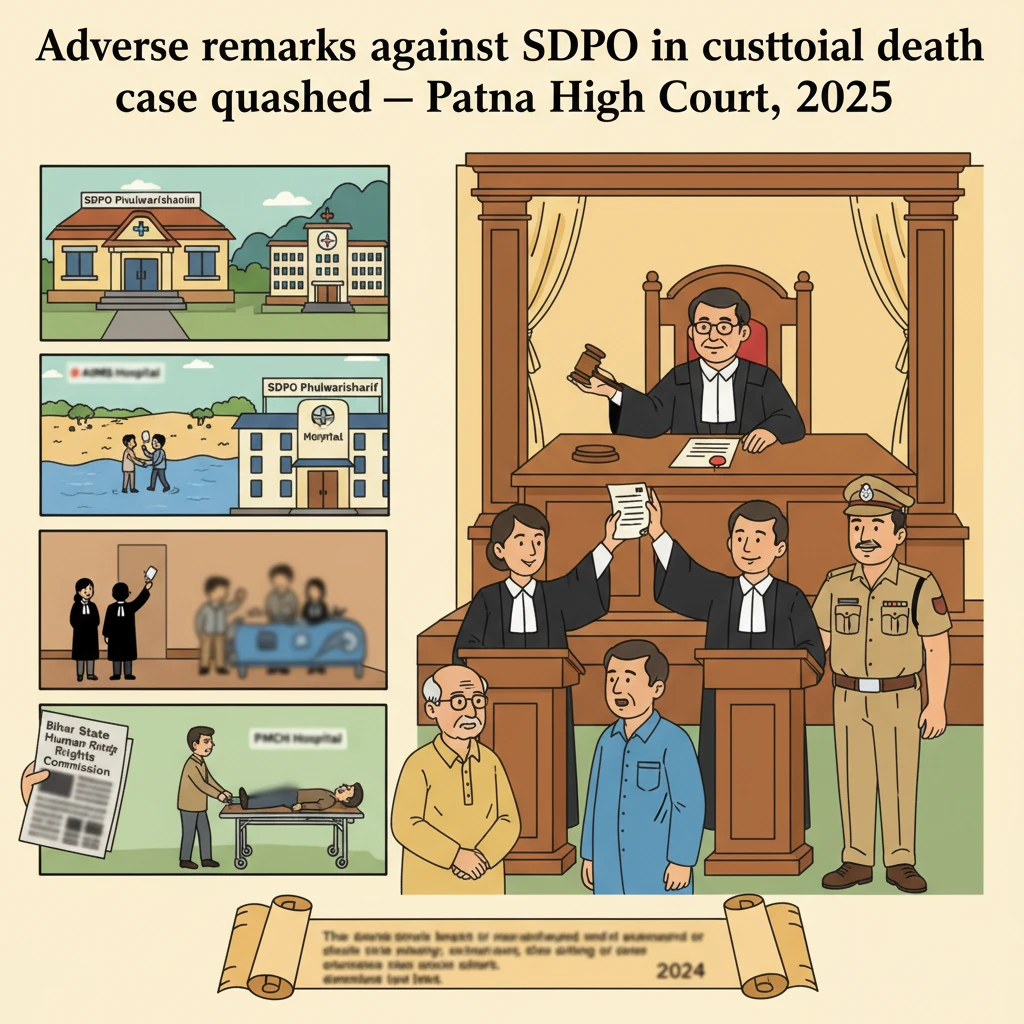
Case Background
This case arises from a tragic custodial death of a young man, Jitesh Kumar, linked to a police station under the Phulwarisharif subdivision in Patna district.
According to the prosecution version, recorded on the written report of opposite party no. 2 (O.P. No. 2), his brother-in-law had earlier lodged an FIR against his son Jitesh Kumar and others. Jitesh had filed an anticipatory bail petition in that earlier case, which was still pending.
O.P. No. 2 alleged that on 31.03.2024, his son Jitesh was sitting at Bans Ghat with a friend, Mukesh Kumar. Police personnel from Phulwarisharif Police Station allegedly came there and took Jitesh to the office-cum-residence of the Sub-Divisional Police Officer (SDPO), Phulwarisharif, where another friend, Rahul Kumar, was already present.
It was alleged that Jitesh was then taken to another room and brutally beaten by police. He screamed, and when Mukesh and Rahul tried to intervene, they too were beaten. Jitesh was said to be lying in pain, crying, and vomiting. After some time, he became unconscious. Police then hurriedly took him to AIIMS Hospital, where he was declared brought dead.
Later, O.P. No. 2 was informed in the morning by Rajeev Nagar Police Station that his son was admitted at PMCH. When he reached there, he found Jitesh dead with bruises all over his body. He also alleged that two individuals, Surendra Singh and Sandesh Kumar, had earlier threatened to kill his son and that they had killed him in connivance with police.
On this written report, Phulwarisharif P.S. Case No. 5117070240487 of 2024 dated 01.04.2024 was registered under Sections 302 and 120-B of the Indian Penal Code.
Before registration of this FIR, the Bihar State Human Rights Commission, Patna, had already initiated a suo motu enquiry on the basis of a newspaper report, registered as Case No. 2215/4/26/2024-AD.
After its enquiry, the Commission passed a report-cum-order dated 20.06.2024, making several recommendations, including for initiation of contempt proceedings against the then Senior Superintendent of Police, Patna (as on 31.03.2024) and all police officials indicated in the order. The present petitioner, an IPS officer posted as SDPO, Phulwarisharif-1, was one of those against whom adverse remarks were recorded.
He therefore moved the Patna High Court under Section 482 CrPC in Criminal Miscellaneous No. 66363 of 2024, seeking two main reliefs: a direction for just, proper and scientific investigation in the FIR, and expunging of adverse remarks and recommendations against him in the Commission’s order.
What the Court Examined and Decided
The matter was heard by Hon’ble Mr. Justice Chandra Shekhar Jha. The Court heard counsel for the petitioner, the State, and O.P. No. 2.
The petitioner’s counsel argued that the Bihar State Human Rights Commission had passed serious adverse remarks against him, especially in paragraph 24 (page 30) and paragraph 27 (pages 32–33) of its report-cum-order dated 20.06.2024, without even issuing him a show cause notice.
He pointed out that although the Commission had recorded the petitioner’s statement during the suo motu enquiry, it did not provide him the complete materials nor did it give him any opportunity to explain or defend himself before recording findings adverse to him.
According to the petitioner, the Commission’s order was based on conjectures and presumptions, not on concrete material. The Commission, he said, had made a “presumptive analysis” and concluded that he shared common intention with others simply because he was in a supervisory role over Phulwarisharif Police Station.
The petitioner stressed that he was not present when the alleged torture took place. He stated that on 31.03.2024, from 7:00 p.m. to 8:15 p.m., he was attending an official meeting convened by the SSP, Patna, through virtual mode. An official instruction for this meeting had been sent to him on WhatsApp at 5:40 p.m., after which he prepared for and joined the meeting.
He submitted that the Commission’s findings suggesting his presence at the time of occurrence were “totally false” and that there was no material to connect him with the alleged cruelty. Since the FIR had already been registered and investigation was pending, the Commission, he argued, should have refrained from giving such findings which might prejudice the ongoing investigation.
He further contended that simply being in a supervisory position does not create criminal liability without any evidence of active role, connivance, or knowledge. The Commission had, in his view, “vicariously connected” him with the offence only because he was SDPO.
The petitioner also highlighted that the adverse remarks could seriously harm his career prospects and even lead to his false implication in the criminal case despite there being no fault on his part. At the same time, he made it clear that he had full sympathy with the deceased, did not support any custodial torture, and himself sought a proper and scientific investigation so that real offenders could be punished.
On behalf of O.P. No. 2, the father of the deceased, it was argued that his son Jitesh Kumar had been murdered by policemen in police custody at the SDPO office, Phulwarisharif, in presence of the petitioner. Counsel submitted that the police had maintained silence after the incident, which led the Human Rights Commission to take suo motu cognizance based on a newspaper report in “Dainik Jagran” dated 02.04.2024.
O.P. No. 2’s counsel justified the Commission’s order dated 20.06.2024 by describing the deceased as a young, dynamic student with a bright future, whose custodial death had shattered his family. He stressed that the SDPO, being in charge of the subdivision, was responsible for maintaining law and order, preventing and detecting crime, and enforcing law within the jurisdiction, and therefore bore responsibility.
Citing constitutional principles, he argued that custodial torture and custodial deaths are grave violations of Article 21 and related safeguards in the Constitution and CrPC, and that such practices have been long prevalent and often ignored. He relied upon Supreme Court decisions, including:
- Prakash Kadam v. Ramprasad Vishwanath Gupta (2011) 6 SCC 189, where it was observed that police personnel committing crimes deserve harsher punishment because their acts are contrary to their duty to uphold law.
- Prakash Singh v. Union of India (2006) 8 SCC 1, which dealt with police reforms, separation of investigation from law and order functions, and creation of complaints authorities for human rights violations, including custodial deaths.
- Sanjay Gupta and others v. State of Uttar Pradesh (2022) 7 SCC 203, which concerns compensation for violation of life and personal liberty, to be computed on principles of just compensation.
On this basis, he argued that the family should be compensated with at least Rs. 50 lakhs and a government job to a family member, and that the application filed by the petitioner deserved dismissal.
The High Court, however, focused on the material available regarding the petitioner’s role and on the procedure followed by the Human Rights Commission.
A key document for the Court was the Judicial Enquiry Report prepared by the learned Judicial Magistrate 1st Class, Patna, in connection with custodial death of Jitesh Kumar under Phulwarisharif P.S. Case No. 34 of 2024. The Court specifically reproduced and relied on Para IV of the conclusion of this report.
In that paragraph, the Judicial Magistrate clearly recorded that the then SDPO, Phulwarisharif, the present petitioner, “had no knowledge of the accused being tortured at the S.D.P.O. office Phulwarisharif.” The Magistrate found that the petitioner came to know about the occurrence only when he was informed by police personnel. He then reached the SDPO office and, upon seeing the compounder and other officials, directed the SHO, Phulwarisharif, to take the victim to hospital immediately for treatment.
Thereafter, on being informed about the victim’s death, the petitioner immediately informed his superiors. During all this time, he was engaged in an official meeting through virtual mode presided over by the SSP, Patna. The Judicial Enquiry Report concluded that the SDPO, Vikram Sihag, “is not involved in any manner in the alleged torture of the victim.”
The High Court took note of this finding. It held that the petitioner was only in a supervisory capacity over Phulwarisharif Police Station and could not be held liable for any offence in the absence of material evidence connecting him with the alleged torture or conspiracy. The Court found that there was “absolutely no material” before the Human Rights Commission to show his involvement or connivance.
The Court also observed that the Commission had not issued any show cause notice to the petitioner and had “straightway” passed an order carrying adverse remarks and recommending contempt proceedings against him. This was held to be violative of the principles of natural justice.
Relying on Para IV of the Judicial Enquiry Report and on the lack of material against the petitioner, the Court concluded that the Commission’s order dated 20.06.2024 in Case No. 2215/4/26/2024-AD, so far as it concerned the petitioner, was unsustainable in law and liable to be quashed.
At the same time, the Court did not interfere with the criminal investigation into the custodial death. Instead, it strengthened the requirement of a fair probe. It directed the Investigating Officer of Phulwarisharif P.S. Case No. 5117070240487 of 2024 to conduct a “proper and scientific investigation” and to submit charge-sheet as early as possible, keeping in view the judicial enquiry report and in accordance with law.
Accordingly, the application under Section 482 CrPC was allowed, and the impugned order of the Bihar State Human Rights Commission was quashed only “qua petitioner”. A copy of the High Court’s order was directed to be communicated to the trial court and to the Bihar State Human Rights Commission, Patna.
Why This Judgment Matters
This judgment is important on two fronts.
First, it shows that even in a serious matter like custodial death, a person cannot be blamed or punished merely because he is a senior officer or holds a supervisory post. There must be clear material showing his role, knowledge, or connivance. Otherwise, adverse remarks can be struck down.
Second, the Patna High Court has balanced protection of individual officers with the need for accountability for custodial deaths. While clearing the SDPO of involvement and removing remarks that could damage his career, the Court has not diluted the seriousness of the custodial death. It has directed a proper and scientific investigation and kept the path open for action against those actually responsible.
For families of victims and for police officers alike, the message is that investigations must be fair, evidence-based, and in line with natural justice. Human rights bodies too must follow due process before recording findings against any individual.
Legal Issues and Answers
-
Issue: Can the Bihar State Human Rights Commission record adverse findings and recommend contempt proceedings against a supervisory police officer without giving him a show cause notice or having material to link him with the alleged torture?
Answer: No. The Patna High Court held that in the absence of material connecting the SDPO with the alleged torture and without giving him an opportunity of hearing, the adverse remarks and recommendations are violative of principles of natural justice and unsustainable in law, and therefore were quashed qua the petitioner. -
Issue: Should the criminal investigation into the custodial death be interfered with or weakened because of this application?
Answer: No. The Court instead directed the Investigating Officer to carry out a proper and scientific investigation in the FIR relating to the custodial death and to file charge-sheet at the earliest, considering the judicial enquiry report and in accordance with law.
Cases Cited by the Court
- The High Court judgment itself does not cite or rely upon specific Supreme Court or High Court decisions. However, counsel for O.P. No. 2 referred to the following decisions of the Hon’ble Supreme Court:
- Prakash Kadam v. Ramprasad Vishwanath Gupta (2011) 6 SCC 189
- Prakash Singh v. Union of India (2006) 8 SCC 1
- Sanjay Gupta and others v. State of Uttar Pradesh (2022) 7 SCC 203
These were cited in argument to emphasize accountability for custodial violence and the need for police reforms and compensation, but the final reasoning of the Patna High Court turned mainly on the judicial enquiry report and principles of natural justice.
Case Details
Case Number: Criminal Miscellaneous No. 66363 of 2024 (arising out of Phulwarisharif P.S. Case No. 487 of 2024)
Case Title: Vikram Sihag v. The State of Bihar & Ors.
Citation: 2025(4) PLJR 42
Court: High Court of Judicature at Patna
Coram: Hon’ble Mr. Justice Chandra Shekhar Jha
Date of Judgment: 18-08-2025
Advocates:
- For the Petitioner: Mr. Rana Vikram Singh, Advocate
- For the State: Md. Anzarul Haque Sahara, APP
- For Opposite Party No. 2: Mr. Subhash Patel, Advocate
Nature of the Case: Petition under Section 482 of the Code of Criminal Procedure, 1973, seeking directions for proper and scientific investigation in an FIR under Sections 302 and 120-B IPC arising out of an alleged custodial death, and for quashing/expunging adverse remarks and recommendations contained in a report-cum-order of the Bihar State Human Rights Commission.
Link to Judgment: Click here to read the full judgment of the Patna High Court
If you found this explanation helpful and wish to stay informed about
how legal developments may affect your rights in Bihar,
you may consider following Samvida Law Associates for more updates.







