
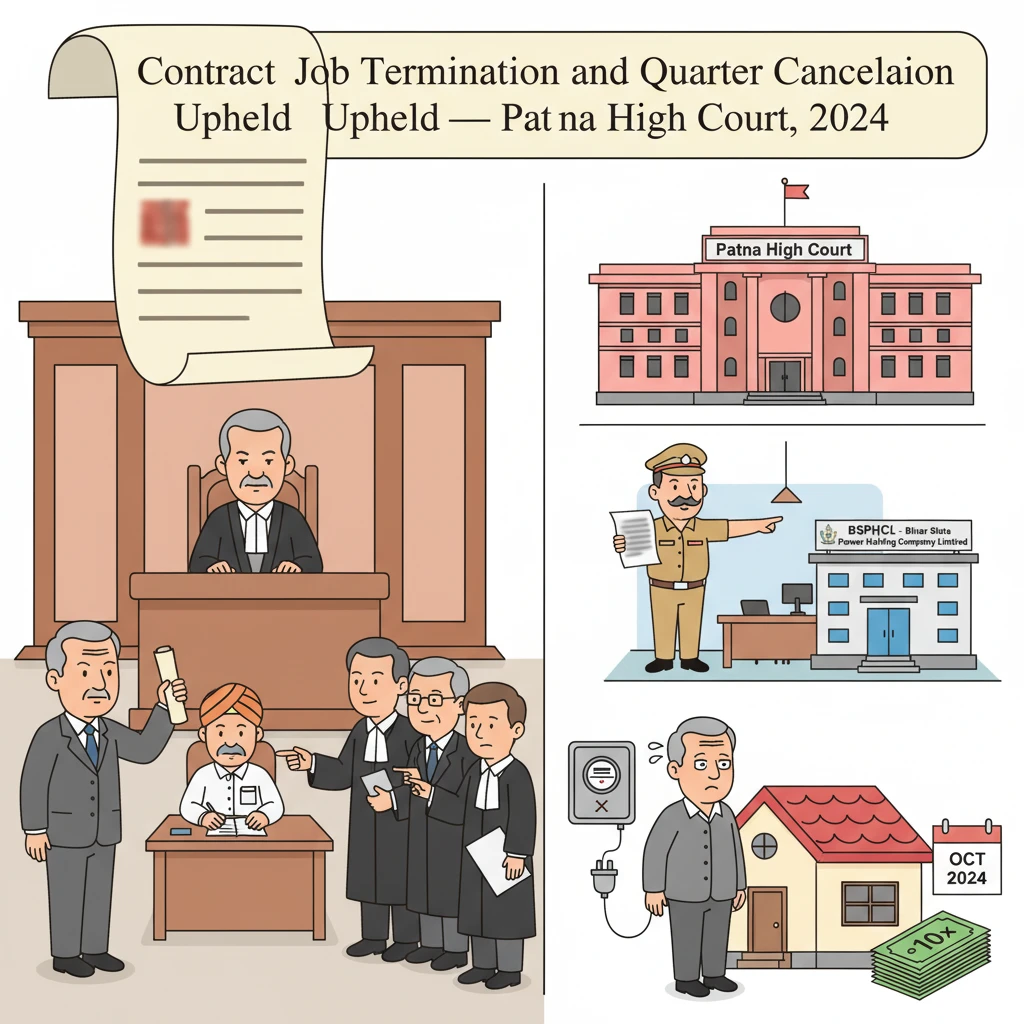
Case Background
The petitioner was a retired IPS officer and former DIG of Police. After retirement, he applied for and was selected under Job Engagement Contract Notice No. 06/2022, issued by Bihar State Power Holding Company Limited (BSPHCL) for the post of Advisor (Energy Accounting & Audit).
An appointment letter bearing letter no. 384/Patna dated 15.11.2022 was issued to him. He joined BSPHCL as Advisor on contract for a period of three years. The engagement letter specified terms and conditions, including that the contract could be extended up to the age of 67 years depending on the company’s requirement and his performance.
Considering his previous experience in Left Wing Extremism (LWE) affected and crime-prone districts and his regular appearances as prosecution witness or Investigating Officer in vigilance cases, the then management allotted him Quarter No. B/5 (Old), New Punaichak, Electricity Board Colony, Rajvanshi Nagar, Patna. This was described as being for his “smooth and safe working in special circumstances,” on rent 10 times higher than that paid by regular staff. He had been staying there on a temporary basis since December 2023.
On 23.09.2024, BSPHCL issued Notification No. 539 with Memo No. 540, terminating the petitioner’s job engagement contract with immediate effect. He claims this order was a three-line communication without any prior notice or reasons and in violation of his contract terms.
Subsequently, by Office Order No. 1318 (H-IX vividh (Awash) 4002/2024/Patna) dated 08.10.2024, the Deputy General Manager (HR/Administration), BSPHCL cancelled the allotment of his quarter with immediate effect. On 10.10.2024, the Executive Engineer (Civil), Civil Division No. II, Punaichak, Patna issued Letter No. 1074 directing him to vacate Quarter No. B/5 (Old) immediately, warning that the water connection would be disconnected. The petitioner alleged that on 14.10.2024, electricity and water to his quarter were forcibly disconnected.
Aggrieved, the petitioner submitted a written representation dated 14.10.2024 by email to the CMD, BSPHCL, also forwarding a copy to the Chief Secretary, Government of Bihar and the Secretary, Department of Energy. As no action was taken and another person was appointed in his place, he approached the Patna High Court via this writ petition.
What the Court Examined and Decided
The petitioner challenged four main actions: the termination notification dated 23.09.2024, cancellation of his quarter allotment, the direction to vacate the quarter, and steps such as alleged disconnection of water and electricity. He also sought mandamus to restrain the authorities from acting arbitrarily or with mala fide intention against him and to ensure compliance with terms of the job engagement contract.
His case was that the termination order was arbitrary, whimsical, issued without notice, without evaluation of his work, and contrary to the specific contractual clause that required either one month’s prior notice or adherence to conditions. He also stressed that his contract had already been renewed and was valid till November 2025, with a possibility of extension up to age 67 depending on performance.
The petitioner argued through written submissions that the termination was in truth punitive and that the internal communications dated 21.11.2024 (Annexure R/6 and R/7) and subsequent directions to vacate the quarter showed that the authorities had formed adverse findings behind his back. He even alleged, in strong language, that the respondents should be criminally prosecuted for manufacturing false reports and cited several Supreme Court decisions on arbitrariness, fairness in contractual actions of the State, and accountability of public officials, including Kumari Shrilekha Vidyarthi v. State of U.P.
The Court noted that some of the language used by the petitioner’s counsel in the written argument was inappropriate and “diminished the majesty of this Court.” However, since the counsel tendered an apology in open court, the matter was not pursued further.
On the other side, BSPHCL argued that the petitioner’s appointment was purely contractual for three years with clear terms in the engagement letter. It was emphasized that satisfactory performance was an essential condition under clauses 1 and 10 of his job contract. According to BSPHCL, his services were terminated because of unsatisfactory performance and multiple complaints regarding lack of interest and failure to discharge duties effectively.
The respondents pointed to two detailed performance reports dated 21.11.2024:
First, the General Manager (Revenue), South Bihar Power Distribution Company Limited, in Letter No. 1494, listed a series of failures by the petitioner, including:
- No action plan for consumer billing being given to the Revenue Department.
- No plan for rectifying billing data errors.
- No plan for billing new consumers after reviewing their details.
- No plan for monitoring daily consumption of smart meter consumers, non-communicating consumers and disconnected consumers, to ensure monthly billing.
- No plan to prevent theft by analyzing billing data.
- No plan for inspecting premises of temporarily disconnected consumers with large pending dues, creating scope for illegal consumption and revenue loss.
- No plan to increase revenue collection or to recover outstanding dues.
- No steps for ensuring payment of electricity dues by government departments.
The report concluded that due to the petitioner’s inaction, the Revenue Department itself had to carry out continuous supervision and monitoring, taking suo motu actions to gradually reduce AT&C losses.
Second, the Chief Engineer (Special Task Force), North Bihar Power Distribution Company Limited, in Letter No. 638, stated that the petitioner’s work as Advisor (Energy Accounting & Auditing) was not satisfactory. It recorded, among other things:
- He did not adequately monitor cases where FIRs for electricity theft were not registered by police despite applications by electricity officials.
- He failed to present any action plan in meetings chaired by the CMD regarding expeditious disposal of electricity theft cases pending in courts.
- Recovery of final assessment amounts in many theft cases was “zero,” and better coordination with police could have improved recovery.
- He did not take any initiative to hold separate review meetings with the Managing Director, NBPDCL, to periodically review STF work and give guidelines.
- Despite a specific emphasis by the CMD on 19.09.2023 for strong efforts to reduce non-technical losses such as theft, wrong tariff billing, faulty or missing meters and billing mistakes, no meaningful initiatives were taken by the petitioner.
On the question of notice, the respondents stated that even if one month’s prior notice had not been given, they would pay one month’s salary in lieu of notice as per the contract conditions.
The Court framed the key legal question as: whether the termination order dated 23.09.2024, read with subsequent internal communications dated 21.11.2024 (Annexures R/6 and R/7), was punitive in nature so as to attract constitutional protection like Article 311(2), or whether it was a simple contractual termination.
The Court surveyed a long line of Supreme Court decisions to apply the correct test. It referred to:
- Parshotam Lal Dhingra v. Union of India, explaining that where termination is based on a contractual right or service rules and does not visit the employee with “evil consequences” like stigma affecting future employment, it is not punishment in the sense of Article 311.
- Cases like Ravindra Kumar Misra, where the Supreme Court developed the “motive versus foundation” test: if alleged delinquency is only the background or motive but not the foundation of the order, the order can remain non-punitive.
- Shamsher Singh and later decisions (including Abhay Jain and Swati Priyadarshini) clarifying that even innocently worded termination orders can be treated as punitive if they are founded on proved misconduct without holding proper inquiry. However, if the employer assesses overall unsuitability or loss of confidence in a contractual/probationary context and acts within the contract, the order may remain simpliciter.
- Kaushal Kishore Shukla, Karnataka State Road Transport Corporation v. S.G. Kotturappa and related cases reiterating that even if some inquiry or preliminary assessment is held, a simple discharge of a temporary/contractual employee on unsuitability, without attaching stigma, does not automatically become punishment.
Applying these principles, the Court examined the actual termination notification (Notification No. 539 dated 23.09.2024). The operative part simply stated that the petitioner’s contract as Advisor (Energy Accounting & Audit), BSPHCL “is terminated with immediate effect” with approval of the competent authority. No allegations, stigma, or blame language was used in the order itself.
The internal performance reports dated 21.11.2024 were used by the company to justify its decision and to decide the petitioner’s representation. The Court treated these as part of the employer’s internal assessment based on service records, not as a basis for imposing a formal penalty.
Critically, the Court also noted that the petitioner himself had not pleaded in the writ petition that the termination was punitive in the Article 311 sense and required a departmental enquiry. His main thrust was arbitrariness and violation of contract, not constitutional protection as a civil servant.
The Court concluded that:
- The petitioner was a purely contractual appointee on specific terms.
- He had no legal right to continue beyond the contract terms.
- The termination was an exercise of contractual power based on performance assessment.
- It did not cast an indelible stigma nor impose “evil consequences” like loss of rank or statutory civil post status.
- Article 14, 16 and 311 were not violated in these facts.
On this reasoning, the Court held that the termination was a “termination simpliciter” and did not require a regular departmental inquiry or application of Article 311(2). Hence, there was no ground for judicial interference.
Regarding the quarter, the Court noted that the allotment was linked to his contractual engagement. Once the contract ended, BSPHCL was entitled to cancel the allotment and require him to vacate. The Court held that BSPHCL, being a separate entity falling within “State” under Article 12, could not be compelled to continue his occupation after termination of his engagement.
At the end of the hearing, the petitioner, appearing in person, requested 60 days’ time to continue in the quarter, citing that he had to appear almost daily as a witness or IO in vigilance cases and needed time to relocate. The Court categorically declined to bind BSPHCL on this basis. It observed that any such protection or accommodation should be sought from the State Government or Vigilance Investigation Bureau, not from BSPHCL, whose relationship with him was purely contractual and had ended.
Finally, the Patna High Court dismissed the writ petition in full, without costs.
Why This Judgment Matters
This judgment is important for anyone working on a contractual basis with government companies or public sector utilities in Bihar, especially in advisory or specialist roles.
First, it confirms that if your appointment is purely contractual, the employer can end the contract in line with its terms, after assessing your performance. Courts will generally not treat such termination as “punishment” unless the order itself carries stigma or is clearly based on proven misconduct without due process.
Second, the judgment shows that internal performance reports and loss of confidence by management, even if strongly worded, may still be treated as part of an internal evaluation, not necessarily as disciplinary findings that trigger Article 311-type protections.
Third, official accommodation linked to a contractual post is not a long-term right. Once the contract ends, the employer can withdraw the quarter and seek eviction. Even genuine personal difficulties (like attending court as a witness) do not force the employer to continue the allotment beyond service tenure.
For contractual appointees, this decision underscores the need to clearly understand the engagement terms, especially clauses on termination and notice pay, and to be aware that judicial review of such decisions is limited.
Legal Issues and Answers
- Issue: Was the petitioner’s termination from the post of Advisor (Energy Accounting & Audit), BSPHCL legally invalid as a punitive, arbitrary, or mala fide action requiring prior notice and enquiry?
Answer: No. The Court held that the petitioner was a contractual appointee, that his termination was a termination simpliciter based on performance assessment and contractual terms, and that it did not amount to punitive action attracting Article 311 or warranting interference. - Issue: Did the petitioner have a right to continue in the official quarter after termination of his contract, or to insist on extended time to vacate on personal grounds?
Answer: No. The quarter allotment was linked to his contractual engagement. Once the contract ended and allotment was cancelled, BSPHCL could require him to vacate. Any security or accommodation concerns had to be addressed to appropriate State or vigilance authorities, not imposed on the company.
Cases Cited by the Court
- Purushottam Lal Dhingra v. Union of India, 1957 SCC Online SC 5.
- Ravindra Kumar Misra v. U.P. State Handloom Corporation Ltd., AIR 1987 SC 2408.
- State of U.P. & Ors. v. Ram Bachan Tripathi, (2005) 6 SCC 496.
- Rajesh Kumar Srivastava v. State of Jharkhand & Ors., (2011) 4 SCC 447.
- Abhay Jain v. High Court of Judicature for Rajasthan & Anr., (2022) 13 SCC 1.
- Swati Priyadarshini v. State of Madhya Pradesh & Ors., Civil Appeal No. 9758 of 2024 arising out of SLP (C) No. 11685 of 2021.
- The Workmen of Sudder Office, Cinnamara v. Management of Sudder Office & Anr., (1972) 4 SCC 746.
- State of U.P. & Anr. v. Kaushal Kishore Shukla, (1991) 1 SCC 691.
- Karnataka State Road Transport Corporation & Another v. S.G. Kotturappa & Anr., AIR 2005 SC 1933.
- Municipal Committee, Sirsa v. Munshi Ram, (2005) 2 SCC 382.
- Registrar, High Court of Gujarat & Another v. C.G. Sharma, (2005) 1 SCC 132.
Case Details
Case Number: Civil Writ Jurisdiction Case No. 17327 of 2024
Case Title: Prakash Nath Mishra @ Prakash Nath v. The State of Bihar & Ors.
Citation: 2025(3) PLJR 396
Coram: Hon’ble Mr. Justice Purnendu Singh
Date of Judgment: 10.12.2024
Advocates:
- For the petitioner: Mr. Krishna Ballabha Sharma, Advocate
- For BSPHCL respondents: Mr. Lalit Kishore, Senior Advocate; Mr. Vinay Kirti Singh, Senior Advocate; Mr. Akhileshwar Singh, Advocate; Mr. Venkatesh Kirti, Advocate
- For the State of Bihar: Mr. Raghwanand, GA 11; Mr. Rajnish Shadilya, AC to GA 11
Nature of the Case: Writ petition under civil writ jurisdiction challenging termination of contractual engagement and cancellation of government company accommodation.
Link to Judgment: Click here to view the official Patna High Court judgment
If you found this explanation helpful and wish to stay informed about how legal developments may affect your rights in Bihar, you may consider following Samvida Law Associates for more updates.







