
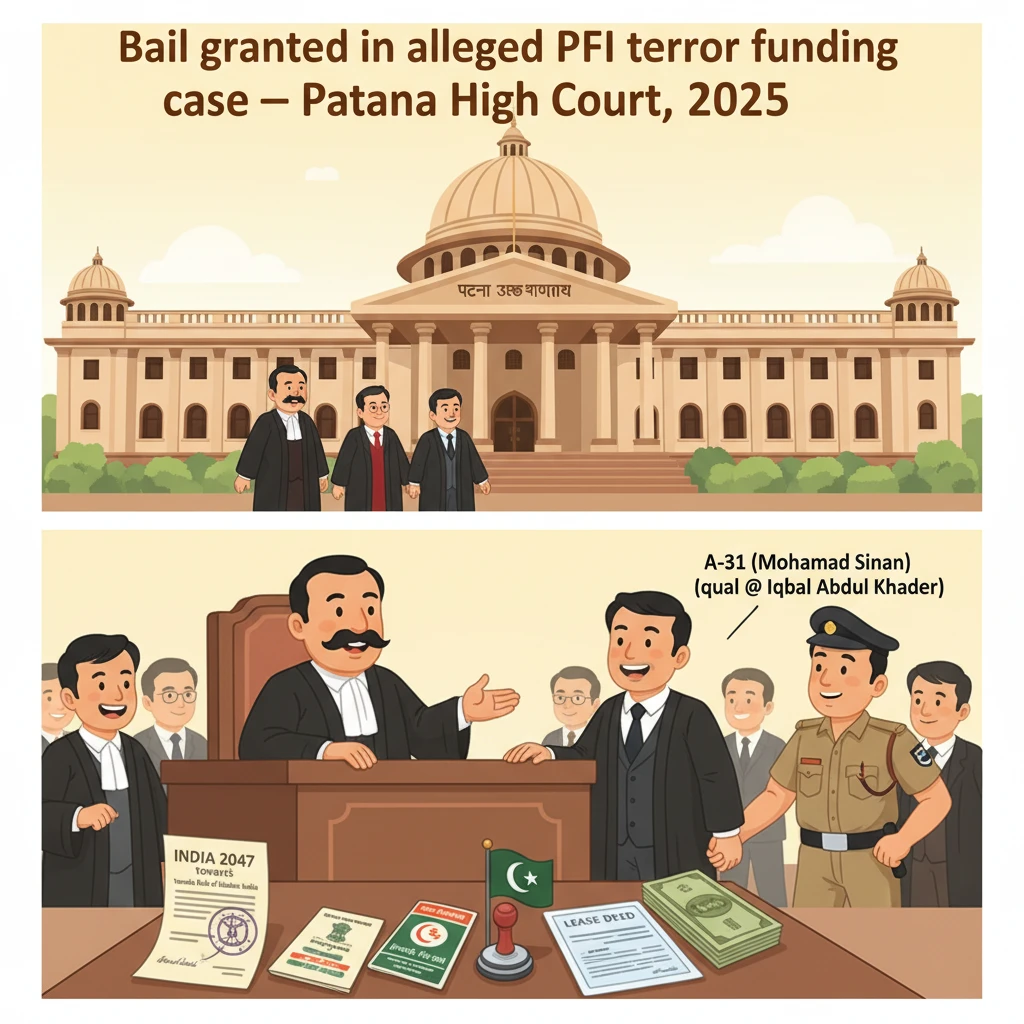
Case Background
The case arises from a written report dated 12.07.2022 lodged by the Officer-in-Charge of Phulwarisharif Police Station, Patna. He received information on 11.07.2022 that some persons were planning an incident during the proposed Patna visit of the Prime Minister of India and were allegedly undergoing training for a fortnight for this purpose.
Acting on this input, a police team went to a building known as “Ahmed Palace” under Phulwarisharif Police Station. They learnt that unknown persons had been meeting on the second floor of this building for the last two months and that suspicious meetings had also taken place on 6th–7th July 2022, with people from other States attending.
During search of the second floor, in the presence of the owners and independent witnesses, the police allegedly recovered a document titled “India 2047 towards Rule of Islamic India, Internal Document not for circulation”, pamphlets of Popular Front of India (PFI) in Urdu and Hindi, several flags, Urdu booklets, and a photocopy of a lease deed in favour of one of the co-accused.
The police recorded that one co-accused admitted past association with SIMI and current association with SDPI and PFI, and allegedly spoke about revenge against perceived atrocities on Muslims and incidents in Amravati and Udaipur. On this basis, Phulwarisharif P.S. Case No. 827 of 2022 was registered under Sections 120/120B/121/121A/153/153B/34 of the IPC.
During investigation, the National Investigation Agency (NIA) took over and later filed a second supplementary charge-sheet. In this, the present appellants, Mohammad Sinan (A-31) and Iqbal @ Iqbal Abdul Khader (A-33), both residents of Karnataka, were added as accused. They were arrested on 06.03.2023 after searches in Kerala and Karnataka on 05.03.2023.
The learned Special Judge, NIA, Patna, by order dated 07.03.2024 in Special Case No. 07 of 2022/R.C. No. 31 of 2022, rejected their bail applications. Aggrieved, both appellants filed these criminal appeals before the Patna High Court.
What the Court Examined and Decided
The Patna High Court heard detailed submissions from counsel for the appellants and the Additional Solicitor General (ASG) for the NIA. The central allegation against both appellants was that they were members of PFI and that they had helped in illegal channelising of funds from abroad, especially UAE and Saudi Arabia, to PFI members in India, including persons linked to the East Champaran (Motihari) module.
The NIA case, as reflected in the second supplementary charge-sheet, was that appellant A-31 (Sinan) was running an online service for air and train ticket booking and insurance and that, along with another accused A-34, he made multiple cash deposits of amounts less than Rs. 50,000/- from Canara Bank branches in Dakshina Kannada, Karnataka, into the Canara Bank account of one Md. Sajjad Alam in Bihar. The pattern of deposits was said to be designed to avoid generation of Suspicious Transaction Reports.
It was further alleged that appellant A-33 (Iqbal) was stationed in Dubai, collected money there and routed it into India through illegal channels for PFI activities, including funds to Sajjad Alam and other PFI members. The NIA relied on extracted data from digital devices seized from the appellants and their associates, CCTV footage of bank deposits, and cash deposit receipts in the name of Sinan.
The trial court had rejected bail relying on Supreme Court judgments in NIA v. Zahoor Ahmad Shah Watali and Gurwinder Singh v. State of Punjab, holding that the accusations appeared prima facie true and that the bar under Section 43D(5) of the Unlawful Activities (Prevention) Act, 1967 applied.
Before the High Court, counsel for the appellants argued that the entire prosecution story of illegal terror funding was false and uncorroborated. For A-31, it was submitted that he was merely running a small e-ticket booking and mobile recharge shop, and that some funds he received from a nephew in Saudi Arabia were purely for family expenses of his sister’s household. These family remittances, according to the defence, had been wrongly portrayed as illegal funding.
It was also contended that there was no material to show that any alleged funds were used for procuring arms, ammunition, or committing any terrorist act as defined in the UA(P) Act. The defence stressed that PFI was at the relevant time a registered society engaged in welfare activities and was banned only on 27.09.2022, while the alleged transactions related to the pre-ban period.
For A-33, it was argued that he worked in Dubai and sent money back to India through legal channels for family livelihood, and that some transactions were related to providing room rent services for clients through brokers. Such digital-era financial dealings, it was argued, could not automatically be treated as illegal channelisation of terror funds. His health condition — specifically treatment for a serious ailment, Acute Achalasia cardia — was also brought to the Court’s notice.
Counsel for the appellants further submitted that several co-accused had already been granted bail, including one by the Patna High Court and two by the Supreme Court. They urged that, given that there are 160–170 witnesses and only PW-2 was under cross-examination, the trial was unlikely to conclude soon, and that prolonged incarceration should weigh with the Court.
The NIA, on the other hand, maintained that PFI was an unlawful association whose objective was to overthrow the democratic system and impose an Islamic Caliphate by 2047. The ASG argued that the appellants were part of the financial network supporting this agenda, and that there was sufficient material to attract offences under IPC and UA(P) Act and invoke the bar under Section 43D(5).
The High Court carefully examined the charge-sheet and supporting material placed on record. It noted that the appellants had been charge-sheeted under Sections 120B, 121, 121A and 123 IPC and Sections 10, 13, 17 and 18 of the UA(P) Act. At the same time, the Court paid close attention to what was not present in the material.
First, the Court observed that although there were allegations that the appellants were PFI members and part of a conspiracy to establish Islamic rule in India by 2047 and wage war against the Government of India, these serious accusations were not supported or corroborated by concrete material against them. Unlike some other co-accused, the appellants had not been charge-sheeted under Sections 153A and 153B IPC, which deal with promoting enmity and assertions prejudicial to national integration. This distinction was considered significant.
Second, the Court noted that the appellants were residents of Kerala and Karnataka. The NIA’s counter affidavit stated that Iqbal (A-33), Sarfaraz (A-32) and Sinan (A-31) were involved in illegal fund transactions, but the statements were vague and did not disclose the specific period of such transactions or detailed linkage with any terrorist act in Bihar.
Importantly, the Court recorded that no money transaction had been shown directly between these appellants and key accused like Reyaz Moarif (A-4) or other accused in Supplementary Charge-sheet No. 1A/2023. The Court also highlighted that no telephonic connection of these appellants had been found with other main accused such as Md. Yaqub Khan (A-27) and Shahid Reza (A-38).
On the digital evidence, the charge-sheet stated in general terms that extracted data from devices of A-31 to A-35 revealed that they were instrumental in illegal channelising of funds from UAE/Saudi Arabia to entities including the East Champaran PFI module. However, the High Court pointed out that nowhere in the charge-sheet was it asserted that the appellants had received money in their own bank accounts from UAE/Saudi Arabia.
The Court also referred to another charge-sheet (No. 1D/2023) where detailed call data analysis of co-accused Reyaz Moarif (A-4) showed his telephonic links with many PFI accused and members even after the ban. That chart did not show any connection of Reyaz with Sajjad Alam, Sinan or Iqbal. In contrast to others like Md. Irshad Alam or Md. Yaqub Khan, no legally intercepted voice calls linked these appellants to any planned violent act or targeted killing.
The Court further relied on the Supreme Court’s observations in the bail order of co-accused Athar Parvez, where it was noted that PFI had not been declared a “terrorist organisation” within the meaning of Section 2(m) of the UA(P) Act at the relevant time and that funds collected as Zakat before the ban, without proof of their misuse for illegal activities, could not by themselves attract UA(P) offences. The Patna High Court observed that in the present case, there was not even material to show that the appellants had transferred any funds into PFI accounts or to Athar Parvez or Reyaz Moarif.
Taking the charge-sheet “as it is” and applying the test under Section 43D(5) of the UA(P) Act on broad probabilities, the Court concluded that there were no reasonable grounds for believing that the accusations against these appellants of raising funds for terrorist acts were prima facie true. Therefore, the statutory bar on bail under Section 43D(5) did not apply in their case.
In view of this finding, the Court did not find it necessary to examine the alternative plea based on long incarceration and delay in trial, though it did note that the appellants had already been in custody for over two years.
Ultimately, the High Court set aside the impugned bail rejection order of the Special Judge, NIA, Patna, and directed that the appellants be released on bail, on such terms and conditions as the trial court may impose after hearing the NIA. It also clarified that all observations made were tentative and would not prejudice the trial on merits.
Why This Judgment Matters
This judgment is important for people accused in terror-related and UA(P) Act cases, especially where the main allegation is of financial transactions. The Patna High Court has emphasised that serious charges like “raising funds for terrorist acts” must be backed by clear, specific material, not just broad or vague statements.
For families of accused persons, the decision shows that the Court will closely examine whether there is any concrete link between money transfers and actual terrorist activities. Routine or family remittances, without proof of use for terrorism, cannot automatically be treated as terror funding.
The judgment also shows that merely being accused of association with an organisation like PFI or being added in a supplementary charge-sheet does not, by itself, justify denial of bail under the strict UA(P) provisions. Courts will compare each accused’s role with that of co-accused and will not assume equal culpability where the material is weaker.
Finally, the decision protects the balance between national security concerns and individual liberty, by ensuring that the special bail bar in UA(P) Act is applied only when accusations are supported by reasonable, prima facie evidence.
Legal Issues and Answers
-
Issue: Whether there were reasonable grounds to believe, on a prima facie basis, that the appellants had raised or channelised funds for terrorist acts so as to attract the bar on bail under Section 43D(5) of the UA(P) Act, 1967.
Answer: The Court held that, on the material in the charge-sheet, there were no reasonable grounds to believe that the accusations of raising funds for terrorist acts against the appellants were prima facie true. Therefore, Section 43D(5) did not bar the grant of bail. -
Issue: Whether the appellants could be treated on par with co-accused whose bail had been rejected, despite differences in charges and material.
Answer: The Court held that the appellants’ cases were distinguishable: they were not charge-sheeted under Sections 153A and 153B IPC, had no proven telephonic or financial links with key conspirators in post-ban activities, and no material showed their involvement in any specific terrorist act. Hence, they were entitled to bail. -
Issue: Whether alleged suspicious cash deposits and digital data, without showing actual use of funds for terrorism or transfer to PFI post-ban, are sufficient to sustain a prima facie case of terror funding under Section 17 UA(P) Act.
Answer: The Court effectively answered in the negative, holding that mere allegation of suspicious transactions and general statements about illegal channelisation of funds, without detailing the accounts, time period, or linkage to terrorist acts, were insufficient to form the required prima facie belief.
Cases Cited by the Court
- NIA v. Zahoor Ahmad Shah Watali, (2019) 5 SCC 1 (relied on by the trial court, noticed by High Court).
- Gurwinder Singh v. State of Punjab, 2024 SCC OnLine SC 109 (relied on by the trial court, noticed by High Court).
- T.T. Antony v. State of Kerala, (2001) 6 SCC 181 (cited by appellants regarding “Doctrine of Sameness”).
- Union of India v. K.A. Najeeb, (2021) 3 SCC 713 (cited by appellants on long incarceration; distinguished as not necessary to apply).
- Vernon v. State of Maharashtra and Anr., (2023) 15 SCC 56 (cited by appellants; Court held ratio not directly applicable on facts).
- Javed Shaikh v. State of Maharashtra, (2024) 9 SCC 813 (cited by appellants; Court held ratio not directly applicable on facts).
- Supreme Court bail order in Criminal Appeal No. 3173 of 2024 (Athar Parvez) – particularly paragraph 30, discussed and applied by the Patna High Court.
- Supreme Court bail order in Criminal Appeal No. 5387 of 2024 (Md. Jalaluddin Khan @ Md. Jalaluddin), noticed as co-accused granted bail.
Case Details
Case Number:
Criminal Appeal (DB) No. 514 of 2024
Criminal Appeal (DB) No. 535 of 2024
Case Title:
Mohammad Sinan v. The Union of India through National Investigation Agency
Iqbal @ Iqbal Abdul Khader v. The Union of India through National Investigation Agency
Originating Case:
Arising out of P.S. Case No. 31 of 2022, NIA Police Station, District – Patna (Special Case No. 07 of 2022/R.C. No. 31 of 2022)
Citation:
2025 (4) PLJR 27
Court and Coram:
Patna High Court
Hon’ble Mr. Justice Rajeev Ranjan Prasad
Hon’ble Mr. Justice S. B. Pd. Singh
Date of Judgment:
18.04.2025 (CAV judgment; CAV date 11.04.2025)
Advocates:
For the appellants (both appeals): Mr. Kundan Kumar Ojha, Advocate
For the respondent/NIA (Criminal Appeal (DB) No. 514 of 2024): Mr. Krishna Nandan Singh, A.S.G.; Mr. Manoj Kumar Singh, Spl. PP; Mr. Ankit Kumar Singh, JC; Mr. Pramod Kumar, PP, NIA
For the respondent/NIA (Criminal Appeal (DB) No. 535 of 2024): Dr. Krishna Nandan Singh, A.S.G.; Mr. Manoj Kumar Singh, Spl. PP; Mr. Ankit Kumar Singh, JC; Mr. Pramod Kumar, PP, NIA
Nature of the Case:
Criminal appeals (Division Bench) against rejection of bail by the Special Judge, NIA, Patna, in a UA(P) Act/IPC case involving alleged terror funding and conspiracy.
Link to Judgment:
Patna High Court Judgment – Criminal Appeal (DB) No. 514 of 2024 & 535 of 2024
If you found this explanation helpful and wish to stay informed about how legal developments may affect your rights in Bihar, you may consider following Samvida Law Associates for more updates.







