
Case Background
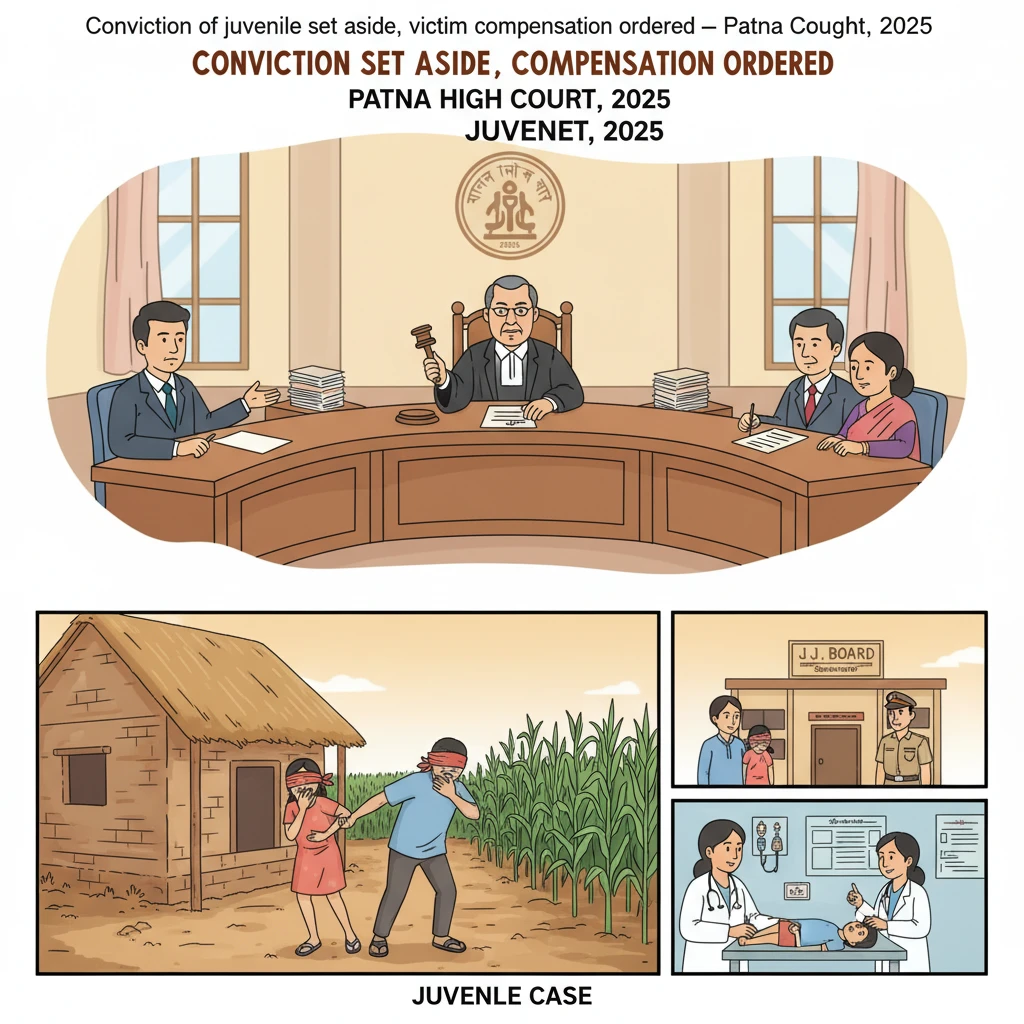
This criminal revision arose from an incident dated 03.03.2011 in village Mujari Chakmahi, Police Station Khanpur, District Samastipur. On the basis of the fardbeyan of a minor girl recorded on 03.03.2011, Khanpur P.S. Case No. 36 of 2011 was registered under Section 376(2)(g) of the Indian Penal Code against the petitioner and a co-accused.
During investigation, both accused claimed to be juveniles. Their records were therefore sent to the Juvenile Justice Board, Samastipur. After investigation, charge-sheet was filed only against the petitioner. The co-accused was found innocent at that stage, though he was later summoned under Section 319 Cr.P.C., and his record was separated from that of the petitioner.
In the juvenile inquiry before the J.J. Board, twelve prosecution witnesses were examined, including the victim, her family members, co-villagers, the Investigating Officer and the doctor. Medico-legal documents were also exhibited. The petitioner did not examine any defence witness or produce any document.
The J.J. Board held the petitioner guilty of an offence under Section 376 IPC and directed that he be kept in a Special Home under Section 15(1)(g) of the Juvenile Justice (Care and Protection of Children) Act, 2000. Being aggrieved, the petitioner filed Criminal Appeal No. 46 of 2016/152 of 2017 before the Sessions Court. The appellate court upheld both the conviction and the sentence, leading to the present Criminal Revision No. 819 of 2019 before the Patna High Court.
What the Court Examined and Decided
The Patna High Court, presided over by Hon’ble Mr. Justice Jitendra Kumar, heard arguments from the counsel for the petitioner, the Amicus Curiae, the State, and the counsel for the victim.
On behalf of the petitioner, it was argued that both the J.J. Board and the appellate court had wrongly appreciated the evidence. According to the defence, the prosecution had failed to prove the case beyond reasonable doubt, yet the petitioner had been sent to Special Home for three years. It was also argued that the orders were contrary to the object and spirit of the Juvenile Justice Act.
The State and the victim’s counsel supported the judgments of the courts below. They submitted that the evidence had been correctly appreciated and there was no illegality in either the conviction under Section 376 IPC or the sentence awarded.
The State further argued that, in revisional jurisdiction, the High Court cannot re-appreciate the evidence as if it were hearing an appeal, and therefore should not interfere with concurrent findings. On the other hand, the victim’s counsel and the Amicus Curiae highlighted that neither the J.J. Board nor the Children Court had passed any order for payment of compensation to the victim, despite finding that she had suffered penetrative sexual assault.
The State contended that the Revisional Court could not grant compensation in a petition filed by the convict, and further that the Bihar Victim Compensation Scheme, 2014 could not apply as the incident took place in 2011, prior to the notification of the scheme.
Scope of revisional powers
The Court first explained the limits of its revisional jurisdiction under Sections 397 and 401 Cr.P.C. It noted that revision is a supervisory power meant to correct miscarriage of justice due to errors in findings, orders or proceedings of lower courts. However, this power is discretionary and cannot be used to conduct a fresh, full re-appreciation of evidence as in an appeal.
The Court referred to a long line of Supreme Court decisions (including Akalu Ahir, K. Chinnaswami Reddy, Duli Chand, Janta Dal, Vimal Singh, State of Kerala v. Puttumana Namboodiri, Jagannath Chaudhary, Bindeshwari Prasad Singh, Manju Ram Kalita, Amit Kapoor, Ganesha, Shlok Bhardwaj, Sanjaysinh R. Chavan, and Malkeet Singh Gill) to list exceptional situations where revisional interference is justified. These include lack of jurisdiction, glaring illegality, shutting out important evidence, reliance on inadmissible evidence, ignoring clinching material, findings based on no evidence, perverse appreciation, arbitrary exercise of discretion or invalid compounding.
With this legal framework, the Court then examined if the present case fell within these exceptional categories.
Assessment of evidence in the present case
The allegation in the fardbeyan was that at about 8 a.m., when the victim was alone in the house and working in the kitchen, the petitioner and co-accused entered, gagged and blindfolded her with a “gamcha”, took her to a maize field, and committed penetrative sexual assault on her, causing injury to her private part. On returning, she informed her mother.
In her examination-in-chief before the J.J. Board, the victim broadly supported her earlier version. However, in cross-examination, she admitted that there was enmity between her family and the family of the petitioner. She also stated that her blood-stained clothes were “shown” to the police, but did not say that she handed those clothes over. She denied the suggestion that the allegation was false due to enmity.
No other witness was an eye-witness to the alleged occurrence. Apart from the victim, the witnesses mainly consisted of her father, mother, grandmother and other co-villagers, all of whom were hearsay witnesses. The Investigating Officer (PW-8) and the doctor (PW-11) were official witnesses.
The doctor, PW-11 Dr. Lalita Singh, stated that she examined the victim on the same day, i.e., 03.03.2011, and found injuries on her private part. However, no spermatozoa were found in the vaginal swab. She clearly deposed that she could not say whether rape had been committed.
The Investigating Officer, PW-8, deposed that he found blood on the ground at the place of occurrence. However, in cross-examination he admitted that he did not seize the blood-soaked soil, nor prepare any seizure list. He also said that he had no opportunity to see the victim’s blood-stained clothes, and therefore did not seize them either.
The Court noted that there was no scientific investigation to connect the petitioner to the alleged offence, such as DNA testing or any similar forensic step.
Considering these aspects together, the Court held that it would be unsafe and unjust to uphold a finding of guilt. The prosecution had failed to prove the charge against the petitioner beyond all reasonable doubt. This made the conviction vulnerable as a case of perverse appreciation of evidence, bringing it within the exceptions that allow revisional interference.
Sentencing under the Juvenile Justice Act
The Court then turned to sentencing. It observed that, even assuming guilt, the manner in which the J.J. Board and appellate court applied Section 15 of the Juvenile Justice Act, 2000 was not in line with the object, spirit and provisions of the Act.
Because the incident occurred on 03.03.2011, the Juvenile Justice (Care and Protection of Children) Act, 2000 (as amended in 2006) applied, not the 2015 Act, in view of Section 25 of the 2015 Act, which saves pending proceedings under the old Act.
The Court discussed the preamble of the 2000 Act, emphasising that the law is based on the belief that children are the future of society and, if they come into conflict with law, they should be reformed and rehabilitated, not punished. The Act adopts a child-friendly approach aiming at ultimate rehabilitation.
Under Section 15, the J.J. Board has several options when a juvenile is found to have committed an offence: admonition, group counselling, community service, payment of fine in some cases, release on probation with parents or a fit person/institution, or sending the juvenile to a Special Home for up to three years, with reasons recorded. Section 16 bars death or life imprisonment for juveniles and stresses placement in suitable places of safety.
Rule 3 of the Juvenile Justice (Care and Protection of Children) Rules, 2007 lays down “fundamental principles”, including the principle of best interest, family responsibility, last resort (institutionalisation only after reasonable inquiry and for minimum duration), and fresh start. The Rules underline that criminal justice goals like retribution must give way to rehabilitative and restorative objectives.
In earlier Supreme Court decisions like Salil Bali v. Union of India, Jitendra Singh @ Babloo Singh v. State of U.P., and Subramanian Swamy v. Raju, the Court highlighted that the juvenile system aims at reform and reintegration, not punishment, and that juvenile inquiries are distinct from adult criminal trials.
Failure to consider social investigation report
In this case, the Social Investigation Report by the Probation Officer showed that the petitioner had no criminal antecedents. Co-villagers and local representatives described him as cooperative and did not speak adversely about him. His family background was poor: father a labourer, mother a housewife, small holding of one house and two kathas of land, with several siblings, including minor sisters. One brother worked as a labourer outside Bihar, others were students, and the petitioner himself was studying in the village school.
The High Court found that neither the J.J. Board nor the appellate court properly considered this report or analysed what would truly be in the petitioner’s best interest. By sending him to a Special Home for two years, they had effectively interrupted his education and did not explore less restrictive options such as probation or counselling.
The Court also observed that the authorities ought to have considered directing the district administration to extend benefits of poverty alleviation schemes to the petitioner’s family, given their economic hardship.
In light of the weak evidence on guilt and the failure to follow the spirit and procedure of the Juvenile Justice Act, the High Court concluded that both the conviction and sentence were unsustainable in law.
The Criminal Revision was therefore allowed. The judgment of conviction and the order of sentence passed by the J.J. Board and confirmed by the appellate court were set aside, and the petitioner was acquitted of all charges.
Compensation for the victim despite acquittal
After dealing with the petitioner’s case, the Court turned to the victim’s rights. It noted that both the J.J. Board and the Children Court had, in their judgments, proceeded on the footing that the victim had suffered penetrative sexual assault. Yet they had not passed any order for compensation in her favour.
The Court cited Sections 2(wa), 357 and 357A Cr.P.C. and the Bihar Victim Compensation Scheme, 2014. It explained that under Section 357, compensation is payable by the convict, whereas under Section 357A, compensation comes from the State’s Victim Compensation Fund, administered through Legal Services Authorities.
The Court pointed out that there is no time-bar against a court recommending compensation under the Scheme. The limitation in Section 8 of the Scheme applies only to applications made directly by victims where the offender is unknown or no trial takes place, and even that delay can be condoned.
Referring to its earlier Division Bench judgment in Sunil Kumar Jha v. State of Bihar, the Court reiterated that trial, appellate and revisional courts are duty-bound to pass reasoned orders on victim compensation under Sections 357 and 357A, whether the case ends in conviction, acquittal or discharge, and even if the victim has not filed any application.
The Court further held that these principles apply equally to proceedings before Juvenile Justice Boards and Children Courts, because the Juvenile Justice Act does not create a separate compensation regime, and Section 103 of the 2015 Act bars Cr.P.C. provisions only where there is a conflicting provision in the J.J. Act.
Applying this to the present case, the Court noted that while the petitioner was acquitted for want of proof beyond reasonable doubt, the victim had undoubtedly suffered a sexual offence and therefore fell within the definition of “victim” under Section 2(wa) Cr.P.C. Hence, she was entitled to compensation under Section 357A Cr.P.C. and the Bihar Victim Compensation Scheme, 2014, regardless of the acquittal.
The Court recorded that, according to the report of the Bihar State Legal Services Authority, the victim had not received any compensation so far. The Court therefore directed the Bihar State Legal Services Authority to pay compensation to the victim/informant as per the Scheme within one month of receiving the order.
The Court also directed that a copy of this judgment be circulated among Presiding Officers of Juvenile Justice Boards and Children Courts in Bihar and sent to the Bihar Judicial Academy for use in training programmes. The assistance of the Amicus Curiae was acknowledged with a direction to pay honorarium.
Why This Judgment Matters
This judgment is important at two levels.
First, it shows that the Patna High Court will closely scrutinise convictions of juveniles where evidence is shaky or the appreciation of evidence by lower courts appears one-sided. Even under limited revisional powers, the Court stepped in because the findings were unsafe and the basic safeguards of criminal law, like proof beyond reasonable doubt, were not met.
Second, it gives strong guidance on victim compensation in criminal cases, including those involving juveniles. The Court makes it clear that a victim’s right to compensation does not depend on whether the accused is convicted or acquitted. If the court is satisfied that a person has suffered loss or injury due to a crime, it must consider recommending compensation under Section 357A Cr.P.C. and the State’s compensation scheme.
For survivors of sexual offences, especially minors in rural and poor backgrounds, this ruling underlines that they can still receive support and rehabilitation through compensation, even when the criminal case fails for lack of strict proof.
For juvenile accused and their families, the judgment reinforces that the Juvenile Justice system is meant to reform and reintegrate, not simply imprison in the name of punishment. Courts and Juvenile Justice Boards must carefully read social investigation reports, consider the child’s background and education, and use institutionalisation only as a last resort.
Legal Issues and Answers
- Issue: Whether the petitioner’s conviction for rape by the J.J. Board and its affirmation by the appellate court could stand in revision in light of the evidence on record.
Answer: No. The High Court found that the prosecution failed to prove the charge beyond all reasonable doubt. There was no eye-witness other than the victim, no scientific link to the petitioner, crucial material like blood-stained soil and clothes was not seized, and the doctor could not confirm rape. The conviction and sentence were set aside and the petitioner was acquitted. - Issue: Whether, despite acquitting the juvenile, the Court could and should order compensation for the victim of the alleged sexual offence.
Answer: Yes. The Court held that under Sections 357A Cr.P.C. and the Bihar Victim Compensation Scheme, 2014, victims are entitled to compensation irrespective of conviction, acquittal or discharge. The revisional court is duty-bound to consider and recommend compensation where appropriate. The Court therefore directed the Bihar State Legal Services Authority to pay compensation to the victim. - Issue: Whether the Juvenile Justice Boards and Children Courts are bound to apply Cr.P.C. provisions on victim compensation in their proceedings.
Answer: Yes. The Court held that the Juvenile Justice Act does not contain separate provisions for victim compensation and therefore the general law in Sections 357 and 357A Cr.P.C. and State schemes applies equally to proceedings before J.J. Boards and Children Courts. They are under a duty to pass appropriate orders for compensation to victims.
Cases Cited by the Court
- The Court referred to several precedents on revisional scope and juvenile justice, including:
- Akalu Ahir and Others v. Ramdeo Ram, (1973) 2 SCC 583
- K. Chinnaswami Reddy v. State of A.P., 1962 SCC Online SC 32
- Duli Chand v. Delhi Administration, (1975) 4 SCC 649
- Janta Dal v. H.S. Chowdhary & Others, (1992) 4 SCC 305
- Vimal Singh v. Khuman Singh & Another, (1998) 7 SCC 323
- State of Kerala v. Puttumana I. J. Namboodiri, (1999) 2 SCC 452
- Jagannath Chaudhary v. Ramayan Singh, (2002) 5 SCC 659
- Bindeshwari Prasad Singh @ B.P. Singh & Others v. State of Bihar (Now Jharkhand) & Another, (2002) 6 SCC 650
- Manju Ram Kalita v. State of Assam, (2009) 13 SCC 330
- Amit Kapoor v. Ramesh Chander, (2012) 9 SCC 460
- Ganesha v. Sharanappa & Another, (2014) 1 SCC 87
- Shlok Bhardwaj v. Runika Bhardwaj & Others, (2015) 2 SCC 721
- Sanjaysinh R. Chavan v. D. G. Phalke, (2015) 3 SCC 123
- Malkeet Singh Gill v. State of Chhattisgarh, (2022) 8 SCC 204
- Salil Bali v. Union of India and Another, 2013 7 SCC 705
- Jitendra Singh @ Babloo Singh v. State of U.P., (2013) 11 SCC 193
- Subramanian Swamy & Others v. Raju, (2014) 8 SCC 390
- Harendra Rai v. State of Bihar and Others, 2023 (9) SCC 702
- Sunil Kumar Jha v. State of Bihar, 2024 SCC Online Pat 960
Case Details
Case Number: Criminal Revision No. 819 of 2019 (arising out of Khanpur P.S. Case No. 36 of 2011)
Case Title: Pandav Kumar v. The State of Bihar
Citation: 2025 (3) PLJR 497
Court: High Court of Judicature at Patna
Coram: Hon’ble Mr. Justice Jitendra Kumar
Date of Judgment: 07.07.2025 (CAV; CAV date 30.06.2025)
Advocates:
- For the Petitioner: Mr. Pankaj Kumar Jha, Advocate
- Amicus Curiae: Ms. Shashi Priya, Advocate
- For the State: Mr. Upendra Kumar, APP
- For the Victim: Mr. Raja Ram Mishra, Advocate
Nature of the Case: Criminal revision against appellate judgment affirming conviction and sentence passed by Juvenile Justice Board in a case under Section 376 IPC; also involving directions on victim compensation under Section 357A Cr.P.C. and Bihar Victim Compensation Scheme, 2014.
Link to Judgment: Patna High Court Judgment in Cr. Rev. No. 819 of 2019
If you found this explanation helpful and wish to stay informed about how legal developments may affect your rights in Bihar, you may consider following Samvida Law Associates for more updates.







