
Case Background
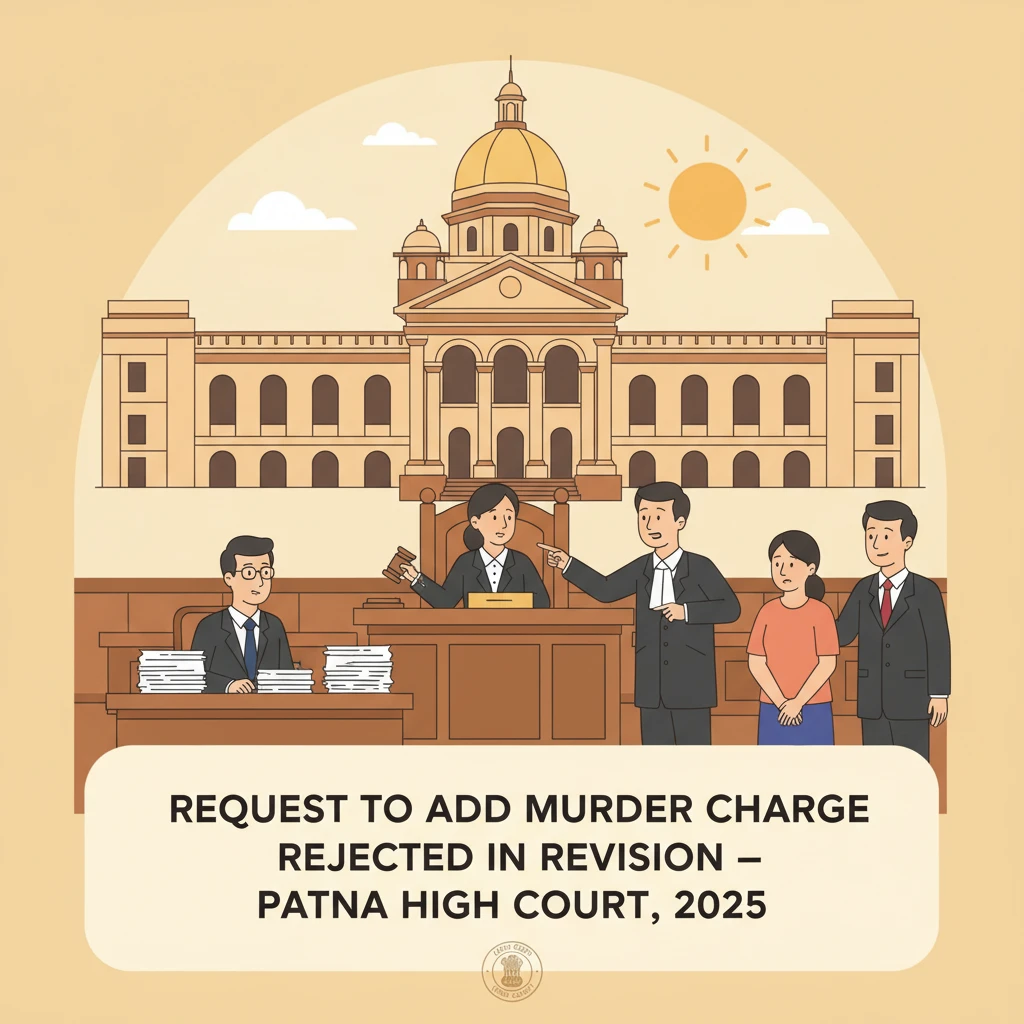
The criminal case started with Warisaliganj P.S. Case No. 64 of 2011 in District Nawada. During trial, the accused, who is opposite party no. 2 in the revision, was facing a charge under Section 306 of the Indian Penal Code, which deals with abetment of suicide.
The prosecution examined its witnesses. After that, the statement of the accused was recorded under Section 313 of the Code of Criminal Procedure. At this point, the evidence stage was over and the matter had reached the final argument stage in Sessions Trial No. 323 of 2013/C.I.S. No. 3285 of 2014, pending before the Additional Sessions Judge-XII, Nawada.
At this late stage, the prosecution filed an application under Section 216 Cr.P.C. It requested that, in addition to Section 306 IPC, an extra charge under Section 302 IPC (murder) should also be framed against the accused, based mainly on the evidence of P.W.-1, P.W.-5 and P.W.-8.
The accused opposed the application, arguing that there was no sufficient material on record to justify adding a murder charge.
After hearing both sides and discussing the evidence including the injury report and the doctor’s testimony, the Trial Court held that there was no sufficient material to frame an additional charge under Section 302 IPC. The application under Section 216 Cr.P.C. was, therefore, rejected on 14.03.2023.
Aggrieved, the present petitioner, who is not the State but a private person connected with the case, filed Criminal Revision No. 471 of 2023 before the Patna High Court challenging this order of the Additional Sessions Judge-XII, Nawada.
What the Court Examined and Decided
The Patna High Court, through Hon’ble Mr. Justice Jitendra Kumar, first noted that the case was at the admission stage. The Court heard learned counsel for the petitioner and the learned APP for the State.
The petitioner’s main submission was that the Trial Court had rejected the prosecution’s application arbitrarily and erroneously. According to the petitioner, there was sufficient material in the prosecution evidence to add a charge under Section 302 IPC. On that basis, the petitioner contended that the impugned order was not sustainable in law.
On the other hand, the learned APP for the State strongly opposed the revision. He argued that there was no illegality or infirmity in the impugned order. He emphasized that adding an additional charge is within the discretionary power of the Trial Court, based on the material on record.
He further argued that under revisional jurisdiction, the Patna High Court has only a limited power to interfere. If, on the same evidence, two views are reasonably possible, and the Trial Court has taken one plausible view after appreciating the material, the Revisional Court cannot simply re-appreciate the evidence and replace that view with its own. Therefore, he submitted that the revision petition had no merit and should be dismissed at the threshold.
The High Court then took up two broad questions. First, what is the scope of revisional jurisdiction under Sections 397 and 401 Cr.P.C.? Second, how and when can a court alter or add a charge under Section 216 Cr.P.C.?
On revisional jurisdiction, the Court explained that this power is supervisory and paternal in nature. It exists to correct miscarriage of justice by examining the correctness, legality, or propriety of orders passed by subordinate courts, and the regularity of their proceedings.
The Court made it clear that revisional power is discretionary, not automatic. Importantly, a Revisional Court is not an Appellate Court. It cannot generally re-appreciate the entire evidence to come to a fresh conclusion, as if hearing an appeal. Such re-appreciation is justified only in exceptional cases, for example:
- where the trial court has no jurisdiction;
- where the order suffers from glaring illegality;
- where relevant evidence was wrongly shut out;
- where the order is based on inadmissible evidence;
- where crucial material is overlooked;
- where findings are based on no evidence;
- where there is perverse appreciation of evidence;
- or where judicial discretion is exercised arbitrarily or capriciously.
The Court supported this view by referring to several Supreme Court decisions on revisional powers, including Akalu Ahir v. Ramdeo Ram, K. Chinnaswami Reddy v. State of A.P., Duli Chand v. Delhi Administration, Janta Dal v. H.S. Chowdhary, Vimal Singh v. Khuman Singh, State of Kerala v. Puttumana I.J. Namboodiri, Thankappan Nadar v. Gopala Krishnan, Jagannath Chaudhary v. Ramayan Singh, Bindeshwari Prasad Singh v. State of Bihar (now Jharkhand), Manju Ram Kalita v. State of Assam, Amit Kapoor v. Ramesh Chander, Ganesha v. Sharanappa, Shlok Bhardwaj v. Runika Bhardwaj, Sanjaysinh R. Chavan v. D.G. Phalke, and Malkeet Singh Gill v. State of Chhattisgarh.
In particular, the Court referred to Ashish Chadha v. Asha Kumari, where the Supreme Court held that the High Court should not, in revision, re-appreciate material to decide whether a charge should be framed. That function belongs to the Trial Court.
The Patna High Court next turned to Section 216 Cr.P.C., which allows the court to “alter or add to any charge at any time before judgment is pronounced.” The judgment reproduced the entire text of Section 216 and then surveyed several Supreme Court authorities explaining its meaning and limits.
In Jasvinder Saini v. State (NCT of Delhi), the Supreme Court held that while the power to alter or add charges is very wide and can be exercised at any time before judgment, it normally arises when the court finds the original charge defective or considers an additional charge necessary in view of the evidence led during trial.
In Sohan Lal v. State of Rajasthan, the Supreme Court clarified that “add to any charge” means adding a new charge where some charge already exists, and “alteration” means changing or varying an existing charge. If no charge exists against a person, Section 216 Cr.P.C. cannot be used to newly frame a charge.
In CBI v. Karimullah Osan Khan, the Supreme Court again underlined that Section 216 gives considerable power to the Trial Court, even after completion of evidence and arguments, but such power must be exercised only when some material exists that is connected to the new or modified charge, and without causing prejudice to the accused.
In Anant Prakash Sinha v. State of Haryana, the Supreme Court held that alteration or addition of charge must be based on material on record, which may come either from the FIR, the complaint, or evidence led during trial. The court must also ensure that the accused is not prejudiced and has a fair trial.
In P. Kartikalakshmi v. Sri Ganesh, the Supreme Court stressed that the power under Section 216 Cr.P.C. is exclusive to the court. No party — neither the prosecution, nor the accused, nor the complainant — has a vested right to seek alteration or addition of a charge by filing an application. If such applications were treated as a matter of right, speedy trial would be jeopardised.
The Patna High Court also referred to Nallapareddy Sridhar Reddy v. State of A.P., where the Supreme Court held that Section 216 gives the court wide power to change or alter charges even after evidence and arguments, provided the material on record has a direct link with the ingredients of the new offence and no prejudice is caused to the accused.
Further, the Court cited Soundarajan v. State, where the Supreme Court reminded trial courts and public prosecutors to be meticulous at the stage of framing charges, because errors can later delay trials or lead to acquittals.
Lastly, the Court discussed the recent decision in Directorate of Revenue Intelligence v. Raj Kumar Arora, 2025 SCC OnLine SC 819. There, the Supreme Court explained that Section 216 allows “alter” or “add” to a charge but does not allow deletion of a charge altogether. The power is wide but not unlimited, and it must be exercised after a charge has been framed, not after discharge.
Summarising all these rulings, the Patna High Court set out the following principles:
- Section 216 Cr.P.C. allows a court to alter or add to a charge already framed, any time after framing of charge and before judgment.
- Alteration or addition usually arises if the original charge is defective or if evidence during trial shows the need for a different or additional charge.
- Section 216 does not permit deleting a charge or discharging an accused mid-trial; after framing of charge, the case must end in conviction or acquittal, unless a higher court intervenes.
- If an accused has already been discharged, or no charge exists against a person, Section 216 cannot be used to frame a fresh charge against that person.
- The power can be invoked by the court on its own or on application, but no party has a “right” to insist on alteration or addition of charge.
- The power must be exercised based on relevant material and with due care to avoid prejudice to either the accused or the prosecution.
Applying these principles to the present case, the Court noted that the accused was already facing a charge under Section 306 IPC. The prosecution evidence was complete, and the statement under Section 313 Cr.P.C. had been recorded. Only at that late stage did the prosecution seek to add a charge under Section 302 IPC.
The Trial Court, after examining the entire material and evidence (including the medical evidence), held that there was no sufficient material to frame the additional charge of murder. It gave detailed reasons and dealt with the relevant witnesses.
The High Court observed that the petitioner had not shown any jurisdictional error, glaring illegality, perversity, or arbitrary exercise of discretion in the Trial Court’s order. The order was described as reasoned, without perversity or arbitrariness in appreciation of evidence.
Even if another view might be theoretically possible on the same evidence, the High Court stated that it could not interfere in its revisional jurisdiction merely to substitute its own view for a plausible and reasonable view taken by the Trial Court.
On this basis, the Court held that no ground was made out for interference. The criminal revision was found to be devoid of merit and was dismissed in limine, meaning at the threshold, without issuing notice for a detailed hearing.
Why This Judgment Matters
This judgment is important for people involved in criminal cases, especially where there is pressure to “add” serious charges like murder after the trial has progressed.
The Patna High Court has clearly said that adding or changing charges is mainly the responsibility of the Trial Court. The High Court will not lightly interfere with that decision in revision unless there is clear misuse of law, perversity, or injustice.
It also shows that late attempts to convert a case of abetment of suicide into a murder trial will not succeed unless there is strong and clear evidence on record justifying such a change. Mere disagreement with the Trial Court’s assessment of evidence is not enough.
Practically, this judgment reassures accused persons that charges cannot be changed casually at the end of trial, and reassures victims and complainants that Section 216 Cr.P.C. has clear limits and safeguards to ensure fair trial.
Legal Issues and Answers
- Issue: Can the Patna High Court, in revisional jurisdiction, interfere with the Trial Court’s refusal to add a murder charge under Section 302 IPC by invoking Section 216 Cr.P.C.?
Answer: No. The Court held that the Trial Court had carefully considered the evidence and taken a plausible view that there was no sufficient material to add a charge under Section 302 IPC. There was no perversity, illegality, or arbitrariness, so revisional interference was not justified. - Issue: What is the extent of a court’s power under Section 216 Cr.P.C. to alter or add charges during trial?
Answer: The Court reaffirmed that Section 216 Cr.P.C. allows alteration or addition of charges at any time before judgment, but only on the basis of material on record and in a manner that does not prejudice the accused or the prosecution. The power is exclusive to the court and cannot be demanded as a matter of right by any party.
Cases Cited by the Court
- Akalu Ahir and Others v. Ramdeo Ram, (1973) 2 SCC 583
- K. Chinnaswami Reddy v. State of A.P., 1962 SCC OnLine SC 32
- Duli Chand v. Delhi Administration, (1975) 4 SCC 649
- Janta Dal v. H.S. Chowdhary and Others, (1992) 4 SCC 305
- Vimal Singh v. Khuman Singh and Another, (1998) 7 SCC 323
- State of Kerala v. Puttumana I.J. Namboodiri, (1999) 2 SCC 452
- Thankappan Nada and Others v. Gopala Krishnan, (2002) 9 SCC 393
- Jagannath Chaudhary v. Ramayan Singh, (2002) 5 SCC 659
- Bindeshwari Prasad Singh @ B.P. Singh and Others v. State of Bihar (Now Jharkhand) and Another, (2002) 6 SCC 650
- Manju Ram Kalita v. State of Assam, (2009) 13 SCC 330
- Amit Kapoor v. Ramesh Chander, (2012) 9 SCC 460
- Ganesha v. Sharanappa and Another, (2014) 1 SCC 87
- Shlok Bhardwaj v. Runika Bhardwaj and Others, (2015) 2 SCC 721
- Sanjaysinh R. Chavan v. D.G. Phalke, (2015) 3 SCC 123
- Malkeet Singh Gill v. State of Chhattisgarh, (2022) 8 SCC 204
- Ashish Chadha v. Asha Kumari and Another, (2012) 1 SCC 680
- Jasvinder Saini v. State (NCT of Delhi), (2013) 7 SCC 256
- Sohan Lal v. State of Rajasthan, (1990) 4 SCC 580
- CBI v. Karimullah Osan Khan, (2014) 11 SCC 538
- Anant Prakash Sinha v. State of Haryana, (2016) 6 SCC 105
- P. Kartikalakshmi v. Sri Ganesh, (2017) 3 SCC 347
- Nallapareddy Sridhar Reddy v. State of A.P., (2020) 12 SCC 467
- Soundarajan v. State, (2023) 16 SCC 141
- Directorate of Revenue Intelligence v. Raj Kumar Arora and Others, 2025 SCC OnLine SC 819
Case Details
Case Number: Criminal Revision No. 471 of 2023, arising out of Warisaliganj P.S. Case No. 64 of 2011, District Nawada
Case Title: Md. Makbool Alam v. The State of Bihar and Another
Coram: Hon’ble Mr. Justice Jitendra Kumar
Date of Judgment: 27-06-2025
Citation: 2025(3) PLJR 530
Advocates:
- For the Petitioner: Mr. Satyapal Singh, Advocate; Mr. Om Prakash Srivastava, Advocate
- For the State: Md. Zainul Abedin, APP
Nature of the Case: Criminal revision challenging rejection of prosecution’s application under Section 216 Cr.P.C. for framing an additional charge under Section 302 IPC in a Sessions Trial where the accused was already facing a charge under Section 306 IPC.
Link to Judgment: https://patnahighcourt.gov.in/viewjudgment/NyM0NzEjMjAyMyMxI04=-YM56Pvh1–am1–Vk=
If you found this explanation helpful and wish to stay informed about
how legal developments may affect your rights in Bihar,
you may consider following Samvida Law Associates for more updates.







