
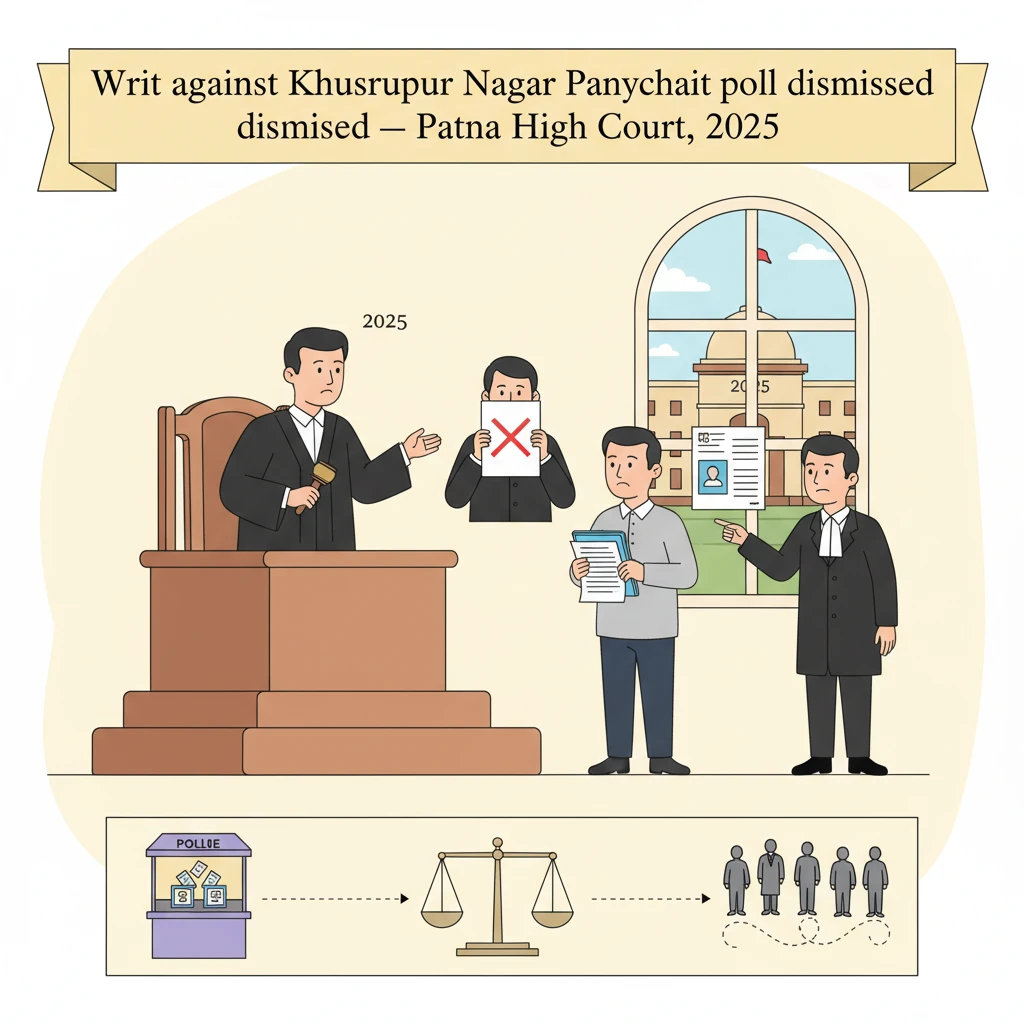
Case Background
The dispute arises from the election for the post of Chief Councillor/Chairperson of Khusrupur Nagar Panchayat in Patna district, held on 28.06.2025.
The petitioner participated in this municipal election conducted by the respondent authorities. According to the petitioner, the State Election Commission permitted voting through both e-voting and offline (physical) mode.
The petitioner claimed that because of the way the Election Commission implemented this mixed system, some voters were allegedly able to cast their votes twice. It was alleged that the same voters appeared in both the offline electoral roll and the online e-voting record, leading to double counting of their votes.
The petitioner asserted that due to this alleged duplicate voting, another candidate was declared elected as Chairperson, and the petitioner lost the election.
In support of these allegations, the petitioner referred to paragraph numbers 17 and 18 of the writ petition, where a tabular list of alleged duplicate voters was provided, along with their EPIC (Elector Photo Identity Card) numbers. The petitioner claimed to have submitted representations to the Chief Electoral Officer, the District Magistrate, and the Sub-Divisional Officer (SDO) pointing out these alleged duplicate entries and double votes.
The petitioner further alleged that duplicate voting took place in two ways: first, through two different voting modes (e-voting and offline) and second, by permitting duplicate voting in two distinct Panchayat jurisdictions using two EPIC numbers or slightly varied names within the same family lineage.
On this basis, the petitioner approached the Patna High Court in its writ jurisdiction, seeking multiple directions including inquiry into duplicate voting, stay on final certification of results, cancellation of dual votes, possible declaration of the election as null and void, and disciplinary and penal action against officials under Section 171 of the Bharatiya Nyaya Sanhita, 2023 and the Bihar Panchayat Election Rules, 2025 (amended).
What the Court Examined and Decided
The Court first recorded the reliefs sought in the writ petition.
The petitioner sought directions for a comprehensive inquiry into duplicate and cross-Panchayat voting in the Khusrupur Nagar Panchayat election held on 28.06.2025. The petitioner also requested a stay on final certification of the result for the Chairperson post until exclusion of alleged illegal votes.
Further, the petitioner prayed for cancellation of all votes cast through dual voting (both e-voting and offline) by the same individuals, and urged that the election be declared null and void if cancellation of such votes materially affected the outcome. Additionally, the petitioner sought disciplinary and penal proceedings against election officials and others under Section 171 of the BNS, 2023 and relevant election rules, along with any other suitable relief.
On the factual and legal side, learned counsel for the petitioner argued that:
First, the election was conducted under the supervision of State Election Commission authorities, and guidelines were issued permitting e-voting. Because of the implementation method, the same voter’s name appeared in both offline and online lists, which allegedly led to double counting.
Second, reliance was placed on the pleadings in paragraphs 17 and 18 of the writ petition, where a detailed list of alleged duplicate voters with EPIC numbers was provided. The petitioner claimed to have already alerted the Chief Electoral Officer, District Magistrate, and SDO about these alleged irregularities.
Third, the petitioner contended that duplicate voting also occurred in two distinct Panchayat jurisdictions, using two EPIC numbers or slightly different names within the same family lineage, which allegedly vitiated the fairness of the poll.
To support the plea for High Court intervention, the petitioner cited judgments of the Hon’ble Supreme Court:
(a) Kishansing Tomar v. Municipal Corporation of Ahmedabad & Ors., (2006) 8 SCC 352, to argue that the State Election Commission is duty-bound to ensure free and fair elections.
(b) Mohinder Singh Gill & Anr. v. Chief Election Commissioner & Ors., AIR 1978 SC 851, to underline that electoral fairness is a fundamental feature of democracy, and its subversion invites judicial scrutiny.
On this basis, counsel for the petitioner argued that the Election Commission failed to synchronise e-voting records with physical polling lists, thereby violating its constitutional mandate to conduct free and fair elections.
On the other hand, learned counsel for the State Election Commission raised a strong objection to the maintainability of the writ petition.
The Commission’s counsel argued that the election in question is a municipal election governed by Part IXA of the Constitution of India, inserted by the 74th Constitutional Amendment (described in the judgment as the Constitutional 47th amendment, 1992). Municipalities are specifically covered under this Part, and Article 243ZG of the Constitution provides a clear bar on court interference in electoral matters.
The Court was informed that Article 243ZG(b) states that no election to any Municipality shall be called in question except by an election petition presented to such authority and in such manner as prescribed by law made by the State Legislature.
The State Election Commission’s counsel then referred to the Bihar Municipal Act, 2007 (Act No. 11 of 2007), notified on 05.04.2007. Attention was drawn to Section 478 of this Act, which adopts the constitutional mandate of Article 243ZG. Section 478(b) specifically provides that no election to any Municipality shall be called in question except by an election petition presented to the prescribed authority under the Act.
Further, the Commission pointed out that Section 479(1)(d)(iii) of the Act lays down the grounds on which an election may be declared void. One such ground is that the result of the election has been materially affected “by the improper reception, refusal or rejection of any vote or reception of any vote which is void.” According to the Commission, the petitioner’s grievance about duplicate votes plainly falls within this clause and must be addressed only through an election petition.
In response, counsel for the petitioner tried to clarify that through the writ petition, the petitioner was challenging the procedure adopted by the Election Commission during the municipal election, rather than merely questioning the result.
At this stage, the Court put a specific question to the petitioner’s counsel: if the writ petition were allowed, would the elected candidate be affected? The petitioner’s counsel candidly accepted that, yes, the elected candidate would be affected.
The Court then examined the array of parties in the writ petition and noted that the elected candidate, whose election would be directly impacted if the petition succeeded, had not been made a party to the case.
The Court then distilled the controversy into a single legal question:
“Whether the Court in the writ jurisdiction should interfere in the process of election which was alleged to be taken with procedural irregularity and result has been published or not and even after publication of result, any remedy left to the petitioner?”
To answer this, the Court examined the relevant constitutional and statutory provisions.
First, it referred to Article 243ZG of the Constitution, which explicitly lays down a “Bar to interference by courts in electoral matters.” The provision states that:
(a) The validity of any law relating to delimitation of constituencies or allotment of seats shall not be questioned in any court.
(b) No election to any Municipality shall be called in question except by an election petition presented to such authority and in such manner as provided by or under State law.
Next, the Court quoted Sections 476 and 478 of the Bihar Municipal Act, 2007. Section 476 provides that an election to any office of a Municipality shall not be called in question except by an election petition filed before the competent court (Munsif for Nagar Panchayat, Sub-Judge for Municipal Council and Municipal Corporation). It also mandates that all returned candidates be made parties where their election is challenged.
Section 478 then reproduces the bar similar to Article 243ZG, confirming that no municipal election shall be questioned except through an election petition before the prescribed authority.
Finally, the Court reproduced Section 479 of the Act, which lists the “Grounds for declaring election to be void.” Among other grounds, Section 479(1)(d)(iii) covers cases where the result has been materially affected “by the improper reception, refusal or rejection of any vote or reception of any vote which is void.”
After carefully reading these provisions, the Court concluded that the legislature has already created a specific and complete mechanism for dealing with disputes about counting of votes and similar irregularities in municipal elections. Any such challenge has to be brought by way of an election petition under Section 476, and the grounds are clearly laid down in Section 479.
The Court also recorded that the issues raised by the petitioner in paragraphs 17 and 18 of the writ petition, particularly regarding duplicate or improper reception of votes, fall squarely under Section 479(1)(d)(iii) of the Bihar Municipal Act, 2007.
Additionally, the Court noted that the elected candidate had not been made a party to the writ petition. Since allowing the writ would directly affect the elected candidate, proceeding without their presence was not permissible.
In light of the constitutional bar under Article 243ZG, the statutory framework in Sections 476, 478, and 479 of the Bihar Municipal Act, and the availability of a specific remedy through an election petition, the Court held that it would not exercise writ jurisdiction to interfere in this election dispute after publication of the result.
Accordingly, the Patna High Court dismissed the writ petition, holding that the petitioner must avail the statutory remedy of an election petition.
However, the Court granted an important latitude to the petitioner. It clarified that if the petitioner filed an election petition within 30 days from the date of the judgment, the appropriate forum under Section 476 of the Bihar Municipal Act, 2007, would consider and decide the matter within one year.
Why This Judgment Matters
This judgment is significant for all candidates and voters involved in municipal elections in Bihar, especially those who suspect irregularities like duplicate voting or improper counting.
The Patna High Court has made it clear that after election results are declared, disputes about votes, counting, or electoral irregularities cannot be raised directly through a writ petition under Article 226. Instead, they must be pursued through the special remedy of an election petition as laid down in the Bihar Municipal Act, 2007.
This protects the finality and stability of municipal election results, and ensures that challenges are handled by a detailed, time-bound process before the prescribed authority. It also underlines the need to join the elected candidate as a necessary party in any such challenge, as their rights are directly at stake.
For aggrieved candidates, the judgment acts as a clear roadmap. If they believe that void or duplicate votes have materially affected the election result, they must move an election petition under Section 476, relying on grounds like Section 479(1)(d)(iii), rather than approaching the High Court in writ jurisdiction.
Legal Issues and Answers
- Issue: Can the Patna High Court, in writ jurisdiction, interfere with a concluded municipal election on allegations of procedural irregularity and duplicate voting?
Answer: No. In view of Article 243ZG of the Constitution and Sections 476, 478, and 479 of the Bihar Municipal Act, 2007, such challenges must be brought through an election petition before the prescribed authority. - Issue: Is there any remedy available to a candidate alleging improper reception of votes or duplicate voting after declaration of municipal election results?
Answer: Yes. The candidate has a specific statutory remedy by filing an election petition under Section 476 of the Bihar Municipal Act, 2007, on grounds including those under Section 479(1)(d)(iii). - Issue: Can an elected candidate’s election be challenged without making them a party to the proceeding?
Answer: No. The Court noted that the elected candidate is a necessary party where their election is under challenge, and in this case, their non-joinder further supported dismissal of the writ.
Cases Cited by the Court
- The petitioner relied on the following Supreme Court decisions:
- Kishansing Tomar v. Municipal Corporation of Ahmedabad & Ors., (2006) 8 SCC 352
- Mohinder Singh Gill & Anr. v. Chief Election Commissioner & Ors., AIR 1978 SC 851
- The High Court’s reasoning, however, primarily turned on Article 243ZG of the Constitution of India and the Bihar Municipal Act, 2007.
Case Details
Case Number: Civil Writ Jurisdiction Case No. 12818 of 2025
Case Title: Puja Kumari v. The State of Bihar & Ors.
Citation: 2025(4) PLJR 79
Court: High Court of Judicature at Patna
Coram: Hon’ble Mr. Justice Dr. Anshuman
Date of Judgment: 18-08-2025
Advocates for the Petitioner: Mr. Apurv Harsh, Advocate; Mr. Manu Tripurari, Advocate; Mr. Sujit Kumar, Advocate; Mr. Raghu Raj Pratap, Advocate; Ms. Jaya Singh, Advocate; Ms. Aditi Sahay, Advocate; Mr. Pransho Prakash, Advocate; Mr. Hritik, Advocate
Advocates for the State: Mr. Subhash Pd. Singh (GA-3); Mr. Indeshwari Pd (AC to GA-3)
Advocate for the State Election Commission: Mr. Ravi Ranjan, Advocate
Nature of the Case: Writ petition under Article 226 of the Constitution challenging the conduct and result of a municipal (Nagar Panchayat) election
Link to Judgment: Patna High Court Judgment CWJC No. 12818 of 2025
If you found this explanation helpful and wish to stay informed about
how legal developments may affect your rights in Bihar,
you may consider following Samvida Law Associates for more updates.







