
Case Background
This case arose from Mahila P.S. Case No. 17 of 2015, Bhagalpur. The informant was a minor girl who alleged that two neighbours sexually assaulted her in an agricultural field.
On 12.03.2015, according to the written report, the girl went from her village to Mohanpur Bahiyar along with eight other girls to cut grass. Around 2:00 p.m., two boys from the neighbourhood allegedly came there, after which the other girls fled and the informant was taken to a nearby maize field and allegedly raped by both accused, one after the other.
The victim stated in the written report that she returned home after the incident, but her parents were away for work and reached back only at night. She then narrated the incident to them. Because it was already late night, they did not go to the police station immediately and went the next morning.
Her written application (Exhibit P1/PW-1) was lodged at Bhagalpur Sadar Mahila Police Station, where Mahila P.S. Case No. 17 of 2015 was registered under Section 376D of the Indian Penal Code and Section 6 of the Protection of Children from Sexual Offences Act.
During the investigation, the Magistrate recorded the victim’s statement under Section 164 Cr.P.C., while the Investigating Officer recorded statements of other witnesses under Section 161 Cr.P.C. After completing the investigation, a chargesheet was filed against the appellant and the co-accused for offences under Section 376 read with Section 34 of the IPC.
During trial, the co-accused did not appear. He was declared an absconder and his case was separated. The trial, therefore, continued only against the present appellant in Special POCSO Case No. 127 of 2021 before the court of the Additional Sessions Judge-VI-cum-Special Judge, POCSO Act, Bhagalpur.
The appellant was charged under Section 376D IPC and Section 6 of the POCSO Act. The charges were explained to him in Hindi; he pleaded not guilty and claimed trial.
The prosecution examined five witnesses — the victim (PW-1), her mother (PW-2), her brother (PW-3), the doctor who examined her (PW-4), and the Investigating Officer (PW-5). Several documents, including the medical report and FIR-related papers, were exhibited.
After the prosecution evidence closed, the statement of the appellant was recorded under Section 313 Cr.P.C. He denied the incriminating circumstances but did not set up any specific defence or examine any defence witness.
By judgment dated 05.12.2022, followed by sentence order dated 07.12.2022, the trial court convicted the appellant under Section 376D IPC and Section 6 POCSO. Applying Section 42 of the POCSO Act (which deals with punishment where offences overlap), the trial court actually punished him only under Section 6 POCSO, sentencing him to 20 years’ rigorous imprisonment and a fine of Rs. 1,00,000/-, with one year’s simple imprisonment in default.
The appellant challenged this conviction and sentence before the Patna High Court by way of Criminal Appeal (DB) No. 72 of 2023. Notice was issued to respondent no.2 (the victim). Despite valid service, she did not appear in the appeal.
What the Court Examined and Decided
The Division Bench of the Patna High Court, comprising Hon’ble Mr. Justice Rajeev Ranjan Prasad and Hon’ble Mr. Justice Shailendra Singh (authoring the oral judgment), heard arguments from both sides and analysed the entire trial record.
Counsel for the appellant attacked the reliability of the victim’s testimony, pointing to serious contradictions between the FIR, her statement under Section 164 Cr.P.C., and her deposition before the trial court. He argued that:
• The eight companion girls mentioned in the FIR were never examined, and even their identities were largely not disclosed.
• There were inconsistencies about the purpose of going to the field (cutting grass versus doing labour work), about her clothes (torn or washed), and about who was present when she came back home.
• Independent witnesses, such as the companion girls, the owner of the field, and persons whose fields were on the boundary, were not examined.
• The medical evidence did not support the allegation of rape or physical injuries.
The State, represented by the Additional Public Prosecutor, argued that in cases of sexual offences against minors, the victim’s testimony alone can be sufficient. It was urged that there was no shown enmity between the victim’s family and the appellant, and no reason for her to level a false charge that would damage her own reputation. The State relied on the settled principle that corroboration from medical evidence is not mandatory in rape cases, and claimed that the victim was a “sterling witness.”
The High Court first noted the core prosecution story: the minor victim went to Mohanpur Bahiyar with eight girls to cut grass; at around 2:00 p.m. two neighbours (the appellant and the co-accused) arrived, the other girls fled, and the accused took her to a maize field, tied her mouth and allegedly raped her one by one.
The Court then closely examined whether the evidence on record supported this version beyond reasonable doubt.
On the issue of companion girls, the Court observed:
• Their identities were not disclosed in the FIR.
• In her Section 164 Cr.P.C. statement, the victim said nothing at all about these girls.
• Only during cross-examination before the trial court did she name two girls, and even then did not name the others.
• The Investigating Officer (PW-5) stated that he could not verify the addresses of the girls allegedly present as they were from nearby villages.
The Bench held that this either meant the victim intentionally concealed their identities and addresses, or that those girls were not present in the way claimed. The Court remarked that, in the normal course, a minor girl is unlikely to go three to four kilometres away with completely unknown girls to cut grass, and these circumstances created doubt about the prosecution story.
The Court also found a material contradiction regarding the purpose of going to the field. In the FIR, the victim said she went to cut grass; before the trial court, she said she went to do labour work in another person’s field located in the “Diara” area. If she had gone as labour, the presence of the field owner or a supervising person would be expected, but no such person was named or examined. The victim and her mother remained silent on this crucial aspect, and the I.O. did not record the statement of any such person. The Court considered this vagueness as weakening the prosecution case.
On the timing and the victim’s return home, the Court noted further inconsistencies. The alleged rape took place at about 2:00 p.m., and the victim alleged that after the companions and the accused left, she was alone. Yet she claimed she reached home only at 5–6 p.m., saying she became unconscious and returned only on regaining consciousness. This assertion of unconsciousness was not in the FIR.
Additionally, there was contradiction in how unconsciousness occurred: in the Section 164 statement she claimed the accused made her unconscious before raping her; before the trial court she said the accused fled when she raised alarm and only then did she become unconscious.
The Court also pointed to contradictions regarding her clothes. The FIR did not mention that her clothes were torn. In cross-examination, the victim stated that the accused tore her clothes and that she did not give them to police as she kept them at home. However, the Investigating Officer stated that he did not collect her clothes because, according to the victim and her mother, the clothes had already been washed. This directly clashed with the victim’s later claim that her clothes were torn and kept aside, creating doubt about this aspect of her story.
Medically, the alleged assault happened on 12.03.2015 and the victim was examined on 13.03.2015 by PW-4. The doctor found no signs of rape and no injuries on the private parts. The victim had also claimed that she was slapped and sustained an injury on the mouth. Yet, the medical report did not show such injury.
The Bench correctly reiterated the legal position that absence of injuries alone does not negate rape. However, when a specific allegation of physical assault is made (such as being slapped and dragged, with scratch marks), one expects some medical indication. Here, neither the alleged mouth injury nor scratches were medically supported.
The Court then assessed further contradictions between the FIR and deposition on how and when the parents came to know and when they went to the police. In the FIR, the victim stated her parents came home only at night, she informed them then, and they did not approach police that night due to late hour. Before the trial court, she said she regained consciousness around 5–6 p.m., went home and informed her mother and brother, and that they first went to Nath Nagar Police Station where her case was not registered, and then went to Mahila Police Station, where it was registered. None of this regarding Nath Nagar P.S. appeared in the FIR.
The mother (PW-2) also contradicted the victim in some respects. She said that when the S.H.O. asked for clothes, she told him the clothes had been washed, and she did not say they were torn. She further stated that there were dragging and scratching marks on the victim’s body, but these were not reflected in the medical report. She too did not disclose the name of the field owner.
The Court criticised the I.O. for not examining the owner of the alleged field or persons with adjoining lands. This lapse, combined with silence of the victim and her mother on the owner’s identity, further weakened the prosecution version.
After a comprehensive review, the High Court concluded that there were serious inconsistencies in the victim’s various statements and that her testimony, in light of lack of medical support and non-examination of key witnesses, did not inspire confidence. The prosecution failed to establish the foundational facts of the alleged rape. Given these serious doubts, the appellant was entitled to the benefit of doubt.
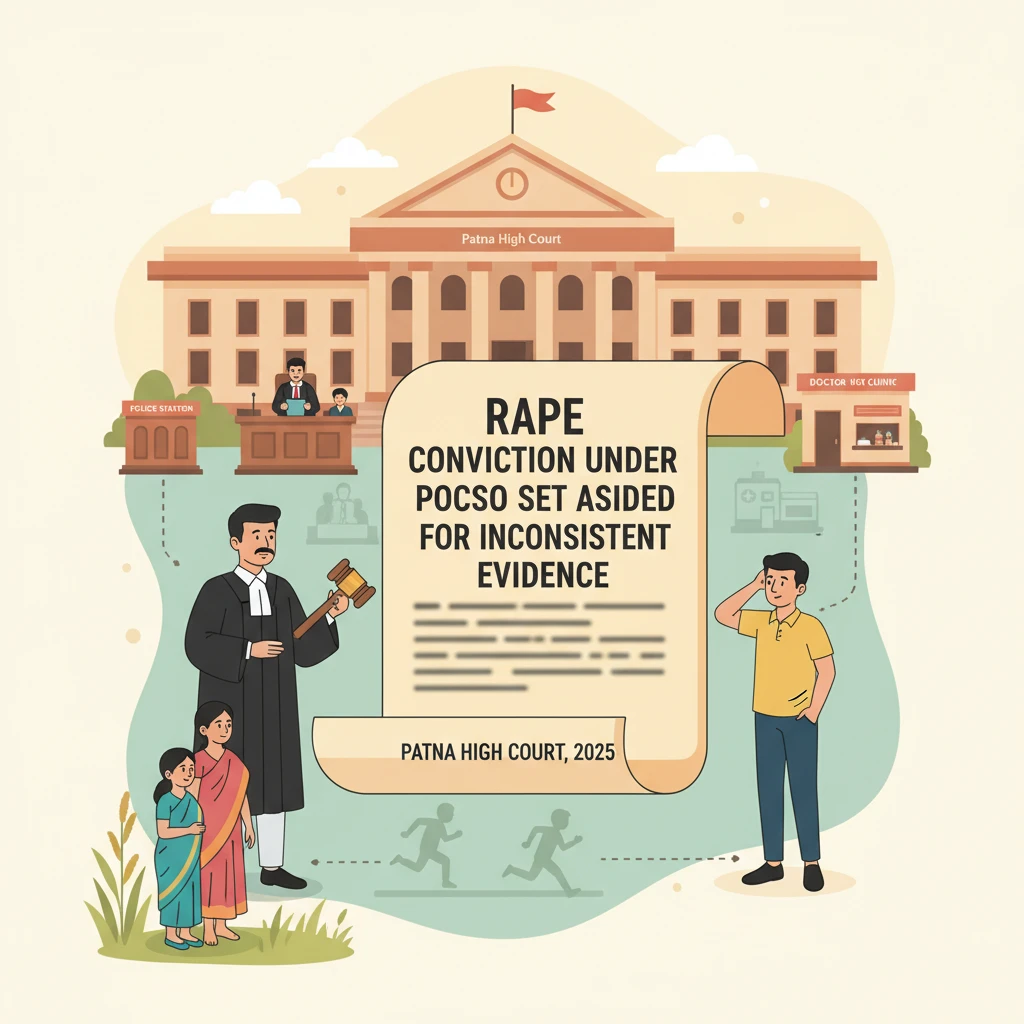
Accordingly, the High Court set aside the conviction judgment dated 05.12.2022 and sentence order dated 07.12.2022 in POCSO Case No. 127 of 2021. The criminal appeal was allowed. As the appellant was in judicial custody, the Court directed that he be released forthwith, if not required in any other case. The trial court record and a copy of the judgment were ordered to be sent to the trial court and concerned jail authority for compliance.
Why This Judgment Matters
This judgment shows how closely the Patna High Court scrutinises evidence in serious sexual offence cases under the POCSO Act.
For victims and families, it underlines the importance of giving a consistent version from the very beginning — in the FIR, before the Magistrate, and before the trial court. Major changes in the story, or silence on important facts like presence of companions or field owners, can weaken a case badly.
For the police, the judgment signals that investigation must be thorough. Here, the failure to identify and examine the eight companion girls, the field owner, and boundary landholders, and the failure to properly preserve and examine clothes, were treated as serious lapses. Courts do not simply overlook such gaps, especially when the entire case rests mainly on oral testimony.
For accused persons, the ruling reiterates that even in POCSO matters, conviction must be based on proof beyond reasonable doubt. Where there are serious contradictions, absence of supporting medical evidence despite specific injury allegations, and no independent witnesses, the benefit of doubt will go to the accused.
Practically, the decision reinforces that while the sole testimony of a victim can be enough to convict, it must be consistent, credible, and not shaken by inherent contradictions. This balance protects both the rights of genuine victims and the rights of accused persons against wrongful conviction.
Legal Issues and Answers
- Issue: Whether the appellant’s conviction under Section 6 POCSO (read with Section 376D IPC) could be sustained solely on the victim’s testimony in light of contradictions and lack of corroborative evidence.
Answer: No. The Patna High Court held that serious inconsistencies in the victim’s statements, lack of medical support for alleged injuries, and non-examination of key witnesses created reasonable doubt. The prosecution failed to prove the foundational facts of rape beyond reasonable doubt, so the appellant was entitled to acquittal. - Issue: Whether non-examination of material witnesses like the companion girls and field owner, coupled with investigative lapses, affected the prosecution case.
Answer: Yes. The Court found that failure to identify and examine these persons, along with the I.O.’s negligence in verifying their addresses and recording statements of neighbouring landholders, significantly weakened the prosecution story and contributed to the grant of benefit of doubt.
Cases Cited by the Court
- No previous judgments or case law have been expressly cited or relied upon in the text of this judgment, beyond general references to settled legal principles. Therefore, there are no specific case citations to list.
Case Details
Case Number: Criminal Appeal (DB) No. 72 of 2023; arising out of Mahila P.S. Case No. 17 of 2015; Special POCSO Case No. 127 of 2021
Case Title: Abla Yadav @ Ablay Yadav v. The State of Bihar & Anr.
Citation: 2025(4) PLJR 60
Coram: Hon’ble Mr. Justice Rajeev Ranjan Prasad; Hon’ble Mr. Justice Shailendra Singh
Advocates: Mr. Aditya Nath Pandey, Advocate for the appellant; Ms. Shashi Bala Verma, Additional Public Prosecutor for the State
Nature of Case: Criminal appeal (Division Bench) against conviction and sentence under Section 376D IPC and Section 6 of the POCSO Act, arising from a Special POCSO case.
Date of High Court Judgment: 31.07.2025
Trial Court: Court of the Additional Sessions Judge-VI-cum-Special Judge, POCSO Act, Bhagalpur
Outcome: Conviction and sentence set aside; appeal allowed; appellant directed to be released unless required in another case.
Link to Judgment: Patna High Court Judgment Link
If you found this explanation helpful and wish to stay informed about
how legal developments may affect your rights in Bihar,
you may consider following Samvida Law Associates for more updates.







