
Case Background
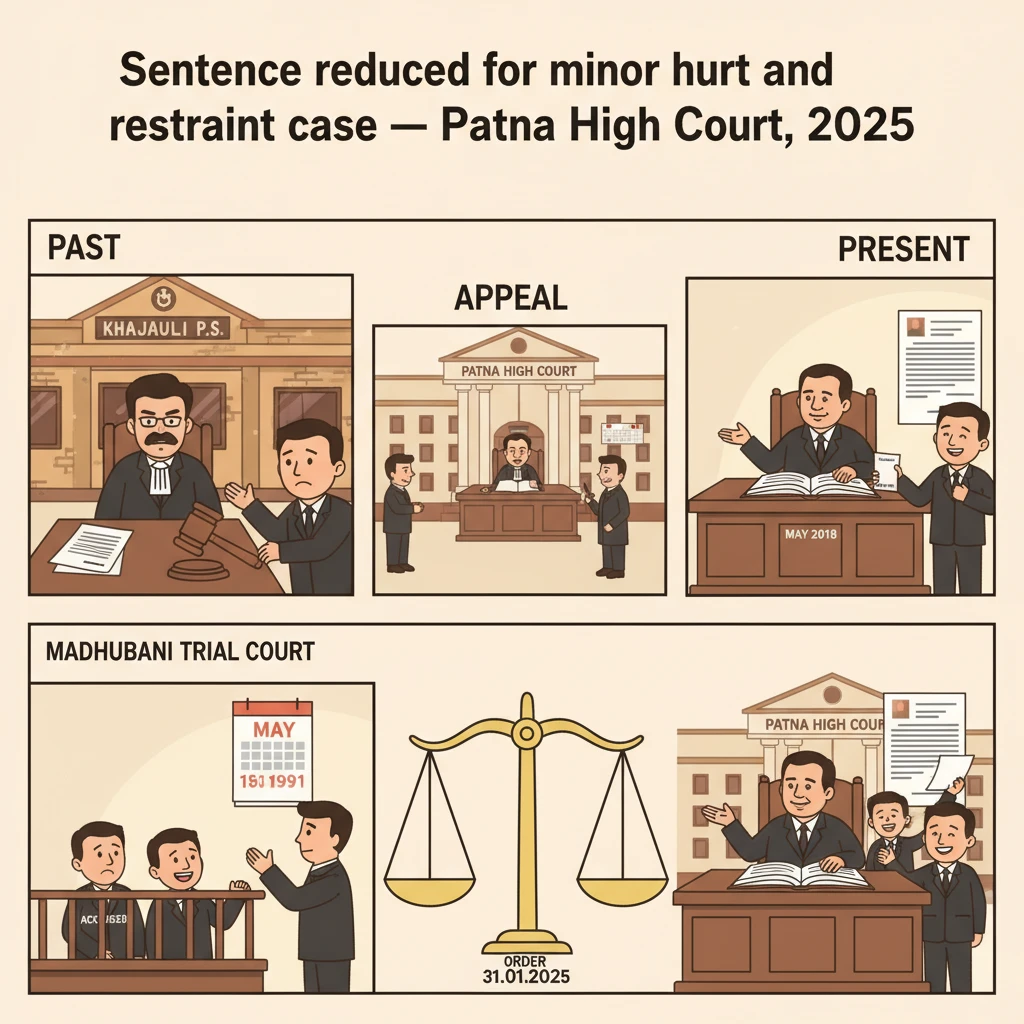
This case arose from a police station case registered as P.S. Case No. 75 of 1991 at Khajauli Police Station in the district of Madhubani, Bihar. On the basis of that FIR, G.R. Case No. 869 of 1991 was instituted and later numbered as Trial No. 420 of 1999 before the Judicial Magistrate Ist Class, Madhubani.
In that trial, the two accused persons (later the petitioners in revision) were tried for offences under Sections 323 and 341 of the Indian Penal Code (IPC). Section 323 IPC deals with punishment for voluntarily causing hurt, and Section 341 IPC deals with punishment for wrongful restraint.
After trial, the learned Judicial Magistrate convicted both accused under Sections 323 and 341 IPC. For the offence under Section 323 IPC, each of them was sentenced to rigorous imprisonment (RI) for three months. For the offence under Section 341 IPC, each was sentenced to rigorous imprisonment for one month. The Magistrate directed that both sentences would run concurrently.
The convicted persons then filed Criminal Appeal No. 70 of 1999 before the Court of the Additional Sessions Judge-II, Madhubani. On 28.05.2018, the appellate court dismissed the appeal and upheld both the conviction and the sentences imposed by the trial court.
Aggrieved by this appellate judgment, the convicted persons approached the Patna High Court by filing Criminal Revision No. 172 of 2019. The revision was heard by Hon’ble Mr. Justice Jitendra Kumar, who delivered an oral judgment on 31.01.2025.
What the Court Examined and Decided
Before the Patna High Court, the petitioners did not challenge the finding that they were guilty under Sections 323 and 341 IPC. Through their counsel, they made it clear that they accepted the conviction as recorded by the courts below.
Their grievance was limited to the quantum of sentence. The petitioners requested the High Court to reduce the period of imprisonment imposed on them, particularly the three months’ rigorous imprisonment ordered under Section 323 IPC, and one month under Section 341 IPC.
The learned counsel for the petitioners submitted that:
- The petitioners were challenging only the sentence and not the conviction recorded under Sections 323 and 341 IPC.
- Under Section 323 IPC, the maximum punishment prescribed is one year, and under Section 341 IPC, the maximum punishment is one month.
- Though the imposed sentences were within the legal limits, considering the overall circumstances, the quantum was on the higher side and deserved reduction.
- The petitioners had already spent more than two months in judicial custody.
- At the time of commission of the offence in 1991, the petitioners were relatively young. Petitioner No. 1, Harendra Jha, was about 27 years old, and Petitioner No. 2, Sudhir Jha, was about 40 years old.
- This was the first offence of the petitioners, and there was no allegation of prior criminal antecedents.
On this basis, learned counsel prayed that the sentence may be suitably reduced and confined to the period already undergone in custody.
The learned Additional Public Prosecutor (A.P.P.) appearing for the State of Bihar did not seriously oppose this request. On the contrary, he fairly submitted that, looking to the facts and circumstances of the case, the sentence may be reduced to the period already undergone by the petitioners.
The High Court considered these submissions and proceeded to examine the material on record for the limited purpose of deciding whether any interference with the sentence was warranted in revision.
The Court noted the following key facts:
- The petitioners had been convicted under Sections 323 and 341 IPC.
- For Section 323 IPC, they had been sentenced to three months’ rigorous imprisonment, and for Section 341 IPC, they had been sentenced to one month’s rigorous imprisonment.
- Both sentences were directed to run concurrently by the trial court, and that direction had been affirmed by the appellate court.
- The petitioners had already undergone more than two months in custody in connection with this case.
- At the time of the alleged offence, both petitioners were of comparatively young age: one being 27 years and the other 40 years.
- The case before the Court was the first offence of the petitioners.
In light of these factors, the High Court weighed the need for punishment against the mitigating circumstances. It recognised that:
- While the law prescribes up to one year’s imprisonment for voluntarily causing hurt, courts have discretion to award lesser sentences depending on the circumstances.
- The petitioners had already served a significant part of the sentence, more than two months, which is close to the three-month term awarded under Section 323 IPC.
- The incident was old, originating from a 1991 police case, and the matter had remained in the criminal justice system for a very long time.
- There was no material before the Court suggesting that the petitioners were habitual offenders or that they had misused liberty during the proceedings.
Taking an overall view, the Court concluded that, in the interest of justice, the sentence could be suitably reduced without disturbing the conviction.
Accordingly, the Patna High Court ordered that the quantum of sentence imposed on the petitioners for the offences under Sections 323 and 341 IPC be reduced to the period already undergone by them in custody.
This meant that, since the petitioners had already served more than two months in judicial custody, no further imprisonment would be required for this case. The conviction under Sections 323 and 341 IPC remained intact, but the actual time to be spent in jail was limited to what they had already undergone.
On this basis, the Criminal Revision No. 172 of 2019 was allowed in part. It was “allowed” to the extent of reduction of sentence, and “in part” because the conviction itself was not interfered with or set aside.
The Court also directed the office to send back the Lower Court Records (LCR) to the concerned court below, completing the formal procedural requirements after disposal of the revision.
Why This Judgment Matters
This judgment is important for accused persons and families involved in older, minor criminal cases under Sections 323 and 341 IPC, especially in Bihar.
First, it shows that even if the conviction has been upheld by the trial court and the appellate court, the Patna High Court can still examine the length of the sentence in revision. Where appropriate, the Court may reduce the sentence without disturbing the conviction.
Second, the judgment highlights that factors like young age at the time of offence, first-time involvement in crime, and time already spent in custody can influence the Court to reduce jail time. This is particularly relevant where the offence is not very serious and arises out of hurt and wrongful restraint.
Third, the case underlines that even the State’s counsel can fairly support a reduction of sentence if the circumstances justify a more lenient view. This can help resolve long-pending matters in a balanced way.
For lay persons facing similar minor charges, the judgment shows that:
- A criminal revision is a possible remedy when the main dispute is only about how long the sentence should be, not about guilt or innocence.
- Courts do look at the time already undergone in custody and the age and background of the accused, especially when the case is very old.
Legal Issues and Answers
- Issue: Whether the sentence of three months’ rigorous imprisonment under Section 323 IPC and one month under Section 341 IPC, as upheld by the appellate court, required interference by the Patna High Court in revision when the petitioners were not challenging their conviction.
Answer: Yes. The Patna High Court, considering that the petitioners were young at the time of the offence, that it was their first offence, and that they had already spent more than two months in custody, reduced the sentence under Sections 323 and 341 IPC to the period already undergone, while maintaining the conviction.
Cases Cited by the Court
- No previous case law has been cited or relied upon in the text of this judgment.
Case Details
Case Number: Criminal Revision No. 172 of 2019 (arising out of P.S. Case No. 75 of 1991, Khajauli, District Madhubani; G.R. Case No. 869 of 1991 / Trial No. 420 of 1999)
Case Title: Harendra Jha & Anr. v. The State of Bihar & Anr.
Coram: Hon’ble Mr. Justice Jitendra Kumar
Citation: 2025(3) PLJR 444
Advocates:
For the petitioners: Mr. Shailendra Kumar Jha, Advocate
For the State: Mr. Mithlesh Kumar Khare, Additional Public Prosecutor (APP)
Nature of the case: Criminal revision against appellate judgment affirming conviction and sentence under Sections 323 and 341 IPC
Date of High Court Judgment: 31.01.2025
Link to judgment: Click here to View full judgment
If you found this explanation helpful and wish to stay informed about
how legal developments may affect your rights in Bihar,
you may consider following Samvida Law Associates for more updates.







