
Case Background
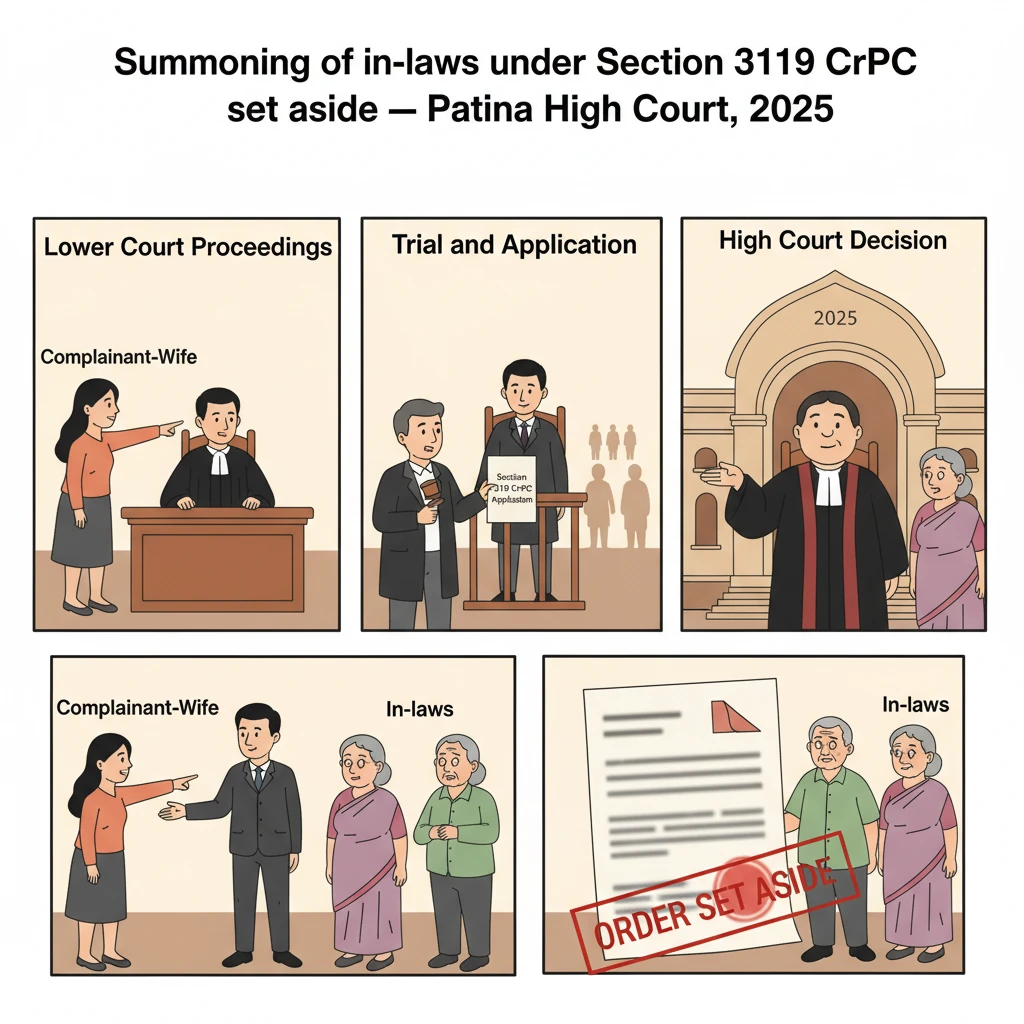
This case began with a criminal complaint filed in 2014 by Rita Singh (opposite party no. 2) in the court at Bikramganj, Rohtas. She filed Complaint Case No. 540 of 2014 against five persons from her matrimonial family.
In the complaint, she named her husband, her father-in-law, her mother-in-law, her brother-in-law and her sister-in-law. She alleged offences under Sections 498A, 406, 420, 308 and 506 of the Indian Penal Code and Section 3/4 of the Dowry Prohibition Act.
After recording the complainant’s statement under Section 200 of the Code of Criminal Procedure (CrPC), the learned A.C.J.M.-I, Bikramganj, did not proceed against all five persons. The Magistrate took cognizance only for the offence under Section 498A of the Indian Penal Code and only against the husband, Navneet Kumar.
The complainant challenged this limited cognizance by filing Criminal Revision No. 409 of 2014. That revision was dismissed. The cognizance order in favour of only the husband was upheld.
The trial then moved forward only against the husband. During the trial, four prosecution witnesses were examined. After these depositions, the complainant filed an application under Section 319 CrPC. She requested the trial court to summon her father-in-law and mother-in-law to also face trial along with the husband.
The father-in-law and mother-in-law (the present petitioners) opposed this move. They filed a reply, contesting the Section 319 CrPC application and maintaining that there was no sufficient evidence to summon them.
Despite their objection, on 17.10.2019, the learned A.C.J.M.-I allowed the complainant’s application under Section 319 CrPC in Complaint Case No. 540 of 2014 (Trial No. 933 of 2019). By that order, the Magistrate summoned the father-in-law and mother-in-law to face trial for the offence under Section 498A IPC along with the husband.
Aggrieved by this order, the in-laws approached the Patna High Court by filing Criminal Revision No. 10 of 2020. This revision came up before Hon’ble Mr. Justice Jitendra Kumar and was decided by oral judgment dated 15.07.2025.
What the Court Examined and Decided
The Patna High Court first noted the narrow scope of the present revision: it was directed only against the order dated 17.10.2019, by which the trial court had summoned the in-laws under Section 319 CrPC to face trial under Section 498A IPC.
The petitioners’ counsel argued that they were innocent and had been falsely dragged into the criminal proceedings. He stressed that the law on Section 319 CrPC requires “strong and cogent evidence” before a person, who is not already an accused, can be summoned to face trial.
He submitted that the evidence needed for invoking Section 319 CrPC must be higher than the usual “prima facie” standard used at the stage of framing of charge. It should be closer to the level of proof needed for conviction, though not exactly the same. Mere possibility or probability of involvement is not enough.
On facts, the petitioners’ counsel pointed to the depositions of the four prosecution witnesses. According to him, even if those statements were taken at face value, they did not disclose even a basic prima facie case against the father-in-law and mother-in-law.
He emphasised that the petitioners were only the complainant’s parents-in-law. The core dispute, as appeared from the evidence, was between the complainant and her husband regarding their disturbed conjugal life.
The complainant suspected that her husband had an illicit relationship with another woman and was not interested in a marital relationship with her. On the other hand, the husband had alleged that the complainant herself was cruel towards him and that she had an illicit relationship. On this basis, he had filed a divorce petition against her.
It was argued that the present criminal complaint was filed only after the husband initiated divorce proceedings. According to the petitioners, the timing showed that the criminal case was a counterblast, meant to pressurise and harass the husband and his family.
The petitioners’ counsel further submitted that the allegations against the in-laws were only general and omnibus, with no specific details about date, time, place or the exact nature of any act of cruelty or demand. He pointed out that, on this very complaint, the Magistrate had earlier refused to take cognizance against the in-laws, and that the complainant’s revision against that order had already failed.
He argued that the evidence which came later at trial was not any stronger or more specific than what was already available at the stage of cognizance. Therefore, using Section 319 CrPC to summon the in-laws on such weak material would be a travesty of justice.
He also submitted, more broadly, that Section 498A IPC is often misused to implicate the husband’s parents, and that this case was a classic example, where the real dispute was with the husband, but the in-laws had been falsely implicated.
On the other side, the learned APP for the State and the counsel for the complainant (opposite party no. 2) supported the trial court’s order. They argued that there was sufficient material to justify summoning the in-laws under Section 319 CrPC and that the order suffered from no illegality or infirmity.
Before weighing these rival submissions, the Patna High Court revisited the legal position on Section 319 CrPC. The Court referred to its earlier detailed judgment in Draupadi Kunwar @ Draupati Kunwar and others vs. State of Bihar, reported in 2025 SCC OnLine Pat 34.
In that decision, the Patna High Court had discussed Section 319 CrPC in depth, after examining the statutory provision and several Supreme Court decisions including:
- Hardeep Singh vs. State of Punjab and Ors, (2014) 3 SCC 92
- S. Mohammad Ispahani vs. Y. Chandak & Ors., (2017) 16 SCC 226
- Rajesh and Ors. vs. State of Haryana, (2019) 6 SCC 368
- Manjeet Singh vs. State of Haryana & Ors., (2021) 18 SCC 321
- Jitendra N. Mishra vs. State of U.P. & Anr., (2023) 7 SCC 344
- Juhru & Ors. vs. Karim and Another, (2023) 5 SCC 406
- OMI @ Omkar Rathore & Anr. vs. The State of Madhya Pradesh and Anr., SLP (Crim) No. 17781 of 2024, decided on 03.01.2025
- Joginder Singh vs. State of Punjab, (1979) 1 SCC 107
Quoting paragraph 24 of Draupadi Kunwar, the High Court highlighted that, for summoning under Section 319 CrPC:
“the Court has to see that there is a strong and cogent evidence against such person laid before the Court and not merely probability of his complicity. The degree of satisfaction of the Court is much stricter. The test that has to be applied is one which is more than prima facie case as exercised at the time of framing of charge, but short of satisfaction to an extent that the evidence, if goes unrebutted, would lead to conviction.”
The Court also noted that only the evidence recorded during trial can be considered at this stage, and that the Court may exercise power even after examination-in-chief, without waiting for cross-examination to be completed.
Turning back to the present case, the High Court noted that the complainant’s Section 319 application was filed after examination of four witnesses, and that the Magistrate’s order summoning the in-laws was based on those four depositions.
After independently examining the evidence, the High Court found that even a prima facie case was not made out against the father-in-law and mother-in-law, let alone the higher standard required under Section 319 CrPC.
The Court termed it “surprising” that the learned A.C.J.M.-I had passed such an order. It observed that the complainant’s own evidence showed that her main grievance was against her husband, and that even a divorce petition was pending between them. The criminal complaint was filed subsequently.
The High Court recorded that all allegations against the in-laws were general and omnibus, without any clear date, time, place or particular act. On such vague accusations, the Court held, even cognizance could not be taken, and in fact had already been refused earlier.
Reiterating that Section 319 CrPC requires a standard of evidence much stronger than a prima facie case, the Court concluded that there was no justification for summoning the in-laws to face trial. To make them stand trial in these circumstances would indeed be a travesty of justice.
Accordingly, the Patna High Court held that the impugned order dated 17.10.2019 was not sustainable in law. It set aside that order and allowed the criminal revision. As a result, the father-in-law and mother-in-law were discharged from facing trial under Section 498A IPC in this proceeding.
Why This Judgment Matters
This judgment of the Patna High Court is important for both families and criminal courts dealing with matrimonial disputes.
First, it protects relatives, especially in-laws, from being added into a criminal case at a late stage without strong and specific evidence. The Court clearly states that vague and general allegations are not enough to drag more family members into a 498A case through Section 319 CrPC.
Second, it reinforces that Section 319 CrPC is an exceptional power. It cannot be used lightly or just to satisfy the complainant. The Court must look carefully at the trial evidence and be satisfied that there is strong, cogent material before summoning any new accused.
Third, the judgment indirectly warns against misuse of criminal law in matrimonial disputes, especially when criminal complaints appear after a divorce petition or other matrimonial litigation. While genuine victims of cruelty remain protected, the Court insists that criminal process should not become a tool of harassment.
For ordinary readers, this decision means that if you are a relative of a spouse and are being added to a 498A case mid-way in trial, the court must first find clear and concrete evidence against you. Suspicion, family tension, or broad statements without details should not be enough.
Legal Issues and Answers
- Issue: Can a trial court summon in-laws under Section 319 CrPC to face trial under Section 498A IPC on the basis of general and omnibus allegations without specific evidence against them?
Answer: No. The Patna High Court held that Section 319 CrPC requires strong and cogent evidence, of a degree higher than a simple prima facie case. Since even a prima facie case was not made out against the in-laws, the order summoning them was set aside. - Issue: What standard should a court apply while exercising power under Section 319 CrPC?
Answer: The Court must be satisfied that there is evidence stronger than the usual prima facie standard used at the stage of framing of charge, though not as high as proof beyond reasonable doubt. Mere probability or general suspicion is insufficient.
Cases Cited by the Court
- Draupadi Kunwar @ Draupati Kunwar and others vs. State of Bihar, 2025 SCC OnLine Pat 34
- Hardeep Singh vs. State of Punjab and Ors, (2014) 3 SCC 92
- S. Mohammad Ispahani vs. Y. Chandak & Ors., (2017) 16 SCC 226
- Rajesh and Ors. vs. State of Haryana, (2019) 6 SCC 368
- Manjeet Singh vs. State of Haryana & Ors., (2021) 18 SCC 321
- Jitendra N. Mishra vs. State of U.P. & Anr., (2023) 7 SCC 344
- Juhru & Ors. vs. Karim and Another, (2023) 5 SCC 406
- OMI @ Omkar Rathore & Anr. vs. The State of Madhya Pradesh and Anr., SLP (Crim) No. 17781 of 2024, decided on 03.01.2025
- Joginder Singh vs. State of Punjab, (1979) 1 SCC 107
Case Details
Case Number: Criminal Revision No. 10 of 2020 (arising out of Complaint Case No. 540 of 2014, Rohtas)
Case Title: Bajrangbali Singh & Anr. vs. The State of Bihar & Anr.
Citation: 2025(3) PLJR 573
Court: High Court of Judicature at Patna
Bench/Coram: Hon’ble Mr. Justice Jitendra Kumar
Date of Judgment: 15.07.2025
Impugned Order: Order dated 17.10.2019 passed by A.C.J.M.-I, Bikramganj, Rohtas in Complaint Case No. 540 of 2014 (Trial No. 933 of 2019)
Parties’ Roles:
- Petitioners: Father-in-law and mother-in-law of the complainant (originally named accused, later summoned under Section 319 CrPC)
- Opposite Party No. 1: State of Bihar
- Opposite Party No. 2: Rita Singh (complainant-wife)
Advocates:
- For the Petitioners: Mr. S.B.K. Manglam, Advocate; Mr. Awnish Kumar, Advocate; Mr. Vikash Kumar Singh, Advocate; Mr. Kumar Gaurav, Advocate
- For the State: Mr. Kumar Veerendra Narayan, APP
- For Opposite Party No. 2: Mr. Krishna Prasad Singh, Senior Advocate; Ms. Sakshi Deep, Advocate
Nature of the Case: Criminal revision against an order under Section 319 CrPC summoning additional accused to face trial under Section 498A IPC
Link to Judgment: https://patnahighcourt.gov.in/viewjudgment/NyMxMCMyMDIwIzEjTg==-nP–am1–FfmaF0Pg=
If you found this explanation helpful and wish to stay informed about
how legal developments may affect your rights in Bihar,
you may consider following Samvida Law Associates for more updates.







