
Case Background
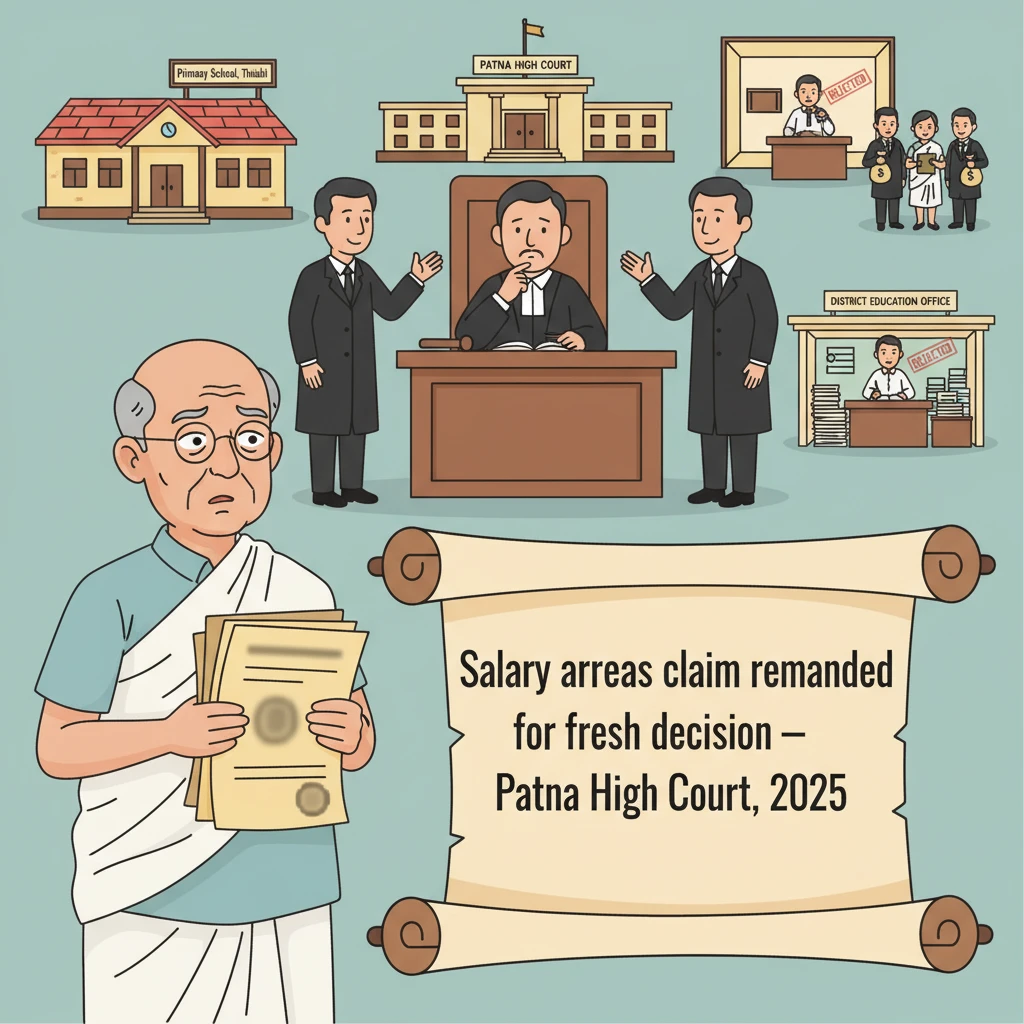
The petitioner worked as an Assistant Teacher in a primary school in Saharsa district. He was appointed by the Managing Committee of Primary School, Thadhi, in Saharsa.
According to him, he joined service on 17.11.1969. Later, the school was taken over by the State under the Bihar Non-government Elementary School (Taking Over of Management and Control) Act, 1976. Under this Act, the service of such teachers needed approval from the State Government.
The petitioner claimed that his service ought to have been approved and that he was entitled to arrears of salary for a long period, from 27.07.1988 to February 2006. He said that other similarly situated persons had received such arrears, but he was denied the same.
The petitioner submitted representations to the District Education Officer, stating that he had joined on 17.11.1969 and seeking recognition of his service and payment of arrears. However, his representation was not acted upon.
Eventually, the Director, Primary Education, Bihar, Patna, passed an order contained in Memo No. 608 dated 20.07.2020. By this order, the Director rejected the petitioner’s claim for arrears of salary. The petitioner alleged that this rejection was done in a “cryptic” manner, without proper reasons and without following earlier court decisions in similar cases.
Aggrieved, the petitioner approached the Patna High Court in Civil Writ Jurisdiction Case No. 16391 of 2021, seeking quashing of Memo No. 608 dated 20.07.2020 and a direction to pay arrears of salary with consequential benefits and statutory interest.
What the Court Examined and Decided
The writ petition was heard by Hon’ble Mr. Justice Purnendu Singh. The Court heard both sides: the petitioner’s counsel and the State’s counsel.
The petitioner’s main case was that his claim was covered by earlier judgments of the Patna High Court, particularly:
(i) Order dated 28.07.2010 passed in CWJC No. 1489 of 2010; and
(ii) Order dated 01.08.2014 passed in CWJC No. 8903 of 2010.
These orders were placed on record as Annexure 15 and 15/1. The petitioner argued that his case was identical to the petitioner in CWJC No. 1489 of 2010, where this Court had directed the Director, Primary Education to pass necessary orders for payment of arrears of salary for the period in question.
He further argued that he had been working continuously and that his appointment being prior to 01.01.1971 and his joining on 17.11.1969 brought him squarely within the ambit of the Act, 1976. Hence, his service required approval and he was entitled to arrears of salary like similarly placed teachers.
The State’s counsel, Mr. Kumar Kamal Nayan, referred to Memo No. 1720 dated 27.07.1988, which had been communicated to the Regional Deputy Director of Education, Koshi Division, Saharsa, regarding a cut-off date. He also referred to the impugned Memo No. 608 dated 20.07.2020 issued by the Director, Primary Education, where the Director had recorded that the petitioner joined on 17.11.1969 but, in the absence of approval of the State Government under the Act, 1976, the petitioner’s claim for arrears was rejected.
The Court noted that no counter affidavit had been filed by the State, despite the case being pending since 2021. Therefore, the State did not bring any additional factual or legal justification on record beyond what was stated in the impugned order and what was argued orally.
Crucially, the Court examined whether the authorities, particularly the Regional Deputy Director of Education and the Director, Primary Education, had properly considered the earlier decisions of the Patna High Court and the legal position when dealing with the petitioner’s case.
The Court observed that the impugned order contained in Memo No. 818 dated 13.05.2016, as referred to in the judgment, and the subsequent decision in Memo No. 608 dated 20.07.2020, had not taken into account that the petitioner’s case was covered by CWJC No. 1489 of 2010.
In CWJC No. 1489 of 2010, the High Court had considered the situation where, before the school was taken over by the State under the Act, 1976, the petitioner in that case had been regularly paid salary by the Managing Committee. In that context, the Court directed payment of arrears of salary for the relevant period. The present Court noted that the petitioner before it stood on a similar footing: he was appointed by the Managing Committee and continued to perform his duties even after the Act, 1976 came into effect.
The Court then turned to a broader legal principle: that the State cannot take advantage of its own inaction or wrong to deny a benefit that should otherwise be granted. This principle is captured in the Latin maxim “nullus commodum capere potest de injuria sua propria” (no man can take advantage of his own wrong).
To reinforce this, the Court referred to several Supreme Court and High Court decisions, including:
– M/S Hindustan Sugar Mills vs. The State of Rajasthan and Others, reported in AIR 1981 SC 1681;
– All India Groundnut Syndicate Limited vs. Commissioner of Income Tax, Bombay City, reported in AIR 1954 Bombay 232; and
– Municipal Committee Katra and Others vs. Ashwani Kumar, Civil Appeal Nos. 14970–71 of 2017, where the Supreme Court in paragraphs 18 and 19 of its judgment dated 09.05.2024 reiterated that no one should be allowed to profit from their own wrong.
The Court reproduced portions of the Supreme Court’s reasoning in Municipal Committee Katra, where it reaffirmed the application of the maxim and emphasised that a person “shall not take advantage of his own wrong” and “a wrong doer ought not to be permitted to make a profit out of his own wrong”. The Court applied this principle to the conduct of State authorities when they fail to act and then seek to deny benefits on that basis.
Applying these principles to the present case, the Patna High Court found that:
– The petitioner’s initial appointment as an Assistant Teacher by the Managing Committee of Primary School, Thadhi, Saharsa was not in dispute.
– The school was taken over under the Act, 1976.
– The petitioner continued to perform his duties even after the Act came into force.
– Despite these facts, the Regional Deputy Director of Education, Koshi Division, Saharsa did not consider the petitioner’s case in light of CWJC No. 1489 of 2010 and the legal principles laid down by the Supreme Court and this Court.
– The authority’s decision to reject the claim for arrears, solely on the ground that there was no formal approval from the State Government, without examining the petitioner’s similarity with other cases where relief was granted, was improper.
On these grounds, the High Court concluded that the impugned order contained in Memo No. 608 dated 20.07.2020 could not stand. It set aside and quashed Memo No. 608.
The Court then issued a clear direction: the Regional Deputy Director of Education, Koshi Division, Saharsa must pass a fresh order in accordance with law. While doing so, the authority must consider:
– The law laid down by the Supreme Court, particularly regarding the principle that no one should profit from their own wrong; and
– The observations made by the Patna High Court in CWJC No. 1489 of 2010 regarding entitlement to arrears where a teacher had been regularly paid by the Managing Committee before the school’s take-over.
Thus, the writ petition was disposed of with directions for reconsideration. The Court did not itself calculate or grant arrears but ensured that the competent authority must re-examine the case fairly and in line with earlier rulings.
Why This Judgment Matters
This judgment is important for teachers of taken-over non-government elementary schools in Bihar, especially those appointed before 01.01.1971 and before the Act, 1976 came into effect.
It makes clear that the education authorities cannot reject claims for salary arrears in a mechanical way. They must consider earlier court decisions in similar matters and the actual working of the teacher, including whether he or she was being regularly paid by the Managing Committee before the school was taken over.
The judgment also reinforces that the State cannot use its own delay or failure (such as not approving service in time) as a reason to deny financial benefits to employees who have actually worked.
For similarly placed teachers, this decision of the Patna High Court shows that if their claims for arrears are rejected without proper reasoning and without considering binding precedents, they can approach the Court to seek a fresh and lawful decision.
Legal Issues and Answers
- Issue: Whether the petitioner’s claim for arrears of salary could be rejected on the ground that his service was not formally approved by the State Government under the Act, 1976, despite his continuous service and similarity with earlier cases where relief was granted.
Answer: The Patna High Court held that the rejection order in Memo No. 608 dated 20.07.2020 was unsustainable, as it failed to consider the petitioner’s similarity with the case decided in CWJC No. 1489 of 2010 and the legal principles laid down by the Supreme Court and this Court. The order was quashed, and the case remanded for a fresh decision in accordance with law. - Issue: Whether authorities can ignore binding judicial precedents and still deny claims like arrears of salary.
Answer: The Court indicated that authorities must consider relevant judgments, including CWJC No. 1489 of 2010 and Supreme Court decisions on the principle that one cannot take advantage of one’s own wrong. Failure to do so justified judicial interference and remand.
Cases Cited by the Court
- M/S Hindustan Sugar Mills vs. The State of Rajasthan and Others, AIR 1981 SC 1681
- All India Groundnut Syndicate Limited vs. Commissioner of Income Tax, Bombay City, AIR 1954 Bombay 232
- Municipal Committee Katra and Others vs. Ashwani Kumar, Civil Appeal Nos. 14970–71 of 2017, judgment dated 09.05.2024
- CWJC No. 1489 of 2010 (Patna High Court)
- CWJC No. 8903 of 2010 (Patna High Court)
Case Details
Case Number: Civil Writ Jurisdiction Case No. 16391 of 2021
Case Title: Upendra Yadav vs. The State of Bihar & Others
Coram: Hon’ble Mr. Justice Purnendu Singh
Citation: 2025(3) PLJR 45
Advocates:
For the Petitioner: Mr. Pramod Kumar, Advocate
For the Respondents (State): Mr. Kumar Kamal Nayan, Advocate
Nature of the Case: Writ petition (Civil) seeking quashing of rejection order and direction for payment of arrears of salary and consequential benefits.
Link to Judgment: https://patnahighcourt.gov.in/viewjudgment/MTUjMTYzOTEjMjAyMSMxI04=-WQA6–ak1–9BYMNs=
If you found this explanation helpful and wish to stay informed about
how legal developments may affect your rights in Bihar,
you may consider following Samvida Law Associates for more updates.







