
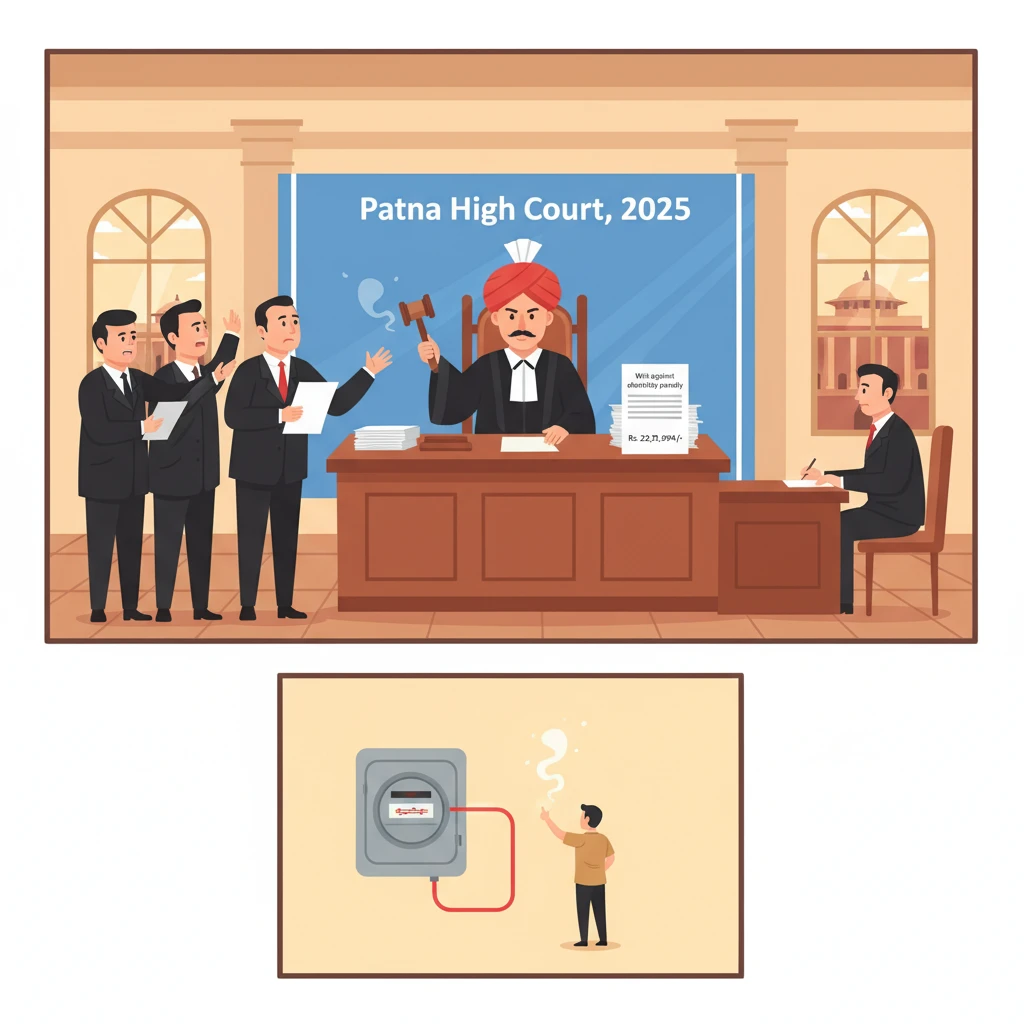
Case Background
The petitioners are the South Bihar Power Distribution Company Ltd. and its officials, who supply electricity as a licensed distribution company. Respondent No. 2 is a private hospital, registered as a consumer of the petitioners with an original sanctioned load of 6 KW under the NDS-II tariff.
On 29.10.2012, the hospital applied for enhancement of load from 6 KW (NDS-II) to 100 KVA (HTS-I tariff). On 16.01.2013, by Letter No. 107a, the Electrical Superintending Engineer provisionally sanctioned a load of 100 KVA with extension from the existing 6 KW load in the name of the hospital’s representative, subject to several terms and conditions.
One important condition was that the consumer had to obtain written permission from the Electrical Inspector, Government of Bihar, Department of Energy, Patna for energisation of the transformer before availing the enhanced load. The system was to be inspected, found leakage proof, and all formalities under the provisional sanction letter were to be completed within 30 days.
On 29.04.2013, the hospital informed the power company that the installed meter had burnt. On 30.04.2013, power supply to the premises was restored by by-passing the burnt meter under Clause 8.19(1)(ii) of the Bihar Electricity Supply Code, 2007.
The hospital deposited security of Rs. 2,70,000/- for the enhanced load of 100 KVA as per letter dated 16.01.2013, but according to the company, other terms and conditions, especially condition No. 7 read with Clause 7.11(4)(b) of the Supply Code, 2007, were not complied with.
However, on 16.05.2013, an HT Agreement was executed between the parties, agreeing that the date of commencement of supply under the HTS-I category would be effective from 28.06.2013, in anticipation that the consumer would comply with the pending conditions of the provisional sanction.
What the Court Examined and Decided
On 15.06.2013, before the agreed commencement date of 28.06.2013, a routine raid was conducted by the Special Task Force (STF) at the hospital premises. The inspection team found that the sanctioned load was still 6 KW, but the total connected load at the premises was 234 KW.
The inspection report recorded that the meter box seal and the one-time locking system of the meter were broken. Power was being supplied by bypassing the meter. The meter was described as completely isolated from the circuit.
The Assistant Electrical Engineer, Kankarbagh, informed the raiding team that the meter had burnt on 29.04.2013, the line had been disconnected, and supply was restored through by-passing the meter on 30.04.2013, after the consumer’s information.
Because the meter was burnt and the line was restored by the licensee through bypassing the meter, no theft case was registered against the hospital. However, the connected load of 234 KW was much higher than the sanctioned 6 KW. The power company treated this as “unauthorized use of electricity” under Section 126 of the Electricity Act, 2003, on the ground of excessive connected load.
A provisional assessment was made under Section 126 by Letter No. 912 dated 20.06.2013, along with a tentative punitive energy bill of Rs. 22,12,094/- and an additional security deposit bill of Rs. 3,42,000/-. The letter invited objections within seven days.
Respondent No. 2 submitted objections to this provisional assessment on 27.03.2013 (as mentioned in the judgment) and the same were received by the power company the same day. The Assessing Officer then issued Letter No. 964 dated 01.07.2013, informing the hospital about a hearing fixed on 04.07.2013 to consider the objections and pass a final order. The notice was received at site by one Nishant on 01.07.2013 on behalf of the hospital.
Despite receipt of the hearing notice, the hospital did not appear before the Assessing Officer. Consequently, a final assessment order was passed ex parte on the basis of the available documents.
This final assessment order dated 08.07.2013 was challenged by the hospital in CWJC No. 15820 of 2013 before the Patna High Court. That writ petition was disposed of on 24.09.2013 with a direction that the Assessing Officer should hear the consumer on its objections and pass a reasoned and speaking order as per Section 126(3) of the Electricity Act, 2003. The consumer was also directed to continue paying current energy charges.
Following this order, the hospital filed a fresh objection on 22.11.2013. After hearing the consumer, the Assessing Officer-cum-Electrical Executive Engineer passed a final assessment order dated 19.12.2013 under Section 126.
Instead of filing an appeal under Section 127 of the Electricity Act against the final assessment order, the hospital approached the Consumer Grievance Redressal Forum, Patna. The CGRF registered Case No. 01 of 2014 (M/s Aastha Lok Hospital Vs. The South Bihar Power Distribution Co. Ltd. & Ors) and, by order dated 08.05.2014, directed the power company to revise the punitive energy bill prepared under Section 126(3) and Annexure-7 of the Bihar Electricity Supply Code, 2007.
The power company then filed the present writ petition (CWJC No. 12741 of 2015) before the Patna High Court, seeking quashing of the CGRF order dated 08.05.2014. The company argued that:
- The CGRF had exercised jurisdiction not vested in it by law.
- The punitive bill was legally prepared under Section 126(3) and the final assessment order was as per statutory provisions.
- The hospital ought to have filed an appeal under Section 127 of the Electricity Act rather than going to the CGRF.
Respondent No. 2 filed a counter affidavit raising two key issues:
- Whether CGRF has jurisdiction to entertain a complaint when the licensee has applied Section 126 of the Electricity Act for unauthorized use of electricity.
- Whether Clause 7.8(v) of the Bihar Electricity Supply Code, 2007 allows a consumer to use enhanced load under changed category after applying for enhancement, and if permission is pending, whether such use can still be treated as “unauthorized”.
The hospital relied on a judgment of the Patna High Court in Krishna Govind Agrawal Vs. Bihar State Electricity Board, reported in 2014(1) PLJR 284. It was pointed out that, in that case, the Court held that once a consumer discloses its intention to enhance load, merely inspecting the premises and raising penal charges on that basis cannot be justified, even without expressly referring to Clause 7.8(v) of the Supply Code.
The hospital also relied on another judgment of a co-ordinate Bench in CWJC No. 14537 of 2015, Kamla Rani Arora Vs. Bihar State Power (Holding) Company Limited and others, decided on 18.12.2023. In that case, the Court quashed action initiated by the licensee under Section 126 by relying upon Clause 7.8(v) of the Supply Code.
Respondent No. 3, Bihar Electricity Regulatory Commission, filed a separate counter affidavit, stating that it only makes regulations and the terms and conditions of CGRF, and that it is not an appellate authority over CGRF. It clarified that it does not interfere in the day-to-day functioning of CGRF and therefore the writ petition was not maintainable against it.
After hearing all parties, the Patna High Court noted certain admitted facts. The hospital had applied for change of category from 6 KW (NDS-II tariff) to 100 KVA (HTS-I tariff). The Electrical Superintending Engineer had provisionally sanctioned 100 KVA on 16.01.2013. The hospital deposited Rs. 2,70,000/- as security on 02.05.2013, and an agreement between the parties was executed on 16.05.2013. These facts, in the Court’s view, showed that change of category was legally permissible and had been allowed by the petitioners.
The Court then considered the earlier decisions cited by the hospital. It acknowledged the ruling in 2014(1) PLJR 284 that once a consumer discloses its intention to enhance load, inspecting the premises and raising penal charges on this basis cannot be justified. The Court also noted the co-ordinate Bench decision in CWJC No. 14537 of 2015, where the licensee’s action under Section 126 had been quashed relying upon Clause 7.8(v) of the Supply Code.
In light of these precedents, and the admitted factual position that the consumer had already applied for enhancement and that provisional sanction and agreement existed, the Court concluded that there was no merit in the petitioners’ challenge to the CGRF order.
The Court held that it found no error in the CGRF’s order dated 08.05.2014. Accordingly, the order of the Consumer Grievance Redressal Forum, Patna, was confirmed. The writ petition was dismissed as devoid of merit. Any interlocutory applications stood disposed of.
Why This Judgment Matters
This judgment is important for consumers who apply for enhancement of electricity load or change of tariff category while already using electricity for a higher load.
The Patna High Court emphasised that where a consumer has openly applied for enhancement and the distribution company itself has granted provisional sanction and accepted security and an agreement, the company cannot lightly treat the situation as a case of unauthorized use under Section 126.
The decision reinforces earlier Patna High Court rulings that once a consumer discloses its intention to enhance load, mere inspection and penal billing based on higher connected load is not automatically justified.
It also shows that orders of the Consumer Grievance Redressal Forum in such matters will not be interfered with lightly by the High Court, especially when they align with the statutory scheme and prior judgments.
Legal Issues and Answers
- Issue: Whether the punitive energy bill and assessment under Section 126 of the Electricity Act against a consumer who had already applied for enhanced load and obtained provisional sanction could stand, and whether the CGRF order interfering with such assessment was illegal.
Answer: No. In view of the admitted facts of application for enhancement, provisional sanction, security deposit and agreement, and in light of prior judgments and Clause 7.8(v) of the Supply Code, the Court found no error in the CGRF’s order and dismissed the writ petition. - Issue: Whether the Consumer Grievance Redressal Forum had exceeded its jurisdiction by directing revision of the punitive bill prepared under Section 126(3) of the Electricity Act.
Answer: The Court did not accept the petitioners’ objection to the CGRF’s jurisdiction in the facts of this case and held that there was no legal infirmity in the CGRF order dated 08.05.2014, which was confirmed. - Issue: Whether, after disclosure of intention to enhance load and steps taken towards change of category, use of higher connected load could automatically be treated as “unauthorized use” under Section 126.
Answer: In light of prior Patna High Court decisions and the protection flowing from Clause 7.8(v) of the Bihar Electricity Supply Code, the Court proceeded on the basis that penal action under Section 126 was not justified in such circumstances and upheld relief in favour of the consumer.
Cases Cited by the Court
- Krishna Govind Agrawal Vs. Bihar State Electricity Board, 2014(1) PLJR 284 – relied on for the principle that once a consumer discloses intention to enhance load, inspection and penal charges on that basis cannot be justified.
- Kamla Rani Arora Vs. Bihar State Power (Holding) Company Limited and others, CWJC No. 14537 of 2015, order dated 18.12.2023 – relied on for quashing licensee’s action under Section 126 on the strength of Clause 7.8(v) of the Bihar Electricity Supply Code, 2007.
Case Details
Case Number: Civil Writ Jurisdiction Case No. 12741 of 2015
Case Title: The South Bihar Power Distribution Company Ltd. and Ors Vs. The State of Bihar & Ors
Citation: 2025(3) PLJR 102
Court: High Court of Judicature at Patna
Coram: Hon’ble Justice Smt. G. Anupama Chakravarthy
Date of Judgment: 05.05.2025
Advocates:
For the Petitioners: Mr. Prakash Kumar, Advocate
For the State (Respondent No. 1): Mr. Ashok Kumar Pathak, Advocate
For Respondent No. 2 (M/s Aastha Lok Hospital): Mr. Suraj Samdarshi, Advocate
For Respondent No. 3 (Bihar Electricity Regulatory Commission): Mr. Rajani Kant Mishra, Advocate; Mr. L.L. Pandey, Advocate
Nature of the Case: Writ petition under civil writ jurisdiction challenging the order of the Consumer Grievance Redressal Forum concerning a punitive electricity bill and assessment under Section 126 of the Electricity Act, 2003.
Link to judgement; https://patnahighcourt.gov.in/viewjudgment/MTUjMTI3NDEjMjAxNSMxI04=-bry3vGkzkZc=
If you found this explanation helpful and wish to stay informed about
how legal developments may affect your rights in Bihar,
you may consider following Samvida Law Associates for more updates.







