
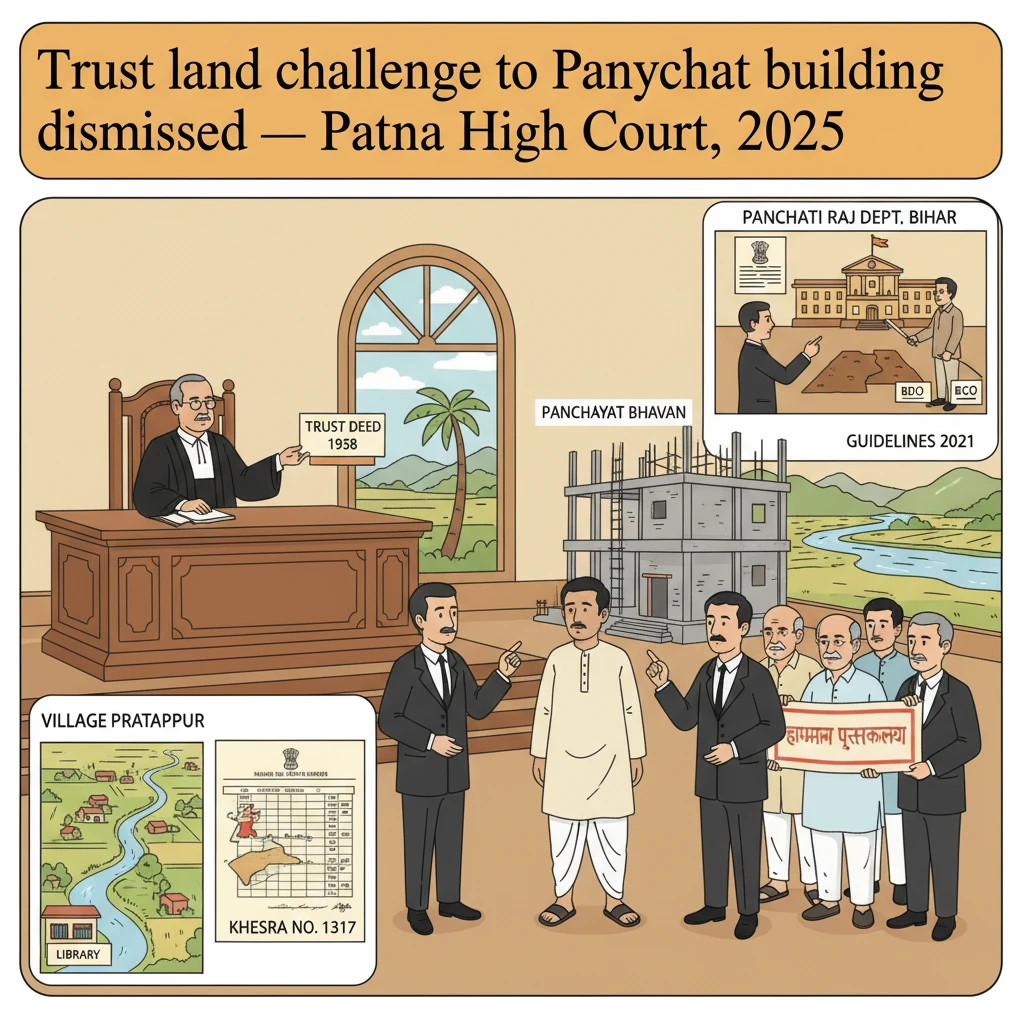
Case Background
This case arose from a dispute over land at Village Pratappur, in Marwan Block, District Muzaffarpur. The land had been endowed in 1958 through a registered Trust Deed (Nyas Patra) by Late Ram Adhikari Devi, wife of Late Hanuman Prasad Singh.
Under that deed, land measuring 2 Bigha, 19 Katha and 17 Dhur was given for establishing and running “Hanuman Library, Pratappur” (Hanuman Pustakalaya). Five trustees were named to manage the library and the trust property for the benefit of the public.
Many years later, the Panchayati Raj Department of the Government of Bihar decided, through guidelines dated 12.05.2021, to construct Panchayat Sarkar Bhavans in Gram Panchayat headquarters, including Karjadeeh under Marwan Block. The dispute concerns 43 decimals of land recorded as Khata No. 449, Khesra No. 1317, Mauza Pratappur.
The petitioner, claiming to be a legal heir of Late Sewak Singh and Late Hanuman Prasad Singh’s family, approached the Patna High Court in Civil Writ Jurisdiction Case No. 5215 of 2025. He sought to restrain the authorities from constructing the Panchayat Sarkar Bhavan on what he claimed was trust land belonging to Hanuman Pustakalaya.
During the case, an interlocutory application (I.A. No. 01 of 2025) was filed to add further reliefs: demolition of the building already constructed, and compensation to Hanuman Pustakalaya, Pratappur. The Court allowed this I.A., treating the amended prayers as part of the main writ petition.
What the Court Examined and Decided
The Patna High Court first noted what the petitioner was asking for. He wanted:
• A restraint order stopping the State and local authorities from continuing construction of the Panchayat Sarkar Bhavan at Karjadeeh.
• A direction to hold an inquiry as ordered earlier by the District Panchayat Raj Officer on 15.11.2024.
• Implementation of the State guidelines dated 12.05.2021 regarding selection and verification of land for Panchayat Bhavans.
• Through the later I.A., demolition of the constructed building and compensation to Hanuman Pustakalaya.
The Court then summarised the petitioner’s main grounds. First, he said the land in dispute formed part of the trust property dedicated to Hanuman Pustakalaya, Pratappur by the 1958 Trust Deed, and therefore, it could not be used for any purpose other than a library and associated educational activities. He also pointed to a Gram Sabha resolution said to have opposed construction on that land.
Second, he argued that the guidelines of 12.05.2021 had not been followed, especially Clause 7, which requires verification of land by the Block Development Officer and Circle Officer before construction of a Panchayat Sarkar Bhavan and preference for government or public land, with conditions for use of private gifted land.
Third, he claimed that the District Panchayat Raj Officer, Muzaffarpur, had on 15.11.2024 directed the Sub-Divisional Officer and Block Development Officer to conduct an inquiry into objections against the construction, but that no such inquiry was held and the work continued.
The State and other respondents presented a different picture. They stated that the land is indeed Khata No. 449, Khesra No. 1317, measuring 43 decimals, at Mauza Pratappur, Thana No. 148, Anchal Marwan. They said the Gram Sabha, in its meeting on 23.01.2023, approved the proposal to use this land for construction of the Panchayat Sarkar Bhavan.
The respondents accepted that the land was originally donated by Late Ramadhikari (Ram Adhikari) Devi by the Trust Deed dated 11.07.1958. However, they argued that she died issueless, that the petitioner is only a distant relative, and that the legal heirs of the donor had already given their consent through an affidavit dated 31.10.2023.
The State further pointed out that in the Revisional Survey Khatiyan, the land is recorded as “Hanuman Pustakalaya, Pratapur Karjan Kism Bhit”, indicating it is designated for public use. On that basis, they argued it is public property and suitable for a Panchayat Sarkar Bhavan under the Department’s guidelines.
The respondents asserted that all procedural requirements were followed: land records were verified, Gram Sabha approval was obtained, consent of heirs was taken, and the Department’s guidelines were adhered to. They also informed the Court that the Panchayat Sarkar Bhavan had already been constructed up to the second floor, including the roof level.
After hearing both sides and examining the Trust Deed and documents, the Court focused on two key questions: the nature of the trust and the petitioner’s right (locus standi) to challenge the use of the land.
The Court carefully read the 1958 Trust Deed. It found that the trust was created for establishing Hanuman Pustakalaya, a library for the “educational and moral advancement” of the people of Pratappur and nearby villages. Five trustees were named to manage and administer the library and its property.
The trust deed clearly stated that the property was to be used for a public purpose: maintaining the library and related educational activities. It also contained an important clause: if at any time the library ceased to exist or its name was changed, the trust could use the income from the property for any other public purpose for the benefit of the general public, provided it did not go against Hindu culture.
The Court then referred to the Supreme Court judgment in Devaki Nandan v. Murlidhar, AIR 1957 SC 133. In that case, the Supreme Court distinguished between private and public trusts. In a private trust, the beneficiaries are definite individuals or a fixed group of persons. In a public trust, the beneficiaries are the public or a large, indefinite section of the public.
Applying this principle, the Patna High Court held that Hanuman Pustakalaya, Pratappur is a public charitable trust. The beneficiaries are villagers and members of the public who may use the library or otherwise benefit from its activities.
Once property is dedicated to a public charitable trust, the Court noted, the ownership of the settlor and their heirs ends. The property then vests in the trustees, to be used only for the trust’s public purposes. The Court observed from the record that the five original trustees named in 1958 had died and no successor trustees had been appointed.
Importantly, the petitioner was not a trustee under the deed. His claim was solely based on being a distant relative or descendant of the donor’s family. The Court held that such family connection does not give any ownership or managerial right over trust property once it has been validly dedicated to a public trust.
The Court then looked at the extent of the land used. The construction was on 43 decimals in Khata No. 449, Khesra No. 1317, Mauza Pratappur, which is only a small fraction of the total trust land (2 Bigha, 19 Katha, 17 Dhur). The question was whether using this portion for a Panchayat Sarkar Bhavan was completely against the trust’s purpose.
Reading the trust’s recitals and objects, the Court concluded that constructing a Panchayat Sarkar Bhavan, which is a public office for local self-governance and public services, is not wholly inconsistent with the charitable and public purpose of the trust. Rather, it could be seen as furthering public benefit, in line with the broad intention behind the trust.
On this basis, the Court found support in the spirit of the trust deed for the respondents’ contention that use of part of the land for a Panchayat Bhavan aligned with public good.
Considering all these factors together, the Court reached two crucial findings:
First, there is currently no validly appointed or functioning trustee of Hanuman Pustakalaya, Pratappur. Secondly, the petitioner, being merely a distant relative of the settlor and not a trustee, has no legal or proprietary right in the trust property. Therefore, he has no locus standi to file this writ petition seeking to stop construction, demolish the building, or claim compensation.
Consequently, the Court refused to interfere with the substantial construction already made on the land. It declined to grant any of the petitioner’s reliefs, including demolition and compensation in his favour.
However, the Court did leave a limited window open for the future. It clarified that if, in due course, trustees are appointed as per law, and they as a duly constituted body consider that compensation is due for use of trust land, they may file appropriate legal proceedings. Any such claim, the Court said, would have to be decided on evidence and in accordance with law.
With these observations and directions, the writ application was disposed of.
Why This Judgment Matters
This judgment is important for villagers, social workers, and those involved with public trusts and community property. The Patna High Court has made it clear that once land is given to a public charitable trust, family members of the donor cannot later claim ownership or control simply because they are related.
The Court also signalled that using a small part of trust land for another public purpose, like a Panchayat Sarkar Bhavan, can be acceptable if it continues to serve the general public and does not violate the basic charitable object.
At the same time, the judgment protects the trust’s interest by keeping the door open for properly appointed trustees to claim compensation later, if they feel it is justified. This balances public interest in local infrastructure with the legal status of charitable trust property.
Legal Issues and Answers
-
Issue: Does a distant relative of the original settlor of a public charitable trust have the right to challenge the use of trust land and seek demolition and compensation?
Answer: No. The Court held that once the property is dedicated to a public trust, the settlor’s and heirs’ ownership ends, and a distant relative with no trustee status has no locus standi. -
Issue: Is construction of a Panchayat Sarkar Bhavan on a small portion of land endowed for a public library necessarily contrary to the trust’s charitable purpose?
Answer: No. The Court found that such construction, being for public offices and services, is not wholly inconsistent with the broad public and charitable object of the trust. -
Issue: Can compensation for use of trust land be claimed in this writ petition by the petitioner on behalf of the trust?
Answer: No. The Court held that only duly appointed trustees may, in future, raise such a claim before the proper forum, to be decided on evidence and in accordance with law.
Cases Cited by the Court
- Devaki Nandan v. Murlidhar, AIR 1957 SC 133
Case Details
Case Number: Civil Writ Jurisdiction Case No. 5215 of 2025
Case Title: Ranjan Kumar v. The State of Bihar & Ors.
Coram: Hon’ble Mr. Justice Anil Kumar Sinha
Citation: 2025(4) PLJR 682
Advocates: For the petitioner: Mr. Harsh Anuj; For the respondents: Mr. Government Pleader (12)
Nature of the Case: Writ petition (civil) challenging construction of Panchayat Sarkar Bhavan on alleged trust land, with added prayers for demolition and compensation.
Date of Judgment: 04.11.2025
Link to Judgment: View full judgment on Patna High Court website
If you found this explanation helpful and wish to stay informed about how legal developments may affect your rights in Bihar, you may consider following Samvida Law Associates for more updates.







