
Case Background
A Single Judge in one writ case (C.W.J.C. No. 18727 of 2017) and Division Benches in other matters noticed conflicting earlier judgments of the Patna High Court.
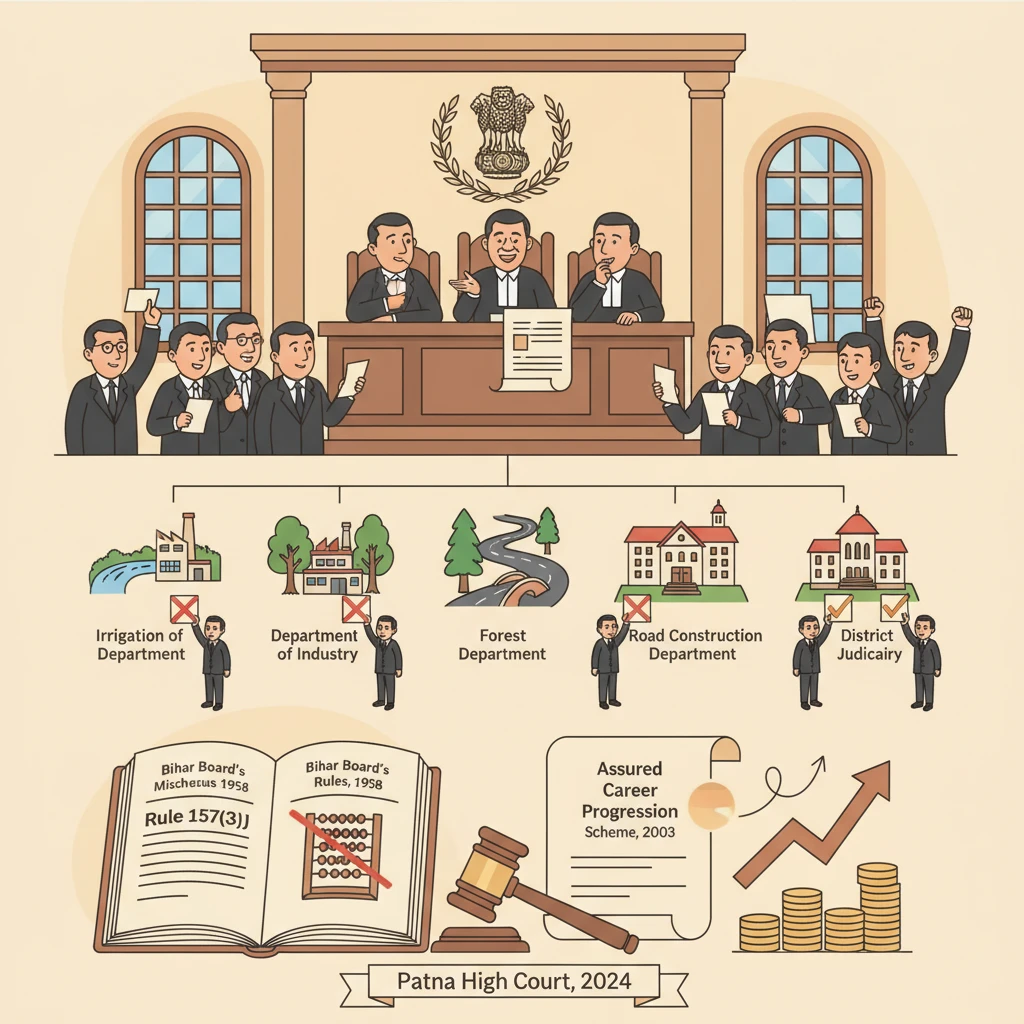
All those cases involved one common dispute: can employees be denied ACP benefits because they did not pass the Departmental Accounts Examination prescribed under Rule 157(3)(J) of the Bihar Board’s Miscellaneous Rules, 1958?
Because of this conflict, the issue was referred to a larger Bench.
The Full Bench, comprising Hon’ble Mr. Justice Ashutosh Kumar, Hon’ble Mr. Justice Nani Tagia and Hon’ble Mr. Justice Partha Sarthy, heard together:
- C.W.J.C. No. 18727 of 2017
- L.P.A. No. 1788 of 2017 (in C.W.J.C. No. 18372 of 2016)
- C.W.J.C. No. 2376 of 2018
- L.P.A. No. 1609 of 2019 (in C.W.J.C. No. 7751 of 2016)
- C.W.J.C. No. 6245 of 2020
The central legal question was framed in three parts by the Single Judge in Kamlanand Thakur’s case, and a similar question was referred in the appeal in Manzar Hassan’s case.
In simple words, the High Court had to decide:
- Does Rule 157(3)(J) (Accounts Examination) control ACP benefits under the 2003 Rules?
- Is that Rule limited only to confirmation, efficiency bar and selection grade, and not to regular or time-bound promotions/ACP?
- How does Rule 4(5) of the ACP Rules, 2003 interact with this requirement?
The Full Bench heard detailed arguments, looked at earlier Patna High Court decisions and finally applied a recent Supreme Court ruling to settle the law.
What the Court Examined and Decided
The Full Bench began by setting out the exact legal provisions.
On one side was Rule 157(3)(J) of the Bihar Board’s Miscellaneous Rules, 1958.
This rule says:
a clerk who has not passed the preliminary Accounts Examination cannot be confirmed or allowed to cross the efficiency bar, and a clerk who has not passed the final Accounts Examination will not be promoted to the selection grade.
It also provides a temporary arrangement for promoting junior clerks who have passed, until seniors pass the exam.
On the other side were the Bihar State Employees Condition of Service (Assured Career Progression Scheme) Rules, 2003 (ACP Rules).
Rule 4 lays down who is eligible for financial progression after 12 and 24 years if they remain in the same pay scale, and Rule 4(5) says that the requirements and mode for ACP shall be “the same” as those for regular promotion under the relevant Recruitment/Service Rules—including departmental examinations—subject to ACP being due after 12/24 years of service.
The Court then traced how earlier Benches had interpreted these rules.
Some Division Benches and a Full Bench had treated the Accounts Examination as essential not only for selection grade and efficiency bar, but also for time-bound promotion and ACP.
Judgments like:
- State of Bihar & Ors. v. Anjani Kumar, 2013 (2) PLJR 643
- State of Bihar & Ors. v. Mahendra Baitha, 2018 (3) PLJR 173
- State of Bihar v. Md. Naisruddin, 2016 (3) PLJR 861
- State of Bihar & Ors. v. Kusheshwar Nath Pandey, 2013 (1) PLJR 939
had leaned towards requiring the exam for time-bound promotions and, in some readings, for ACP as well.
On the other hand, other Benches had taken a softer view.
In cases such as:
- Ramadhar Thakur v. State of Bihar (L.P.A. No. 599 of 2015)
- Uday Shankar Prasad v. State of Bihar, 2017 (3) PLJR 824
- State of Bihar & Ors. v. Sri Ram Subhag Singh, 2022 (2) PLJR 773
- State of Bihar & Ors. v. Smt. Jivachi Devi, 2020 (2) BLJ 471
- Indu Devi v. State of Bihar, 2019 (2) BLJ 330
the Court had indicated that ACP is only financial progression, not an actual promotion, and therefore the Accounts Examination under the 1958 Rules is not an automatic barrier for ACP unless the specific departmental Service Rules make it so.
The Full Bench noted that the Supreme Court had been approached against some of these judgments, including in Uday Shankar Prasad’s case.
The Supreme Court dismissed the State’s appeal in that matter but clearly observed that the issue had wide consequences and stated that the High Court’s decision there was not to be treated as a precedent.
Similarly, in other cases where the High Court required passing the exam for ACP, the Supreme Court dismissed Special Leave Petitions but kept the question of law open.
So, there was no final binding Supreme Court view on this exact ACP–Accounts exam conflict—until 2023.
The turning point came with the Supreme Court’s judgment in Amresh Kumar Singh & Ors. v. State of Bihar & Ors., 2023 (2) PLJR (SC) 423.
The Full Bench treated this Supreme Court ruling as decisive.
In that case, the appellants were Accounts Clerks.
Earlier, there was a combined cadre of Junior and Senior Accounts Clerks, later merged and then de-merged.
They had no promotional avenues after demerger but sought ACP benefits.
The Division Bench of the Patna High Court had denied them ACP on the ground that they were not Graduates, which was a necessary educational qualification under the Bihar Accounts Service Rules, 2000 for promotion.
The Supreme Court examined those Service Rules and the ACP Rules, 2003.
It recognised that ACP is a non-functional, in situ, financial upgradation meant to fight stagnation and frustration in service where employees have no or limited promotional opportunities.
The Supreme Court then held in clear terms that:
fulfilment of the educational qualifications prescribed under the Recruitment Rules for the purposes of promotion are not necessary for non-functional in situ promotion. In other words, educational qualification required for the purposes of promotion is not necessary for the grant of in situ promotion, i.e., only for extending the monetary benefit where there are no promotional avenues and the employees are likely to be stagnated.
The Full Bench of the Patna High Court applied this reasoning to the present reference.
If educational qualifications for promotion are not required for ACP, then, by the same logic, passing the Departmental Accounts Examination (another kind of qualification) cannot be insisted upon for ACP which is only a financial upgradation, not an actual promotion to a higher post.
The Court stressed the difference between:
- actual promotion to a higher post (with changed duties and status), and
- financial upgradation like ACP or selection grade, which is basically a higher pay scale without a change in post.
Earlier, in Maheshwar Prasad Singh’s Full Bench decision, the Court had already explained that selection grade itself was a concept created to give higher pay to employees with no promotional outlet, without change in duties.
With ACP, the object is similar—anti-stagnation through better pay.
Because ACP is only an “in situ promotion” or non-functional monetary benefit, the Full Bench held that it cannot be blocked simply because the Accounts Examination has not been passed, especially where the employee is otherwise eligible by length of service.
The Bench then directly answered the referred questions:
- Rule 157(3)(J) of the 1958 Miscellaneous Rules, which demands passing the Accounts Examination for promotion, does not apply to grant of ACP benefits under the ACP Rules, 2003.
- Rule 157(3)(J) is limited to confirmation, crossing the efficiency bar, and promotion to selection grade; it does not govern regular promotions.
- Even though Rule 4(5) of the ACP Rules says that ACP conditions shall be the same as those for regular promotion, including departmental exams, this cannot defeat the basic nature of ACP as non-functional in situ financial progression after 12/24 years of service. Therefore, ACP must be granted despite non-passing of departmental exams or lacking educational qualifications prescribed only for promotion to higher posts.
Finally, the Full Bench concluded that, in light of this settled position, all the pending cases mentioned in the reference would go back to their respective Benches to be decided in terms of this law.
Why This Judgment Matters
This Full Bench judgment is very important for a large number of Bihar government employees who have remained in the same pay scale for long years and seek ACP benefits.
Many of them had been denied ACP or faced recovery orders only because they had not passed the Departmental Accounts Examination.
The Patna High Court has now made it clear that:
- ACP is a financial benefit for long service without promotion.
- It is not an actual promotion in rank or post.
- The Accounts Examination under Rule 157(3)(J) is not a legal roadblock for getting ACP.
Practically, this means that clerks and similar employees, who have completed 12 or 24 years of regular service but could not pass the Accounts Examination, cannot be refused ACP solely on that ground.
They may still have to meet other basic conditions of regular service, but the exam itself is no longer a bar for ACP.
The judgment also brings clarity where earlier judgments of the Patna High Court had differed from each other.
Lower courts, department officials and employees now have a clear, Supreme Court-aligned answer.
Legal Issues and Answers
-
Issue: Does Rule 157(3)(J) of the Bihar Board’s Miscellaneous Rules, 1958 (Accounts Examination requirement) apply to grant of ACP under the Bihar State Employees Condition of Service (ACP Scheme) Rules, 2003?
Answer: No.
The Full Bench held that Rule 157(3)(J) is not applicable for granting ACP benefits under the 2003 ACP Rules. -
Issue: Is Rule 157(3)(J) confined only to confirmation, crossing efficiency bar and promotion to selection grade, and not to regular promotion?
Answer: Yes.
The Court held that Rule 157(3)(J) operates only for confirmation, crossing the efficiency bar and promotion to selection grade, and not for regular promotions. -
Issue: Does Rule 4(5) of the ACP Rules, 2003 allow denial of ACP if the officer has not passed a departmental examination required for promotion?
Answer: No, not for ACP.
The Court held that although Rule 4(5) generally aligns ACP conditions with those for promotion, ACP is merely in situ financial progression.
Therefore, non-passing of departmental exams or lacking educational qualifications required only for promotion cannot defeat the employee’s right to ACP after 12/24 years of service.
Cases Cited by the Court
- Md. Shamsuddin & Ors. v. State of Bihar & Ors., 1983 PLJR 347
- Maheshwar Prasad Singh v. State of Bihar, 2000 (4) PLJR 262 (Full Bench)
- State of Bihar & Ors. v. Kusheshwar Nath Pandey & Anr., 2013 (1) PLJR 939
- State of Bihar & Ors. v. Anjani Kumar, 2013 (2) PLJR 643
- Avinash Chandra Singh v. State of Bihar & Ors., 2012 (1) PLJR 663
- Uday Shankar Prasad v. State of Bihar & Ors., 2017 (3) PLJR 824
- Ramadhar Thakur v. State of Bihar & Ors., L.P.A. No. 599 of 2015
- State of Bihar & Ors. v. Mahendra Baitha, 2018 (3) PLJR 173
- State of Bihar & Ors. v. Smt. Jivachi Devi, 2020 (2) BLJ 471
- Masomat Indu Devi v. State of Bihar & Ors., 2019 (2) PLJR 241
- Sant Ram Sharma v. State of Rajasthan, AIR 1967 SC 1910
- Lalit Mohan Dev v. Union of India, AIR 1972 SC 995
- Amresh Kumar Singh & Ors. v. State of Bihar & Ors., 2023 (2) PLJR (SC) 423
- Union of India & Ors. v. C.R. Madhava Murthy & Anr., (2022) 6 SCC 183
- Union of India & Anr. v. G. Ranjanna & Ors., (2008) 14 SCC 721
Case Details
Case Numbers (Reference Group)
- Civil Writ Jurisdiction Case No. 18727 of 2017
- Letters Patent Appeal No. 1788 of 2017 in C.W.J.C. No. 18372 of 2016
- Civil Writ Jurisdiction Case No. 2376 of 2018
- Letters Patent Appeal No. 1609 of 2019 in C.W.J.C. No. 7751 of 2016
- Civil Writ Jurisdiction Case No. 6245 of 2020
Case Titles
- C.W.J.C. No. 18727 of 2017: Kamlanand Thakur v. State of Bihar & Ors.
- L.P.A. No. 1788 of 2017 in C.W.J.C. No. 18372 of 2016: The State of Bihar & Ors. v. Jai Prakash Prasad & Anr.
- C.W.J.C. No. 2376 of 2018: Wasi Ahmad Ansari v. State of Bihar & Ors.
- L.P.A. No. 1609 of 2019 in C.W.J.C. No. 7751 of 2016: The State of Bihar & Ors. v. Manzar Hassan
- C.W.J.C. No. 6245 of 2020: Ram Naresh Choudhary v. State of Bihar & Ors.
Coram
- Hon’ble Mr. Justice Ashutosh Kumar
- Hon’ble Mr. Justice Nani Tagia
- Hon’ble Mr. Justice Partha Sarthy
Citation
- 2025 (2) PLJR 623
Advocates
- In C.W.J.C. No. 18727 of 2017:
For the petitioner: Mr. Prashant Sinha, Mr. Kunal Kumar, Mr. Rishi Raj Raman
For the respondents (State): Mr. Anjani Kumar, AAG-4; Mr. Alok Kr. Rahi, AC to AAG-4; Mr. Shailendra Kr. Singh, AC to AAG-4; Mr. Amit Kr. Jha, AC to AAG-4 - In L.P.A. No. 1788 of 2017:
For the appellants (State): Mr. Abbas Haider, SC-6; Mr. Wasi Mohammad, AC to SC-6
For the respondents: Mr. Rajesh Dayal - In C.W.J.C. No. 2376 of 2018:
For the petitioner: Mr. Sanjay Prakash Verma
For the State of Bihar: Mr. A.N. Sinha, GP-21
For the State of Jharkhand: Mr. Sanjay Kr. Pandey - In L.P.A. No. 1609 of 2019:
For the appellants (State): Mr. Ajay, GA-5; Mr. Pratik Kumar Sinha, AC to GA-5
For the respondent: Mr. Amit Shrivastava, Sr. Adv.; Mr. Prabhat Ranjan Singh; Mr. Girish Pandey - In C.W.J.C. No. 6245 of 2020:
For the petitioner: Mr. Sunil Kumar Singh
For the State of Bihar: Mr. Sanjay Kumar Ghosarvey, AC to AAG-3
For the High Court: Mr. Satyabir Bharti; Mr. Kanupriya; Mr. Abhishek Anand
Nature of the Proceedings
- Civil writ jurisdiction cases seeking service and ACP-related reliefs.
- Letters Patent Appeals arising out of writ petitions involving ACP and service benefits.
- Reference to Full Bench on questions of law concerning ACP and Departmental Accounts Examination.
Date of Full Bench Judgment
- 28-06-2024
Link to the Judgment
If you found this explanation helpful and wish to stay informed about
how legal developments may affect your rights in Bihar,
you may consider following Samvida Law Associates for more updates.







