
Case Background
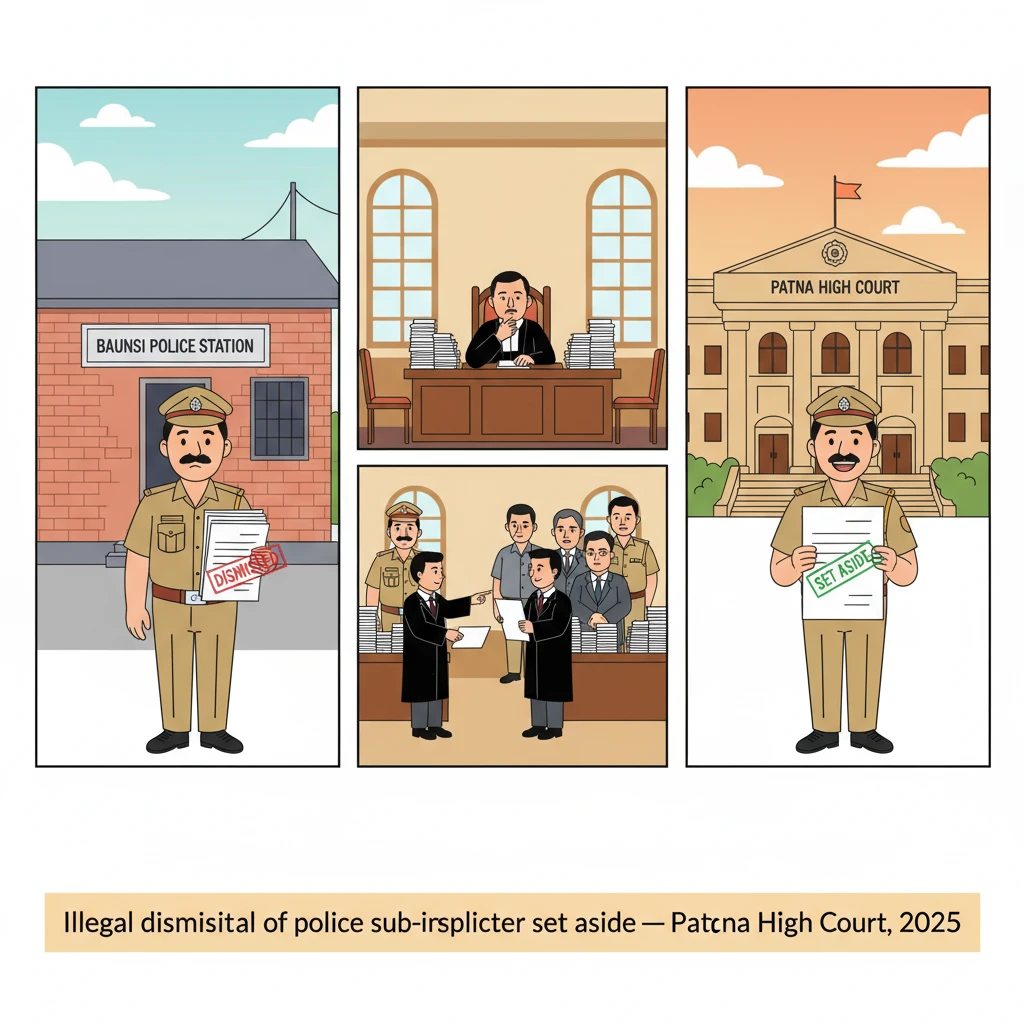
The petitioner was appointed as a Sub-Inspector of Police in Bihar in 2009. At the relevant time, he was posted as Station House Officer (S.H.O.) at Baunsi Police Station.
According to the record, one person, Mukesh Mukhiya, was brought to the police station in a drunken condition. It was alleged that the petitioner released him after taking a bribe of Rs. 8,000 through a chaukidar named Raj Kumar.
On the same date, another person, Asfaque, was allegedly arrested with five bottles of Corex cough syrup on his motorcycle. An FIR was registered on the basis of a written complaint lodged by the petitioner himself.
Assistant Sub-Inspector (ASI) Surendra Paswan was appointed as the investigating officer in that case. The judgment records that he initially refused to accept the case for investigation. This led to a hot exchange of abusive language between him and the petitioner.
ASI Surendra Paswan then filed a written complaint to the Superintendent of Police (SP), Araria. He named witnesses who had allegedly seen the events. It was further alleged that the petitioner took a bribe of Rs. 15,000 from the family members of accused Asfaque and then released the seized motorcycle illegally.
On receiving the complaint, the SP, Araria, issued Memo No. 19481 dated 01.07.2019 directing the Sergeant Major to conduct an enquiry and submit a report. The Sergeant Major submitted his first report on 05.07.2019.
The SP was not satisfied. He issued Memo No. 20234 dated 07.07.2019 calling for a fresh enquiry focused on certain points. A second enquiry report was submitted on 12.07.2019, but again the SP remained dissatisfied.
The SP ordered another enquiry, leading to a third report on 19.07.2019. This also did not satisfy him, so he issued Memo No. 30470 dated 20.07.2019 seeking yet another report. A fourth report was submitted on 26.07.2019. Even then, the SP directed one more enquiry, and finally a fifth report was submitted on 07.08.2019.
After these repeated preliminary enquiries, the SP sought an explanation from the petitioner. The petitioner submitted his defence, but the SP found it unsatisfactory.
The SP then framed a Memo of Charge in Prapatra ‘d’ through Memo No. 3038 dated 11.10.2019 and Memo No. 3788 dated 07.12.2019, directing the petitioner to respond. Subsequently, a fresh Memo of Charge, Memo No. 3922 dated 18.12.2019, was issued, formally registering Departmental Proceeding No. 30/2019 against the petitioner.
The Sub-Divisional Police Officer, Forbesganj, was appointed as Conducting Officer, and one Gopal Jee Singh was appointed as Presenting Officer. The petitioner filed his written defence against all articles of charge.
After completion of the enquiry, the Conducting Officer submitted an enquiry report holding the petitioner guilty of the charges. Based on this report, the SP, Araria, issued a second show-cause notice vide Memo No. 2120 dated 04.08.2020. The petitioner again filed his explanation.
The SP, still not satisfied, sent a recommendation to the Inspector General of Police (IGP), Purnea Range, through Memo No. 2267 dated 18.08.2020, suggesting dismissal/removal/compulsory retirement of the petitioner. The petitioner was also asked to submit his explanation before the IGP, which he did.
Finally, by Memo No. 1108 dated 08.12.2020, the IGP, Purnea Range, passed an order dismissing the petitioner from service. The petitioner’s departmental appeal before the Additional Director General of Police (Law & Order), Patna, was rejected by letter no. 106 dated 02.03.2021. His Memorial appeal to the Home Secretary (Police), Home Department, Bihar, was also rejected by Memo No. 6101 dated 23.06.2022.
What the Court Examined and Decided
The writ petition before the Patna High Court challenged three things: the dismissal order dated 08.12.2020 (Memo No. 1108), the appellate order dated 02.03.2021 (letter no. 106), and the rejection of the Memorial appeal dated 23.06.2022 (Memo No. 6101).
The petitioner’s counsel argued primarily that, as a Sub-Inspector of Police, his Disciplinary Authority under the Bihar Police Manual and the Bihar Government Servants (Classification, Control & Appeal) Rules, 2005 (CCA Rules, 2005) was the Deputy Inspector General/Inspector General of Police, not the Superintendent of Police.
By referring to Rule 16(1)(a) of the CCA Rules, 2005, it was submitted that only the appointing authority or the Disciplinary Authority could initiate disciplinary proceedings and frame charges. In this case, the SP, Araria, not only sought explanation and framed the Memo of Charge but also recommended dismissal, which, according to the petitioner, was without jurisdiction.
Counsel further argued that multiple preliminary enquiries ordered until the SP’s “satisfaction” and repeated charge-memos showed mala fide conduct. It was claimed that three separate charge-memos were issued for the same proceedings, with vague charges, and that Rule 17 of the CCA Rules, 2005, as well as the Bihar Chargesheet Rule, 2017, had been violated.
The petitioner alleged that the charges did not properly explain the allegations and instead only reproduced preliminary enquiry reports, fact-finding reports, statements of witnesses and internal orders of the SP. It was also alleged that key eye-witnesses to the alleged seizure and release of the motorcycle were never made witnesses in the departmental enquiry, despite instructions from Police Headquarters.
The petitioner’s counsel also attacked the dismissal order as cryptic and mechanical, stating that it was passed without real reasons and without proper consideration of his explanations. Similar criticism was made of the appellate and Memorial orders, which allegedly failed to address the procedural and legal defects.
On the other hand, the State’s Additional Advocate General defended the process. He stated that fresh preliminary enquiries were ordered only because the first one had not been conducted properly. The allegations in the complaint, according to him, were substantiated in preliminary enquiry, justifying the issue of a Memo of Charge.
He submitted that the second Memo of Charge was issued because the first one did not mention any Conducting Officer or Presenting Officer. He argued that this defect did not vitiate the entire proceeding. He also emphasized that the charge-memo contained lists of documents and witnesses, that witnesses were examined in the enquiry, and that they supported the charges.
The State argued that the Conducting Officer had considered the petitioner’s defence, found the charges proved, and then a proper second show-cause notice was issued. The SP’s recommendation was claimed to be based on a thorough enquiry, and the IGP, as Disciplinary Authority, independently considered the matter before imposing dismissal. It was also submitted that the scope of judicial review over departmental enquiries is limited and does not permit re-appreciation of evidence.
The Court first expressed strong disapproval of the way repeated preliminary enquiries were ordered and three different Memos of Charge were issued for the same departmental proceeding. The Court recalled settled Supreme Court law that a preliminary enquiry is only to decide whether a regular disciplinary proceeding is needed and that evidence recorded in a preliminary enquiry, where the delinquent officer is not associated or allowed to cross-examine, cannot be used as evidence in the regular enquiry.
The Court referred to the Constitution Bench decision in Amalendu Ghosh v. North Eastern Railway, AIR 1960 SC 992, which held that preliminary enquiries are only for prima facie satisfaction and cannot lead directly to punishment. It also referred to Champaklal Chimanlal Shah v. Union of India, AIR 1964 SC 1854, emphasizing that preliminary enquiries are only for the Government’s satisfaction and are not subject to Article 311(2) safeguards.
The Court further cited Narayan Dattatraya Ramteerthakhar v. State of Maharashtra, (1997) 1 SCC 299, to restate that once a regular enquiry begins after a charge-sheet, the preliminary enquiry loses importance and its procedural defects become irrelevant. However, in the present case, the Court noted that the charge-memo and enquiry report themselves were filled with references to the preliminary enquiry reports and directions of the SP, and that the preliminary enquiry material appeared to have been woven into the regular enquiry in a way that affected fairness.
The Court held that using preliminary enquiry evidence in this manner, without the delinquent’s participation and without cross-examination, violated principles of natural justice and fair play.
Next, the Court turned to the crucial issue of jurisdiction to initiate and conduct the disciplinary proceedings. It relied on its earlier judgment in Uday Pratap Singh v. State of Bihar & Ors., 2017 (4) PLJR 195. In that case, after examining Rules 2(f), 2(j), and 16 of the CCA Rules, 2005, the Court had held that only the appointing authority, an authority authorized by it, or an authority authorized by a special or general order could initiate disciplinary proceedings against a Government servant.
For a Sub-Inspector of Police, the appointing and disciplinary authority is the Inspector General of Police or Deputy Inspector General of Police. The Court quoted paragraph 31 of Uday Pratap Singh, which had held that initiation of disciplinary proceedings by the Senior Superintendent of Police, without any authorisation from the competent authority, was without jurisdiction.
The Court also referred to the Supreme Court judgment in Secretary, Ministry of Defence v. Prabhash Chandra Mirdha, AIR 2012 SC 2250, to reinforce the principle that only a competent authority can initiate disciplinary proceedings.
In the present case, the Court noted that the petitioner had specifically pleaded that the SP had no jurisdiction to issue the charge-memo or to initiate the proceeding. The State, in its counter affidavit, had not shown any authorization empowering the SP to do so. No order or notification authorising the SP was placed on record. Thus, following Uday Pratap Singh and Dharmendra Kumar v. State of Bihar & Ors. (C.W.J.C. No. 470 of 2018), the Court held that initiation of the departmental proceeding by the SP through the charge-memo was wholly illegal.
The Court then examined Rule 17 of the CCA Rules, 2005, which lays down the procedure for imposing major penalties. Rule 17(3) requires that the Disciplinary Authority draw up the articles of charge or cause them to be drawn, including clear statements of imputed misconduct, list of documents, and list of witnesses.
Rule 17(4) mandates that the charge-memo must be delivered by the Disciplinary Authority or an officer duly authorized and that the Disciplinary Authority must apply its mind to the explanation and decide whether to proceed with an enquiry or to drop the matter. The Court referred to Shankar Dayal v. State of Bihar & Ors. (C.W.J.C. No. 7207 of 2016), where it had held that this obligation of the Disciplinary Authority is non-delegable.
The Court found that in this case Rule 17(4) had been completely ignored. The SP had taken upon himself the role of seeking explanation, evaluating the enquiry report, and then recommending punishment, while the IGP’s final order appeared to be based largely on the SP’s recommendation, without independent reasoning.
On examining the enquiry report, the Court observed that while witnesses were formally examined, the report mainly repeated the preliminary enquiry material and the SP’s directions. The report ran to eighteen pages, but the actual opinion of the Enquiry Officer consisted of only two lines, stating that the charges stood proved. There was no discussion of why the petitioner’s defence was rejected.
The Court held that such an enquiry report failed to show proper consideration of the defence, and was legally unsatisfactory.
The Court further held that the SP committed a serious error by asking for the petitioner’s explanation after the enquiry report and then recommending the “harsh punishment” of dismissal. The Disciplinary Authority (IGP), in turn, committed “serious illegality” by imposing dismissal solely based on the SP’s recommendation, revealing “total non-application of independent mind.”
The Court highlighted the importance of giving reasons in administrative and quasi-judicial orders, relying on Kranti Associates (P) Ltd. v. Masood Ahmed Khan, (2010) 9 SCC 496. The Supreme Court there held that recording reasons restrains arbitrary exercise of power and facilitates judicial review.
The Court also referred to the Division Bench judgment in Kems Services Private Limited v. State of Bihar, 2014 (1) PLJR 622, which explained that natural justice is not fulfilled by a mere show-cause notice and reply. The final order must show that the authority applied its mind to the defence and recorded reasons why it was not acceptable.
Applying these principles, the Court held that the entire disciplinary proceeding was illegal and dehors the statutory procedure. It therefore quashed the Memo of Charge, the dismissal order dated 08.12.2020, the appellate order dated 02.03.2021, and the Memorial order dated 23.06.2022.
The Court then considered whether the petitioner should receive back wages. Referring to Deepali Gundu Surwase v. Kranti Junior Adhyapak Mahavidyalaya, (2013) 10 SCC 324, the Court noted that reinstatement with continuity of service and back wages is the normal rule in cases of wrongful termination, subject to factors like length of service, nature of misconduct, and financial condition of the employer.
Here, the Court found that the respondents had completely failed to justify their action and had acted in gross violation of statutory provisions and/or principles of natural justice. It therefore directed the respondents to pay back wages to the petitioner along with all consequential benefits.
The writ petition was allowed accordingly.
Why This Judgment Matters
This judgment is important for police personnel and other government employees in Bihar who face departmental proceedings.
First, it makes clear that only the lawful Disciplinary Authority or an authorized person can start and control a departmental case. If a lower-rank officer, like a Superintendent of Police in this case, initiates such a proceeding without authorization, the entire action can be struck down.
Second, the Patna High Court warns against misusing preliminary enquiry reports. Those are only for a first look, not for direct use as evidence in regular disciplinary enquiries. If they are treated as evidence without giving the accused officer a chance to participate and cross-examine, it violates natural justice.
Third, the judgment stresses that enquiry reports and punishment orders must give proper reasons. Authorities cannot simply say that the explanation is “not satisfactory” without explaining why. This protection helps ensure fairness and prevents arbitrary decisions.
Finally, the Court has directed payment of full back wages and consequential benefits after quashing the dismissal. This underlines that when the State seriously violates legal procedure, the affected employee can be restored financially, not just reinstated on paper.
Legal Issues and Answers
-
Issue: Could the Superintendent of Police, Araria, lawfully initiate and conduct disciplinary proceedings, including issuing the charge-memo, against a Sub-Inspector of Police?
Answer: No. The Court held that for a Sub-Inspector, the appointing and disciplinary authority is the Inspector General/Deputy Inspector General of Police, and there was no proof that the SP was authorized. The initiation by the SP was therefore without jurisdiction. -
Issue: Was the departmental enquiry conducted in accordance with Rule 17 of the CCA Rules, 2005 and principles of natural justice?
Answer: No. The Court found that Rule 17(4) was ignored, preliminary enquiry material was improperly used in the regular enquiry, the Enquiry Officer failed to give reasoned findings, and the Disciplinary Authority acted mechanically on the SP’s recommendation. -
Issue: After holding the dismissal illegal, was the petitioner entitled to back wages and consequential benefits?
Answer: Yes. Considering the serious procedural violations and absence of justification from the State, the Court directed reinstatement with back wages and all consequential benefits.
Cases Cited by the Court
- Amalendu Ghosh v. North Eastern Railway, AIR 1960 SC 992
- Champaklal Chimanlal Shah v. Union of India, AIR 1964 SC 1854
- Narayan Dattatraya Ramteerthakhar v. State of Maharashtra, (1997) 1 SCC 299
- Secretary, Ministry of Defence v. Prabhash Chandra Mirdha, AIR 2012 SC 2250
- Kranti Associates (P) Ltd. v. Masood Ahmed Khan, (2010) 9 SCC 496
- Deepali Gundu Surwase v. Kranti Junior Adhyapak Mahavidyalaya and Others, (2013) 10 SCC 324
- Uday Pratap Singh v. State of Bihar & Ors, 2017 (4) PLJR 195
- Kems Services Private Limited v. State of Bihar, 2014 (1) PLJR 622
- Dharmendra Kumar v. State of Bihar & Ors, C.W.J.C. No. 470 of 2018
- Shankar Dayal v. State of Bihar & Ors, C.W.J.C. No. 7207 of 2016
- Sanjay Kumar Singh v. State of Bihar & Ors, C.W.J.C. No. 6530 of 2017
Case Details
Case Number: Civil Writ Jurisdiction Case No. 13380 of 2022
Case Title: Satyendra Kumar Gupta v. The State of Bihar & Ors.
Citation: 2025 (2) PLJR 537
Coram: Hon’ble Mr. Justice Harish Kumar
Date of Judgment: 18.03.2025
Advocates:
For the Petitioner: Mr. Vinay Ranjan, Advocate; Mr. Abhishek Teerthankar, Advocate; Mr. Ankit Kumar, Advocate
For the Respondents (State): Mr. P. K. Verma, AAG-3 (Senior Advocate-cum-Additional Advocate General No. 3)
Nature of the Case: Writ petition under civil writ jurisdiction challenging departmental dismissal from service, appellate order, and rejection of Memorial appeal.
Link to the Judgment: Patna High Court Judgment – CWJC No. 13380 of 2022
If you found this explanation helpful and wish to stay informed about how legal developments may affect your rights in Bihar, you may consider following Samvida Law Associates for more updates.







