
Case Background
The appellant was appointed as a Lecturer at the National Institute of Technology (NIT) Patna on 07.03.2006. He was also pursuing a Ph.D. in Electrical Engineering as a part-time candidate, bearing roll no. 135EE05.
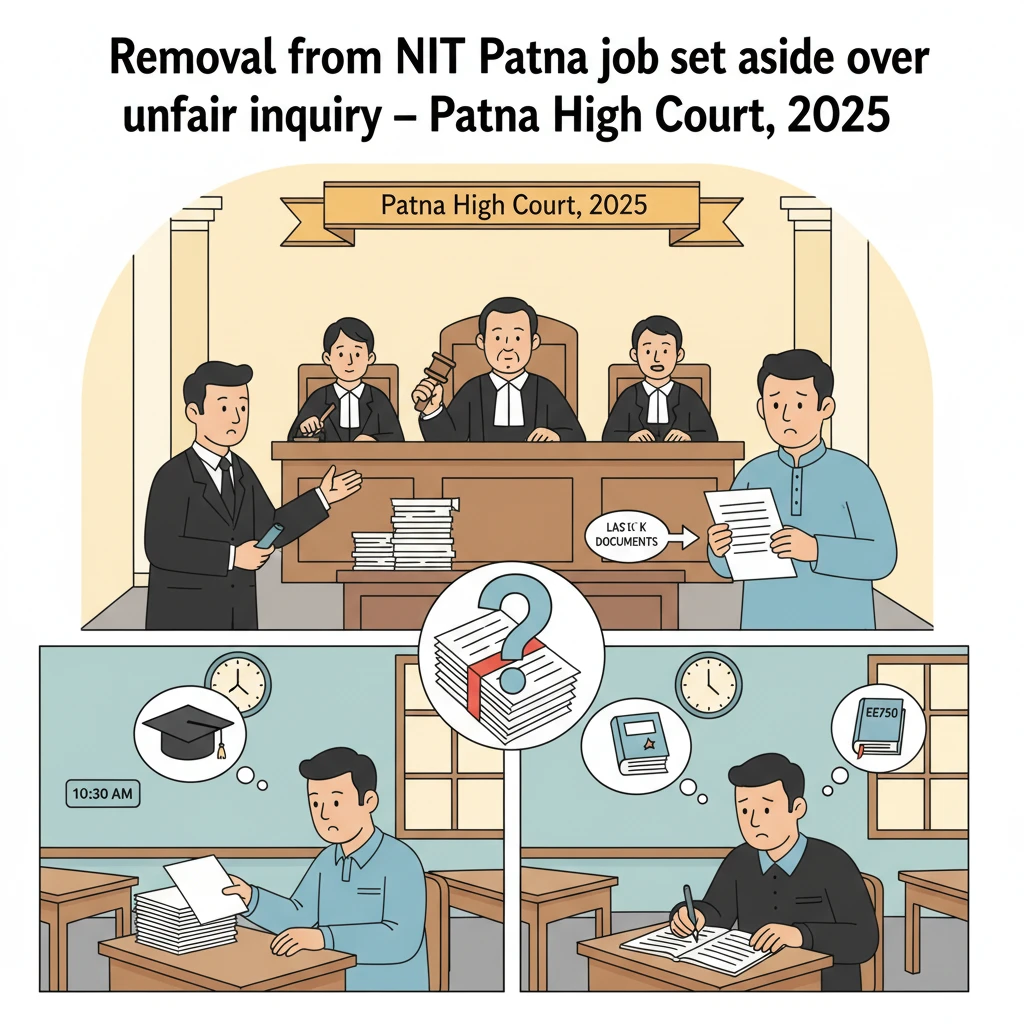
On 13.03.2014, during mid-semester examinations, he was deployed as an invigilator in one room in the forenoon session and, in the afternoon, appeared as an examinee for a Ph.D. course work paper (EE750 – Power System Protection). Allegations later arose that he had taken away a blank answer book in the forenoon and then used it, pre-written, in the afternoon exam.
Because of this incident, he was debarred from his Ph.D. course. That debarment became the subject of Civil Writ Jurisdiction Case No. 19403 of 2016, in which he had already suffered an adverse order.
Separately, NIT Patna started a departmental inquiry against him in his capacity as a faculty member. A charge memo dated 21.09.2015 framed two articles of charge. Article I accused him of taking away one blank answer book from the mid-semester examination 2014 while on invigilation duty on 13.03.2014. Article II accused him of using that same answer book, with pre-written answers, in the afternoon session of his own Ph.D. course work paper on 13.03.2014, allegedly to cheat and gain wrongful advantage.
The appellant repeatedly asked for the documents listed as Annexure-III to the charge memo, which contained 12 documents that the disciplinary authority proposed to rely on. Despite these requests, the documents were not supplied before or during the inquiry.
He filed his objections to the charge memo on 01.10.2015 without getting those documents. The Inquiring Officer concluded the inquiry in one sitting on 11.10.2015, from 10:30 A.M. to 1:30 P.M., after considering 12 documents and recording statements of four witnesses. The inquiry report holding the charges proved was submitted to the disciplinary authority on 10.02.2016.
The disciplinary authority then issued a second show-cause notice with a copy of the inquiry report on 28.11.2016. Again, on 26.04.2017, the appellant demanded certain documents, but they were still not supplied. The disciplinary authority obtained advice from the Central Vigilance Commission (CVC), and on 05.08.2019, the CVC advised that it was a case for imposition of a major penalty. The advice was not given to the appellant.
On 15.10.2019, the disciplinary authority passed an order of removal from service, which was approved by the Board of Governors. The appellant challenged that order in C.W.J.C. No. 119 of 2020. The learned Single Judge dismissed his writ petition on 07.02.2022, upholding the removal.
The appellant then filed Letters Patent Appeal No. 117 of 2022 against the single-judge judgment, leading to the present decision by a Division Bench of the Patna High Court.
What the Court Examined and Decided
The Division Bench heard detailed arguments from both sides. The appellant’s counsel argued that the inquiry and removal order were vitiated because of violation of principles of natural justice and statutory rules, and because of bias in the appointment and functioning of the Inquiring Officer.
On the documents issue, the appellant had asked for the documents listed in Annexure-III to the charge memo dated 21.09.2015 on several dates: 28.09.2015, 07.10.2015, 26.04.2017 and again on 28.08.2019. These 12 documents were the very materials the disciplinary authority wanted to use to prove the charges. Despite these repeated written demands, there was no response from the disciplinary authority and no order either granting or refusing them.
Because the documents were not supplied, the appellant had to file his objection to the charge memo and face the inquiry effectively “in the dark”, without the materials being used against him. Yet the Inquiring Officer relied on those very documents (numbers 1 to 12) and on four witnesses’ statements, and concluded the inquiry in a single sitting on 11.10.2015.
The Court compared this factual position with what the learned Single Judge had recorded. In para 23 of the single-judge order, it was stated that the petitioner was given a list of documents proposed to be used (including answer-book, invigilators’ reports, and findings of the Unfair Means Committee), and that the petitioner actually wanted those documents and the invigilators’ duty chart. However, the Division Bench found that there was no clear material to show on what date or which specific documents (among document numbers 1 to 12) were actually given to the appellant.
In other words, the record did not support a finding that the relied-on documents had in fact been supplied, despite repeated requests. The Court treated this as a serious lapse.
The Court then examined the applicable law on judicial review in departmental inquiries. It referred to several Supreme Court decisions, including:
State of Karnataka & Anr. vs. Umesh, (2022) 6 SCC 563, which lays down that in judicial review the court does not act as an appellate authority over findings of misconduct but only checks, among other things, whether rules of natural justice have been complied with and whether statutory rules have been observed.
Union of India and Others vs. P. Gunasekaran, (2015) 2 SCC 610, which lists what the High Court can and cannot do in writ jurisdiction in disciplinary matters, emphasizing that reappreciation of evidence is not permitted, but violations of natural justice and procedure can be examined.
Kumaon Mandal Vikas Nigam Ltd. vs. Girja Shankar, discussing the necessity of a fair inquiry process, with proper production of records, list of witnesses, and adherence to basic fairness.
UOI and Others vs. Gyanchand Chattar, (2009) 12 SCC 78, which summarises that charges should be specific and definite, and that enquiries must strictly comply with statutory provisions and natural justice.
The Division Bench also referred to Central Organisation for Railway Electrification v. M/s ECI SPIC SMO MCML (JV), (2024) SCC Online SC 3219, particularly paras 76 to 78, where the Supreme Court elaborated principles of natural justice.
Against this legal background, the Bench highlighted Rule 14(4) of the Central Civil Services (Classification, Control and Appeal) Rules, 1965 (CCS (CCA) Rules). This rule requires the disciplinary authority to deliver to the government servant a copy of the articles of charge, statement of imputations, and a list of documents and witnesses by which each charge is to be sustained.
The Court noted that this provision effectively mandates not just listing such documents but making them available so the delinquent employee can defend himself. In this case, although Annexure-III (list of documents) accompanied the charge memo, the actual documents were never supplied despite clear and repeated demands. The disciplinary authority also did not pass any reasoned order either accepting or rejecting those requests.
The Bench held that this was a direct violation of Rule 14(4) of the CCS (CCA) Rules and of the principles of natural justice. Without access to the documents being used to prove the charges, the appellant could not effectively defend himself.
The Court then addressed the allegation of bias. The Inquiring Officer was Dr. Rajiv Sinha, a Board of Governors (BOG) member of NIT Patna. As a BOG member, he was in a higher position than the disciplinary authority. The appellant alleged that Dr. Sinha, after acting as Inquiring Officer and giving findings against him, also participated in the Board’s decision approving the removal order dated 15.10.2019.
The respondents disputed that he had participated, but they did not place any clear material before the Court to show that he had recused himself when the Board considered the removal order. The Court therefore drew the inference that he had participated in approving the penalty.
The Bench found this unacceptable. It observed that, in all fairness, an Inquiring Officer who has already given findings in a disciplinary proceeding should not be part of the decision-making body that approves or confirms the penalty based on his own report. His proper role is to conduct an impartial inquiry and submit findings; the disciplinary authority and competent bodies then decide on exoneration or penalty. His participation at the penalty stage undermines the fairness and impartiality of the process.
The Bench further noted that the learned Single Judge had not properly examined these legal issues — non-supply of documents, violation of Rule 14(4), and conflict of role/bias of the Inquiring Officer — which constituted errors apparent on the face of the record.
Another important point was that the disciplinary authority and, to some extent, the defence of the respondents seemed to rely on the fact that the appellant had already been debarred from his Ph.D. course and that this debarment had been affirmed in C.W.J.C. No. 19403 of 2016. The Court held that this factor was extraneous to the present departmental proceedings on two specific charges related to the 13.03.2014 incident.
The Court observed that the penalty decision should have been based only on the material relevant to these two charges. The debarment from Ph.D. and its affirmation in a separate writ could not legally colour the mind of the disciplinary authority. The Court considered this as indicating bias against the appellant in imposing the extreme penalty of removal.
In the result, the Division Bench set aside both the removal order dated 15.10.2019 (Annexure-14 to C.W.J.C. No. 119 of 2020) and the single-judge judgment dated 07.02.2022 in C.W.J.C. No. 119 of 2020.
The Court directed the Disciplinary/ Appointing Authority to reinstate the appellant in service and to extend all service and monetary benefits from time to time, on par with his immediate junior. Reinstatement was to be done within one month, and all other consequential benefits to be worked out within six months.
At that stage, counsel for the respondents requested that the matter be remanded so that the disciplinary proceedings could continue from the defective stage. The Bench accepted that submission, relying on the Supreme Court’s decisions in Managing Director, ECIL, Hyderabad vs. B. Karunakar, (1993) 4 SCC 727, read with Chairman-cum-Managing Director, Coal India Ltd. & Ors. v. Ananta Saha & Ors., (2011) 5 SCC 142.
The Court therefore ordered that the disciplinary authority may commence the inquiry afresh from the defective stage, but only after supplying all documents mentioned in Annexure-III to the charge memo dated 21.09.2015. The appellant must then file a fresh reply to the charge memo, and the authority must thereafter conduct and conclude the inquiry strictly in accordance with the CCS (CCA) Rules, 1965, within six months from receipt of the Court’s order.
The Court clearly warned that if the inquiry is not completed within six months from the date of the order, the disciplinary proceedings will be deemed to have terminated automatically. The appellant was also requested to cooperate in the inquiry.
Why This Judgment Matters
This judgment is important for employees of public institutions, including those like NIT Patna, because it shows that even if serious allegations are made, an employee cannot be removed without a fair, rule-based inquiry.
The Patna High Court made it clear that:
When an employee asks for copies of documents that the employer wants to rely on, the employer cannot ignore those requests. If those documents are not supplied, the entire inquiry can be set aside as unfair.
The person who conducts the inquiry should not later sit in judgment on the penalty. Mixing those roles can show bias and destroy the fairness of the process.
Past disputes, such as earlier punishments in academic matters, cannot be used as hidden reasons to justify a new penalty if they are not part of the formal charge and show-cause process.
For employees, this decision provides a roadmap on what kinds of procedural violations can be challenged. For institutions, it is a warning that disciplinary power must be exercised carefully, with full respect to the CCS (CCA) Rules and principles of natural justice.
Legal Issues and Answers
- Issue: Was the departmental inquiry and removal from service vitiated due to non-supply of relied-upon documents and violation of Rule 14(4) of the CCS (CCA) Rules, 1965?
Answer: Yes. The Court held that repeated non-supply of documents listed in Annexure-III, despite demands, violated Rule 14(4) and principles of natural justice, vitiating the proceedings and the removal order. - Issue: Did the appointment and conduct of the Inquiring Officer, who was also a BOG member, give rise to bias by his participation in the approval of the removal order?
Answer: Yes. The Court inferred that the Inquiring Officer participated in approving the penalty and held that this dual role was unfair and contrary to the requirement of an impartial inquiry, further vitiating the proceedings. - Issue: Should the entire matter end with reinstatement, or can the disciplinary authority restart the inquiry?
Answer: The Court ordered reinstatement with full benefits but, following Supreme Court precedents, remanded the matter to allow the disciplinary authority to restart the inquiry from the defective stage, subject to strict compliance with CCS (CCA) Rules and completion within six months.
Cases Cited by the Court
- State of Karnataka & Anr. vs. Umesh, (2022) 6 SCC 563.
- Union of India and Others vs. P. Gunasekaran, (2015) 2 SCC 610.
- Kumaon Mandal Vikas Nigam Ltd. vs. Girja Shankar.
- UOI and others vs. Gyanchand Chattar, (2009) 12 SCC 78.
- Central Organisation for Railway Electrification v. M/s ECI SPIC SMO MCML (JV), (2024) SCC Online SC 3219.
- Managing Director, ECIL, Hyderabad vs. B. Karunakar, (1993) 4 SCC 727.
- Chairman-cum-Managing Director, Coal India Ltd. & Ors. v. Ananta Saha & Ors., (2011) 5 SCC 142.
Case Details
Case Number: Letters Patent Appeal No. 117 of 2022 in Civil Writ Jurisdiction Case No. 119 of 2020
Case Title: Alok Ranjan vs. The National Institute of Technology Patna & Ors.
Court: High Court of Judicature at Patna
Coram: Hon’ble Mr. Justice P. B. Bajanthri and Hon’ble Mr. Justice S. B. Pd. Singh
Date of Judgment: 01.05.2025
Citation: 2025(3) PLJR 134
Advocates:
For the Appellant: Mr. Shekhar Singh, Sr. Adv.; Mr. Sumit Kumar, Adv.; Mr. Satyendra Rai, Adv.
For the Respondents: Mr. Y.V. Giri, Sr. Adv.; Mr. Sanjay Kumar Giri, Adv.; Mr. Mritunjay Harsh, Adv.
Nature of the Case: Letters Patent Appeal (intra-court appeal) against dismissal of writ petition challenging departmental removal order.
Link to Judgment: https://patnahighcourt.gov.in/viewjudgment/MyMxMTcjMjAyMiMxI04=-s4EeIT9NU48=
If you found this explanation helpful and wish to stay informed about how legal developments may affect your rights in Bihar, you may consider following Samvida Law Associates for more updates.







