
Case Background
The dispute arose from a government process to grant Public Distribution System (PDS) licences in Purnea district under the Bihar Targeted Public Distribution System (Control) Order, 2016.
A notice dated 19.05.2017 was published in the Hindi daily “Dainik Jagran” based on Letter No. 1222 dated 08.03.2017. Applications were invited for PDS licences in various sub-divisions of Purnea.
The petitioner, a resident of Village Bhanghatula, applied for a PDS licence for Latraha Panchayat, Barhara Kothi Block, under the General (Female) category. Respondent No. 7, also a resident of the same village, applied for the same licence and category.
A comparative chart was prepared in the office of the Sub-Divisional Officer (SDO), Dhamdaha, listing five applicants for this PDS licence. A provisional merit list dated 29.09.2018 was later prepared for the licence in question.
The petitioner raised objections before the District Magistrate, Purnea, on 28.07.2018 and again on 23.10.2018, and also before the Commissioner, Purnea Division, on 24.10.2018. Despite this, a final merit list was issued on 29.09.2018, in which Respondent No. 7 was shown as selected for the PDS licence for Latraha Panchayat.
Aggrieved, the petitioner approached the Patna High Court in CWJC No. 22529 of 2018. That writ was disposed of on 27.11.2018 with a direction to the petitioner to file a representation before the Commissioner, Purnea Division, within four weeks. The Commissioner was directed to decide it within eight weeks.
Following this direction, the Commissioner, Purnea Division, passed an order on 18.06.2019 in Misc. Supply Case No. 107 of 2018 in favour of the petitioner, setting aside the selection of Respondent No. 7.
Respondent No. 7 then filed an appeal before the Secretary, Food & Consumer Protection Department, Patna. By order dated 25.11.2019, contained in Memo No. 5547, the Secretary set aside the Commissioner’s order and directed that PDS licence be granted to Respondent No. 7.
The present writ petition (CWJC No. 3870 of 2020) was filed by the petitioner to challenge the Secretary’s order dated 25.11.2019 and to seek a direction to grant the PDS licence to her in accordance with the provisional merit list.
What the Court Examined and Decided
The Patna High Court, through Hon’ble Justice Smt. G. Anupama Chakravarthy, examined the background facts, the orders passed by the Commissioner and the Secretary, and the objections raised by the petitioner regarding eligibility and fairness in selection.
The core of the petitioner’s case was that Respondent No. 7 was not eligible because a close relative was already running a PDS shop in the same ward. She also claimed that other candidates were disqualified on grounds such as lack of computer knowledge or having relatives who were already PACS Presidents and PDS dealers, and therefore she should have been chosen as the most suitable candidate.
The petitioner relied on Clause 11(i) of the Bihar Targeted PDS (Control) Order, 2016, which defines family members for disqualification where more than one person in a joint family cannot be granted a PDS licence. She argued that the “cousin father-in-law” of Respondent No. 7, who already held a PDS licence in the same panchayat, should be treated as part of the same joint family, thereby disqualifying Respondent No. 7.
In support of this broader understanding of “joint family”, the petitioner cited Supreme Court judgments such as Surjit Lal Chhabda v. CIT (1976 AIR 109), Rukhmabai v. Lal Laxminarayan (1960 AIR 335), and Rajagopal v. Padmini (1996 AIR 238).
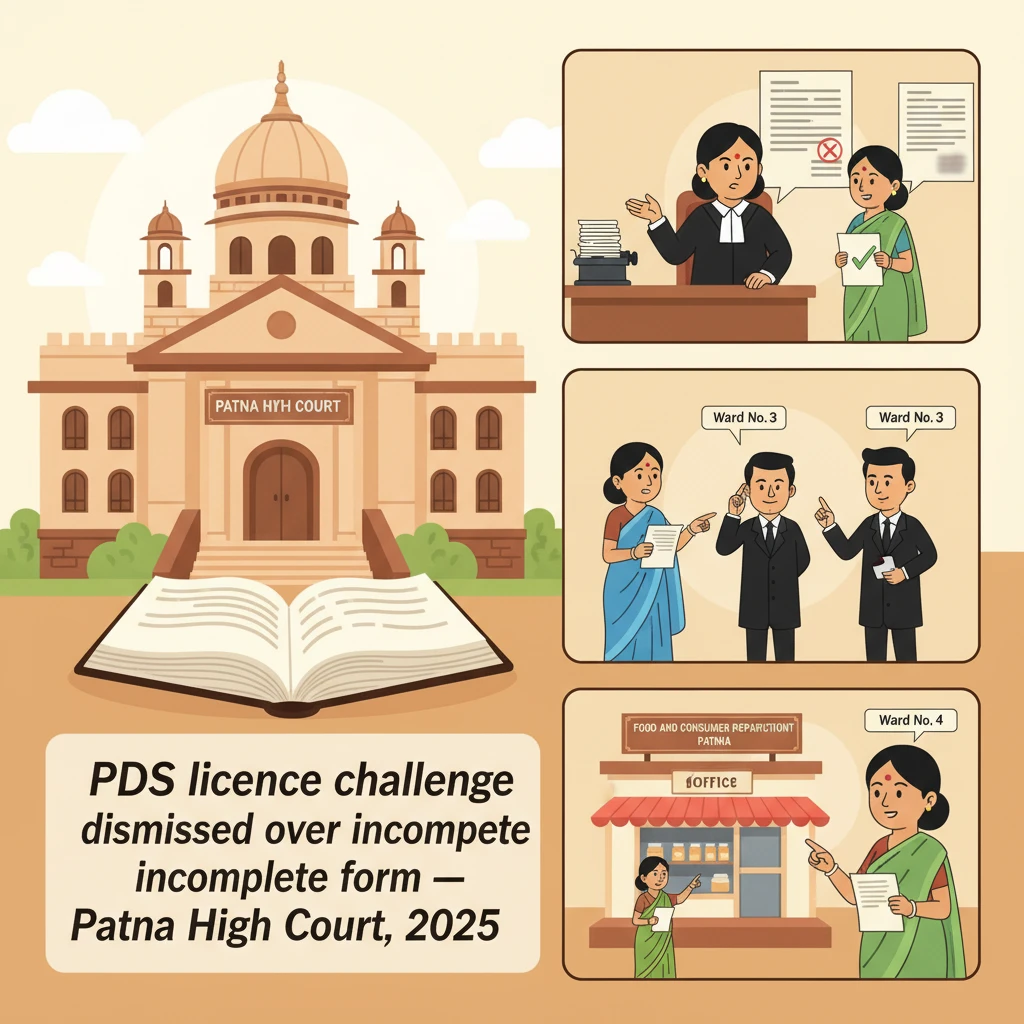
The petitioner also argued that the Commissioner’s order dated 18.06.2019 was correct. In that order, the Commissioner had held that Respondent No. 7 was a resident of Ward No. 3 where a PDS shop was already being run by a close relative, whereas the petitioner was a resident of Ward No. 4 where no PDS shop existed. The Commissioner had reasoned that the object of granting fresh PDS licences is to ensure consumers can access their nearest PDS shop and that the advertisement barred candidates from wards where a PDS shop was already operating. On that basis, the Commissioner had set aside the selection of Respondent No. 7.
The Secretary, Food & Consumer Protection Department, however, reversed the Commissioner’s decision by order dated 25.11.2019. The Secretary held, in substance, that:
First, granting a licence in the same ward where a PDS shop already exists was not, in itself, an illegality under the governing framework.
Second, a letter issued for Madhepura district could not be applied to Purnea district in deciding eligibility.
The petitioner attacked this order before the High Court, contending that Sub-Rule (ii) of Rule 9 of the Bihar Targeted PDS Control Order, 2016, mandates that a consumer should not have to travel more than 2 km to reach a Fair Price Shop in rural areas. According to her, this objective supported the Commissioner’s approach that priority should be given to wards without an existing PDS shop.
On the other hand, respondent authorities (Respondent Nos. 2 to 6) and Respondent No. 7 defended the Secretary’s order and the selection of Respondent No. 7.
Respondent Nos. 2 to 6 submitted that the petitioner’s own writ was not sustainable because the Secretary had already set aside the Commissioner’s order and directed that licence be issued to Respondent No. 7 by order dated 25.11.2019.
Respondent No. 7 specifically denied being disqualified under Clause 11(i). It was pointed out that this clause defines “family” for the purpose of disqualification as including father, mother, brother, brother’s wife, husband, wife, son, son’s wife and step brother. A “cousin father-in-law” does not fall within this defined group. Therefore, the fact that a cousin father-in-law had a licence in the same ward did not bar Respondent No. 7 from being granted another licence.
Respondent No. 7 also argued that the PDS shop had been running since 2018 without complaint.
Further, it was contended that the petitioner’s own application for a PDS licence was incomplete and not fully filled up, and had been rejected by the selection committee on this ground.
During the hearing, the Court raised two specific queries to the official respondents:
First, why and how a second PDS shop licence was granted in Ward No. 3 where a PDS shop already existed.
Second, where was the petitioner’s original application and whether it was complete or not.
In a supplementary counter affidavit, the respondents explained that the advertisement had been issued for Latraha Panchayat as a whole, under unreserved female category, and not ward-wise. Five applications were received for that panchayat, and Respondent No. 7 was found to be the most eligible candidate. It was stated that the fact that the selected candidate resided in a ward that already had a PDS shop was only a coincidence and did not violate the advertisement conditions.
Regarding the “joint family” argument, the supplementary affidavit clarified that the petitioner’s objection was that the brother of the father-in-law of Respondent No. 7 already held a PDS licence. As per Rule 11(i), such a relation (brother of father-in-law) does not fall in the prohibited category for refusing a licence.
On the second query, the respondents stated that Columns 3 to 13 of the petitioner’s application form were incomplete. Therefore, the selection committee had rightly rejected her application as incomplete.
The Court itself examined the original application form submitted by the petitioner. The Court found that the form was indeed incomplete and not duly filled in several columns. On this basis, the Court held that the rejection of the petitioner’s application due to incompleteness was justified.
The Court then turned to Clause 11(i) of the Bihar Targeted PDS (Control) Order, 2016. On a plain reading, the Court observed that the clause clearly restricts family members to a specific list: father, mother, brother, brother’s wife, husband, wife, son, son’s wife and step brother. It held that a “cousin father-in-law” does not fall within the definition of “joint family” as contemplated under Clause 11(i).
As a result, the Court found no legal basis to treat Respondent No. 7 as disqualified merely because her cousin father-in-law, or the brother of her father-in-law, was already a PDS dealer in the same ward.
Considering these findings, the Court concluded that there was no infirmity in the Secretary’s order dated 25.11.2019 (Memo No. 5547), which had set aside the Commissioner’s order and directed grant of PDS licence to Respondent No. 7.
Therefore, the writ petition was dismissed as devoid of merit, and any interlocutory applications were also disposed of.
Why This Judgment Matters
This Patna High Court judgment is important for people applying for PDS licences and those challenging the selection process.
First, it makes clear that an incomplete application form can be a decisive factor. Even if a candidate believes she is more deserving, if her application is not fully and correctly filled, the authorities are justified in rejecting it.
Second, the decision clarifies that the disqualification rule under Clause 11(i) of the Bihar Targeted PDS (Control) Order, 2016 is limited to the specific family members mentioned in that clause. Extended relatives like a “cousin father-in-law” or brother of the father-in-law are not treated as part of that “joint family” for the purpose of disqualification.
Third, the Court accepted the State’s stand that the selection was for the entire panchayat, not for each ward separately. The mere fact that a selected candidate belongs to a ward which already has a PDS shop does not automatically render the selection illegal, unless the governing rules expressly prohibit it.
For applicants and lawyers, this judgment is a reminder to carefully follow the eligibility rules, fill all parts of the application form, and understand exactly how “family” is defined for disqualification in government schemes.
Legal Issues and Answers
- Issue: Was the petitioner’s rejection and the grant of PDS licence to Respondent No. 7 illegal in view of the selection process and family disqualification rules?
Answer: No. The Court held that the petitioner’s application was incomplete and rightly rejected, and that Respondent No. 7 was not disqualified under Clause 11(i). The Secretary’s order granting licence to Respondent No. 7 was upheld. - Issue: Does a cousin father-in-law or brother of the father-in-law fall within the “joint family” definition in Clause 11(i) of the Bihar Targeted PDS (Control) Order, 2016 so as to bar another family member from getting a PDS licence?
Answer: No. The Court held that Clause 11(i) covers only the relations expressly listed, and a cousin father-in-law does not come within that definition. - Issue: Was the Secretary justified in setting aside the Commissioner’s order dated 18.06.2019 in favour of the petitioner?
Answer: Yes. Finding no infirmity in the Secretary’s order dated 25.11.2019, the Court upheld it and dismissed the writ petition.
Cases Cited by the Court
- The petitioner relied on the following Supreme Court judgments to argue a wider understanding of “joint family”:
- Surjit Lal Chhabda v. CIT, reported in 1976 AIR 109
- Rukhmabai v. Lal Laxminarayan, reported in 1960 AIR 335
- Rajagopal v. Padmini, reported in 1996 AIR 238
However, the Patna High Court ultimately interpreted Clause 11(i) of the Bihar Targeted PDS (Control) Order, 2016 according to its own wording and held that a cousin father-in-law does not fall within the defined family relations.
Case Details
Case Number: Civil Writ Jurisdiction Case No. 3870 of 2020
Case Title: Sanju Devi v. The State of Bihar & Ors.
Citation: 2025 (2) PLJR 842
Coram: Hon’ble Justice Smt. G. Anupama Chakravarthy
Advocates:
- For the Petitioner: Vijay Anand, Aatish Kumar, Advocates
- For the State (Respondent Nos. 1 to 6): S. Raza Ahmad, AAG 5; Bijay Kumar Sinha, AC to AAG 5
- For Respondent No. 7: Ms. Preety Kunwar, Advocate
Date of Judgment: 02.05.2025
Nature of the Case: Writ petition under civil writ jurisdiction challenging an order of the Secretary, Food & Consumer Protection Department, concerning grant of PDS licence.
Link to judgement; https://patnahighcourt.gov.in/viewjudgment/MTUjMzg3MCMyMDIwIzEjTg==-WsOjN9C5hyA=
If you found this explanation helpful and wish to stay informed about how legal developments may affect your rights in Bihar, you may consider following Samvida Law Associates for more updates.







