
Case Background
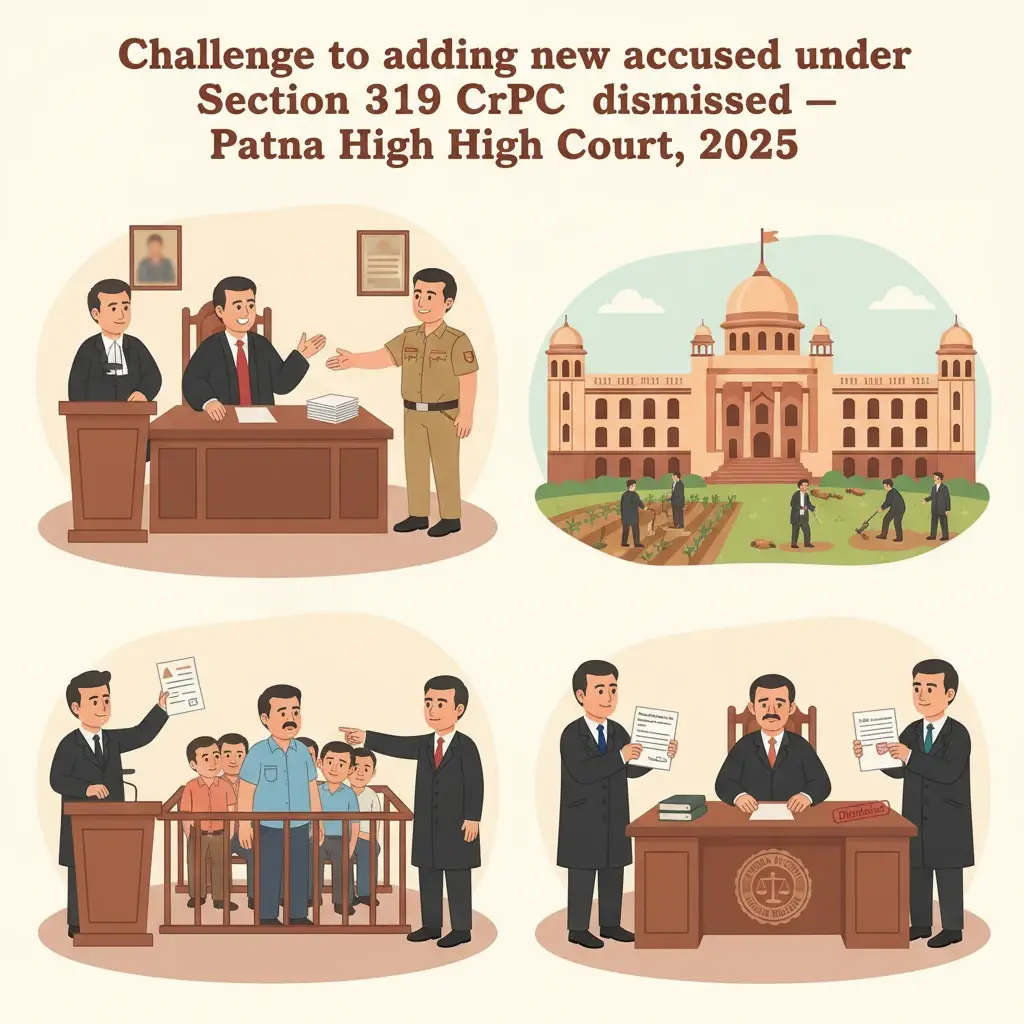
This case arises out of Darauli P.S. Case No. 97 of 2007, District Siwan. As per the prosecution, an incident took place in the field of the informant where several accused persons, including the present petitioner, were allegedly involved.
The petitioner was initially named in the FIR. However, after investigation, the police did not send him up for trial in the charge-sheet. The concerned Magistrate also did not take cognizance of the offences against him.
Later, during the sessions trial (Sessions Trial No. 161 of 2008), the prosecution tried to bring the petitioner into the case. First, a petition was filed before the trial court to add the petitioner’s name in the cognizance order. That petition was rejected. Thereafter, an application under Section 319 of the Code of Criminal Procedure was filed to summon the petitioner as an additional accused. This first Section 319 application was rejected, though not on merits.
After further evidence came on record, the prosecution again moved a fresh application under Section 319 CrPC before the 2nd Assistant Sessions Judge, Siwan. By order dated 21.06.2016, the trial court allowed this second application and directed that the petitioner be summoned to face trial as an accused.
Aggrieved by this summoning order, the petitioner approached the Patna High Court under Section 482 CrPC in Criminal Miscellaneous No. 36683 of 2016, seeking quashing of the order dated 21.06.2016.
What the Court Examined and Decided
Hon’ble Mr. Justice Shailendra Singh heard the matter. The core question was whether the trial court had rightly exercised its power under Section 319 CrPC to summon the petitioner as an accused on the basis of evidence recorded during trial.
The petitioner’s counsel argued that although the petitioner was named in the FIR, the investigation did not support his involvement, and therefore the police did not send him up for trial. The Magistrate also did not take cognizance against him. According to the petitioner, this showed that there was no sufficient material against him.
The petitioner pointed out that the prosecution first tried to add his name in the cognizance order, and that request was rejected. Then, a Section 319 CrPC application was filed and rejected, though not on merits. Despite this, the prosecution again moved under Section 319 CrPC and succeeded, leading to the impugned order summoning him.
To challenge this, the petitioner filed copies of depositions of prosecution witnesses PW 1 to PW 6 before the High Court. Learned counsel argued that none of these witnesses had made any specific allegation about any act committed by the petitioner in the alleged occurrence.
It was argued that the allegations against the petitioner in these depositions were vague and general. Such loose references, according to the petitioner, could not be treated as strong, cogent material for invoking Section 319 CrPC. The contention was that Section 319 can be used only when there is strong evidence, stronger than the usual prima facie standard applied when taking cognizance.
In support, the petitioner relied upon the Supreme Court judgment in Hardeep Singh v. State of Punjab, (2014) 3 SCC 92. The Patna High Court reproduced and took note of important paragraphs from that decision, particularly paragraphs 95, 105 and 106.
From Hardeep Singh, the legal position highlighted was:
- At the time of taking cognizance, the court looks for a prima facie case. Under Section 319 CrPC, though the concept of prima facie case still applies, the degree of satisfaction must be “much stricter”.
- Section 319 CrPC power is discretionary and extraordinary, to be used sparingly, only when circumstances demand it. It cannot be used casually just because the judge thinks someone may also be guilty.
- Only where “strong and cogent evidence” arises from the evidence led before the court should this power be invoked. The evidence must be more than mere probability of complicity, stronger than what is required for framing charge, but still short of the level of being convinced of guilt.
The petitioner further argued that, as per law, a person summoned as an accused under Section 319 CrPC must be given an opportunity of hearing. For this proposition, reliance was placed on Yashodhan Singh & Ors. v. State of U.P. & Ors., (2023) 9 SCC 108, where the Supreme Court, with reference to Jogendra Yadav v. State of Bihar, recognised the right of such a summoned person to be heard before being added as an accused, and also to challenge the summoning order before the High Court and Supreme Court.
The petitioner also claimed that at the time of the alleged occurrence he was a minor, around 14-15 years of age, and that he had sufficient material to prove his juvenility at the time of occurrence. He sought protection of the Juvenile Justice Act.
On the other side, the learned APP for the State opposed the petition and supported the trial court’s order. The State argued that the power under Section 319 CrPC had been correctly invoked by the 2nd Assistant Sessions Judge.
The State submitted that the evidence of prosecution witnesses examined before the trial court contained sufficient material to show the active involvement of the petitioner in the alleged offences. According to the State, these materials were stronger than the basic prima facie threshold needed for taking cognizance.
The Patna High Court then examined the impugned order and, “particularly”, the depositions of the prosecution witnesses recorded prior to summoning the petitioner under Section 319 CrPC.
As per the prosecution story recited by the High Court, on the date and time of occurrence, the accused persons, including the petitioner, all named in the FIR, went to the field of the informant and started harvesting the crop. When the informant and his family members objected, the accused allegedly assaulted the informant using lathi, danda, fists and slaps.
The Court noted that the informant and his son Umesh Singh, examined as PW 3 and PW 4, were the most important witnesses of this occurrence. From their evidence, the Court recorded a clear finding that:
- The petitioner was present at the place of occurrence.
- They clearly deposed that the petitioner was also involved in the commission of the alleged occurrence.
- Though they could not assign a specific role to the petitioner for any particular blow or act, they did not deny his active participation.
On this basis, the High Court held that the materials in the evidence of PW 3 and PW 4 were much stronger than the material required to merely take cognizance of the offences against the petitioner. Therefore, in the opinion of the Court, the learned trial court had rightly exercised its power under Section 319 CrPC to summon the petitioner.
Regarding the argument based on Yashodhan Singh about the right of hearing before being added as an accused, the Patna High Court observed that there was no plea from the petitioner that such a liberty had not been given to him up to that point. The Court clarified that the trial court is bound to provide proper opportunity of hearing to the petitioner before adding him as an accused if such a prayer is made on his behalf.
On the issue of juvenility, the Court did not decide the question directly in this Section 482 petition. Instead, it issued a specific direction to the trial court. The trial court was directed to pass an appropriate order after holding an inquiry, either by itself or through the Juvenile Justice Board, regarding the petitioner’s plea of juvenility, if he files a petition with sufficient prima facie material. The Court further directed that such a plea must be decided in accordance with the provisions of the Juvenile Justice Act.
In the final analysis, the Patna High Court found no illegality in the impugned order dated 21.06.2016 of the 2nd Assistant Sessions Judge, Siwan. It also found no merit in the petitioner’s challenge under Section 482 CrPC. Consequently, the criminal miscellaneous petition was disposed of without granting the relief of quashing.
Why This Judgment Matters
This judgment is important for people who may be named in an FIR but are not charge-sheeted by the police and later find themselves summoned during trial under Section 319 CrPC.
The Patna High Court has made it clear that such a summoning can be legally valid if the prosecution witnesses, especially key eyewitnesses like the informant and close family members, clearly speak of the person’s presence and participation in the incident, even if they do not assign a very specific role.
The decision also balances this by reminding that a person summoned under Section 319 CrPC can seek an opportunity of hearing before being formally added as an accused, in line with Supreme Court rulings. The Court did not deny this right and clarified that the trial court must give such an opportunity if demanded.
For persons who were minors at the time of the alleged offence, the judgment is also significant. It directs the trial court to look into any properly supported claim of juvenility through an inquiry by the court itself or the Juvenile Justice Board and to decide it under the Juvenile Justice Act.
In effect, the judgment reinforces that the Patna High Court will not lightly interfere with Section 319 CrPC orders when trial evidence strongly links a person to the alleged crime, but it will ensure that rights of hearing and juvenility determination are respected.
Legal Issues and Answers
- Issue: Whether the 2nd Assistant Sessions Judge, Siwan, rightly exercised power under Section 319 CrPC to summon the petitioner as an additional accused on the basis of evidence of prosecution witnesses PW 1 to PW 6, especially PW 3 and PW 4.
Answer: Yes. The Patna High Court held that the evidence of the informant and his son clearly showed the petitioner’s presence and active participation in the alleged occurrence and was stronger than the material required for mere cognizance. The Court found no illegality in the exercise of Section 319 power. - Issue: Whether the petitioner was denied his right to be heard before being added as an accused under Section 319 CrPC, in light of Supreme Court decisions like Yashodhan Singh and Jogendra Yadav.
Answer: The Court noted that no specific plea was taken that such hearing had been denied. It clarified that the trial court is bound to grant proper opportunity of hearing if the petitioner makes such a prayer. - Issue: How should the petitioner’s claim of juvenility at the time of occurrence be dealt with?
Answer: The Court directed the trial court to conduct an inquiry itself or through the Juvenile Justice Board on any petition filed by the petitioner with prima facie material and to decide the juvenility plea as per the Juvenile Justice Act.
Cases Cited by the Court
- Hardeep Singh v. State of Punjab, (2014) 3 SCC 92 – relied upon for the standard and scope of power under Section 319 CrPC, including the requirement of strong and cogent evidence and the higher degree of satisfaction compared to cognizance or charge.
- Yashodhan Singh & Ors. v. State of U.P. & Ors., (2023) 9 SCC 108 – cited for recognising the right of a person summoned under Section 319 CrPC to be heard before being added as an accused, with reference to Jogendra Yadav v. State of Bihar, (2015) 9 SCC 244.
Case Details
Case Number: Criminal Miscellaneous No. 36683 of 2016
Arising out of: Darauli P.S. Case No. 97 of 2007, District Siwan
Case Title: Ravi Shankar Pati Dubey v. The State of Bihar
Citation: 2025 (2) PLJR 810
Court: High Court of Judicature at Patna
Coram: Hon’ble Mr. Justice Shailendra Singh
Date of Judgment: 25.03.2025
Advocates:
For the Petitioner: Mr. Prabhakar Singh, Advocate
For the State: Mr. Binod Kumar No. 3, APP
Nature of the Case: Petition under Section 482 CrPC seeking quashing of order passed under Section 319 CrPC in Sessions Trial No. 161 of 2008.
Impugned Order: Order dated 21.06.2016 of the learned 2nd Assistant Sessions Judge, Siwan, allowing prosecution application under Section 319 CrPC and summoning the petitioner to face trial.
Link to Judgment: https://patnahighcourt.gov.in/viewjudgment/NiMzNjY4MyMyMDE2IzEjTg==-5l57T6dKUUo=
If you found this explanation helpful and wish to stay informed about
how legal developments may affect your rights in Bihar,
you may consider following Samvida Law Associates for more updates.







