
Case Background
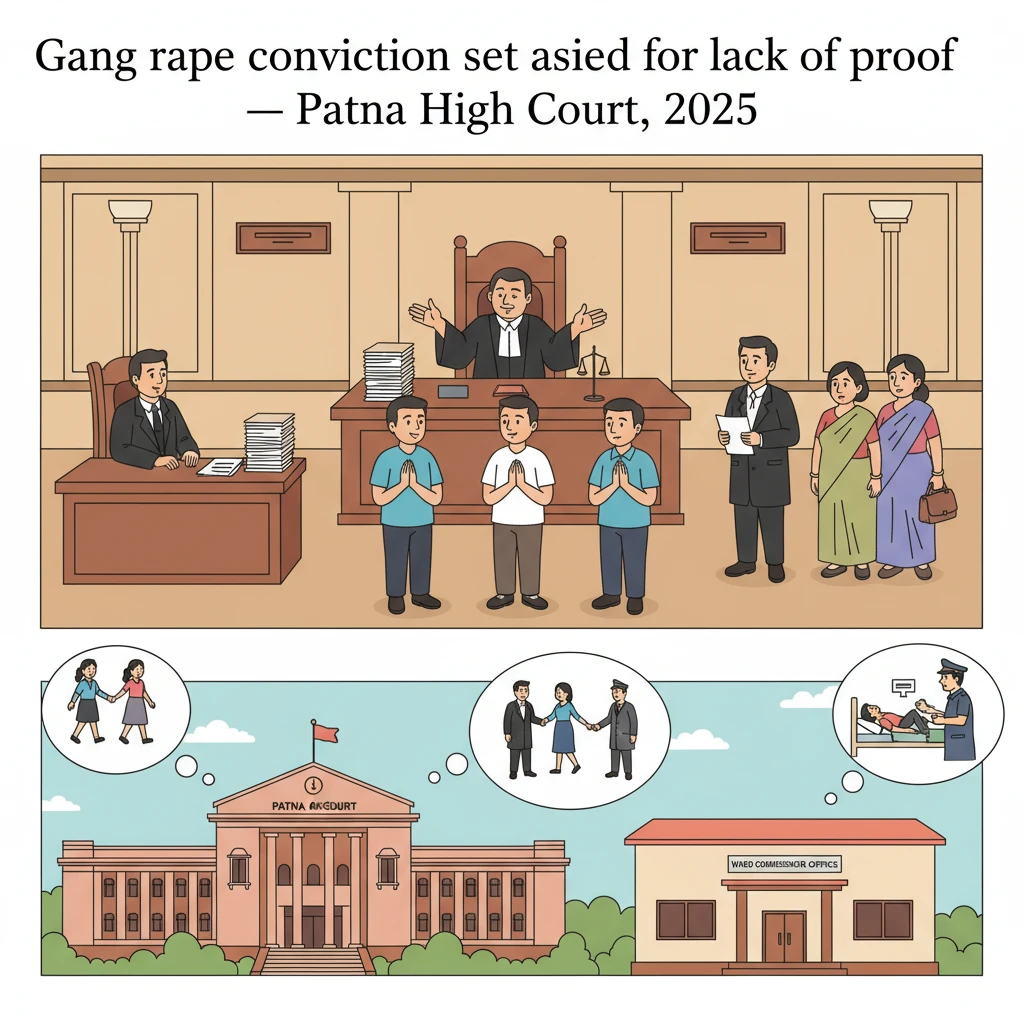
This case arose from Chapra Town P.S. Case No. 446 of 2019, registered on 10.08.2019. The FIR was based on the fardbeyan of the victim (examined at trial as PW-4), recorded at Patna Medical College and Hospital (PMCH), Patna by S.I. Kumari Vibha Rani (PW-5) of Saran Mahila Police Station at about 21:10 hours on the same day.
The girl alleged that at around 12:00 noon on 10.08.2019, after appearing in a school examination and while returning home, three named youths — (1) Ravi Raj Sharma @ Dhyani Sharma, (2) Sonu @ Tarzan @ Saddam Hussain, and (3) Atish Kumar — forcibly caught her, pressed her mouth, took her to the office of the Ward Commissioner (wife of one Atul Sharma), and there each of them raped her one after the other. She claimed she started bleeding heavily and was then left there by them, after which she somehow returned home and told her mother (PW-2). The family then took her to Sadar Hospital, Chapra, from where she was allegedly referred to PMCH, Patna.
On this basis, Chapra Town P.S. Case No. 446 of 2019 was registered under Sections 376(D)/34 IPC and Sections 4, 5, 5(g) and 6 of the POCSO Act. After investigation, charge-sheet No. 660 of 2019 dated 30.09.2019 was submitted against the three accused under Section 376D IPC and Sections 4, 5, 5(g) and 6 of the POCSO Act.
The Exclusive Special Judge (POCSO), Saran at Chapra took cognizance on 23.10.2019 and framed charges on 19.11.2019 under Section 376D IPC and Section 6 of the POCSO Act. The accused pleaded not guilty and stood trial in Sessions Trial (POCSO) No. 86 of 2019. Seven prosecution witnesses and three defence witnesses were examined. Various documents, including seizure lists, FIR, medical report and FSL report, were exhibited by the prosecution; educational documents were produced in defence.
By judgment dated 11.08.2021, the trial court convicted all three appellants under Section 376D IPC and Section 6 of the POCSO Act. By order dated 17.08.2021, it sentenced each of them to rigorous imprisonment for 20 years and a fine of Rs. 20,000/-, with three months’ simple imprisonment in default.
The three convicts then filed Criminal Appeal (DB) No. 670 of 2021, Criminal Appeal (DB) No. 765 of 2021 and Criminal Appeal (DB) No. 221 of 2022 before the Patna High Court, challenging both the conviction and sentence.
What the Court Examined and Decided
The Division Bench of Hon’ble Mr. Justice Rajeev Ranjan Prasad and Hon’ble Mr. Justice Ashok Kumar Pandey closely examined the entire evidence, including the girl’s version, the conduct of the police, medical and forensic reports, and the trial court’s approach.
1. Inconsistencies in the victim’s version
The High Court first compared the girl’s fardbeyan with her testimony in court. In her fardbeyan, she said she was forcibly taken from the way while returning from school to her home. In her evidence before the court, she stated that she had already reached home at 12:00 noon from school and that the accused then came to her house, caught hold of her there, pressed her mouth and took her to the Ward Commissioner’s office.
This was a major change regarding the place from where she was allegedly abducted. There was no evidence from her mother (PW-2), father (PW-3), or grandfather that she was forcibly taken from the house, although they were present at home according to PW-2. The Court found it highly doubtful that three young men could take her away from the house in the presence of adults, commit rape for about 1–1½ hours, and yet no one intervened.
2. Doubts about timing of fardbeyan and seizure of clothes
According to the police, PW-5 (S.I. Vibha Rani) reached PMCH on 10.08.2019 and recorded the fardbeyan at 21:10 hours, and at 21:30 hours she prepared a production-cum-seizure list showing that the victim’s mother produced a red salwar, a ‘kathai’-coloured janghia (underwear) with a pad, allegedly with blood-like stains.
However, the victim’s mother (PW-2) stated in cross-examination that she did not meet any police official on the date of occurrence and that her statement was recorded at Patna only on the “next day”. She also said that the seizure papers for the clothes were prepared on the next day between 10–11 a.m. She categorically denied that police had recorded any statement on the date of occurrence.
This directly contradicted the I.O.’s version and created a serious doubt. The Court concluded that the fardbeyan and the seizure list were very likely antedated and antetimed to 10.08.2019, instead of 11.08.2019.
Further, while PW-2 claimed that the blood-soaked clothes were taken off her daughter’s body at Patna hospital and seized there, PW-6 (Dr. Chitra Sinha) stated that no blood-soaked clothes of the victim were seized in PMCH. The Court found these contradictions substantial and not minor.
3. Missing and doubtful medical trail
The prosecution case was that the victim was first taken to Sadar Hospital, Chapra, and then referred to PMCH. Yet:
No document from Chapra Sadar Hospital was produced. No doctor from that hospital was examined. PW-2 herself admitted that in Chapra Sadar Hospital her daughter did not disclose her injuries to any doctor and that no paper was given from Chapra to take her to Patna.
At the same time, PW-6 (doctor at PMCH) stated that on admission at around 9 p.m. on 10.08.2019, the victim already had an intra-cath in her right hand, haemaccel was running and a “pack in situ” was in the vagina, with no active bleeding. This clearly indicated that she had already received some prior treatment somewhere before reaching PMCH.
Yet, the prosecution did not disclose where this treatment was given, what was recorded as her first version, or what medicines were administered. The usual bed head ticket or discharge summary of PMCH was not brought on record. Instead, only a later letter-like medical report (Exhibit 7) dated 07.09.2019, signed by PW-7 (Dr. Anupam) and countersigned by PW-6, was produced. PW-7 herself stated that she could not say what treatment was given between 10.08.2019 and 19.08.2019, and that the victim was not examined in her presence on the day she reached PMCH.
This withholding of routine medical records, coupled with vague evidence regarding Sadar Hospital, led the Court to conclude that the real medical trail and the victim’s first statements to doctors were being suppressed.
4. Flawed investigation at the place of occurrence
According to the I.O., the place of occurrence was a room used as the Ward Commissioner’s office, with a small brick platform in an open area bordered on two sides by PCC roads and neighbouring houses. The I.O. claimed that blood marks were present on the southern side of the platform and some papers were scattered, but she:
- did not seize any blood from the platform herself,
- did not record statements of neighbouring residents or of the Ward Commissioner (Sarita Devi) and her family,
- did not visit the victim’s school or verify whether any exam was actually held on that day.
The FSL team, led by one Rajesh Kumar or Rajesh Chaudhary (there was confusion in names), allegedly collected cotton swabs and other exhibits and prepared seizure lists. But:
- none of these officers were examined as witnesses,
- witnesses to those seizure lists were not examined,
- one seizure list showed overwriting of the date from 10.08.2019 to 11.08.2019,
- that seizure list did not bear the “seen” endorsement of the court, unlike the fardbeyan and another seizure list.
The High Court held that the investigation at the scene was extremely weak and that the prosecution did not reliably prove what, if anything, was collected from the actual place of occurrence.
5. FSL report and lack of serological linkage
The Forensic Science Laboratory report (marked Exhibit P-8 under Section 294 CrPC) recorded:
- Blood detected on cotton swabs (Exhibits A, B, C) taken from earth and a cemented “chabutara”, on a cloth bag (D), on the alleged janghia of the victim (E), on the alleged red salwar (F), and on the alleged janghia of accused Ravi Raj Sharma @ Dhyani (G).
- Semen detected only on Exhibit G (accused’s janghia) and on the vials containing the semen samples of all three accused (H/x, I/y, J/z).
- No semen detected on the victim’s janghia (E), salwar (F), or on the swabs from the platform (A, B, C, D).
Crucially:
- No blood samples of the victim or accused were collected and matched.
- No DNA analysis or serological grouping was produced to show that the blood on any exhibit belonged to the victim or any accused.
- The semen on accused’s underwear (G) was never compared with the semen sample (H/x) said to have been collected from him.
- The FSL report itself said that a serological report on origin and group would follow, but no such further report was proved.
The Court relied on the Supreme Court’s judgment in Krishna Kumar Malik v. State of Haryana, which emphasises the importance of proper semen and DNA analysis in rape cases. Here, not only was there no semen on the victim’s cloths or the platform swabs, but there was also no scientific linking of any bodily fluid to either the accused or victim.
Further, although the FSL report is technically admissible under Section 293/294 CrPC, it was not supplied to the accused and they were not confronted with its contents during their examination under Section 313 CrPC. Applying the Patna High Court decision in State of Bihar v. Durgawati, the Bench held that such a report, not properly put to the accused, could not safely be relied upon to sustain conviction.
6. Failure to prove minority of the victim under POCSO
The POCSO Act applies only if the victim is a “child”, i.e. below 18 years, on the date of occurrence. In the fardbeyan, her age was written as 17 years. In her evidence about one-and-a-half years later, she claimed to be 15 and even stated in cross-examination that she had recorded her age as 14 in the fardbeyan, which was contradicted by the I.O., who said she mentioned 17.
No school admission register, matric certificate, birth certificate from municipal or panchayat authority, or any other documentary proof of her age was produced. No age determination tests (like ossification) were conducted. PW-6 and PW-7 casually referred to her as about 17 years, but did not estimate age by any recognised method.
The Court referred to Section 34 of the POCSO Act and Section 94 of the Juvenile Justice (Care and Protection of Children) Act, 2015, and to its own earlier decisions including Md. Mahmood Alam v. State of Bihar, and held that the prosecution did not follow the prescribed hierarchy for age determination. In the absence of foundational proof that she was below 18, the statutory presumptions under Sections 29 and 30 of the POCSO Act could not be invoked.
7. Victim not a “sterling witness”
The trial court had described the girl as a “sterling witness”. The High Court applied the test laid down by the Supreme Court in Rai Sandeep v. State (NCT of Delhi): a sterling witness’s version must be absolutely consistent, natural, withstand cross-examination, and be supported by other material.
Here, the victim’s shifting statements about place of abduction, time of return from school, age, and her vague answers about direction and distance of Sadar Hospital, as well as contradictions with medical and seizure evidence, led the Court to conclude that she could not be treated as a sterling witness whose testimony alone could safely sustain conviction.
8. Overall conclusion and acquittal
Taking these factors together — doubtful timing of FIR and seizure, missing primary medical records, poor and incomplete investigation, non-proof of the victim’s minority, lack of scientific linkage of blood or semen to the accused or victim, and inconsistencies in the girl’s account — the Patna High Court held that the prosecution had failed to prove the charges beyond reasonable doubt.
The Court therefore set aside the judgment of conviction dated 11.08.2021 and order of sentence dated 17.08.2021 passed by the Exclusive Special Judge (POCSO), Saran at Chapra in Sessions Trial (POCSO) No. 86 of 2019. All three appellants were acquitted of all charges and ordered to be released forthwith unless wanted in any other case.
The Court also recorded appreciation for the assistance rendered by the amicus curiae, and directed payment of honorarium by the Patna High Court Legal Services Authority.
Why This Judgment Matters
This Patna High Court judgment is important for both victims and accused in sexual offence cases, especially under the POCSO Act.
First, it shows that courts will not simply confirm a conviction because of the seriousness of the allegation. The prosecution must still prove every key fact with trustworthy evidence. Where the investigation is careless, medical records are missing, or scientific tests do not connect the accused to the crime, the benefit of doubt will go to the accused.
Second, in cases under the POCSO Act, the Court has made it clear that the age of the victim cannot be assumed. The prosecution must follow the legal method under the Juvenile Justice Act — using school records, birth certificates, and, if needed, age tests. Without this, POCSO’s stricter provisions and presumptions cannot be applied.
Third, the judgment reinforces that forensic evidence must be properly collected, preserved, documented, and then fairly used in trial. If FSL reports are not explained to the accused or not matched with blood/semen samples, they cannot be treated as conclusive.
For families, this judgment highlights the importance of seeking prompt medical care, ensuring that proper hospital records are created, and cooperating with lawful investigation. For police and prosecutors, it sends a strong message that hasty or manipulated paperwork, missing primary records, and half-done forensic work may lead to acquittal even in grave offences.
Legal Issues and Answers
-
Issue: Whether the prosecution proved beyond reasonable doubt that the appellants committed gang rape on the victim, attracting Section 376D IPC and Section 6 of the POCSO Act.
Answer: No. Due to serious inconsistencies in the victim’s testimony, doubtful fardbeyan and seizure, missing medical records, weak investigation, and lack of forensic linkage, the Court held that guilt was not proved beyond reasonable doubt and acquitted the appellants. -
Issue: Whether the victim was proved to be a “child” (below 18 years) so as to attract POCSO and its presumptions under Sections 29 and 30.
Answer: No. The prosecution did not produce any admissible age documents or conduct age determination tests under Section 94 of the JJ Act. Conflicting oral statements on age were insufficient. Hence, foundational facts for applying POCSO presumptions were not established. -
Issue: Whether the FSL report, admitted under Section 294 CrPC, could be relied upon to sustain conviction in the absence of serological comparison and without confronting the accused with its contents.
Answer: No. While the FSL report was technically admissible, its reliability was doubtful as no serological matching was done; semen was not found on the victim’s clothes; and the report was neither supplied nor put to the accused under Section 313 CrPC. The Court therefore declined to treat it as proof against the appellants.
Cases Cited by the Court
- State of Punjab v. Gurmit Singh, (1996) 2 SCC 384 (referred by prosecution on appreciation of evidence in rape cases).
- Santhosh Moolya & Anr. v. State of Karnataka, (2010) 5 SCC 445 (on effect of varied defence suggestions).
- State of H.P. v. Mast Ram, AIR 2004 SC 5056 (on admissibility of expert reports under Section 293 CrPC).
- Krishna Kumar Malik v. State of Haryana, (2011) 7 SCC 130 (on importance of semen/DNA analysis in rape cases).
- Rai Sandeep v. State (NCT of Delhi), (2012) 8 SCC 21 (on concept of a “sterling witness”).
- State of Bihar v. Durgawati, 2021 (4) PLJR 516 (Patna HC) (on non-supply and non-confrontation of FSL report).
- Md. Mahmood Alam v. State of Bihar, 2024 (4) PLJR 795 (Patna HC) (on foundational facts and age determination in POCSO cases).
- Heera Das v. State of Bihar & Anr., Cr. Appeal (DB) No. 103 of 2019, decided on 19.06.2024 (Patna HC) (on presumption under Section 29 POCSO and foundational facts).
- Dharmender Singh v. State (Govt. of NCT of Delhi), 2020 SCC OnLine Del 1267.
- Sahid Hossain Biswas v. State of West Bengal, 2017 SCC OnLine Cal 5023.
- Joy V.S. v. State of Kerala, 2019 SCC OnLine Ker 783.
- Navin Dhaniram Baraiye v. State of Maharashtra, 2018 SCC OnLine Bom 1281.
Case Details
Case Numbers:
- Criminal Appeal (DB) No. 670 of 2021
- Criminal Appeal (DB) No. 765 of 2021
- Criminal Appeal (DB) No. 221 of 2022
Trial Court Case: Sessions Trial (POCSO) No. 86 of 2019 arising out of Chapra Town P.S. Case No. 446 of 2019.
Case Title (High Court):
- Sonu @ Tarjan @ Saddam Hussain v. The State of Bihar & Anr.
- Aatish Kumar @ Atish Kumar Sharma @ Atish Kumar v. The State of Bihar & Anr.
- Ravi Raj Sharma @ Dhyani Sharma @ Dhyani v. The State of Bihar
Court: High Court of Judicature at Patna.
Coram:
- Hon’ble Mr. Justice Rajeev Ranjan Prasad
- Hon’ble Mr. Justice Ashok Kumar Pandey
Judgment Date (High Court): 05.03.2025
Citation: 2025 (2) PLJR 407
Nature of Case: Criminal appeals (Division Bench) against conviction and sentence under Section 376D IPC and Section 6 of the POCSO Act.
Advocates:
- For the appellant in Cr. Appeal (DB) No. 670 of 2021: Mr. Chandra Mohan Jha, Advocate
- For the appellant in Cr. Appeal (DB) No. 765 of 2021: Mr. Chandra Mohan Jha, Advocate
- For the appellant in Cr. Appeal (DB) No. 221 of 2022: Ms. Surya Nilambari, Amicus Curiae
- For the State in Cr. Appeal (DB) No. 670 of 2021: Mr. Dilip Kumar Sinha, Addl. PP
- For the State in Cr. Appeal (DB) No. 765 of 2021: Mr. Abhimanyu Sharma, Addl. PP
- For the State in Cr. Appeal (DB) No. 221 of 2022: Ms. Shashi Bala Verma, Addl. PP
- For the Informant (where impleaded): Mr. Manish Chandra Gandhi, Advocate; Mr. Himanshu Ranjan, Advocate
Link to Judgment (Patna High Court website): Click here to view full judgment
If you found this explanation helpful and wish to stay informed about
how legal developments may affect your rights in Bihar,
you may consider following Samvida Law Associates for more updates.







