
Case Background
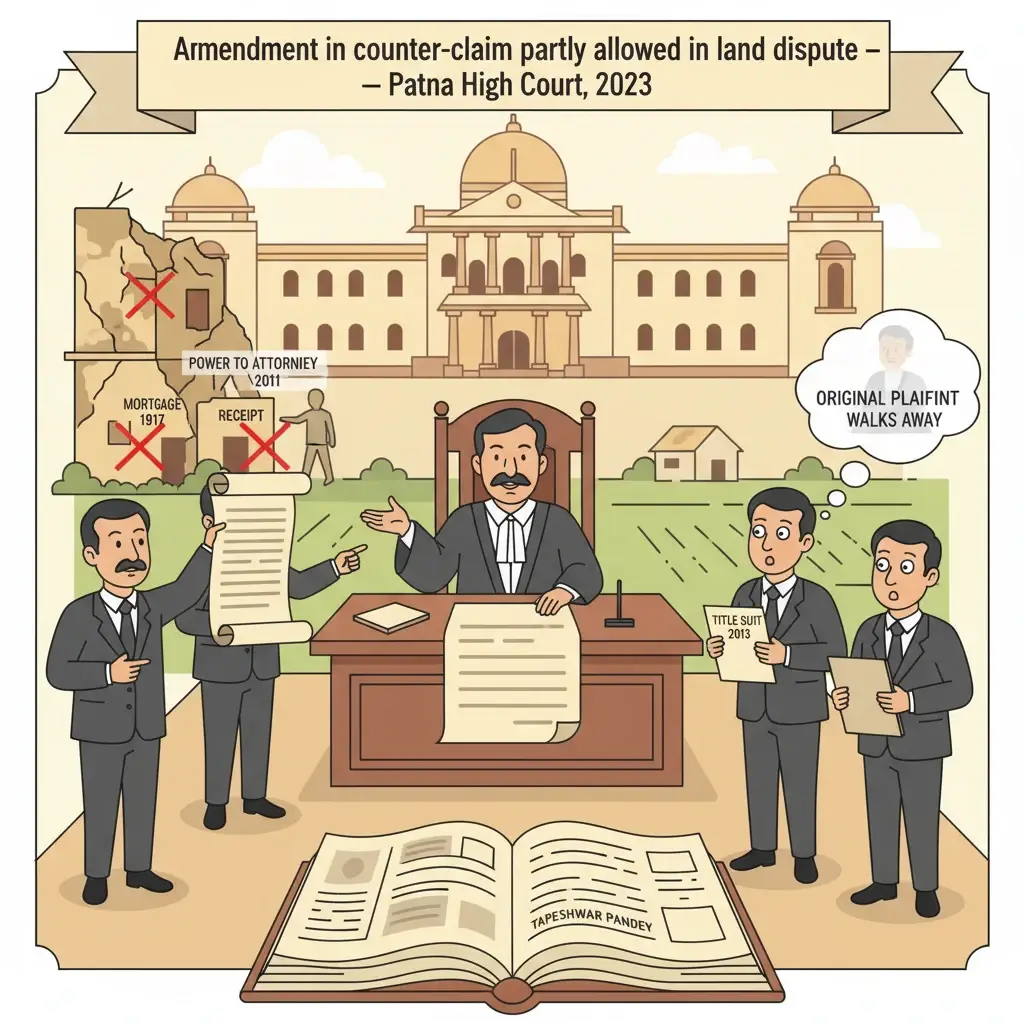
Title Suit No. 110 of 2013 was filed in the court of Subordinate Judge 1st, Siwan by the original plaintiff (described as plaintiff-respondent 5th set in this proceeding). The plaintiff sought a declaration that the disputed land was ancestral property of the plaintiff and defendant 1st set. It was also claimed that defendant 2nd set had no concern with the suit property, along with other related reliefs.
The present petitioner was not an original party in that case. According to him, the original suit was collusive between the plaintiff and the then defendants. He alleges that those defendants filed a collusive written statement. When the petitioner came to know about the filing of the suit, he applied to be added as a party.
His application was allowed and he was impleaded as defendant no. 5 in the title suit. After being added, defendant no. 5 filed a contesting written statement and also set up a counter-claim on 27.04.2015.
In his counter-claim, he sought declaration of his title and possession over Schedule-1 land described in the counter-claim and a declaration that the plaintiff and defendant nos. 1–4 had no concern with the disputed land. He also asked that several sale deeds and a power of attorney, allegedly used to claim title over the land, be declared void, illegal, inoperative and not binding on him.
Later, in 2017, the original plaintiff withdrew Title Suit No. 110 of 2013. After withdrawal of the main suit, the matter proceeded only on the counter-claim, which now effectively became the main plaint in the case.
What the Court Examined and Decided
Defendant no. 5, now the petitioner before the Patna High Court in Civil Miscellaneous Jurisdiction No. 626 of 2018, based his counter-claim on his alleged ancestral rights over the disputed land. He claimed the land belonged to his family, stood in the name of one Tapeshwar Pandey, and that his grandfather had redeemed mortgage rights over the land long ago.
According to the counter-claim, the disputed land was recorded in the name of Tapeshwar Pandey in the recent Survey Khatiyan. It was alleged that Tapeshwar Pandey had mortgaged the suit property to one Md. Musa on 28.12.1917 and 14.06.1920. The petitioner’s grandfather, Brij Kishore Pandey, then paid the mortgage money on 20.07.1932 and redeemed the mortgaged property. Md. Musa allegedly acknowledged this repayment on a plain paper, and from then, the petitioner’s family claims to be in possession.
On the other side, the plaintiff and some of the defendants based their claim on a chain of sale deeds and a power of attorney. The petitioner asserted that for the first time, after reading the plaint in the original suit, he learnt that the plaintiff and defendant 1st set were claiming title on the basis of a sale deed dated 07.03.2011, which he termed forged.
He also came to know that two persons, Riyazuddin Ansari and Jubair Ansari, had executed a sale deed dated 15.02.2011 in favour of Haider Ali, allegedly on the strength of a power of attorney said to have come from him (the petitioner) in respect of the disputed land. The petitioner denied having any such relationship or authorisation, calling the power of attorney and subsequent deeds fraudulent.
Further, he denied that persons named Matsira Kuer, Bahora Kuer and Manu Pandey had any relation with him or the disputed property, and denied execution of any sale deed dated 13.09.1940 in favour of one Kutubuddin Ansari. He maintained that if any such document existed, it should be treated as fraudulent and without consideration, conferring no title on the alleged vendee or his successors.
After the counter-claim was on record and the original suit was withdrawn in 2017, the petitioner says that on 12.12.2017, before issues were framed (pre-trial stage), he was dispossessed from the disputed land by defendants 1–4. This alleged dispossession was a key turning point. Based on this and the reply filed by defendants 2–4 to his counter-claim, he decided to seek amendment of his counter-claim.
Accordingly, on 15.01.2018, he filed an application under Order VI Rule 17 of the Code of Civil Procedure for amendment of the counter-claim. The trial court (Subordinate Judge XII, Siwan) rejected this amendment petition by order dated 12.03.2018. It is this rejection order that was challenged before the Patna High Court.
In the High Court, the petitioner argued that the amendments were necessary to bring subsequent events (such as dispossession on 12.12.2017) on record and to properly decide the real controversy between the parties. He stressed that the application was filed at the pre-trial stage, before framing of issues, and relied on the principle that pre-trial amendments should be considered liberally. He also contended that at the amendment stage, the court should not go into the truth or merits of the amendment, and that limitation issues were arguable questions to be decided at trial, not at the amendment stage.
On the other hand, defendants 3 and 4 opposed the amendment. In their reply filed on 29.01.2018, they said the proposed changes were barred by limitation, frivolous and mala fide, and that they would change the nature of the suit. They specifically pointed out that by way of amendment, the petitioner wanted to challenge, among others, the old sale deed dated 13.09.1940. They argued that, under Article 59 of the Limitation Act, a suit to cancel a sale deed must be filed within three years from when the facts entitling cancellation first become known, and thus the relief was time-barred. They relied on a Supreme Court judgment reported in AIR 2019 SC 1430.
They further argued that one of the proposed reliefs (described as relief no. 1(k) / proposed amendment no. (v)) would convert the original declaratory suit into a mortgage redemption suit. They said the original counter-claim was under Section 34 of the Specific Relief Act, seeking declarations, while a mortgage redemption suit would fall under Order XXXIV of the Code of Civil Procedure, requiring a different kind of proceeding, including preliminary and final decrees. They relied on a Supreme Court decision reported in AIR 2008 SC 2134 to argue that the nature of a suit cannot be changed through amendment.
The Patna High Court carefully examined the amendment petition and broke down the proposed amendments into five parts:
First, the petitioner wanted to add a relief for restoration of possession, based on his alleged dispossession on 12.12.2017 during the pendency of the suit. The Court saw this as grounded in a subsequent event and held that such an amendment could be allowed, as it was appropriate to bring the changed factual position on record.
Second, the petitioner sought correction of paragraph numbers in the counter-claim. The Court treated this as a purely formal and corrective change, which was unobjectionable.
Third, the petitioner wanted to pay ad valorem court fee in line with the relief for restoration of possession. The Court accepted that this amendment flowed from the enhanced relief and was permissible.
Fourth, in relief no. (i) of the existing counter-claim, the petitioner had already asked for a declaration that the sale deeds dated 07.03.2011 and 13.09.1940 were void and fabricated. Through amendment, he sought to add the word “cancellation” so that the relief would also expressly refer to cancellation of these sale deeds and the power of attorney dated 15.02.2011.
On this point, the respondents had argued that adding “cancellation of sale deeds” would attract Article 59 of the Limitation Act and make the suit time-barred. The Court did not accept this objection at the amendment stage. It noted that the petitioner had already sought a declaration that the same sale deeds were void and fabricated. Adding the word “cancellation” did not change the basic nature of the relief. Whether the relief was barred by limitation was described as a mixed question of law and fact, to be decided at trial after issues were framed, not at the stage of deciding an amendment application.
The Court relied on the principle from the Supreme Court judgment reported in (2008) 14 SCC 632 (South Konkan Distilleries & Anr. v. Prabhakar Gajanan Naik & Ors.), where it was held that even an arguably time-barred claim could be introduced by amendment, and the proper course would be to frame a specific issue on limitation.
Fifth, and most crucially, the petitioner proposed a new alternative relief: that if, during trial, he failed to prove that the mortgage had already been redeemed in 1932, he should be allowed to redeem the suit property by paying the mortgage money to defendants 2–4, who should then hand over possession to him.
The Court found this last amendment unacceptable. It observed that, according to the original counter-claim, the very basis of the petitioner’s claim was that the mortgage had already been redeemed on 20.07.1932 and that he and his predecessors had acquired title and possession since then. The suit was explicitly a declaratory suit on that footing.
Allowing the petitioner now to plead, in the alternative, that if redemption could not be proved, he should be permitted to redeem the property, would, in the Court’s view, change both the basis and nature of the suit. The case would shift from a declaratory title suit to a mortgage redemption suit, something not permissible by amendment.
The Court agreed with the respondents’ argument and with the trial court’s finding on this point. It held that allowing such an amendment would change the nature and character of the suit, which is not allowed under settled law.
Because the Court found amendment no. (v) impermissible on this ground, it expressly declined to enter into the parties’ arguments about whether redemption of the usufructuary mortgage was barred by limitation or not. That larger limitation issue was left open.
In the final result, the Patna High Court modified the trial court’s order dated 12.03.2018 in Title Suit No. 110 of 2013. It held that proposed amendments (i), (ii), (iii) and (iv) should be allowed, but proposed amendment (v) must be rejected. The petitioner was permitted to incorporate amendments (i) to (iv) in the counter-claim (now treated as plaint) with the permission of the trial court. The civil miscellaneous application was disposed of accordingly.
Why This Judgment Matters
This judgment is important for people involved in land disputes where documents are challenged as forged and where possession changes hands during the case.
First, it shows that the Patna High Court is willing to allow amendments that bring later events into the case record, especially when a party says he was dispossessed during the pendency of the suit. This is useful for litigants who face fresh wrongs while their case is still pending.
Second, the Court clarified that simply sharpening or expanding an existing relief—such as adding the word “cancellation” to a relief already seeking declaration that a sale deed is void—does not necessarily change the nature of the suit, and whether the claim is time-barred is an issue for trial.
Third, the judgment draws a clear line that a party cannot, by amendment, convert a declaratory title suit into a different type of case like a mortgage redemption suit. The basic foundation of the original pleading cannot be replaced mid-way.
For ordinary landholders, this means: you can correct and strengthen your pleadings, and include later events, but you cannot completely change the core type of your case through amendment.
Legal Issues and Answers
- Issue: Can a defendant, by amendment of a counter-claim at pre-trial stage, add reliefs for restoration of possession and clarify existing challenges to sale deeds?
Answer: Yes. The Patna High Court held that amendments based on subsequent dispossession, correction of paragraph numbers, payment of ad valorem court fee, and addition of the word “cancellation” to already challenged sale deeds can be allowed, as they do not change the nature of the suit and limitation issues can be decided at trial. - Issue: Can a declaratory suit based on past redemption of mortgage be converted, by amendment, into a mortgage redemption suit if the plaintiff fears failing to prove earlier redemption?
Answer: No. The Court held that allowing such an alternative relief would change the basis and character of the suit from a declaratory title suit into a mortgage suit, which is not permissible under law. - Issue: Should a court refuse amendment solely on the ground that the relief may be barred by limitation?
Answer: Not at the amendment stage in these facts. The Court held that when the nature of relief is essentially the same and the question of limitation is a mixed question of fact and law, the amendment can be allowed and limitation can be decided as a separate issue at trial.
Cases Cited by the Court
- The judgment expressly relies on (2008) 14 SCC 632, South Konkan Distilleries & Anr. v. Prabhakar Gajanan Naik & Ors., particularly on the principle that an arguably time-barred claim can be introduced by amendment and a specific issue on limitation can be framed.
- Several other Supreme Court and High Court decisions were cited by counsel (such as 2014(4) PLJR 457, (2001) 2 SCC 472, (2004) 6 SCC 415, (2006) 4 SCC 385, (2014) 9 SCC 185, Civil Appeal No. 89 of 2012, 2018 (1) PLJR 91 (S.C.), AIR 2019 SC 1430, AIR 2008 SC 2134), but the detailed reasoning of the Court is specifically anchored on (2008) 14 SCC 632.
Case Details
Case Number: Civil Miscellaneous Jurisdiction No. 626 of 2018
Case Title: Tarkeshwar Pandey v. Sahabuddin Ansari & Ors.
Court: High Court of Judicature at Patna
Coram: Hon’ble Mr. Justice Anil Kumar Sinha
Date of Judgment: 11.01.2023
Citation: 2023 (1) PLJR 779
Trial Court Order Challenged: Order dated 12.03.2018 passed by Subordinate Judge XII, Siwan in Title Suit No. 110 of 2013
Advocates:
For the Petitioner: Mr. Parth Gaurav, Advocate; Mr. Umesh Kumar Singh, Advocate
For the Respondents: Mr. Chandra Kant, Advocate
Nature of Case: Civil miscellaneous application challenging rejection of amendment petition in counter-claim (arising out of a title suit regarding declaration of title and challenge to sale deeds related to immovable property)
Judgement link ;https://patnahighcourt.gov.in/viewjudgment/NDQjNjI2IzIwMTgjMSNO-I1yD–am1–A–am1–5XVA=
If you found this explanation helpful and wish to stay informed about
how legal developments may affect your rights in Bihar,
you may consider following Samvida Law Associates for more updates.







