
Case Background
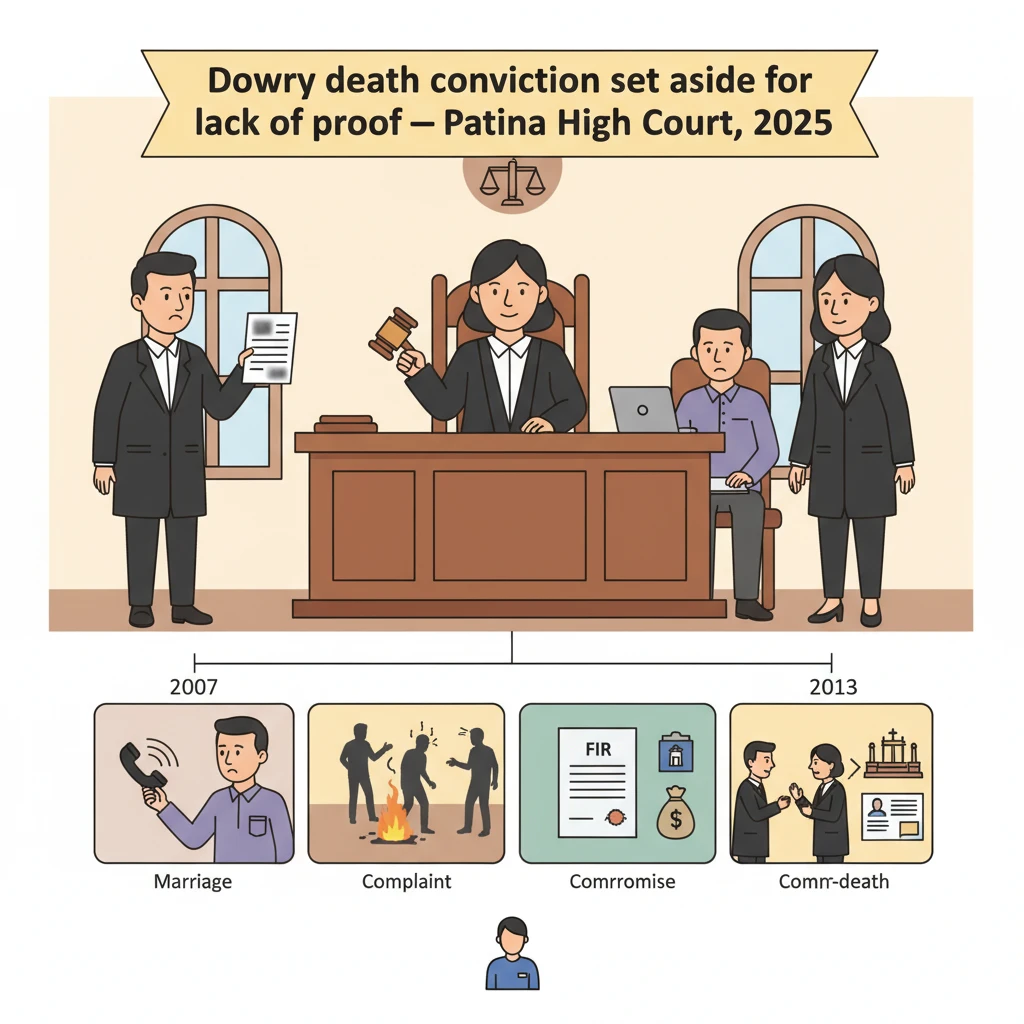
The case arose from the death of a married woman, Afsana Khatoon, in January 2013 in East Champaran district, Bihar.
On 14.01.2013, her father (the informant, later examined as PW-4) received a phone call that his daughter had been killed by her in-laws. He, along with his son Saddam (PW-1) and a co-villager, went to her matrimonial home.
When they reached there, none of the in-laws were present. Villagers told them that the police had already taken the body. They then went to Ramgarhwa Police Station and found the burnt dead body of Afsana, which was later sent for post-mortem.
The informant alleged that his daughter had been married about seven years earlier and had been repeatedly tortured for dowry. Because of this harassment, she had earlier returned to her parental home and filed Complaint Case No. 772 of 2011 before the competent Civil Court at Muzaffarpur.
That complaint case was compromised on 09.05.2012 after a “Panchayati”. On the basis of the agreement submitted before the Court, Afsana returned to her matrimonial home. Around eight months later, on 14.01.2013, she died in suspicious circumstances, leading to registration of the FIR.
The police started investigation. The appellant-husband absconded for several years. He was arrested only on 31.12.2017, about five years after the incident. On the same day, Charge-sheet No. 250 of 2017 was submitted against him under Section 304(B)/120/34 of the Indian Penal Code, though the trial court judgment mistakenly typed the date as 27.10.2018.
Charges were framed on 08.05.2019. The appellant denied the allegations, and the trial proceeded before the court of the Additional Sessions Judge-13, East Champaran, Motihari.
By judgment dated 06.11.2023 and order dated 09.11.2023, the trial court acquitted all the other accused family members but convicted the husband under Section 304(B) IPC (dowry death) and sentenced him to 10 years of rigorous imprisonment, directing set-off of the period already undergone.
Aggrieved by his conviction and sentence, the husband filed Criminal Appeal (SJ) No. 261 of 2024 before the Patna High Court.
What the Court Examined and Decided
The Patna High Court, through Hon’ble Mr. Justice Rajiv Roy, heard the appeal on 03.03.2025. It examined the prosecution evidence, the medical evidence, the requirements of Section 304(B) IPC, and the manner in which the trial court had reasoned and convicted the appellant.
The prosecution examined eight witnesses:
PW-1 Saddam Hussain, the deceased’s brother, and PW-2 Md. Dildar, her cousin, supported the basic prosecution story. They stated that about seven years earlier the marriage had taken place and, on the date of occurrence, they received information that their sister had been burnt to death. On reaching the matrimonial home, they found the in-laws absent, then located the burnt body at the police station.
They also said that Afsana used to complain to them about dowry demands by her in-laws and that when those demands were not met, she was killed.
PW-3 Noor Mohammad, the deceased’s cousin uncle, similarly supported the prosecution. He stated that after receiving information, he went with the informant and another relative to the matrimonial house, found no in-law present, and then located the burnt dead body at the police station. He mentioned that on an earlier occasion, when Afsana had returned to her parental home, she had informed them that a demand of Rs. 1,00,000/- was being made.
PW-4, the informant and father of the deceased, deposed that his daughter’s marriage had taken place in 2007. He alleged that she was tortured for dowry as the husband wanted money to start a scrap business. Due to this, she had filed Complaint Case No. 772 of 2011.
He stated that a Panchayati was held, an agreement was submitted before the Court, and his daughter was taken back to her in-laws’ home. Later, she was killed and her burnt body was found at the Ramgarhwa Police Station. From there, the body was taken to Sadar Hospital, Motihari, and then to SKMCH, Muzaffarpur, for post-mortem.
PW-5, Md. Phool Babu, son-in-law of the informant and brother-in-law of the deceased, narrated essentially the same version as PWs 1 and 2.
PW-6, Dr. Surendra Nath Sinha, Assistant Professor at SKMCH, Muzaffarpur, conducted the post-mortem on the body of Afsana.
His report (Exhibit-2) noted:
- Congested neck tissues and muscles, and congestion of the trachea with fracture of the tracheal ring and blood clots.
- Protrusion of the tongue between the teeth and bulging eyeballs.
- Post-mortem dermo-epidermal burns over the whole body, absence of red zone of reaction over the skin, and light yellow, hard subcutaneous tissues with some blisters without fluid.
- Congested abdominal viscera and lungs.
He opined that the deceased died due to asphyxia as a result of pressure over the neck, and that the time since death was within 2 to 4 days prior to post-mortem.
In cross-examination, he accepted that symptoms of asphyxia may appear in both homicide and suicide, including some hanging cases. He also stated that there was no mention of bad smell from the internal body in the report, and that the burns noted were superficial and second-degree dermo-epidermal burns. He denied the suggestion that the post-mortem was only “table work” or collusive.
PW-7, Ramayan Ram, was the second Investigating Officer, who took charge of the case in July 2017, arrested the appellant on 31.12.2017, and submitted Charge-sheet No. 250/2017 the same day under Sections 304(B)/120/34 IPC.
PW-8, Gauri Shankar Ram, was the first Investigating Officer, posted as Sub-Inspector at Ramgarhwa Police Station on 15.01.2013. He recorded statements of key family witnesses and inspected the place of occurrence, where he found a bed and a tin box. According to him, the post-mortem report recorded death due to burn injuries.
Before the trial court, the prosecution argued that the daughter was killed for dowry and that all accused should be punished. The defence argued that the married sisters-in-law (nanads), an aged mother-in-law (76 years), and a differently abled father-in-law had been wrongly roped in, and that the husband was away from the place of occurrence for work. They claimed that the woman had committed suicide over a minor issue, and that all were falsely implicated.
The trial court accepted the year of marriage as 2007, and, since the death occurred on 14.01.2013, held that it was within seven years of marriage. It applied Section 304(B) IPC (dowry death). However, it acquitted all other family members and convicted only the husband, granting the others benefit of doubt.
In appeal, counsel for the appellant argued that:
- The prosecution failed to prove the date, month, and year of marriage, and it was wrong to assume that simply saying “2007” sufficed to invoke Section 304(B), which requires the death within seven years of marriage.
- After the Panchayati and compromise on 09.05.2012, when Afsana returned to her in-laws’ home, no witness stated that any fresh dowry demand or cruelty occurred between that date and her death on 14.01.2013.
- The medical opinion showed death by asphyxia due to pressure on the neck, which could be either homicidal or suicidal, while the prosecution witnesses maintained a theory of death purely by burning.
- Given these inconsistencies and absence of “soon before death” cruelty or harassment for dowry, the legal chain for Section 304(B) IPC was incomplete, and benefit of doubt should go to the husband, just as it was given to the other family members.
The appellant relied on three Supreme Court decisions: Baljeet Singh v. State of Haryana (2004 3 SCC 122), Charan Singh @ Charanjit Singh v. State of Uttarakhand (2023 SCC OnLine SC 454), and Karan Singh v. State of Haryana (2025 0 Supreme (SC) 254), to stress that:
- The prosecution must first prove that death occurred within seven years of marriage and that “soon before” death the woman was subjected to cruelty or harassment for dowry.
- Mere unnatural death in the matrimonial home within seven years of marriage is not enough for conviction under Section 304(B) IPC.
- Courts should not convict on “moral” considerations alone or by wrongly shifting the burden on the accused.
The State, through the APP, maintained that:
- The year 2007 as the year of marriage was consistently stated and should be accepted, bringing the death within seven years.
- The earlier complaint case and its compromise on 09.05.2012 established the fact of dowry dispute.
- The presence of burn injuries along with asphyxia should not result in acquittal, and as husband, the appellant must bear responsibility.
The Patna High Court agreed with the trial court and the State on one limited point: that the consistent evidence that the marriage took place in 2007 could not be discarded merely because the exact date and month were missing. With death occurring on 14.01.2013, the Court held that it was within seven years of marriage.
However, on the crucial aspect of dowry demand “soon before death”, the High Court found a serious gap. It noted that all five key family witnesses (father, uncle, cousin brothers, and brother-in-law) had spoken about earlier dowry demands and harassment, but none stated that after the Panchayati and compromise on 09.05.2012, there was any further demand of dowry or fresh cruelty up to the date of death on 14.01.2013.
Therefore, the Court held that the “chain” required under Section 304(B) IPC was not complete. This conclusion was supported by the Supreme Court’s guidance in Baljeet Singh and other cases.
The Court also took note of the inconsistency between the prosecution’s theory of death by burning and the medical opinion of death by asphyxia due to pressure on the neck, which could arise in both homicidal and suicidal situations. The doctor had himself accepted that such symptoms may appear in suicide cases also, including hanging.
Further, the Court considered the fact that for the same set of allegations, the trial court had given benefit of doubt to all other accused family members (married sisters-in-law, aged mother-in-law, and differently abled father-in-law), but had convicted the husband alone, effectively because he was the husband and morally expected to protect his wife.
The High Court held that this amounted to a “moral conviction”, which is impermissible in a criminal trial. A husband’s moral responsibility cannot replace legal proof of specific acts of cruelty or dowry demand soon before death.
Relying on the Supreme Court’s observations in Karan Singh, the High Court emphasized that trial courts must avoid convicting merely on notions of moral blame when the legal ingredients of Section 304(B) are not proved beyond reasonable doubt.
In conclusion, the Court found that the prosecution had failed to prove beyond reasonable doubt the role of the husband in causing the death of Afsana. It noted that the appellant had already been in custody since 31.12.2017.
Accordingly, the Patna High Court set aside the conviction and sentence dated 06.11.2023/09.11.2023 under Section 304(B) IPC passed by the Additional Sessions Judge-13, East Champaran, Motihari.
The Court ordered that the appellant, Md. Islam @ Phul Babu, be released if not wanted in any other case and allowed Criminal Appeal (SJ) No. 261 of 2024.
Why This Judgment Matters
This judgment is important for families and accused persons in dowry death cases across Bihar and beyond.
It clearly states that just because a woman dies an unnatural death within seven years of marriage in her matrimonial home, the husband cannot be automatically convicted for dowry death. Courts must carefully check whether there is concrete evidence of dowry demand and cruelty “soon before” the death.
For victims’ families, the decision shows that earlier complaints and panchayat settlements are relevant, but they must also show what happened in the period immediately before the death if they want the strict dowry death law to apply.
For accused persons, especially husbands, the ruling confirms that criminal courts cannot punish a person only because he failed in his moral duty, or because of public pressure. The prosecution must still prove all ingredients of the offence.
For trial courts, the Patna High Court’s reliance on Supreme Court precedents is a reminder to avoid “moral convictions” and to strictly follow the legal requirements of Section 304(B) IPC and Section 113B of the Evidence Act.
Legal Issues and Answers
-
Issue: Was the prosecution able to prove a case of “dowry death” under Section 304(B) IPC against the husband?
Answer: No. Although the death occurred within seven years of marriage, there was no evidence that the deceased was subjected to cruelty or harassment for dowry “soon before her death”, so Section 304(B) IPC was not attracted. -
Issue: Could the husband be convicted solely because he was morally responsible as the husband, when other co-accused were given benefit of doubt?
Answer: No. The High Court held that singling out the husband for conviction in absence of specific proof, while acquitting others on the same evidence, amounted to a “moral conviction” which is not permissible in criminal law. -
Issue: Did the medical evidence on cause of death support the prosecution version of death by burning for dowry?
Answer: No. The post-mortem report showed death due to asphyxia from pressure on the neck, with burns being post-mortem and consistent with both homicidal and suicidal causes, thereby weakening the prosecution story of death solely by burning for dowry.
Cases Cited by the Court
- Baljeet Singh and Anr. v. State of Haryana, 2004 3 SCC 122
- Charan Singh @ Charanjit Singh v. State of Uttarakhand, 2023 SCC OnLine SC 454
- Karan Singh v. State of Haryana, 2025 0 Supreme (SC) 254
Case Details
Case Number: Criminal Appeal (SJ) No. 261 of 2024; arising out of Ramgarhwa P.S. Case No. 6 of 2013, District East Champaran
Case Title: Md. Islam @ Phul Babu v. The State of Bihar
Citation: 2025 (2) PLJR 375
Court: High Court of Judicature at Patna
Coram: Hon’ble Mr. Justice Rajiv Roy
Date of Patna High Court Judgment: 03.03.2025 (Uploading Date: 06.03.2025)
Trial Court Judgment and Order Challenged: Judgment dated 06.11.2023 and order dated 09.11.2023 passed by the learned Additional Sessions Judge-13, East Champaran, Motihari
Offence Alleged: Section 304(B) IPC (dowry death), with charge-sheet initially submitted under Sections 304(B)/120/34 IPC
Nature of Case: Criminal appeal (single judge) against conviction and sentence in a sessions trial for alleged dowry death
Appellant’s Advocates: Mr. Bimlesh Kumar Pandey, Advocate; Mr. Rahul Kumar, Advocate (for the appellant)
Respondent’s Advocate: Mr. Bal Mukund Prasad Sinha, APP (for the State of Bihar)
Link to Judgment: View full Patna High Court judgment
If you found this explanation helpful and wish to stay informed about
how legal developments may affect your rights in Bihar,
you may consider following Samvida Law Associates for more updates.







