
Case Background
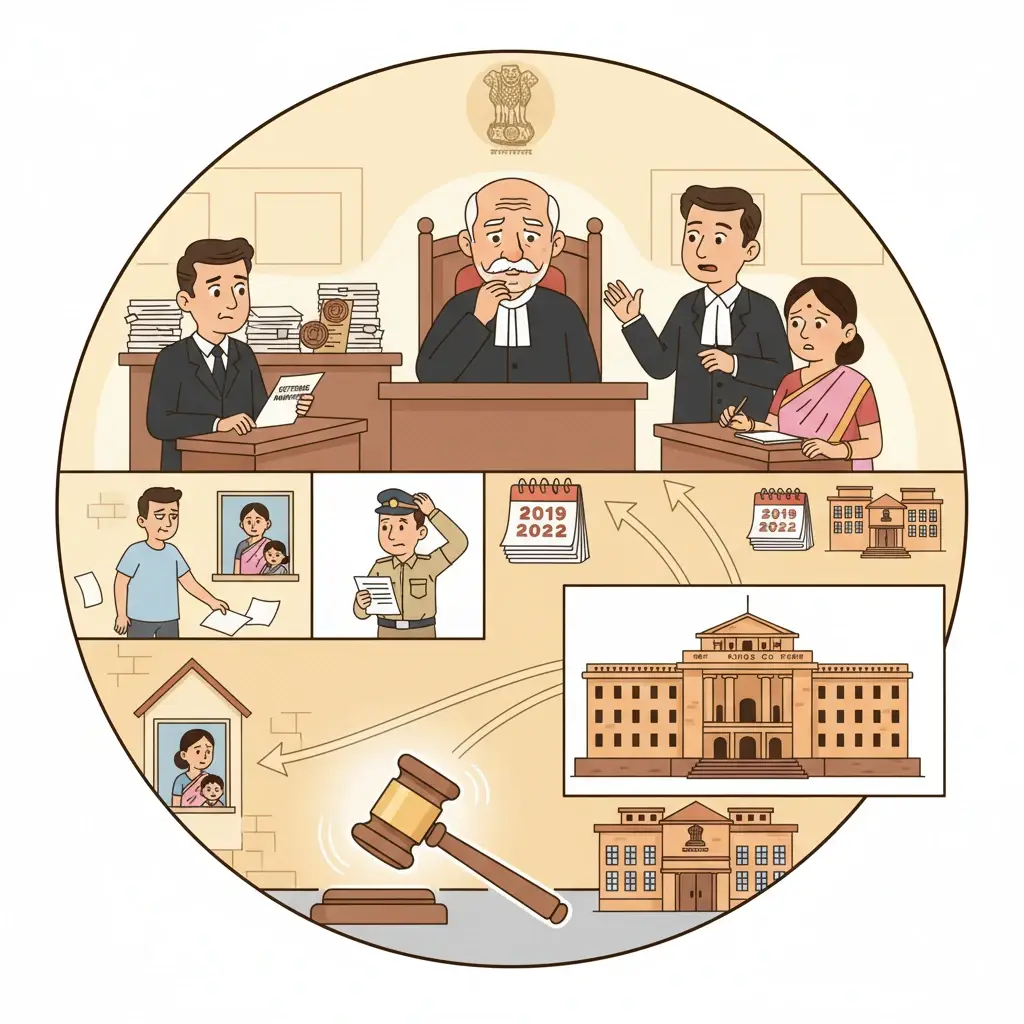
This matter arose from Criminal Revision No. 65 of 2019 before the Patna High Court. The case related to a dispute between a husband (the petitioner) and his wife and minor daughter (opposite parties), in which maintenance had been awarded by the Family Court.
The petitioner approached the Patna High Court by filing a criminal revision. During the hearing on 12-09-2022, his counsel, Mr. Nafisuzzoha, sought permission to withdraw the revision application. The Court, presided over by Hon’ble Mr. Justice Rajeev Ranjan Prasad, allowed the withdrawal.
Before the withdrawal, the petitioner’s counsel drew the Court’s attention to a broader and serious issue. He highlighted the “pitiable condition” of neglected women and children who had been granted maintenance by Family Courts, but were not receiving any money because the husbands had filed revision applications in the High Court and then stopped paying.
The counsel also pointed out another disturbing fact: even where the Family Courts had issued distress warrants to recover maintenance amounts, those warrants were not being executed by the local police.
The learned Additional Public Prosecutor for the State, Mr. Mukeshwar Dayal, accepted that the execution of distress warrants is the responsibility of the concerned police officers. He submitted that if this was not being done, the Court could consider issuing suitable directions.
What the Court Examined and Decided
Although the criminal revision itself was withdrawn and therefore not decided on merits, the Patna High Court treated the larger issues raised by counsel as serious and worthy of immediate attention. The core concern was the non-payment of maintenance to women and children, despite clear orders of the Family Courts.
The Court noted the submissions that in many cases revision applications against maintenance orders had been pending in the High Court for 5–7 years. During this time, husbands were allegedly not paying maintenance after filing the revisions, and, at the same time, distress warrants issued by Family Courts were not being executed.
The Court recorded that these facts were “disturbing the judicial conscience” of the Court. This implies that the Court found it deeply troubling that vulnerable persons—neglected women and children—were being denied the benefit of maintenance orders that were already in their favour.
The focus of the Court’s intervention was not on the correctness of individual maintenance orders, but on the enforcement machinery. The problem was two-fold:
First, delay in disposal of revision applications in the High Court was being used as a ground, in practice, for husbands to stop paying maintenance. Second, even after distress warrants were issued by the Principal Judges of Family Courts to recover the maintenance dues, local police were reportedly not executing such warrants.
The State’s counsel candidly accepted that it is indeed the duty of police officers to execute distress warrants. This acknowledgment created the foundation for the Court to issue detailed directions in exercise of its constitutional role.
Recognising its responsibility as a Constitutional Court, the Patna High Court decided that it would not ignore this systemic problem. While allowing the petitioner to withdraw the criminal revision, the Court nonetheless passed a detailed order aimed at improving the enforcement of maintenance orders across the State of Bihar.
First, the Court directed that all learned Principal Judges of Family Courts across Bihar must examine their records. Specifically, they were asked to identify all cases in which distress warrants had been issued for realisation of maintenance amounts but had not yet been executed.
Second, the Court required that, within 30 days from the date of communication of this High Court order, each Principal Judge must prepare and forward a list of such cases to the Senior Superintendent of Police or Superintendent of Police of the concerned district. This list must also mention the date on which each distress warrant had been issued.
Third, the Court placed clear responsibility on the heads of district police. It stated that it would be the “responsibility of the Senior Superintendent of Police/Superintendent of Police” to ensure that all such distress warrants are duly executed within 30 days from the date of receipt of information from the Family Court, unless execution has been stayed by a competent court of law.
Fourth, the Court required that after this 30-day execution period, an execution report must be submitted by the police to the Principal Judge of the respective Family Court within 15 days. This created a firm reporting structure and accountability timeline.
The Court also provided a follow-up mechanism in case of non-compliance. If a distress warrant is not executed, and if no explanation is given by the office of the Senior Superintendent of Police/Superintendent of Police to the satisfaction of the Principal Judge, then the Principal Judge must call upon the concerned officer to file an affidavit.
This affidavit must explain the reasons for non-execution of the distress warrant and the failure to submit a timely report. It is to be filed within 30 days. This requirement ensures that the responsible officer must personally account for the inaction.
The High Court went one step further to strengthen enforcement. It held that, upon receiving such an affidavit, if the Principal Judge finds that his or her order has been “willfully disobeyed and not complied with,” the matter would be referred to the Patna High Court for initiation of contempt proceedings against the erring officials.
Contempt of court is a serious consequence. By explicitly mentioning that contempt proceedings may be initiated, the High Court signalled that failure to execute distress warrants in maintenance cases would not be taken lightly.
Finally, the Court ordered that a copy of this order be communicated to the Director General of Police, Patna, for appropriate instruction. It also directed that copies be sent to all District Courts across the State of Bihar for “circulation and implementation.”
Through these directions, the Court sought to ensure that women and children who are entitled to maintenance are not left helpless merely because of bureaucratic delay or lack of police action. The order aimed to bring coordination between Family Courts and police authorities so that distress warrants are taken seriously and executed within a defined time frame.
Although the original criminal revision was disposed of as withdrawn, the Patna High Court used the occasion to address a recurring and systemic issue. The order shows the Court’s concern for the effective enforcement of maintenance orders, especially where neglected women and children are involved.
Why This Judgment Matters
This judgment is important for women and children in Bihar who have obtained maintenance orders from Family Courts but struggle to actually receive the money.
By putting clear responsibility on Senior Superintendents of Police and Superintendents of Police to execute distress warrants within a fixed time, the Court has tried to close the gap between “order on paper” and “money in hand.”
It also gives Principal Judges of Family Courts a structured process to follow when warrants are not executed, including the power to demand affidavits from police officers and to refer cases to the High Court for contempt if there is willful disobedience.
For lawyers and litigants, especially in maintenance matters, this order provides a tool to press for faster execution of distress warrants. It sends a clear message that pendency of revision cases or police inaction cannot be excuses to deny maintenance to those who depend on it for survival.
Legal Issues and Answers
- Issue: What should be done when distress warrants issued by Family Courts for recovery of maintenance amounts are not being executed by the local police, leading to hardship for women and children?
Answer: The Patna High Court directed all Principal Judges of Family Courts to identify such pending distress warrants, send details to the Senior Superintendent of Police/Superintendent of Police, and required the police to execute them within 30 days, submit reports, face affidavit-based accountability, and risk contempt proceedings in case of willful disobedience. - Issue: Can the High Court issue general directions in a criminal revision that is being withdrawn, to address a broader systemic problem highlighted during arguments?
Answer: Yes. Acting as a Constitutional Court, the Patna High Court allowed withdrawal of the revision but still passed statewide directions to ensure execution of distress warrants and protection of maintenance rights of women and children.
Cases Cited by the Court
- No prior judgments or case law have been cited or relied upon in the available text of this order.
Case Details
Case Number: Criminal Revision No. 65 of 2019
Case Title: Sarfaraz Alam @ Md. Sarfaraz Alam vs. The State of Bihar & Ors.
Citation: 2023 (1) PLJR 756
Coram: Hon’ble Mr. Justice Rajeev Ranjan Prasad
Advocates:
- For the Petitioner: Mr. Nafisuzzoha, Advocate
- For the State: Mr. Mukeshwar Dayal, Advocate (APP)
Nature of the Case: Criminal revision (with general directions issued regarding execution of distress warrants in maintenance matters)
Date of Order: 12-09-2022
Court: High Court of Judicature at Patna
Judgement Link; https://patnahighcourt.gov.in/vieworder/NyM2NSMyMDE5IzMjTg==-JbLLFNShAYY=
If you found this explanation helpful and wish to stay informed about
how legal developments may affect your rights in Bihar,
you may consider following Samvida Law Associates for more updates.







