
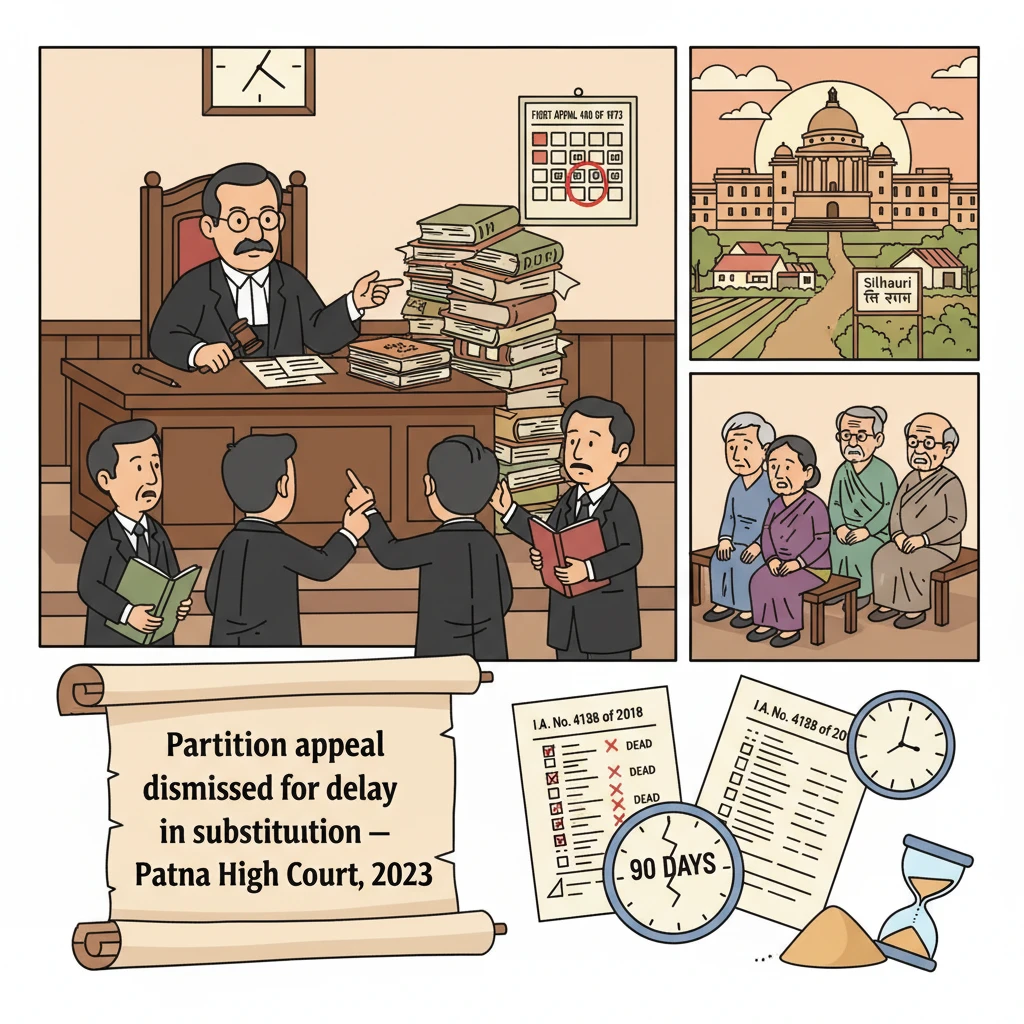
The Court held that the appeal had fully abated because many parties died and their heirs were not brought on record within time.
The judges found the delay of up to 20 years unjustified and refused to condone it.
As a result, the appeal was dismissed as abated and all other applications were closed.
Case Background
The case started as a partition suit before the trial court. A decree was passed there, deciding the shares of the co-sharers in the joint family property.
Against that decree, the present First Appeal No. 408 of 1973 was filed before the Patna High Court.
The appeal involved a large number of family members as parties on both sides.
Over time, several appellants and respondents died.
Under the law, whenever a party dies during the pendency of a case, his or her legal heirs have to be substituted within a fixed period (normally 90 days), failing which the appeal abates against that party.
In this appeal, many such deaths occurred over the years.
Interlocutory applications were filed from time to time to bring on record some of the legal heirs and to set aside abatement.
However, these steps were not taken promptly or for all deceased parties.
By the time the matter came up before the Patna High Court on 18.01.2023, the key question was no longer about the merits of the partition decree.
The main issue had become whether the First Appeal itself had survived in law, in view of the deaths of several parties and long, unexplained delays in substitution.
What the Court Examined and Decided
The Patna High Court, through Hon’ble Mr. Justice Ahsanuddin Amanullah, heard arguments on multiple interlocutory applications.
Most important among them were Interlocutory Application (I.A.) No. 4138 of 2018 and I.A. No. 24 of 2021, both filed on behalf of respondent no. 9.
In these interlocutory applications, respondent no. 9 sought a declaration that the entire First Appeal had abated.
The ground was that several respondents and some appellants had died long back and had not been substituted within the time prescribed by law.
According to the submissions made on behalf of respondents no. 9 and 19, the following parties had died: respondents no. 8(i), 8(iii), 9, 23, 24, 29(c), 33 and 34, and later respondents no. 11, 26, 30(d), 32(ii), as well as appellants no. 9 and 11.
The Court was informed that many of these deaths took place between the years 1999, 2005, 2006, 2010, 2015, 2016, 2017, 2020 and 2021.
To meet these deaths, various substitution applications had been filed by the appellants:
For respondents no. 8(i), 8(iii), 9, 23, 24, 29(c), 33 and 34, I.A. No. 16 of 2019 was filed on 06.02.2019.
For respondents no. 11, 26 and 30(d), I.A. No. 22 of 2021 was filed.
For respondents no. 30(d) and 32(ii), I.A. No. 20 of 2021 was filed.
However, the Court noted a crucial gap: no application had been filed at all with regard to respondent no. 26 and appellants no. 9 and 11, although their deaths had also been reported.
Counsel for respondents no. 9 and 19 argued that the delays in filing these substitution applications ranged from one year to as long as 20 years.
Such extraordinary delay, he submitted, showed “absolute casualness” and “willful delay and laches” on the part of the appellants.
He further submitted that the explanation for delay was vague and insufficient.
The only excuse offered was that the appellants did not know about the deaths.
This, he argued, was difficult to believe because the dispute was a partition suit and the parties were agnates (close relations in the same family line).
In such a situation, it was unrealistic to claim ignorance of the death of close family members for almost two decades.
On the legal side, respondents relied on two important Supreme Court judgments.
First, Majji Sannemma alias Sanyasirao vs. Reddy Sirdevi and others, 2021 SCC Online SC 1260, was cited to show that:
the discretion to condone delay must be exercised judicially;
“sufficient cause” cannot be stretched where negligence, inaction, or lack of bona fides are evident; and
even if the result is harsh for a party, the law of limitation must be applied strictly.
Second, reliance was placed on Budh Ram v. Bansi, (2010) 11 SCC 476.
In that case, the Supreme Court held that where there is a joint and indivisible decree, abatement of the appeal against one necessary party can lead to abatement against others also.
In a partition matter, until actual partition, all co-sharers have a joint and indivisible right in the entire property.
Therefore, if some necessary co-sharers are no longer parties to the appeal due to abatement, the appeal itself becomes incompetent.
Counsel also referred to earlier orders passed in the appeal.
An order dated 24.11.1994 showed that the appeal had already abated against the heirs of deceased respondent no. 3(i).
Another order dated 12.02.2009 granted two weeks’ time to serve a copy of I.A. No. 193 of 2007 on the guardian advocate of minor respondents no. 11 to 21 and 23 to 25.
That order was “peremptory”, meaning mandatory, and stated that non-compliance would result in rejection.
Due to non-compliance, the appeal stood rejected as against deceased appellant no. 2 and respondent no. 9.
On the other hand, counsel for the appellants requested the Court to take a lenient view.
He argued that this being a partition suit, the rights of the parties should be decided on the merits rather than being thrown out on procedural grounds.
However, when the Court asked for a proper, concrete explanation for the long delays in substitution, counsel was unable to give any substantive reply.
After hearing both sides, the Patna High Court considered the legal position and the factual history of the case.
The Court first noted that the rights of the parties had already been adjudicated by the original trial court, which had passed the partition decree.
Therefore, it could not be said that the rights of the parties had never been decided at all.
The Court then turned to the law of limitation.
Under the applicable law, substitution of legal heirs after the death of a party must be done within 90 days.
In this case, multiple parties were not substituted for years together, extending up to 20 years in some instances.
In such circumstances, the Court held that it was not persuaded to interfere with the abatement that had already taken place.
The Court accepted the position that abatement “is automatic” when substitution is not made within time and that it has to be set aside by a formal order — which had not been secured in respect of several parties even by 2023.
Coming to the question whether only part of the appeal had abated or the entire appeal, the Court looked at the nature of the case.
It observed that in a partition suit, until a final decree and actual partition, “in the entire property, there is indivisible and inseparable jointness”.
This means every co-sharer has interest in the whole property, not only in a fixed physical portion.
Because of this, the absence of many co-sharers, whose shares lay in the corpus of the suit property, made the appeal itself incompetent to proceed further.
The Court specifically stated that the ratio of Majji Sannemma alias Sanyasirao and Budh Ram applied to the facts of the present case and supported the objections raised by respondents no. 9 and 19.
On this reasoning, the Court allowed Interlocutory Applications No. 4138 of 2018 and 24 of 2021.
As a direct consequence, the First Appeal itself was dismissed as abated.
Finally, the Court noted that once the appeal itself had abated, all other pending interlocutory applications had become infructuous and were accordingly disposed of.
Why This Judgment Matters
This judgment of the Patna High Court is important for anyone involved in long-running civil disputes, especially partition suits between family members.
It stresses that courts cannot overlook serious delays in bringing legal heirs on record after a party dies.
The case shows that even if the subject is family property and the parties want a full hearing on the merits, procedural law still matters.
If a party dies and their heirs are not substituted within the prescribed period, the appeal can abate automatically.
The decision also underlines that in partition matters, all co-sharers are necessary parties until final partition.
If many co-sharers are no longer on record because of abatement, the entire appeal can fail, not just a small part of it.
For litigants, this judgment is a clear warning: keep track of all parties, report deaths promptly, and file substitution applications with proper explanations and within time.
Otherwise, years of litigation and effort may go to waste, as happened here, where a first appeal pending since 1973 ended not on merits but due to procedural lapses.
Legal Issues and Answers
- Issue: Whether long-delayed and inadequately explained applications for substitution of deceased parties in a partition appeal can be allowed, and the resulting abatement set aside.
Answer: No. The Patna High Court held that with delays extending up to 20 years and only vague explanations, there was no sufficient cause to condone the delay. The abatement stood and was not interfered with. - Issue: Whether, in a partition suit involving joint and indivisible rights, abatement against several co-sharers leads to abatement of the entire appeal.
Answer: Yes. The Court held that in a partition suit, the property remains jointly owned until partition, so the absence of many co-sharers as parties makes the whole appeal incompetent. The entire First Appeal was, therefore, dismissed as abated. - Issue: Whether the Court should adopt a lenient approach in a long-pending partition appeal only to decide rights on merits, despite clear violation of limitation rules.
Answer: No. Relying on Supreme Court precedents, the Court held that the law of limitation must be applied with its full force where negligence and inaction are evident, even if it appears harsh, and thus refused a lenient approach.
Cases Cited by the Court
- Majji Sannemma alias Sanyasirao vs. Reddy Sirdevi and others, 2021 SCC Online SC 1260
- Budh Ram v. Bansi, (2010) 11 Supreme Court Cases 476
Case Details
Case Number: First Appeal No. 408 of 1973; along with I.A. No. 4138 of 2018 and I.A. No. 24 of 2021
Case Title: Bhawar Prasad (since deceased) & Ors. v. Jangali Devi (since deceased) & Ors.
Coram: Hon’ble Mr. Justice Ahsanuddin Amanullah
Citation: 2023 (1) PLJR 739
Advocates: For the Appellants: Mr. Prabhu Narayan Sharma, Advocate; For Respondents No. 9 and 19: Mr. Ashok Kumar and Mr. Sushil Kumar Ojha, Advocates
Nature of the Case: First appeal arising out of a partition suit, with multiple interlocutory applications on substitution and abatement
Date of Judgment: 18-01-2023
Court: High Court of Judicature at Patna
Link to Judgment:https://patnahighcourt.gov.in/viewjudgment/MyMxMTExIzIwMTgjMSNO-ZM–ak1–V2hJximE=
If you found this explanation helpful and wish to stay informed about
how legal developments may affect your rights in Bihar,
you may consider following Samvida Law Associates for more updates.







