
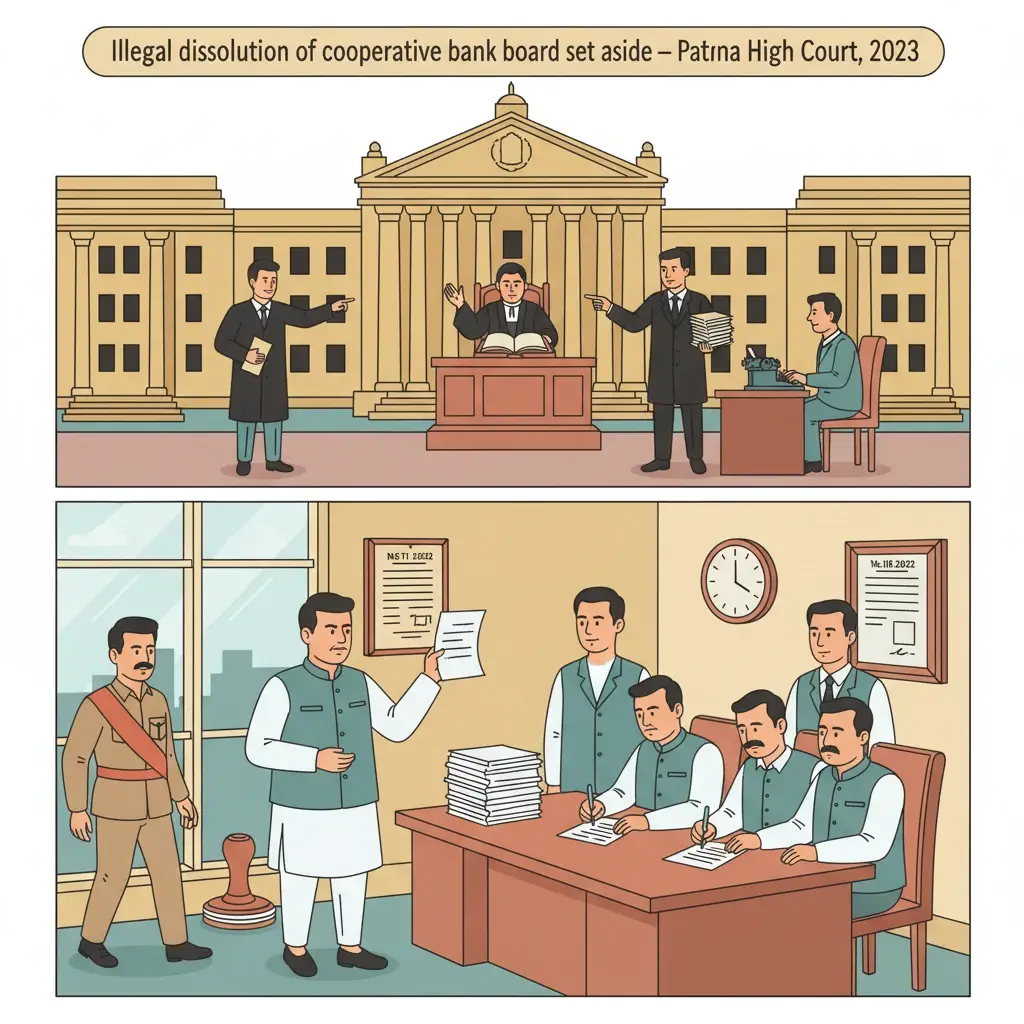
Case Background
This case arose from a dispute over the management of Begusarai Central Co-operative Bank Ltd., a Central Co-operative Bank in Begusarai district, Bihar.
The elected Chairman of the Bank’s Board of Directors filed a writ petition before the Patna High Court. He challenged an order dated 14.10.2022, bearing Memo No. 8249, issued by the Registrar, Co-operative Societies, Bihar, Patna.
By this order, the Registrar dissolved the Managing Committee/Board of Directors of Begusarai Central Co-operative Bank Ltd. and appointed the District Magistrate, Begusarai, as Administrator of the Bank.
The Registrar’s order stated that out of 9 members/directors, four members had resigned. Their resignations were said to have been accepted based on the oral statement of the Managing Director of the Bank. The order also recorded that the resignation process was initiated in the Registrar’s official chamber on 14.10.2022 and, on the same date, the Board of Directors was dissolved.
The petitioner claimed that the Registrar himself admitted in the order that as per the Bank’s bye-laws, the issue of resignation of Board members could only be discussed and decided by the Board/Managing Committee of the Bank. Despite this, the Registrar proceeded on the Managing Director’s statement and treated the resignations as accepted, leading to dissolution of the Board invoking Section 41(5) of the Bihar Co-operative Societies Act, 1935.
What the Court Examined and Decided
The Patna High Court examined whether the Registrar’s order dated 14.10.2022 dissolving the Board of Begusarai Central Co-operative Bank Ltd. was legally and factually sustainable.
The petitioner’s counsel argued that the order was illegal and mala fide. He submitted that four elected members of the Board (respondents 5 to 8) had submitted their resignations addressed to the Chairman of the Board, requesting him to accept them. These resignation letters were then forwarded by the Managing Director of the Bank to the Registrar.
The petitioner argued that the irregularities started from the beginning. Respondents 5 to 8 had affirmed affidavits on 10.10.2022 and allegedly submitted their actual resignation letters on 11.10.2022, addressed to the Chairman. The Managing Director personally carried those resignations to the Registrar, who then called respondents 5 to 8, recorded their statements, and passed the impugned order.
It was argued that this was done at the behest of the Managing Director and in violation of the Act as well as the Bank’s bye-laws. The petitioner asserted that the total strength of the Board, in practice, was 11: nine elected members, the Managing Director as ex officio member and Secretary, and one nominated member under Section 44AX of the Act (Joint Registrar, Co-operative Societies, Bhagalpur). The maximum strength under Section 14(2) for a Central Co-operative Society is 15, but the actually constituted Board was smaller.
The petitioner contended that even if four persons resigned, the Board would reduce from 11 to 7, which still met the quorum requirement: 50% under the Act and 6 members under the bye-laws. He argued that counting 50% on the theoretical maximum strength of 15 was wrong, because 15 is only a maximum limit, not a mandatory requirement at all times.
He further argued that the State authorities had a duty to fill the remaining vacancies, and the existing Board could not be blamed or penalised for non-filling of those seats.
The petitioner also challenged the procedure followed by the Registrar. He submitted that:
- Resignations addressed to the Chairman had to be placed before and accepted by the Board, not by the Registrar directly.
- The Managing Director had no authority to take those resignations to the Registrar.
- The Registrar wrongly treated there as being “deemed resignation” and “deemed acceptance”, without any formal order of acceptance.
- The Registrar failed to give notice or an opportunity of hearing to the remaining elected members before dissolving the Board, violating principles of natural justice.
- For financial institutions like the Bank, Section 41(1) of the Act requires concurrence of the Reserve Bank of India when superseding or dissolving the Board, which was not obtained.
Reliance was placed on Rabindra Nath Mishra v. State of Bihar, 2020 (2) PLJR 644, and on State of M.P. v. Sanjay Nagayach, (2013) 7 SCC 25 to seek restoration and continuation of the Board for its remaining term.
The State’s counsel supported the Registrar’s order, arguing that the Registrar had independent power under Section 41(5) of the Act. According to the State, with four resignations, the Board’s strength dropped below 50%, justifying dissolution.
However, when directly questioned by the Court, the State’s counsel clarified, based on records, that after the election held on 18.01.2018, the constituted Board actually had only 10 members. The Joint Registrar, Co-operative Societies, Bhagalpur, was never nominated to the Board after that election.
Counsel for respondents 5 to 8 argued that under Section 14(1) of the Act, the total number of Board members for the Bank was 15, and that number should be used to determine applicability of Section 41(5). He also argued that Section 41(5) could be invoked independently of Section 41(1), so no prior concurrence of the Reserve Bank of India was needed.
He submitted that since respondents 5 to 8 personally appeared before the Registrar and confirmed their resignations, no further proof was needed. In his view, once the vacancies crossed 50% of 15, the Board automatically ceased to exist and the Registrar was bound to act. He relied on:
- Vinay Kumra v. State of Bihar, 2016 (3) PLJR 160
- Indradeo Prasad v. State of Bihar, 2016 (4) PLJR 903
- Ashok Kumar Singh v. State of Bihar, 2017 (1) PLJR 919
He also argued that the bye-laws framed under Rule 15 of the Bihar Co-operative Societies Rules, 1959 could not override the statutory provisions, relying on Supreme Court decisions in:
- Co-op. Cr. Bank v. Ind. Tri., Hyderabad, AIR 1970 SC 245
- Zoroastrian Co-op. Hsg. Socy. Ltd. v. Dist. Registrar, Co-op. Societies (Urban), AIR 2005 SC 2306
The Bank’s counsel did not take an independent stand as all sides were already represented.
The High Court then examined the statutory provisions, particularly Section 14(2), Section 41(1), Section 41(5) and Section 44AX of the Bihar Co-operative Societies Act, 1935. Section 14(2) makes clear that 15 is the “maximum” number of members in the managing committee of a Central Co-operative Society.
On propriety and procedure, the Court held:
- Resignations were addressed to the Chairman. Unless the Board decided on them, or the members approached the Registrar for inaction, the Managing Director had no authority to carry those resignations to the Registrar.
- Even if the resignations reached the Registrar, he was required to issue notice to remaining Board members and hear them before acting.
- The Registrar did not formally deal with the acceptance of resignations; he simply presumed that they stood accepted.
- There can be no “deemed acceptance” of resignation; a formal order is required to record that a person has resigned and that a vacancy exists.
- No such order existed; the impugned order and the pleadings were silent on formal acceptance.
- Even assuming (without deciding) that the Registrar had power to accept resignations, he first had to pass a specific order accepting them, and then separately issue notice to the remaining members before dissolving the Board.
- Neither step was followed.
On the core legal question—whether the conditions of Section 41(5) were met—the Court held that:
- Though the maximum strength of the Board is 15, it is not mandatory to have all 15 filled at all times.
- Section 14(2) expressly speaks of a “maximum” number, not a fixed compulsory number.
- In this case, the actually constituted Board, as per State records, had only 10 members.
- The Board and its elected members could not be blamed for the State’s failure to fill other seats, nor could adverse consequences be imposed on that basis.
- On the State’s own stand that the Board had 10 members, even if four resigned, five elected members were still available and functioning.
- Thus, the minimum requirement under Section 41(5) (vacancy of half the total seats) was not satisfied with reference to the actually constituted Board.
- Therefore, Section 41(5) could not have been invoked in this case.
The Court held that the judgments cited by respondents 5 to 8 on automatic dissolution when vacancy exceeds 50% did not apply, because here the factual foundation for 50% vacancy was missing.
Similarly, the Supreme Court decisions on the primacy of statutory provisions over bye-laws were found inapplicable, because even without referring to the bye-laws (which required 6 members), there were at least 5 elected members—constituting 50% of the actually constituted Board of 10 as accepted by the State.
The Court strongly observed that cutting short the life of a duly elected body in a casual and summary manner, as done in this case, is arbitrary and unjustified.
Accordingly, the High Court set aside the Registrar’s order dated 14.10.2022. The dissolved Board of the Bank stood restored.
The Court then referred to the Supreme Court’s judgment in State of M.P. v. Sanjay Nagayach, where an illegally superseded Board was permitted to function for its remaining period of life. Following that ratio, the Court directed that the period during which the Board remained wrongly dissolved (from the date it was superseded till the date of the High Court’s judgment) would be added to its original five-year term. Thus, the Board was permitted to function for that extended period.
The writ petition was allowed in these terms.
Why This Judgment Matters
This judgment is important for elected members of co-operative banks and societies across Bihar.
First, it makes clear that a Registrar or government officer cannot casually dissolve an elected Board on the mere basis of some resignations, without properly verifying facts and following legal procedure.
Second, it protects the democratic mandate of members of a co-operative society. The Court emphasised that the life of an elected body cannot be cut short in an arbitrary or summary manner.
Third, it clarifies that when the law prescribes a maximum number of Board members, the authorities must look at the actual constituted strength, not an ideal or theoretical number, to assess vacancies and quorum.
Fourth, the decision underlines that resignations must be formally accepted, and there can be no “deemed” acceptance. Until a formal order is passed, vacancies cannot be presumed.
Finally, by extending the term of the restored Board for the period it remained wrongfully dissolved, the Court has sent a strong message that unlawful interference with elected co-operative management will not only be struck down but practical relief will also be granted to undo the harm as far as possible.
Legal Issues and Answers
- Issue: Could the Registrar validly dissolve the Board of Begusarai Central Co-operative Bank Ltd. under Section 41(5) of the Bihar Co-operative Societies Act, 1935 on the basis of alleged resignations by four members?
Answer: No. The Patna High Court held that the Registrar’s order was unsustainable because resignations were neither formally accepted nor processed in accordance with law, no notice or hearing was given to remaining members, and on the State’s own records the actually constituted Board had 10 members, of which at least 5 remained. Thus, the condition of half the total seats becoming vacant under Section 41(5) was not met. - Issue: Could the Managing Director bypass the Chairman and the Board by directly taking resignation letters to the Registrar, and could the Registrar act on them without involving the Board?
Answer: No. The Court held that the Managing Director had no authority to carry resignations addressed to the Chairman to the Registrar, and the Registrar could not unilaterally act on them. The Registrar was bound to give notice to remaining Board members and could not presume “deemed acceptance” of resignations in the absence of a formal order. - Issue: What relief should be granted when an elected Board of a co-operative bank is wrongly dissolved before the end of its term?
Answer: The Court not only set aside the dissolution order and restored the Board, but also directed that the period during which the Board remained superseded would be added to its original five-year term, following the Supreme Court’s approach in State of M.P. v. Sanjay Nagayach.
Cases Cited by the Court
- Rabindra Nath Mishra v. State of Bihar, 2020 (2) PLJR 644
- State of M.P. v. Sanjay Nagayach, (2013) 7 SCC 25
- Vinay Kumra v. State of Bihar, 2016 (3) PLJR 160
- Indradeo Prasad v. State of Bihar, 2016 (4) PLJR 903
- Ashok Kumar Singh v. State of Bihar, 2017 (1) PLJR 919
- Co-op. Cr. Bank v. Ind. Tri., Hyderabad, AIR 1970 SC 245
- Zoroastrian Co-op. Hsg. Socy. Ltd. v. Dist. Registrar, Co-op. Societies (Urban), AIR 2005 SC 2306
Case Details
Case Number: Civil Writ Jurisdiction Case No. 15746 of 2022
Case Title: Narendra Singh @ Narendra Prasad Singh v. The State of Bihar & Ors.
Citation: 2023 (1) PLJR 733
Court: High Court of Judicature at Patna
Coram: Hon’ble Mr. Justice Ahsanuddin Amanullah and Hon’ble Mr. Justice Harish Kumar
Date of Judgment: 10.01.2023
Advocates:
- For the Petitioner: Mr. Aditya Narain Singh, Advocate with Mr. Kundan Kumar Sinha, Advocate
- For the State: Mr. Mahtab Alam, AC to SC 20
- For Respondent No. 4 (Managing Director, Begusarai Central Co-operative Bank Ltd.): Mr. Patanjali Rishi, Advocate
- For Respondents No. 5 to 8: Mr. Yogendra Mishra, Senior Advocate with Ms. Swati Mishra, Advocate
Nature of the Case: Writ petition (Civil) challenging an order of the Registrar, Co-operative Societies dissolving the Board/Managing Committee of a Central Co-operative Bank and appointing an Administrator.
Link of the judgement ; https://patnahighcourt.gov.in/viewjudgment/MTUjMTU3NDYjMjAyMiMxI04=-x5zND–ak1–RE–ak1–f0=
If you found this explanation helpful and wish to stay informed about
how legal developments may affect your rights in Bihar,
you may consider following Samvida Law Associates for more updates.







