
Simplified Explanation of the Judgment
In this 2022 judgment, the Patna High Court dismissed an appeal filed by a landowner who claimed ownership over land that had been acquired by the State for the construction of an Industrial Training Institute (ITI) building in Samastipur district. The Court upheld the single-judge’s earlier decision and reiterated that questions involving ownership or title over land cannot be decided through writ petitions under Article 226 of the Constitution but must be decided by a competent civil court.
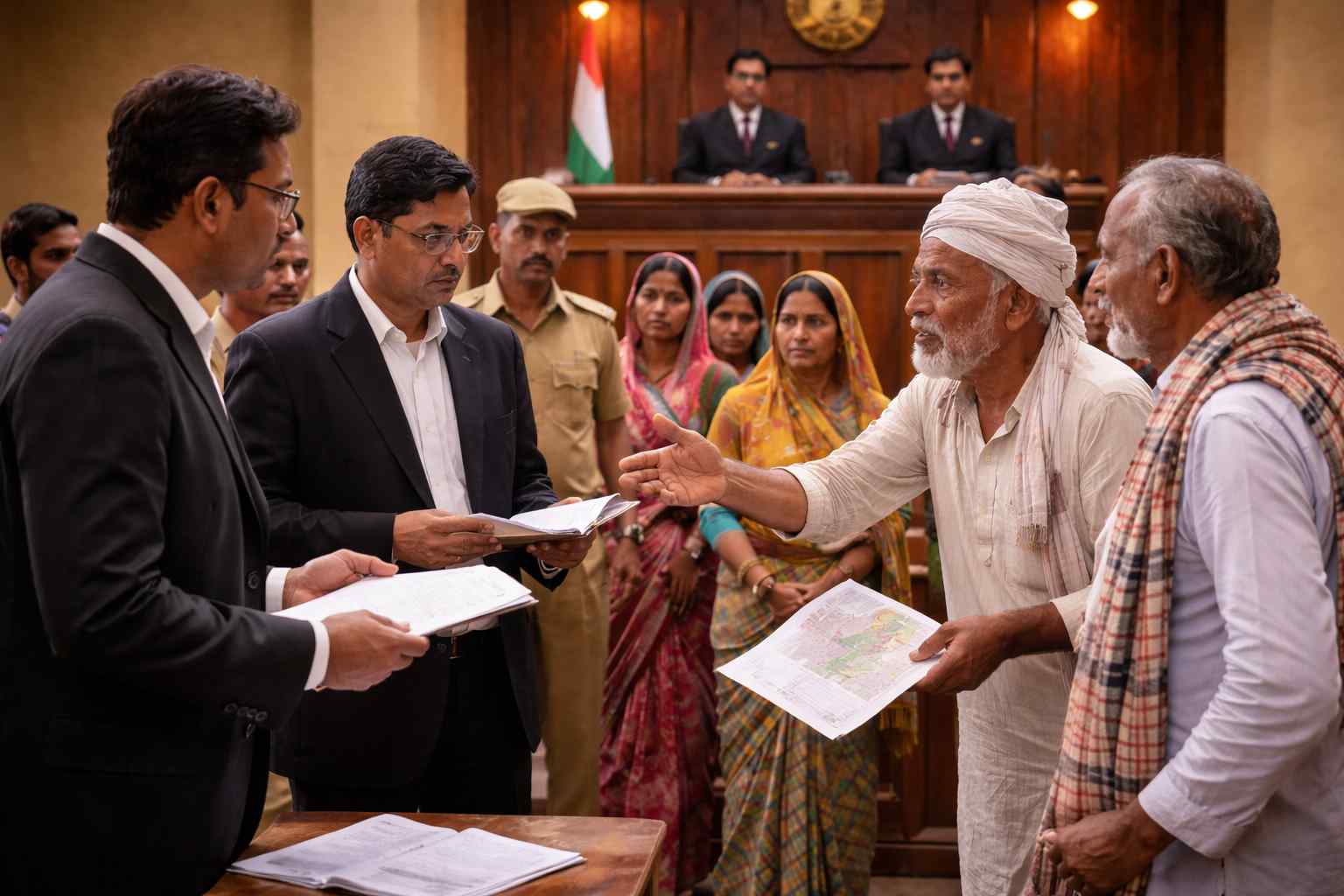
The appellant, a resident of Darba village, Samastipur, had filed a writ petition alleging that the State Government had acquired his land without providing notice or compensation. He asserted that the land in question was his raiyati land (privately owned agricultural land).
The State Government, however, contested this claim and submitted documentary evidence showing that the land on which the ITI building was constructed was not the appellant’s property but rather “Gairmajarua Aam” land, meaning government land meant for public use. The State also pointed out that public notices had been issued before the acquisition and that the boundaries of the land owned by the appellant did not match those of the land acquired for the ITI project.
The learned Single Judge of the Patna High Court had earlier dismissed the writ petition on the ground that such matters involve declaration of ownership and title, which cannot be decided in a writ jurisdiction. The court advised the appellant to file a civil suit before the appropriate court to prove ownership and seek compensation accordingly. The judge also clarified that any claim under the Right to Fair Compensation and Transparency in Land Acquisition, Rehabilitation and Resettlement Act, 2013 (LARR Act, 2013) could only arise if the appellant successfully proved ownership in the civil court.
In the present appeal, the Division Bench of Hon’ble Mr. Justice Ashutosh Kumar and Hon’ble Mr. Justice Nawneet Kumar Pandey agreed with the single-judge’s findings and dismissed the appeal. The Court held that the appellant’s claim was purely a dispute of title, not a procedural irregularity in acquisition.
The High Court emphasized that the writ jurisdiction is not the correct forum to decide such ownership claims, especially where factual disputes exist regarding land boundaries and classification. The appropriate remedy lies before the civil court, which can examine documents, records, and evidence to determine ownership conclusively.
Thus, while the High Court acknowledged the appellant’s right to approach a civil court, it found no reason to interfere with the single-judge’s order.
Significance or Implication of the Judgment
This ruling is significant for landowners and litigants in Bihar and across India because it clarifies the limits of writ jurisdiction in land acquisition cases. When the core dispute is about who owns the land, the High Court cannot resolve the issue under Article 226 — such cases require a civil trial with examination of evidence and land records.
The decision also highlights the difference between procedural challenges to land acquisition (which can be raised in a writ) and ownership disputes (which must go to civil courts).
For the general public, the judgment reinforces the principle that ownership must be proven before compensation can be claimed under the LARR Act, 2013. For government authorities, it supports lawful acquisition for public purposes when proper procedure and documentation are followed.
Legal Issue(s) Decided and the Court’s Decision
- Whether the appellant could challenge land acquisition under Article 226 claiming ownership:
➤ Decision: No. The Court held that writ jurisdiction cannot determine ownership disputes involving private title claims. - Whether the appellant proved ownership of the land acquired for ITI construction:
➤ Decision: No. The records showed that the land was classified as Gairmajarua Aam (government land) and not privately owned. - Whether the appellant is entitled to compensation under the LARR Act, 2013:
➤ Decision: Only if ownership is established by a competent civil court. Until then, compensation cannot be granted. - Outcome:
➤ Letters Patent Appeal dismissed.
➤ Appellant free to file a civil suit to establish ownership and claim compensation if successful.
Judgments Relied Upon or Cited by Court
No specific citations provided; decision based on settled principles of law regarding writ jurisdiction and property title disputes.
Case Title
Satish Kumar Ray vs. The State of Bihar & Others
Case Number
Letters Patent Appeal No. 478 of 2021
(Arising out of Civil Writ Jurisdiction Case No. 2167 of 2018)
Citation(s)
2023 (1) PLJR 627
Coram and Names of Judges
Hon’ble Mr. Justice Ashutosh Kumar
Hon’ble Mr. Justice Nawneet Kumar Pandey
Names of Advocates and Who They Appeared For
- For the Appellant: Mr. Narendra Kumar, Advocate
- For the Respondents (State): Ms. Nutan Sahay, Advocate
Link to Judgment
MyM0NzgjMjAyMSMxI04=-FyqoE6o8OgQ=
If you found this explanation helpful and wish to stay informed about how legal developments may affect your rights in Bihar, you may consider following Samvida Law Associates for more updates.







