
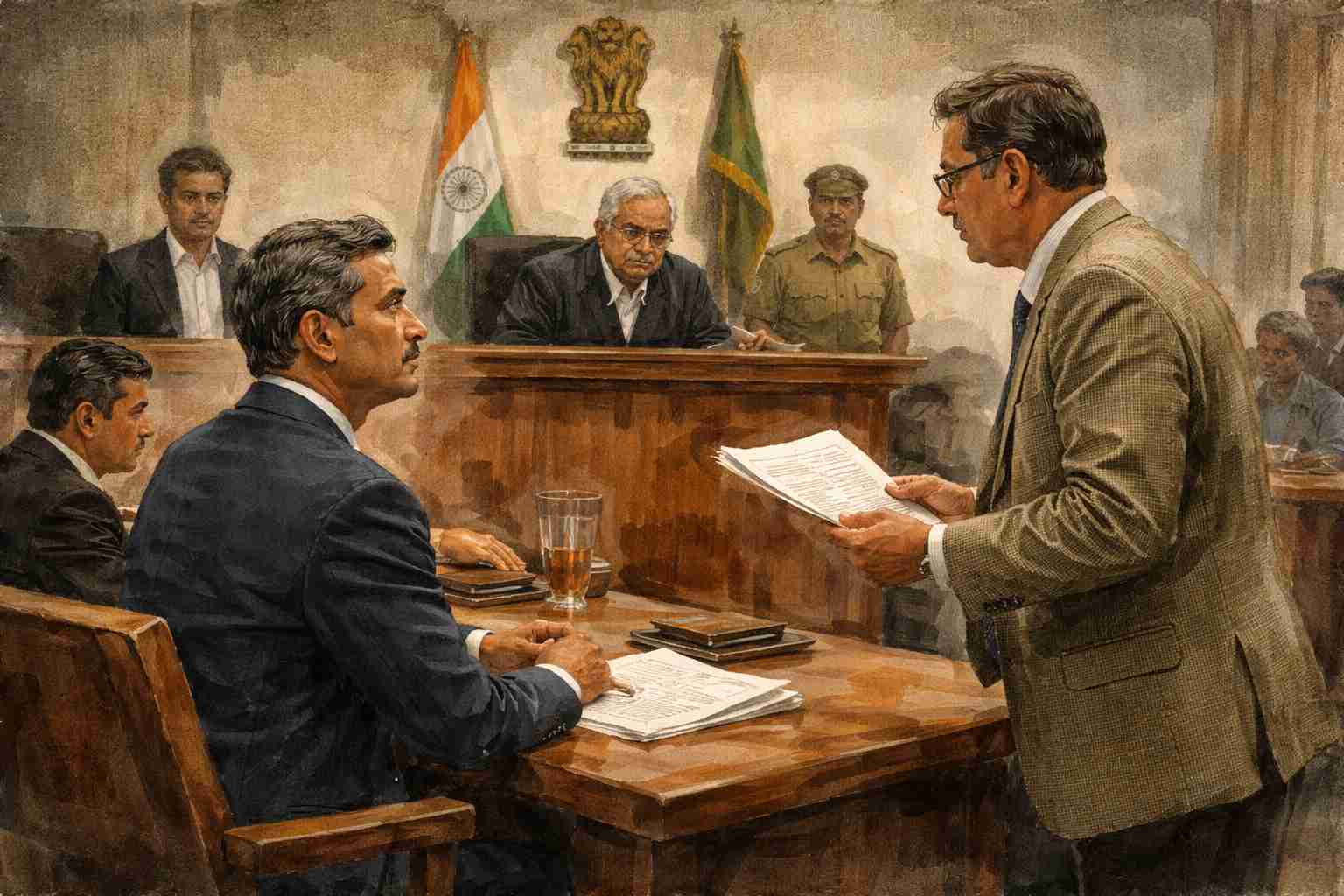
Simplified Explanation of the Judgment
The Patna High Court, in a significant ruling dated 22 December 2022, examined when a court may excuse an accused from personally appearing in a criminal case. The decision was delivered by Hon’ble Mr. Justice Arun Kumar Jha in Criminal Miscellaneous No. 33429 of 2017 arising from Complaint Case No. 2341(C)/2011.
In this case, several senior executives of a well-known footwear company were accused of offences under Sections 201, 465, 467, 468, 471, 477A, 120B, and 34 of the Indian Penal Code for allegedly using forged documents in earlier bail and quashing proceedings. When summoned by the trial court, they requested exemption from personal appearance under Section 205 of the Code of Criminal Procedure (CrPC), but the Judicial Magistrate, Patna rejected their plea on 27 March 2017.
The petitioners approached the High Court seeking to quash this order, arguing that:
- They were high-ranking officials of a reputed company based in New Delhi with extensive work responsibilities involving travel across India and abroad.
- No specific role or direct allegation was made against them.
- The main dispute was civil in nature between the company and the complainant, and the allegation of forgery was baseless.
- Their continuous physical attendance at Patna would disrupt business operations and cause undue hardship.
- They were ready to submit an undertaking and comply with all conditions imposed by the court under Section 205 CrPC.
The State and the complainant (opposite party no. 2) opposed the plea. They argued that after summons were issued, instead of appearing, the accused sought exemption. Non-bailable warrants were issued only because they failed to appear. The complainant submitted that the High Court should direct an early trial instead of granting exemption.
After carefully reviewing the submissions and relevant law, the High Court analysed Sections 205, 317, and 273 of the CrPC. It clarified the distinction between these provisions:
- Section 205 CrPC allows a Magistrate to dispense with personal attendance from the very beginning, if there are sufficient reasons.
- Section 317 CrPC empowers the court to excuse an accused during inquiry or trial stages if presence is unnecessary.
- However, exemption is not a matter of right and must be granted judiciously by considering the facts of each case.
The Court cited the Supreme Court’s decisions in Puneet Dalmia v. CBI [(2020) 12 SCC 695], Bhaskar Industries Ltd. v. Bhiwani Denim & Apparels Ltd. [(2001) 7 SCC 401], and Rameshwar Yadav v. State of Bihar [(2018) 4 SCC 608]* to explain the principles governing exemption.
The Supreme Court had held that:
- Personal attendance is not for mere formality; it serves to ensure trial progress.
- If the trial can proceed smoothly through representation by counsel, courts can exempt attendance to avoid unnecessary hardship.
- The court must obtain an undertaking that the accused will not dispute identity, will be represented by counsel, and will not seek adjournments.
- The trial court can always revoke the exemption if the accused or their counsel delays proceedings.
The High Court noted that the petitioners were company officials residing in New Delhi, and appearing in Patna on every hearing date would be burdensome. The Magistrate had given no reasons why their presence was indispensable.
Therefore, applying the principles from the Supreme Court precedents, the Court concluded that the Magistrate should have exercised discretion judiciously and permitted exemption from personal attendance.
The Court allowed the petition and set aside the Magistrate’s order dated 27 March 2017. It permitted the petitioners’ counsel to represent them in court, subject to strict conditions:
- The petitioners must file an undertaking that they will not dispute identity, and their counsel will appear on all hearing dates without seeking adjournments.
- The petitioners must personally appear when charges are framed or whenever the trial court specifically requires their presence.
- If their counsel fails to attend or delays the proceedings, the trial court may use its powers under Section 205(2) CrPC to compel their appearance.
Finally, the High Court directed the trial court to complete the trial within one year from receipt of the order.
This ruling reiterates that exemption from appearance is possible even in non-bailable offences when justified by circumstances, provided the accused acts bona fide and cooperates with the trial.
Significance or Implication of the Judgment
This judgment is vital for business executives, professionals, and non-resident accused who face trials in distant jurisdictions. The Patna High Court reinforced that:
- Attendance in person is not an absolute requirement when the presence of counsel can ensure fair progress.
- Courts must exercise discretion with compassion and practicality, particularly where long-distance travel causes genuine hardship.
- It protects the right of accused persons to conduct their business and employment responsibilities without being unduly burdened by procedural attendance.
- However, it also balances justice by empowering trial courts to recall exemption if the accused misuse the privilege or delay the proceedings.
For the justice system, this decision promotes efficiency and judicial economy, ensuring trials proceed without unnecessary disruption while preserving fairness.
Legal Issues and Court’s Reasoning
- Issue 1: Whether exemption from personal appearance under Section 205 CrPC can be granted to company officials facing criminal charges of forgery and conspiracy.
- Decision: Yes. The High Court held that exemption can be granted when the accused reside far away, are represented by counsel, and their presence is not necessary for trial progress.
- Issue 2: Whether personal attendance is a mandatory obligation under CrPC.
- Decision: No. Sections 205 and 317 CrPC empower courts to dispense with attendance when justice does not require it.
- Issue 3: Whether the Magistrate was justified in rejecting the petitioners’ plea.
- Decision: No. The Magistrate’s order lacked reasoning and ignored binding Supreme Court precedents.
Judgments Referred by Parties
- Bhaskar Industries Ltd. v. Bhiwani Denim & Apparels Ltd., (2001) 7 SCC 401
- Rameshwar Yadav v. State of Bihar, (2018) 4 SCC 608
- Puneet Dalmia v. CBI, (2020) 12 SCC 695
Judgments Relied Upon or Cited by the Court
- Bhaskar Industries Ltd. v. Bhiwani Denim & Apparels Ltd., (2001) 7 SCC 401
- Puneet Dalmia v. CBI, (2020) 12 SCC 695
- Rameshwar Yadav v. State of Bihar, (2018) 4 SCC 608
Case Title
Ramesh Kumar Dua & Ors. v. State of Bihar & Anr.
Case Number
Criminal Miscellaneous No. 33429 of 2017
(Arising out of Complaint Case No. 2341(C)/2011, District – Patna)
Citation(s)
2023 (1) PLJR 358
Coram and Names of Judges
Hon’ble Mr. Justice Arun Kumar Jha
Names of Advocates and Appearance
- For the Petitioners: Mr. Kaushal Kumar Jha, Senior Advocate; Mrs. Soni Shrivastava, Advocate
- For the State: Mr. Jharkhandi Upadhyay, Advocate
- For Opposite Party No. 2: Mr. Sanjay Kumar Ghosarvey, Advocate
Link to Judgment
NiMzMzQyOSMyMDE3IzEjTg==—ak1–lgh7FoJlks=
If you found this explanation helpful and wish to stay informed about how legal developments may affect your rights in Bihar, you may consider following Samvida Law Associates for more updates.







