
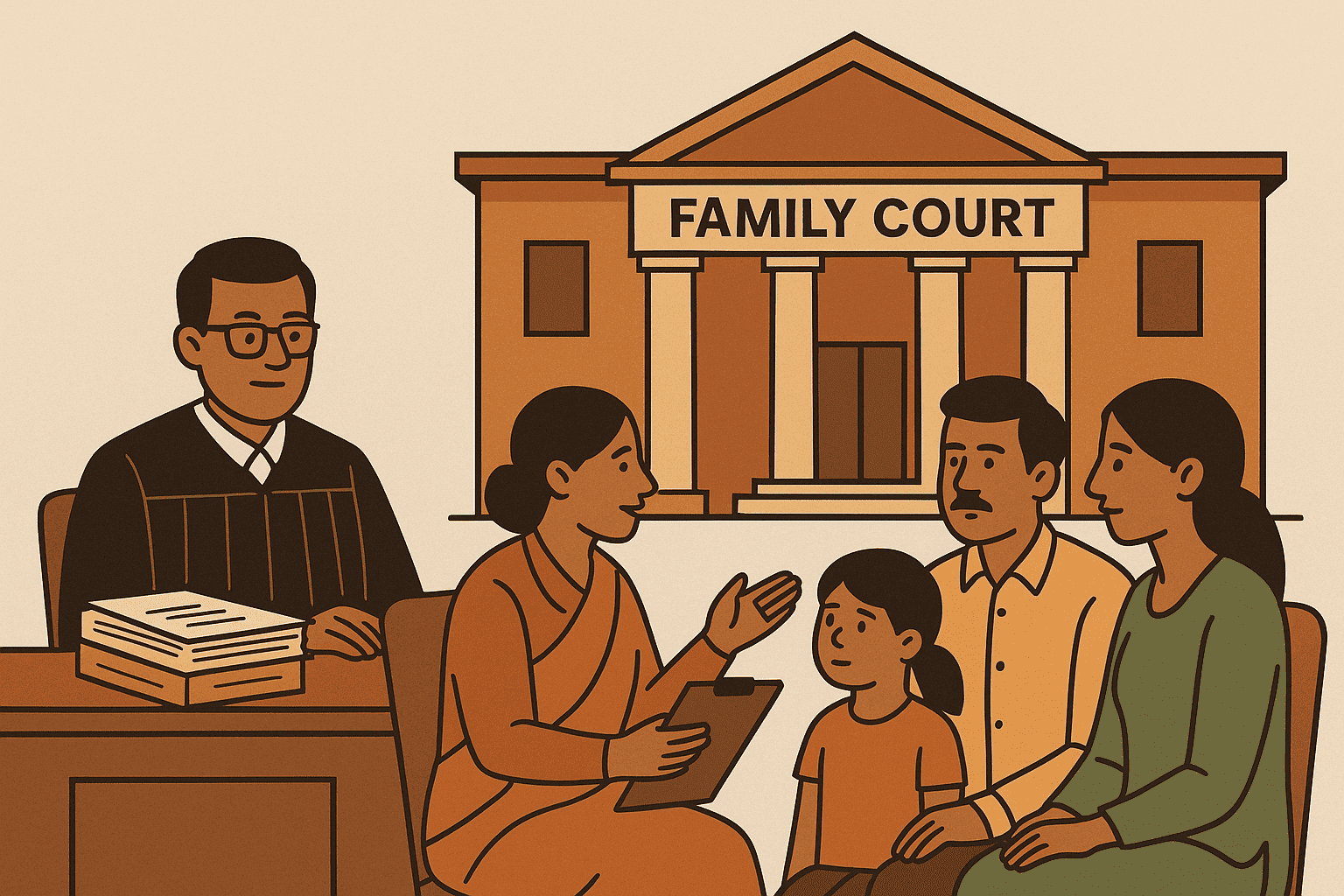
Simplified Explanation of the Judgment
In this case, the Patna High Court was dealing with a criminal revision filed by a wife and her minor son. They had earlier approached the Family Court at Gopalganj under Section 125 of the Code of Criminal Procedure (CrPC), seeking monthly maintenance from the husband. The Family Court had rejected their claim, and they challenged that rejection before the High Court.
Background Facts
- The marriage between the wife and the husband was solemnised on 06.03.2012 according to Hindu rites and customs.
- The wife went to her matrimonial home on 08.03.2012.
- A male child was born on 16.11.2012 in a Navy Hospital during the subsistence of the marriage.
- The wife alleged that after some time the husband began abusing and assaulting her, and also developed an illicit relationship with another woman.
- She stated that she was finally driven out of the matrimonial home along with the child and had to reside with her parents, with no independent income to maintain herself and the child.
- According to her, the husband is a government employee in the Indian Navy and also has agricultural land and rental income.
On this basis, she claimed monthly maintenance of ₹20,000 for herself and the child.
Husband’s Defence
The husband opposed the maintenance claim mainly on two grounds:
- Paternity of the child:
- He alleged that the wife was already pregnant before marriage from someone else.
- He claimed that the child was not his biological son and relied on a DNA test report and a hospital discharge slip to say that the gestational age showed conception prior to marriage.
- Adultery and income of wife:
- He alleged that the wife was living in adultery.
- He further claimed that she was a beautician running a beauty parlour and earning about ₹25,000 per month, and therefore not entitled to maintenance.
The Family Court accepted the husband’s version, held that the wife was living an adulterous life before marriage and that the child was not the husband’s son, and therefore rejected maintenance to both.
What Happened Before the High Court
The wife and minor son challenged the Family Court’s order before the Patna High Court in a criminal revision.
The High Court carefully examined:
- The oral evidence of the wife, her brothers, the husband and his witnesses.
- The way in which the DNA report and discharge slip had been brought on record.
- The legal position under Section 125 CrPC, Section 112 of the Indian Evidence Act, and the principles laid down by the Supreme Court and other High Courts.
On “Living in Adultery”
The Court made an important distinction:
- Adultery under Section 125(4) CrPC is a disqualification for a wife to receive maintenance only if she is “living in adultery” while married.
- The expression “living in adultery” means a continuous course of adulterous conduct, not just one or two lapses.
- Further, this disqualification applies only to conduct after marriage – premarital sexual relationship, even if assumed, cannot be treated as “living in adultery” for the purpose of Section 125(4).
In this case, the husband only made a bald allegation that after marriage she was living in adultery; he gave no details of time, place or the alleged paramour, nor led any convincing evidence. The Family Court had in fact treated alleged premarital pregnancy as “adulterous life”, which is legally incorrect.
The High Court held that there was no legal basis to conclude that the wife was “living in adultery” so as to disqualify her from maintenance.
On Paternity of the Child and DNA Report
The child was born on 16.11.2012, while the marriage was valid and subsisting, and there was no plea by the husband that he had “no access” to his wife after marriage.
The husband relied on:
- A DNA test report, and
- A hospital discharge slip giving gestational age of the foetus.
However, the High Court noted serious evidentiary defects:
- These documents were exhibited by the Family Court merely on the request of the husband’s counsel, without following proper procedure.
- No author of these documents was examined.
- No witness even stated that they were familiar with the authors or how the documents were prepared.
- No opportunity was given to the wife to object before exhibition or to cross-examine on the contents.
Therefore, the Court held that the DNA report and discharge slip could not be treated as legal evidence and must be excluded from consideration.
Once these documents were kept aside, the legal position was clear:
- Under Section 112 of the Indian Evidence Act, a child born during the continuance of a valid marriage is conclusively presumed to be the legitimate child of the husband, unless it is shown that the husband had no access to the wife.
- The birth of the child within about 255 days of marriage was not impossible or unnatural, as premature births are medically common.
Accordingly, the Court held that the minor son is the legitimate child of the husband and entitled to claim maintenance.
Nature of Section 125 CrPC Proceedings
The Court reiterated that:
- Proceedings under Section 125 CrPC are summary and intended to prevent destitution of wives, children and parents.
- Strict standards of proof as applied in a full-fledged civil or matrimonial suit are not to be insisted upon.
- Where a Family Court gives a negative finding on marriage or paternity, which brands a woman as unchaste and bastardises a child, the High Court in revision is duty-bound to re-appreciate the evidence and correct any legal error.
The Court further clarified that findings on marriage or paternity recorded in a Section 125 CrPC proceeding are tentative, and subject to any later, contrary decree passed by a Civil Court or Family Court. In such a situation, parties can seek modification of the maintenance order under Section 127 CrPC.
Final Directions
After examining the evidence and law, the Patna High Court:
- Set aside the Family Court’s order dated 22.06.2019.
- Held that both the wife and minor son are entitled to maintenance from the husband.
- Directed the husband to pay:
- ₹3,000 per month to the wife, and
- ₹3,000 per month to the minor son,
from the date of the maintenance application, i.e. 12.08.2013.
- Directed the husband to pay a lump sum of ₹50,000 towards litigation costs to the wife and son.
- Directed circulation of this judgment to all Family Courts in Bihar and to the Bihar Judicial Academy for training purposes, underlining its instructional value.
Significance or Implication of the Judgment
This judgment has wide significance for spouses and children seeking maintenance, as well as for Family Courts across Bihar:
- Protection of wives from vague allegations of adultery
The Court has made it clear that maintenance cannot be denied merely because the husband makes a general allegation of immoral conduct or premarital pregnancy. The legal standard is higher – the wife must be shown to be “living in adultery” after marriage, and this requires specific pleadings and proof of a sustained adulterous relationship. - Strong reaffirmation of presumption of legitimacy
By giving full effect to Section 112 of the Evidence Act, the Court protects the dignity and status of children born in wedlock. It emphasises that a child is not to be declared illegitimate on the basis of doubtful or improperly proved documents, especially in a summary maintenance proceeding. - Evidentiary discipline in relying on DNA reports
DNA reports, while scientifically powerful, must still be brought on record according to law. This judgment reminds lower courts that documents cannot be treated as evidence unless properly proved and tested through cross-examination. - Guidance on revisional powers of High Court
The judgment explains that although revisional jurisdiction is limited, the High Court must interfere where negative findings on marriage or paternity are legally unsustainable and cause serious stigma to the woman and child. - Practical relief and deterrence
By granting maintenance from the date of the application and awarding litigation costs, the Court not only provides substantial relief to the aggrieved wife and child but also discourages irresponsible defences aimed at denying basic support.
For the general public, this decision reinforces that Section 125 CrPC is a social justice provision intended to prevent destitution, and not a platform for character assassination. For government authorities and Family Courts, it offers a clear roadmap on how to handle allegations of adultery, DNA evidence, and paternity disputes in maintenance cases.
Legal Issue(s) Decided and the Court’s Decision (with Reasoning)
- Whether the wife was disqualified from maintenance on the ground of “living in adultery” under Section 125(4) CrPC
- Decision: No.
- Reasoning: “Living in adultery” means a continuous adulterous relationship after marriage. Alleged premarital relationship is outside the scope of Section 125(4), and the husband led no proper evidence of post-marital adultery.
- Whether the minor child born during the marriage is the legitimate son of the husband for the purpose of maintenance
- Decision: Yes.
- Reasoning: The child was born during the subsistence of a valid marriage. The husband did not plead or prove non-access. Under Section 112 of the Evidence Act, legitimacy is conclusively presumed. Birth within 255 days of marriage is medically possible as a premature birth.
- Whether the DNA report and hospital discharge slip could be relied on to deny paternity
- Decision: No.
- Reasoning: These documents were exhibited without following legal procedure, without examining their authors or giving the wife opportunity to object or cross-examine. They therefore did not amount to legal evidence and had to be excluded from consideration.
- Extent of revisional jurisdiction of the High Court in Section 125 CrPC matters involving negative findings on marriage or paternity
- Decision: High Court can re-appreciate evidence in such cases.
- Reasoning: Negative findings brand the wife as unchaste and the child as illegitimate, causing grave prejudice. In such situations, the High Court is obliged to re-evaluate the evidence to see whether the findings are legally sustainable.
- Whether the wife and child were entitled to maintenance and from which date
- Decision: Yes; from the date of the application (12.08.2013).
- Reasoning: The wife was a legally wedded spouse living separately for sufficient reasons and not living in adultery. The child was a legitimate minor son. The husband, a government employee with landed property, had sufficient means and had neglected their maintenance.
- Whether findings on marriage and paternity in Section 125 CrPC proceedings are final
- Decision: No.
- Reasoning: Such findings are tentative and subject to the outcome of any civil or matrimonial proceedings. If a later decree is passed inconsistent with the maintenance order, the parties can seek modification under Section 127 CrPC.
Judgments Referred by Parties
- Nandlal Wasudeo Badwaik v. Lata Nandlal Badwaik & Anr., (2014) 1 SCR 120 – relied upon by the husband to support his stand based on DNA evidence.
Judgments Relied Upon or Cited by the Court
- Hitesh Deka v. Jinu Deka, 2025 SCC OnLine Gau 259
- Sukhdev Pakharwal v. Rekha Okhale, 2018 SCC OnLine MP 1687
- Ashok v. Anita, 2011 SCC OnLine MP 2249
- Sandha v. Narayanan, 1999 SCC OnLine Ker 64
- Pandurang Barku Nathe v. Leela Pandurang Nathe & Anr., 1997 SCC OnLine Bom 264
- Kamala v. M.R. Mohan Kumar, (2019) 11 SCC 491
- Pravati Rani Sahoo v. Bishnupada Sahoo, (2002) 10 SCC 510
- Ivan Rathinam v. Milan Joseph, AIRONLINE 2025 SC 57
- Balram Yadav v. Fulmaniya Yadav, (2016) 13 SCC 308
- Dwarika P. Satpathy v. Bidyut Prava Dixit, (1999) 7 SCC 675
- Santosh v. Naresh Pal, (1998) 8 SCC 447
Case Title
Suman Devi @ Suman Gupta & Anr. v. The State of Bihar & Anr.
Case Number
Criminal Revision No. 1080 of 2019
(arising out of Maintenance Case No. 156 of 2013, Family Court, Gopalganj)
Citation(s)
2025 (2) PLJR 281
Coram and Names of Judges
Hon’ble Mr. Justice Jitendra Kumar
Names of Advocates and Who They Appeared For
- Mr. Pankaj Kumar Dubey, Advocate – for the petitioners (wife and minor son)
- Mr. Chandra Sen Prasad Singh, APP – for the State of Bihar
- Mr. Ranjeet Kumar Pandey, Advocate – for Opposite Party No. 2 (husband)
- Mr. Ajay Kumar Thakur, Advocate – Amicus Curiae
Link to Judgment
NyMxMDgwIzIwMTkjMSNO-ATNnusDxiPc=
If you found this explanation helpful and wish to stay informed about how legal developments may affect your rights in Bihar, you may consider following Samvida Law Associates for more updates.







