

Case Background
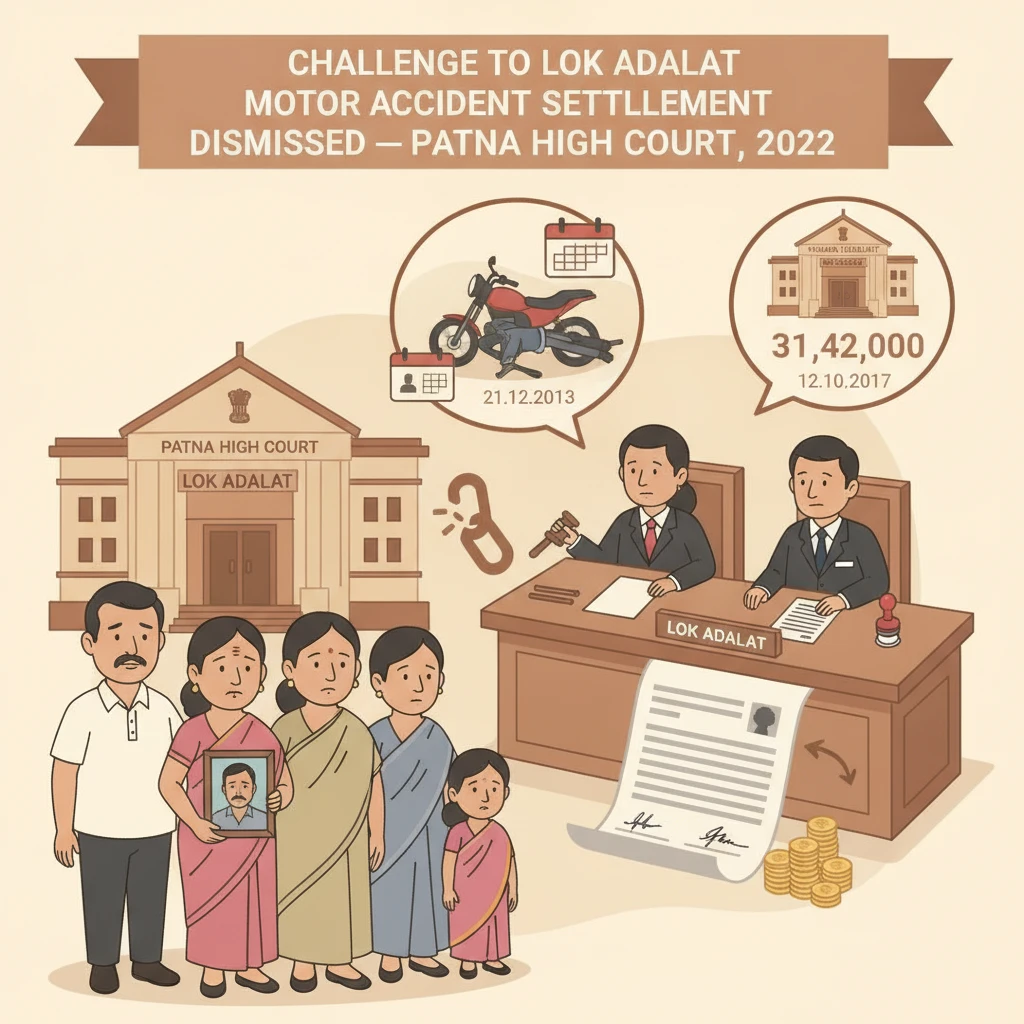
This case arose from a fatal road accident on 21.12.2013. The victim, Late Prakash Kumar Gupta, died in that accident.
His family members – father, mother, widow, son and daughter – filed Motor Vehicle Claim Case No. 01 of 2014 before the Additional District and Sessions Judge VI-cum-Motor Accident Claims Tribunal, Siwan. They claimed compensation for his death.
National Insurance Company Limited, as insurer of the motorcycle involved, and another opposite party filed written statements before the Claims Tribunal. After following the legal procedure, the Claims Tribunal passed its judgment on 12.10.2017.
The Tribunal held that the motorcycle was insured with National Insurance Company on the date of the accident. It also found that both the rider of the motorcycle and the deceased had valid driving licences. The Tribunal awarded compensation of Rs. 31,42,000/- to the claimants.
National Insurance Company was aggrieved by this award and filed Miscellaneous Appeal No. 140 of 2018 before the Patna High Court. A learned Single Judge of the High Court, by order dated 05.07.2019, referred the appeal to the Lok Adalat held at the High Court premises for possible settlement.
The Lok Adalat, comprising a sitting Judge of the Patna High Court as Member (Judicial) and an advocate as Member (Legal Profession), took up the appeal on 13.07.2019.
What the Court Examined and Decided
In the Lok Adalat on 13.07.2019, the appeal filed by National Insurance Company was taken up. The award of the Lok Adalat records that it was an appeal by the insurance company against the award of the Motor Vehicle Accident Claims Tribunal.
The learned counsel appearing for the appellants before the Lok Adalat submitted that their case was that the driver had no licence and therefore liability lay with the owner. However, he also stated that the appellants were ready to pay the amount awarded to the claimants within one month. It was further recorded that the right of recovery of the insurer, according to law, was settled by several judgments, and with that right reserved, the appellants were ready to withdraw the appeal.
On this basis, the Lok Adalat disposed of the appeal as withdrawn. The award recorded that the court fee, if any, paid by any party would be refunded. The award was signed by the representative of the appellants, namely Mr. Nikhilesh Gayen, Manager, Regional Office, National Insurance Company Limited, Patna, with his official stamp. It was also signed by the claimants’ advocate, Mr. Raghav Prasad, and by both members of the Lok Adalat.
Later, National Insurance Company filed the present writ petition (Civil Writ Jurisdiction Case No. 6079 of 2021) under Articles 226 and 227 of the Constitution of India. The company asked the Patna High Court to quash the Lok Adalat award dated 13.07.2019.
The main grounds taken by the insurer were that its counsel had not appeared before the Lok Adalat on 13.07.2019, and that the award had been passed “behind his back”. It was claimed that no submission had been made by its counsel regarding withdrawal of the appeal.
On the role of its representative, the insurer contended that Mr. Nikhilesh Gayen, Manager, Patna Regional Office, was present in the High Court premises during the Lok Adalat. According to the petitioners, he was given a blank, unfilled copy of the award for signing. It was said that he signed it under the impression that the conducting advocate, being conversant with the facts and law, had properly dealt with the matter and sought withdrawal of the appeal.
The Division Bench of the Patna High Court, speaking through Hon’ble Mr. Justice Rajan Gupta, first examined the scheme of the Legal Services Authorities Act, 1987. The Court reproduced and discussed Sections 19 and 20, which deal with organisation of Lok Adalats and cognizance of cases, and noted that Lok Adalats have a conciliatory role.
The Court stressed that Lok Adalats have no adjudicatory or judicial function like a regular court. Their work is to help parties arrive at a compromise or settlement. An award can be passed only when a settlement is reached. If no compromise is possible, the matter must be returned to the referring court for regular hearing.
The Bench highlighted that where an award is made by the Lok Adalat in terms of a settlement duly signed by the parties and annexed to the award, it becomes final and binding. It is executable like a decree of a civil court, and no appeal lies against it. A challenge is possible only through a writ petition under Articles 226 or 227, and only on very limited grounds, such as fraud.
The Court referred in detail to Supreme Court precedents explaining the nature and effect of Lok Adalat proceedings and awards. It relied on State of Punjab v. Ganpat Raj, (2006) 8 SCC 364, which underlined that the Lok Adalat can dispose of matters only through compromise or settlement, and that if no compromise is reached, no award can be passed.
The Court also cited P.T. Thomas v. Thomas Job, (2005) 6 SCC 478, which held that every award of a Lok Adalat is deemed to be a civil court decree, final and binding on the parties, and that no appeal lies against such an award. The judgment elaborated that Lok Adalats provide fast, informal and inexpensive justice, and that awards are equivalent to consent decrees.
Further reliance was placed on State of Punjab v. Jalour Singh, (2008) 2 SCC 660. In that case, the Supreme Court clarified that an award based on a signed settlement is final and binding and executable as a decree. It held that any challenge to such an award can only be in a writ petition on very limited grounds like fraud. The Court quoted paragraph 12 of Jalour Singh, which distinguishes between true Lok Adalat awards based on settlement and mere orders that do not reflect any compromise.
Applying these principles, the Patna High Court examined the record of the present case. It noted that the appeal had been referred to the Lok Adalat, and that the Lok Adalat recorded the settlement terms: the insurer agreed to pay the amount awarded within one month, with a right of recovery as per law, and withdrew the appeal. The award was signed by the duly authorised representative of the insurer and by the claimants’ advocate and the Lok Adalat members.
The Bench held that once the authorised representative of the insurer had signed the award, it was binding on the company. Section 21 of the Legal Services Authorities Act, 1987 clearly states that an award passed by Lok Adalat with consent of the parties is final and binding on all parties, and no appeal lies against it. Only in cases where fraud has been played in obtaining the award can a writ petition be entertained to challenge it.
In this writ petition, the insurer did not allege any fraud by any party in securing the Lok Adalat award. The Court pointed out that there was no such plea in the petition and no such argument advanced. In fact, in paragraph 14 of the writ petition, the insurer admitted that the award had been signed by its authorised representative, Mr. Nikhilesh Gayen, Manager. Yet, the affidavit supporting the writ petition was not sworn by him but by another officer, Basudeo Manjhi, Regional Manager/Constituted Attorney/Authorised Signatory.
The Court also noted that no disciplinary action had been taken by the company against Mr. Nikhilesh Gayen, despite its suggestion that he had signed a “blank” award. The Bench observed that this fact spoke volumes about the bona fides of the petitioners and did not support their version.
The Court further remarked that the bona fide actions of a sitting High Court Judge, who had presided over the Lok Adalat as Member (Judicial), could not be doubted. No allegation was made in the writ petition against the genuineness or good faith of the Lok Adalat members, and rightly so.
Even on merits, the Court found no substance in the insurer’s position. The insurer sought to raise a defence relating to violation of policy conditions under Sections 147 and 149 of the Motor Vehicles Act, 1988, saying that the deceased did not have a valid licence. But the Claims Tribunal, in paragraph 15 of its judgment dated 12.10.2017, had specifically recorded that both the rider of the motorcycle and the deceased had valid driving licences, and that the vehicle was insured with National Insurance Company on the date of the accident.
The Court noted that in the appeal (M.A. No. 140 of 2018), this finding had not been raised or challenged by the insurer. At the same time, despite the accident occurring in December 2013 and the Tribunal award being passed in October 2017, the claimants – including the widow, minor children and aged parents of the deceased – had not received any compensation. The insurer had not paid “a single penny” even after about eight and a half years.
The Court also referred to Shalini Shyam Shetty v. Rajendra Shankar Patil, (2010) 8 SCC 329, to reiterate that powers under Article 227 are to be used sparingly and mainly to maintain the efficiency and purity of the justice system, not to reopen individual matters lightly.
Considering all these aspects, the Bench held that the writ petition was devoid of merit. In absence of any allegation or proof of fraud in obtaining the Lok Adalat award dated 13.07.2019, and in view of the clear legal position about the finality and binding nature of Lok Adalat awards, the Court refused to interfere.
The writ petition filed by National Insurance Company Limited was dismissed. As a result, the Lok Adalat award and the original compensation award of the Claims Tribunal remain binding and enforceable.
Why This Judgment Matters
This judgment is important for families of accident victims and for insurance companies alike. It confirms that once a settlement is recorded in a Lok Adalat and signed by authorised representatives, it is final and binding.
An insurance company cannot later claim that its officer signed “by mistake” or without full understanding, unless it can show clear fraud. Mere internal misunderstanding or lack of communication is not enough to undo a Lok Adalat award.
The decision also highlights that accident claimants should not be kept waiting for years after an award. Here, the Court took note that the widow, minor children and aged parents had still not received any amount despite a long delay, and it declined to give the insurer another chance.
For ordinary people, the judgment reinforces faith in Lok Adalats as a forum where settlements, once honestly reached, will not be casually disturbed. For insurers and other institutions, it is a reminder to act carefully but responsibly when authorising representatives to appear in Lok Adalats.
Legal Issues and Answers
- Issue: Can National Insurance Company avoid a Lok Adalat award on the ground that its counsel did not appear and its representative signed the award without understanding it, when no fraud is alleged?
Answer: No. The Patna High Court held that the award, signed by the insurer’s authorised representative in a Lok Adalat, is final and binding under Section 21 of the Legal Services Authorities Act, 1987. In the absence of any allegation of fraud, there is no ground to set aside the award. - Issue: Can the High Court, in writ jurisdiction under Articles 226 and 227, re-open the merits of the motor accident compensation award after the insurer has settled the matter before a Lok Adalat?
Answer: No. The Court reiterated that Lok Adalat awards based on settlement are equivalent to consent decrees and cannot be challenged on merits. Article 227 powers are to be used sparingly and not to disturb such consent awards. - Issue: Does an insurer’s later plea of violation of policy conditions (for example, alleged absence of valid driving licence) help it after a binding Lok Adalat settlement?
Answer: No. Especially where the Claims Tribunal has already found the licences valid and the issue was not pressed in appeal, such a defence cannot be revived after a settled Lok Adalat award.
Cases Cited by the Court
- State of Punjab v. Ganpat Raj, (2006) 8 SCC 364
- P.T. Thomas v. Thomas Job, (2005) 6 SCC 478
- State of Punjab v. Jalour Singh, (2008) 2 SCC 660
- Shalini Shyam Shetty v. Rajendra Shankar Patil, (2010) 8 SCC 329
- Punjab National Bank v. Laxmichand Rai, AIR 2000 MP 301 (referred in extract)
- Board of Trustees of the Port of Visakhapatnam v. Presiding Officer, Permanent Lok Adalat-cum-Secretary, District Legal Services Authority, (2000) 5 ALT 577 (referred in extract)
- Sailendra Narayan Bhanja Deo v. State of Orissa, AIR 1956 SC 346 (referred in extract)
Case Details
Case Number: Civil Writ Jurisdiction Case No. 6079 of 2021
Case Title: National Insurance Company Limited & Anr. v. The State of Bihar & Ors.
Coram: Hon’ble Mr. Justice Rajan Gupta and Hon’ble Mr. Justice Mohit Kumar Shah
Citation: 2022 (3) PLJR 227
Advocates: Mr. Durgesh Kumar Singh, Advocate for the petitioners (National Insurance Company Limited and its Branch Manager); Mr. Lalit Kishore, Advocate General, for the respondents (including the State of Bihar and claimants).
Nature of the Case: Writ petition under Articles 226 and 227 of the Constitution of India challenging a Lok Adalat award that recorded withdrawal of a motor accident compensation appeal.
Link to Judgment: Click here to read the full judgment of the Patna High Court
If you found this explanation helpful and wish to stay informed about
how legal developments may affect your rights in Bihar,
you may consider following Samvida Law Associates for more updates.







