

Case Background
This case arises from a long-running dispute about the affiliation of Mahanth Shatanand Giri Harihar Sanskrit College at Bodh Gaya.
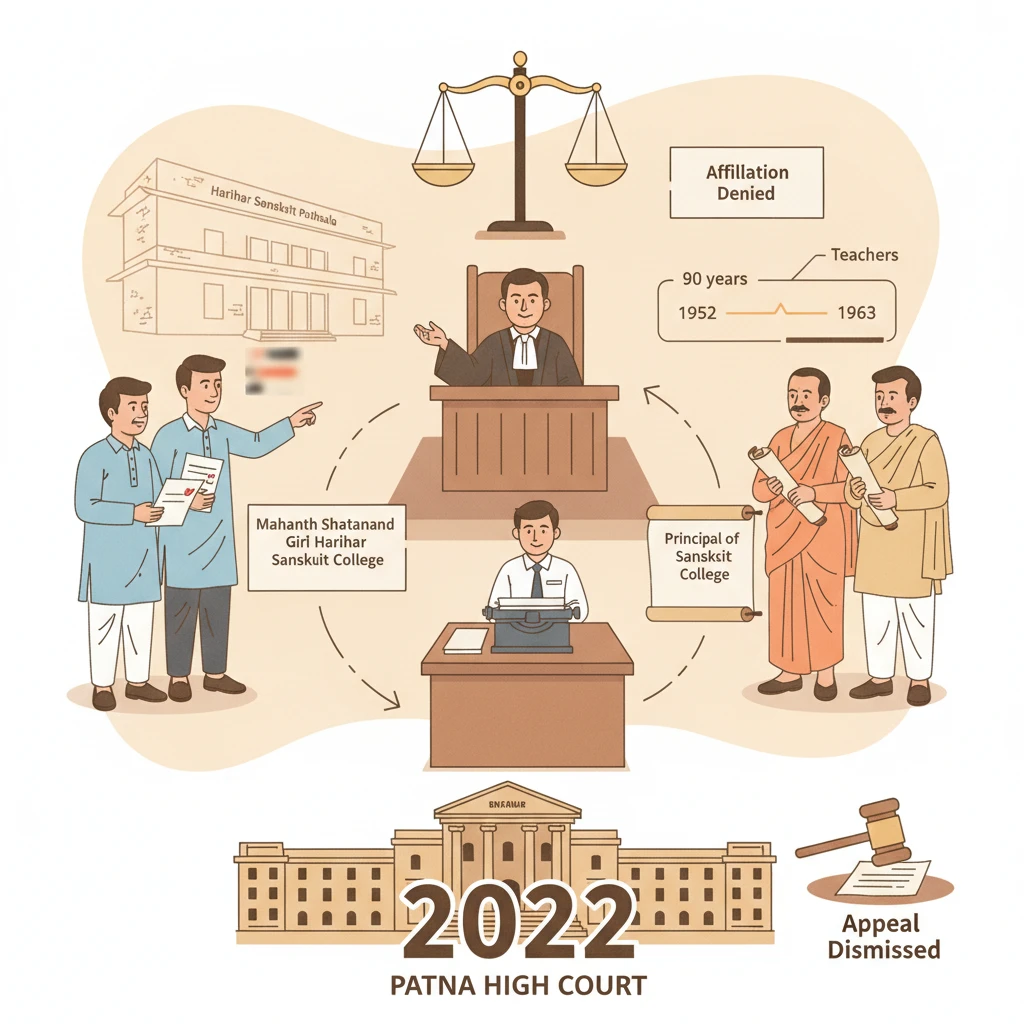
The college is about ninety years old. It finds place in a list of Sanskrit institutions existing up to 31 March 1952 published by the Sanskrit Association, Bihar, Patna. It is also listed in the Bihar Gazette dated 09.10.1963.
Despite this background, the college was not granted regular affiliation. According to the judgment, in the past it could get only temporary affiliation and that too only when the Patna High Court intervened.
On 11.07.2019, the Deputy Director, Department of Education, rejected the college’s claim for affiliation. He gave two reasons: first, that the land on which the college stands is not registered in the name of the college but in the name of “Harihar Sanskrit Pathsala, Bodh-Gaya”; and second, that out of the sanctioned strength of ten teachers, only six were working.
The college challenged this Government decision in a writ petition (C.W.J.C. No. 17283 of 2019). The learned Single Judge of the Patna High Court allowed the writ petition on 23.08.2019. The Judge directed the State to grant temporary affiliation so that the vacant sanctioned posts of teachers could be filled and the institution could continue to run properly.
The State of Bihar, through its Education Department and Director, Higher Education, filed the present Letters Patent Appeal No. 26 of 2021 against that order.
During the appeal, an intervenor, claiming to be the present Mahant of Bodh Gaya Math, under whose aegis the college was established, was allowed to participate. He supported the case of the college. Since his stand did not conflict with that of the college, the Division Bench permitted his intervention without calling for responses from other parties.
What the Court Examined and Decided
The Division Bench of the Patna High Court, comprising Hon’ble Mr. Justice Ashutosh Kumar and Hon’ble Mr. Justice Anjani Kumar Sharan, heard the State’s appeal and the parties on 17.05.2022.
The appeal centred on whether the Single Judge was right in directing temporary affiliation in favour of the college despite alleged deficiencies in infrastructure, particularly the land title and the shortfall in the number of teachers.
The Court first noted what the Single Judge had already found. The college had been in existence for about ninety years and had been running for nine decades. It had been listed in the Bihar Gazette in 1963. Yet, its affiliation had been refused and, historically, it obtained only temporary affiliation with the Court’s intervention.
The Single Judge had also observed that because the institution was not affiliated, the University was not constituting a selection committee to appoint teachers on the vacant posts. This had created a “conundrum”: without affiliation, no appointments; without sufficient teachers, no affiliation. The Judge also noticed that, in present times, almost no educational institution runs with the full sanctioned strength of teachers. The shortfall was not solely due to any fault of the college and should not be used to deny affiliation.
In the appeal, the State argued that the Single Judge was wrong to order temporary affiliation. Counsel for the appellants submitted that there is no provision in the Bihar State Universities Act, 1976 for granting temporary affiliation in the manner directed. They contended that until the institution develops all required infrastructure and meets all norms, including proper land ownership and full staffing, affiliation cannot be ordered.
The State also referred to a Government Resolution No. 2291 dated 18.10.1976, which laid down parameters for Sanskrit colleges established before that date. According to the State, when these parameters were re-examined, it was found that the land for this college stood in the name of Harihar Sanskrit Pathsala, Bodh-Gaya, and receipts were also issued in that name. On this basis the State maintained that the college did not meet land-related requirements.
The State further tried to distinguish this college from another Sanskrit institution, Goswami Laxminath Madhusudan Sanskrit College. That other college had been granted temporary affiliation pursuant to an order of the Patna High Court. The State’s counsel argued that in that case the only deficiency was an insufficient number of teachers, which could be remedied after affiliation. In contrast, in the present college, the State claimed that land ownership itself was defective, so it deserved different treatment.
On the other side, counsel for the respondent-college stressed that the State was ignoring the statutory framework. He relied on Section 79 of the Bihar State Universities Act, 1976. Under this provision, all Sanskrit colleges and institutions that were running before the commencement of the Kameshwar Singh Darbhanga Sanskrit University Act, 1962 and were recognised by the Bihar Sanskrit Association would be deemed to have been admitted to the University upon commencement of that Act.
The college’s counsel pointed out that the Syndicate and Senate of Kameshwar Singh Darbhanga Sanskrit University had, on 17.12.2021 and 18.12.2021, respectively, decided that the college deserved affiliation. They recorded that the college had been established in 1930 and had been affiliated to the Bihar & Orissa Sanskrit Association in 1934 for imparting Shastri and Acharya level education.
Acting on these decisions, the University sent a recommendation on 13.04.2022 to the Principal Secretary, Education Department, for a decision on affiliation of the college.
Counsel for the college also informed the Court that the institution’s name appeared in the list of Sanskrit institutions existing up to 31 March 1952, published by the Sanskrit Association, Bihar, Patna, and in the 1963 Gazette Notification. Relying on these facts along with Section 79, he argued that the State had failed to perform its statutory duty and had not followed earlier directions of the Court. He characterised the State’s reasons for refusal as an “illusory distinction”.
The Division Bench agreed with the college’s stand. It found the repeated reliance on the land-title point to be unjustified. The last affidavit filed by the State merely reiterated that, since the land was not registered in the name of the institution, the college did not meet infrastructure parameters and therefore could not be granted affiliation.
The Court stated clearly that this was only a repetition of the earlier ground “which has got no basis.” It observed that the State appeared to be “cherry-picking between Institutions.” In other words, the State was treating different Sanskrit colleges differently without a sound reason, particularly when another college had been granted temporary affiliation despite deficiencies.
The Bench also considered an assurance given earlier by the college’s counsel, Mr. Satyam Shivam Sundaram, before a predecessor Division Bench. He had undertaken that no third-party rights would be created in respect of the land and that the necessary steps would be taken to get the name of the college mutated in the land records.
The Court felt that the State ought to have accepted this undertaking and not taken a hyper-technical stand. It held that there was no reason to be “captious” in refusing to follow the Single Judge’s direction.
After reviewing the materials, the statutory provision (Section 79 of the Bihar State Universities Act, 1976), the University’s own decisions, and the long existence of the college, the Division Bench concluded that the Single Judge’s order did not call for interference.
The Court therefore dismissed the State’s appeal. It confirmed the directions that temporary affiliation be granted to the college, that the University constitute a committee for recommending appointment to the vacant teacher posts, and that a final decision on permanent affiliation be taken thereafter. The Bench fixed a time limit: the entire exercise is to be completed within three months.
With these directions, the Letters Patent Appeal was dismissed, and any pending interlocutory applications were disposed of.
Why This Judgment Matters
This judgment is important for old educational institutions, especially Sanskrit colleges in Bihar, whose legal status or land records may be unclear.
The Patna High Court emphasised that long-recognised Sanskrit colleges, which are covered by Section 79 and historical recognition by the Bihar Sanskrit Association, cannot be denied affiliation on narrow technical grounds like the precise name in which land is recorded.
The Court also criticised unequal treatment, where one college gets temporary affiliation and another is refused on similar facts. This sends a message that the State cannot selectively apply rules.
For teachers and students, the judgment opens the way for filling vacant sanctioned posts and continuing courses smoothly. The Court’s three-month time frame aims to prevent further delay.
Legal Issues and Answers
Issue: Could the State refuse affiliation to a long-established Sanskrit college on the ground that the land was not registered in the college’s name and that there were fewer teachers than the sanctioned strength?
Answer: No. The Patna High Court held that these grounds had no real basis, especially in light of Section 79 of the Bihar State Universities Act, the college’s long recognition, and the University’s recommendation. The State was directed to grant temporary affiliation and proceed towards permanent affiliation.
Issue: Was the Single Judge justified in directing temporary affiliation and further steps despite the State’s objection that there is no express provision for such temporary affiliation in the Bihar State Universities Act, 1976?
Answer: Yes. The Division Bench refused to interfere with the Single Judge’s order, effectively affirming that, in the special facts of this case, granting temporary affiliation was proper to break the deadlock and allow appointments and a final decision on permanent affiliation.
Cases Cited by the Court
- The Single Judge had been conscious of a Full Bench decision in Braj Kishore and the provisions of Sections 35 and 21(2)(d) of the Bihar State Universities Act, 1976. However, the Division Bench did not base its own reasoning on any specific precedent. No other case names are expressly relied upon in the Division Bench judgment.
Case Details
Case Number: Letters Patent Appeal No. 26 of 2021
Case Title: The State of Bihar and others v. Mahanth Shatanand Giri Harihar Sanskrit College, Bodh Gaya and others
Citation: 2022 (3) PLJR 237
Court: High Court of Judicature at Patna
Coram: Hon’ble Mr. Justice Ashutosh Kumar and Hon’ble Mr. Justice Anjani Kumar Sharan
Date of Judgment: 17.05.2022
Advocates:
- For the Appellants (State of Bihar and officials): Mr. Shashi Shekhar Tiwary, Advocate
- For Respondent No. 1 (College): Mr. Satyam Shivam Sundaram, Advocate
- For the University: Mr. Gyanand Roy, Advocate
- For the Intervenor: Mr. Ambarish Kumar, Advocate
Nature of the Case: Letters Patent Appeal against a Single Judge’s order in a writ petition (C.W.J.C. No. 17283 of 2019) concerning affiliation of a Sanskrit college.
Link to Judgment: View full judgment on Patna High Court website
If you found this explanation helpful and wish to stay informed about
how legal developments may affect your rights in Bihar,
you may consider following Samvida Law Associates for more updates.







