

Case Background
The petitioner is a woman from Laxmipur Bhagwat, Madhepura district. She was involved in selection and appointment to the post of Anganwari Sevika at an Anganwadi Centre in Gram Panchayat Laxmipur Bhagwati, Ward No. 16, Block Kumarkhand, District Madhepura.
A dispute arose regarding the selection on this post. The petitioner claimed that she had higher merit points than the private respondent, another woman from the same village, who had been selected as Anganwari Sevika.
Earlier, by order dated 10.11.2016, a decision had been taken in the matter. That order was later set aside by the then Collector, Madhepura on 31.03.2018, who remanded the case back for a fresh decision after properly considering all material facts.
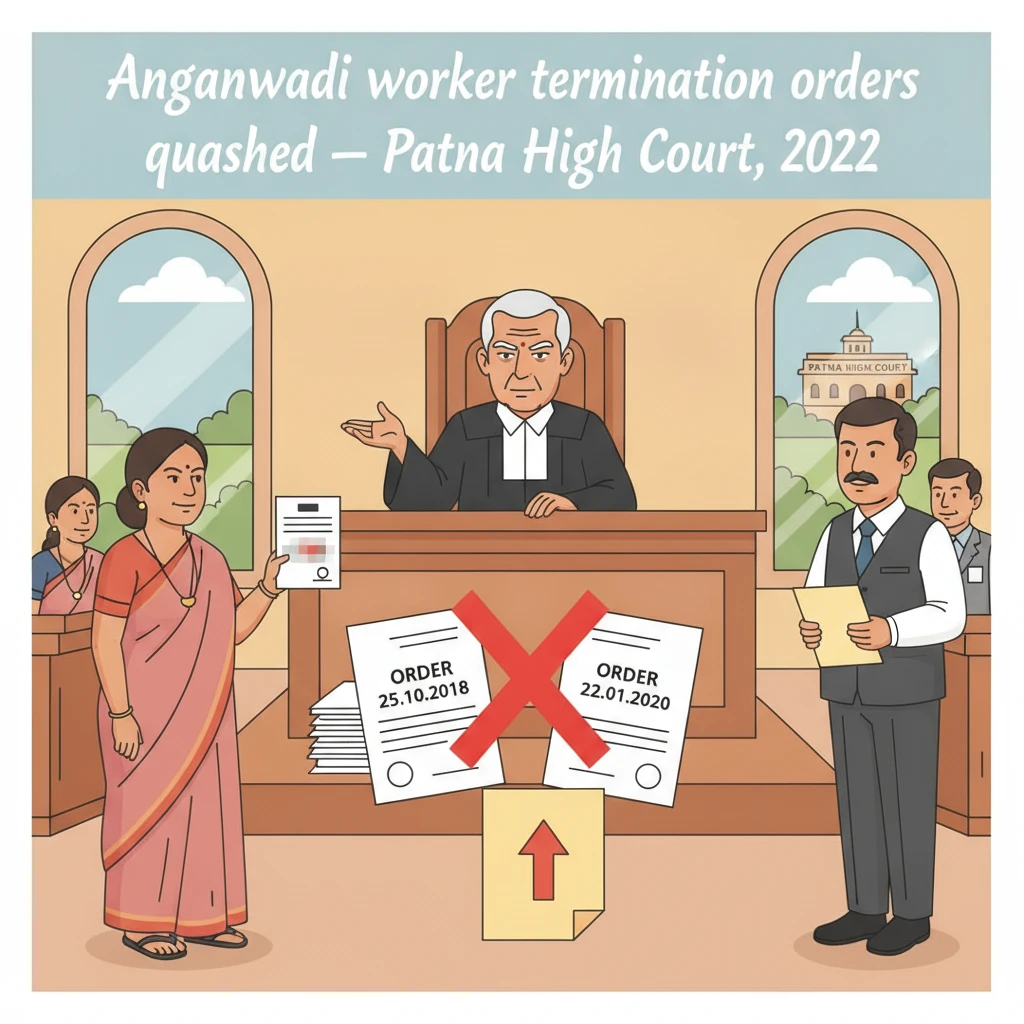
After remand, the District Programme Officer, ICDS, Madhepura passed an order on 25.10.2018 in Anganwari Case No. 06/2018. By this order, the officer affirmed the selection of the private respondent as Anganwari Sevika.
The petitioner filed an appeal against this order before the Collector, Madhepura, which was registered as Anganwari Appeal Case No. 35/2018. On 22.01.2020, the Collector dismissed the appeal and affirmed the order of the District Programme Officer. The petitioner felt that both authorities had acted mechanically and illegally, ignoring her higher merit and previous directions of the Collector.
Aggrieved by these two orders dated 25.10.2018 and 22.01.2020, the petitioner approached the Patna High Court by filing Civil Writ Jurisdiction Case No. 9071 of 2020.
What the Court Examined and Decided
The case came up before Hon’ble Mr. Justice P. B. Bajanthri. The petitioner sought several reliefs. She wanted the High Court to quash the order dated 22.01.2020 passed by the Collector in Anganwari Appeal Case No. 35/2018. She also challenged the order dated 25.10.2018 passed by the District Programme Officer, ICDS, Madhepura in Anganwari Case No. 06/2018 affirming the selection of the private respondent.
Besides asking for quashing of these orders, the petitioner requested a direction (mandamus) to appoint her as Anganwari Sevika at the concerned centre by removing the private respondent, on the ground that she had higher merit points.
During the hearing, an important allegation emerged from the State side: the petitioner’s certificate for the post of Anganwari Sevika was said to be forged. If true, this would go to the root of her claim. However, the Court wanted to know whether there was any proper enquiry or finding on this issue and whether she was ever given a chance to defend herself.
On 18.04.2022, the Court passed an interim order. It directed the District Collector-cum-District Magistrate, Madhepura (respondent no. 4) to appear before the Court with all records. The purpose was to find out who had given the finding that the petitioner’s certificate was forged and whether the petitioner had been given an opportunity before declaring her certificate forged.
The matter was ordered to be re-listed on 06.05.2022, and a copy of this order was to be supplied to the State counsel. This interim step shows that the Court treated the allegation of forgery seriously, but also insisted that basic principles of natural justice must be followed.
On the final date of hearing, Mr. Shyam Bihari Meena, District Collector-cum-District Magistrate, Madhepura, personally appeared before the Court. He had gone through the departmental records relating to the case.
After examining the records, the District Magistrate made two crucial admissions before the Court. First, he stated that the petitioner had not been provided an opportunity before her certificate was treated as forged. Second, he confirmed that there was no concrete finding anywhere on record that the petitioner had actually furnished a forged document.
These two facts became the turning point of the case. The High Court noted that the petitioner had made out a prima facie case in her favour. In simple terms, this means that, on the face of the record, she had raised a serious and credible grievance that could not be brushed aside.
Once the Court found that there was no proper finding of forgery and that no opportunity had been given to the petitioner, it concluded that the impugned orders could not be allowed to stand. Both the order of the Collector dated 22.01.2020 (Annexure-2) and the order of the District Programme Officer dated 25.10.2018 (Annexure-1) were therefore set aside.
The Court further directed that monetary benefits should be calculated from the date of termination till the date of reinstatement. These benefits were to be paid to the petitioner within one month from the date of the judgment, that is, within one month from 18.05.2022.
By setting aside the orders, the High Court effectively restored the petitioner to her earlier position, subject to the outcome of a fresh inquiry. However, the Court did not straightaway confirm her appointment or permanently remove the private respondent. Instead, it chose a middle path balancing fairness to the petitioner with the need to verify the authenticity of her documents.
The Court directed the competent authority to proceed further strictly in accordance with law. Specifically, it ordered that, in order to find out whether the petitioner’s documents are forged or not, a domestic inquiry should be conducted.
This domestic inquiry must follow certain minimum safeguards. The Court clearly stated that ample opportunity of hearing must be given to the petitioner at every stage of the inquiry. That means she should be informed of the allegations, allowed to respond, produce her own documents, and cross-check any material used against her.
After completing this inquiry, the competent authority has to take appropriate steps either to continue the petitioner’s services or to terminate them, depending on the findings. The Court fixed a time limit for this process: the entire exercise must be completed within three months from the date of receipt of the Court’s order.
By imposing this time limit, the Court ensured that the matter would not be kept pending indefinitely, which could have caused further hardship to both the petitioner and the functioning of the Anganwadi Centre.
Since the District Magistrate had already appeared and assisted the Court, his personal appearance was formally dispensed with for future dates. The interlocutory application, I.A. No. 01 of 2022, was also disposed of. With these directions, the writ petition was allowed.
The judgment therefore achieves two things. First, it protects the petitioner from being condemned on the basis of an unproved allegation of forgery without any chance to defend herself. Second, it leaves the door open for the authorities to hold a proper inquiry and take a fresh, legally sound decision about her continuance as Anganwadi Sevika.
Why This Judgment Matters
This judgment is important for Anganwadi workers and other contractual or scheme-based workers across Bihar. Many such workers face allegations about their certificates or eligibility without ever being given a fair hearing.
The Patna High Court has made it clear that, before branding someone’s educational or other certificates as forged, the authorities must conduct a proper inquiry and give the person a full chance to defend herself. Orders passed without such an inquiry can be set aside.
For women working as Anganwadi Sevika in rural areas, who often have limited access to legal help, this decision offers protection. It shows that even if government officers suspect forgery, they cannot simply terminate a worker or ignore her claim without following due process.
The judgment also directs that if a wrongful termination has taken place, the worker is entitled to monetary benefits from the date of termination till reinstatement. This can reduce the financial hardship suffered during the period when the worker was kept out of service unlawfully.
At the same time, the Court has not stopped the authorities from investigating suspected forgery. Instead, it has insisted that any such inquiry must be fair, time-bound, and based on evidence. This balances the interests of genuine candidates and the integrity of public schemes.
Legal Issues and Answers
Issue: Can an Anganwadi Sevika be denied appointment or continuation on the ground of alleged forged certificates without giving her any opportunity of hearing or recording a clear finding of forgery?
Answer: No. The Patna High Court held that where no opportunity was given and no concrete finding of forgery existed, the orders against the Sevika were unsustainable and had to be set aside, with directions for a fresh domestic inquiry following due process.
Issue: What relief is appropriate when termination or adverse orders are passed in violation of natural justice in Anganwadi selection disputes?
Answer: The Court quashed the defective orders, ordered calculation and payment of monetary benefits from termination till reinstatement, and directed a fresh domestic inquiry to decide whether to continue or terminate services in accordance with law.
Cases Cited by the Court
- No previous judgments or case law have been cited or relied upon in the text of this decision.
Case Details
Case Number: Civil Writ Jurisdiction Case No. 9071 of 2020
Case Title: Kanchan Kumari @ Kanchan Devi vs. The State of Bihar & Others
Coram: Hon’ble Mr. Justice P. B. Bajanthri
Citation: 2022 (3) PLJR 56
Advocates: For the petitioner – Mr. Pramod Mishra, Advocate and Mr. V.K. Mukul, Advocate; For the State – Mr. Asit Kumar Jha, AC to GP 2
Nature of the Case: Writ petition challenging orders in Anganwari selection dispute and seeking appointment/continuation as Anganwadi Sevika
Date of Judgment: 18.05.2022
Link to Judgment: Patna High Court Judgment in CWJC No. 9071 of 2020
If you found this explanation helpful and wish to stay informed about
how legal developments may affect your rights in Bihar,
you may consider following Samvida Law Associates for more updates.







