

Case Background
The petitioner was working as a Revenue Karamchari under the Collectorate of Bettiah in West Champaran district.
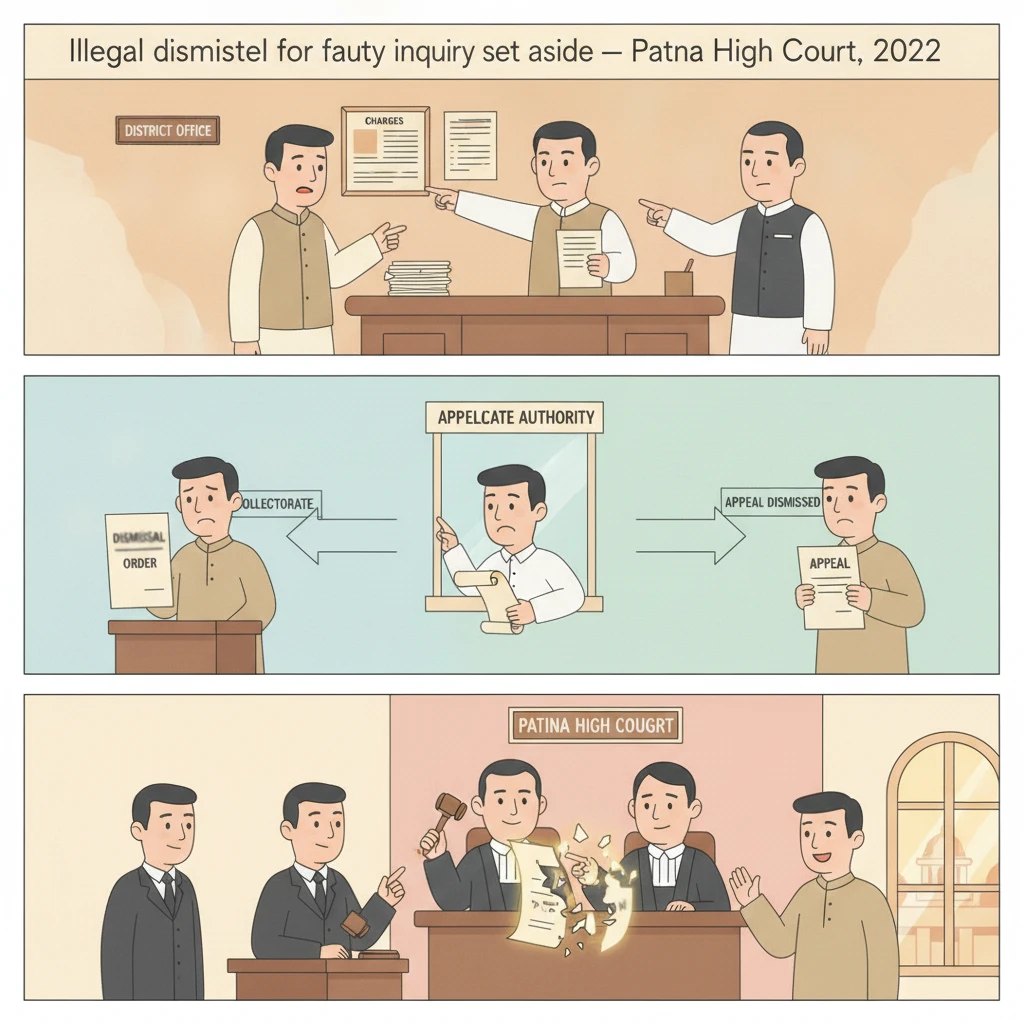
While in service, he was accused of misconduct. On that basis, the department started disciplinary proceedings against him. Articles of charge were framed and served on him.
An Enquiry Officer was appointed to conduct the departmental inquiry. After holding the inquiry, the Enquiry Officer submitted his report on 25.10.2013, holding that the charges levelled against the petitioner were proved.
After the inquiry report, the department followed up with formal steps like issuing a show cause notice to the petitioner, receiving his reply, and finally imposing a penalty.
On 05.03.2019, the Collector, West Champaran passed an order dismissing the petitioner from service. The dismissal order was issued under memo no. 150 dated 05.03.2019.
Aggrieved by this dismissal, the petitioner filed a departmental appeal before the Divisional Commissioner, Tirhut Division, Muzaffarpur. This appeal was registered as Service Appeal No. 91 of 2019.
On 20.09.2019, the Commissioner dismissed the appeal and confirmed the dismissal order passed by the Collector. Left with no other departmental remedy, the petitioner approached the Patna High Court under its civil writ jurisdiction.
In his writ petition, the petitioner requested the Court to quash both the dismissal order of the Collector and the appellate order of the Commissioner. He also sought reinstatement with back wages, all consequential benefits, costs for the harassment caused to him, and a stay on the operation of the dismissal during the pendency of the case.
What the Court Examined and Decided
The case came up before a Division Bench of the Patna High Court comprising Hon’ble Mr. Justice P. B. Bajanthri and Hon’ble Mr. Justice Rajeev Ranjan Prasad. The oral judgment was delivered on 25.04.2022 by Hon’ble Mr. Justice P. B. Bajanthri.
The core question before the Court was whether the departmental inquiry leading to the petitioner’s dismissal had been conducted in accordance with the Bihar Government Servants (Classification, Control & Appeal) Rules, 2005, commonly known as the Bihar CCA Rules.
The Court examined the charge memo that had been issued to the petitioner at the beginning of the disciplinary proceedings. On going through this document, the Court found a serious legal defect.
The Bench noted that the charge memo clearly showed non-compliance with sub-rule (4) of Rule 17 of the Bihar Government Servants (Classification, Control & Appeal) Rules, 2005.
Though the judgment does not reproduce the exact text of Rule 17(4), it clearly records that this provision, which is part of the procedure for holding departmental inquiries, had not been followed when the charges were framed and the proceedings were initiated.
The Court stated that the non-compliance of Rule 17(4) was “crystal clear” from the charge memo itself. This meant that the defect was not a minor irregularity, but a basic violation of the mandatory procedure prescribed under the service rules.
Importantly, when this point was raised, the learned counsel appearing for the State of Bihar could not refute the petitioner’s contention with reference to the records. In other words, the State was unable to demonstrate that Rule 17(4) had been complied with.
After perusing the records, the Court reiterated that there was indeed non-compliance of sub-rule (4) of Rule 17 of the Bihar CCA Rules, 2005. This legal defect went to the root of the disciplinary proceedings.
Because of this procedural illegality, the Court held that both the original dismissal order dated 05.03.2019 and the appellate order dated 20.09.2019 could not be sustained in law. On this basis alone, the Bench set aside both impugned orders.
However, the Court did not close the matter by simply quashing the dismissal and reinstating the petitioner with full benefits. Instead, it adopted the approach laid down by the Supreme Court for such situations, where an order of punishment is set aside on technical grounds related to procedure.
The Court directed the disciplinary authority to restart the departmental inquiry from the stage where the defect had occurred, that is, from the “defective stage”. This means that the authority must correct the Rule 17(4) violation and then proceed afresh in accordance with law.
To ensure that the matter is not kept pending indefinitely, the Court fixed a strict time limit. The disciplinary authority has to complete the inquiry proceedings within six months from the date of receipt of the High Court’s order.
On the question of what should happen to the petitioner’s service status in the meantime, the Bench relied heavily on binding decisions of the Supreme Court.
The Court referred to the judgment in Managing Director, ECIL v. B. Karunakar, reported in (1993) 4 SCC 727, and also to Chairman-cum-Managing Director, Coal India Limited & Ors. v. Ananta Saha & Ors., reported in (2011) 5 SCC 142. Paragraphs 46 to 50 of the latter judgment were quoted at length.
These Supreme Court decisions lay down that when a punishment is quashed on technical grounds, the employer is generally allowed to hold a fresh inquiry from the stage where the illegality occurred. For this limited purpose, the delinquent employee is to be reinstated, but the employer is also permitted to keep him under suspension during the fresh inquiry, in accordance with the service rules.
The Supreme Court has also clarified that the question of back wages does not get automatically decided in favour of the employee. The grant of back wages is a discretionary matter, to be considered by the disciplinary authority after the fresh inquiry is completed, taking into account all relevant facts and principles of justice, equity and good conscience.
Following this settled law, the Patna High Court, in the present case, directed the disciplinary authority to take a specific decision regarding the petitioner’s status. Within two months from the date of receipt of the High Court’s order, the authority must decide whether the petitioner should be reinstated straightaway, or reinstated and simultaneously placed under suspension during the pendency of the fresh inquiry.
The Court further observed that once the inquiry is completed and a fresh order is passed, the disciplinary authority will have to examine how to treat the intervening period between the date of dismissal and the date of the new order.
This means the authority must later decide whether this period will be treated as duty, leave, suspension, or otherwise, and what salary and benefits, if any, the petitioner will be entitled to for this intervening period. This decision too must be taken in accordance with law, after the conclusion of the inquiry.
Finally, with these observations and directions, the writ petition was disposed of. No specific order on costs was recorded in the operative portion of the judgment.
Why This Judgment Matters
This judgment is important for government employees and lower-level staff such as Revenue Karamcharis across Bihar.
First, it shows that even if the allegations against an employee appear serious and are found “proved” in an inquiry, the dismissal cannot stand if the basic procedure prescribed by the Bihar Government Servants (Classification, Control & Appeal) Rules, 2005 is not followed.
Second, it clarifies that if a dismissal is set aside on technical or procedural grounds, the case does not automatically end in full reinstatement with back wages. The department gets another chance to correct its mistake and conduct the inquiry afresh from the defective stage.
Third, the judgment ensures that the employee is not left in uncertainty. The Patna High Court fixed clear time limits both for completing the fresh inquiry and for deciding whether the employee will be under suspension or in active service during that period.
For similarly placed employees facing departmental action, this ruling underlines two clear messages: one, they can question inquiries that do not follow the mandatory rules; and two, even successful challenges may lead to a fresh inquiry rather than final relief.
Legal Issues and Answers
- Issue: Whether the departmental proceedings and the dismissal order against the petitioner were valid when sub-rule (4) of Rule 17 of the Bihar Government Servants (Classification, Control & Appeal) Rules, 2005 had not been complied with.
Answer: No. The Patna High Court held that there was clear non-compliance of Rule 17(4). On this legal ground, it set aside both the dismissal order dated 05.03.2019 and the appellate order dated 20.09.2019, and directed that the inquiry be recommenced from the defective stage. - Issue: What should be the petitioner’s service status and financial treatment after the punishment was quashed on technical grounds.
Answer: Relying on the Supreme Court decisions in ECIL v. B. Karunakar and Coal India Ltd. v. Ananta Saha, the Court directed the disciplinary authority to reinstate the petitioner and then decide, within two months, whether to keep him under suspension or in active service. The authority must also, after completion of the fresh inquiry, decide how to regulate the intervening period and the question of back wages in accordance with law.
Cases Cited by the Court
- Managing Director, ECIL v. B. Karunakar, (1993) 4 SCC 727.
- Chairman-cum-Managing Director, Coal India Limited & Ors. v. Ananta Saha & Ors., (2011) 5 SCC 142.
- R. Thiruvirkolam v. Presiding Officer (referred within the quoted Supreme Court passage).
- Punjab Dairy Development Corpn. Ltd. v. Kala Singh (referred within the quoted Supreme Court passage).
- Graphite India Ltd. v. Durgapur Projects Ltd. (referred within the quoted Supreme Court passage).
- U.P. SRTC v. Mitthu Singh (referred within the quoted Supreme Court passage).
- Akola Taluka Education Society v. Shivaji (referred within the quoted Supreme Court passage).
- Balasaheb Desai Sahakari S.K. Ltd. v. Kashinath Ganapati Kambale (referred within the quoted Supreme Court passage).
- Union of India v. Y.S. Sadhu (referred within the quoted Supreme Court passage).
Case Details
Case Number: Civil Writ Jurisdiction Case No. 808 of 2020
Case Title: Surendra Prasad Yadav v. The State of Bihar & Ors.
Coram: Hon’ble Mr. Justice P. B. Bajanthri and Hon’ble Mr. Justice Rajeev Ranjan Prasad
Citation: 2022 (3) PLJR 123
Advocates: Mr. Arvind Kumar, Advocate for the petitioner; Mr. Raj Kishore Roy (GP-18) for the State-respondents
Nature of the Case: Writ petition challenging dismissal from service and appellate confirmation in a departmental proceeding
Link to Judgment: https://patnahighcourt.gov.in/viewjudgment/MTUjODA4IzIwMjAjMSNO-zh7Fr0SaHyU=
If you found this explanation helpful and wish to stay informed about how legal developments may affect your rights in Bihar, you may consider following Samvida Law Associates for more updates.







