

Case Background
The dispute arose from recruitment to the post of Assistant Professor (Hindi) in different universities of Bihar. The Bihar Public Service Commission (B.P.S.C.) issued Advertisement No. 50/2014 for 250 posts of Assistant Professor (Hindi), with 126 posts for the unreserved category. The last date for submitting the application form was 20 November 2014.
Under the advertisement, a candidate needed a good academic record with at least 55% marks in Master’s degree, NET/SET or equivalent accredited to UGC, and could be exempted from NET if holding a Ph.D degree. NET/SET was not required where it was not conducted for that subject.
The selection process had 100 marks: 85 marks for educational qualifications and 15 marks for interview. Within the 85 marks, different stages of education had fixed marks and 10 marks were kept for Ph.D or M.Phil. Schedule-V of the advertisement further split these 10 marks depending on whether the Ph.D or M.Phil was “as per UGC Regulations, 2009” and whether the candidate had NET.
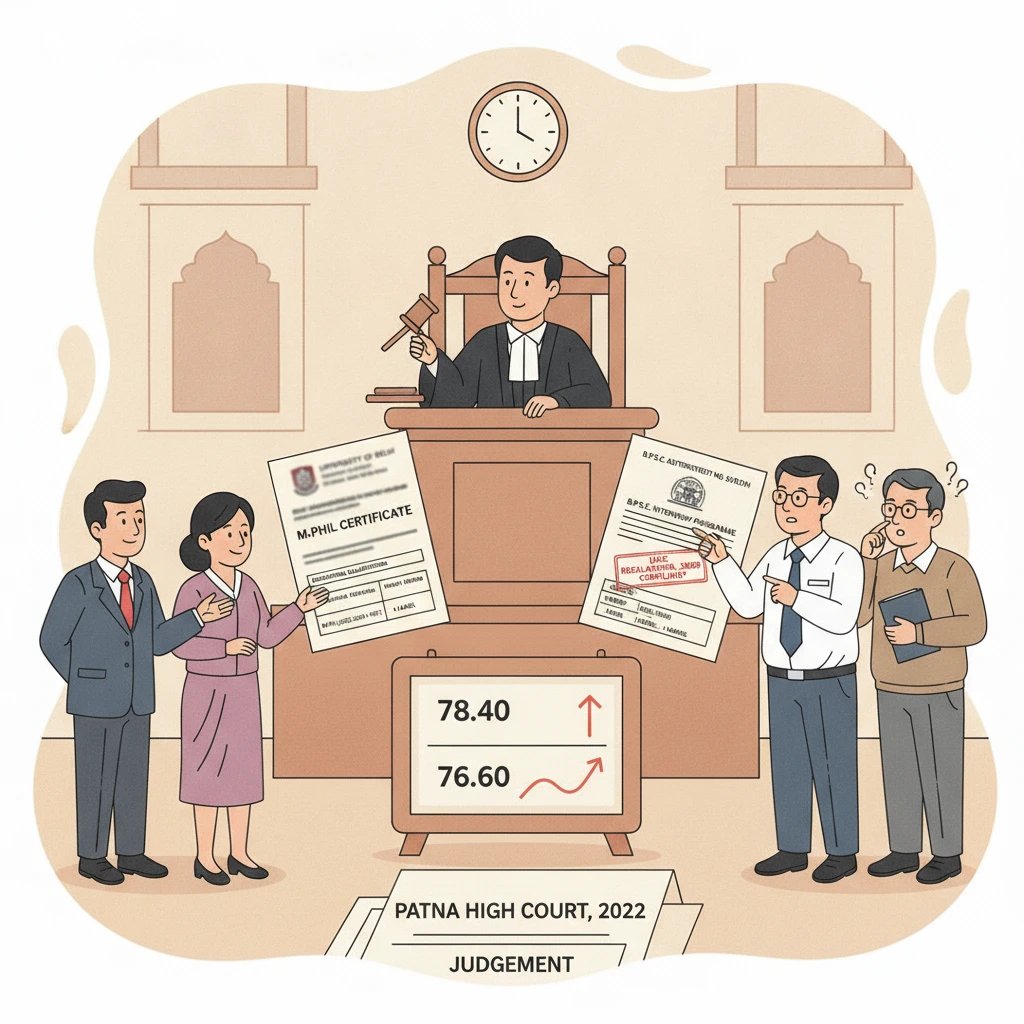
The petitioner, an applicant for Assistant Professor (Hindi), possessed an M.Phil in Hindi from the University of Delhi obtained in 2013, and had also cleared NET in Hindi. The University of Delhi issued a certificate stating that his M.Phil was awarded as per UGC Regulations, 2009.
Later, on 17 March 2016, the Department of Education, Government of Bihar issued a letter directing B.P.S.C. to accept M.Phil qualifications granted by universities outside Bihar as being under UGC Regulations, 2009, if the M.Phil had been awarded after two years from the notification of the UGC Regulations, that is, after 17 July 2009.
B.P.S.C. eventually published a combined merit list of candidates. The petitioner was placed at serial number 132. Despite his certificate from the University of Delhi, B.P.S.C. treated his M.Phil as “not as per UGC Regulations, 2009” and awarded him only 2 marks instead of 4 marks under Schedule-V.
According to the petitioner, with 4 marks for M.Phil his total would have been 78.40, raising his rank to 85. Since the general category cut-off was 76.60, he claimed he was pushed out of selection solely because of this wrongful reduction in M.Phil marks.
What the Court Examined and Decided
The main question before the Patna High Court was narrow: whether the petitioner should have received 4 marks or 2 marks for his M.Phil qualification under Schedule-V of Advertisement No. 50/2014.
Schedule-V provided that an M.Phil as per UGC Regulations, 2009 with NET carried 4 marks, while an M.Phil not as per UGC Regulations, 2009 with NET carried only 2 marks. The entire case turned on which of these applied to the petitioner.
The petitioner’s side argued that his M.Phil from the University of Delhi in 2013 clearly fell under UGC Regulations, 2009. They relied on the explicit certificate given by the University of Delhi stating that his M.Phil degree was as per UGC Regulations, 2009.
They also referred to the 17 March 2016 letter of the Department of Education, Government of Bihar. That letter directed B.P.S.C. to accept M.Phil degrees from universities outside Bihar as being under UGC Regulations, 2009, if awarded after two years from 17 July 2009. The petitioner’s degree met this time condition as well.
The petitioner further pointed out that another candidate, Prashant Kumar, who also held an M.Phil from the University of Delhi, had been awarded 4 marks by B.P.S.C. This, they argued, showed that B.P.S.C. had been inconsistent and discriminatory in his case.
Additionally, the petitioner challenged B.P.S.C.’s demand for a detailed “criteria certificate” at the interview stage. In the interview programme for Hindi published on 15 May 2018, B.P.S.C. asked candidates to obtain a certificate from their universities specifying how many and which criteria they had fulfilled while doing Ph.D/M.Phil. According to him, such a requirement was neither mentioned in the 2014 advertisement nor in the 2014 statute for appointment of teachers in Bihar universities, and was not demanded for other subjects. Hence, he claimed it was arbitrary and discriminatory.
The petitioner relied on an earlier decision of a coordinate Bench in the case of Nitu Kumari, where this Court held that insisting on furnishing detailed criteria of Ph.D degree through a later notification amounted to changing the rules of the game midway. The Court had there declared such new conditions to be redundant, inapplicable and not necessary.
He also relied on UGC Regulation 2009, especially clause 20 and related provisions, to argue that once the awarding University certifies that the degree is as per UGC Regulations, that certificate by itself should be accepted. Demanding additional “criteria details” was said to be contrary to the UGC Regulations.
The petitioner further argued that the so-called 11-point criteria, which B.P.S.C. was insisting upon, had never been notified by UGC as a condition for recognising M.Phil degrees. He pointed to the Supreme Court judgment in P. Suseela v. University Grants Commission, (2015) 8 SCC 129, where it was noted that such 11-point criteria recommended by an expert committee had not been accepted by UGC itself.
On the other side, B.P.S.C. supported its decision to award only 2 marks. Its counsel highlighted that the candidates’ call for interview was purely provisional, and the Commission had the right to verify certificates and take necessary decisions thereafter. All candidates called for interview had been asked to produce originals and photocopies of their certificates.
According to B.P.S.C., candidates claiming NET had to produce the original NET qualification certificate issued by UGC on or before the last date of application. Similarly, in view of clause 20 of UGC Regulations, 2009, candidates had to produce a certificate from the Registrar of their University at the time of interview, certifying that their Ph.D/M.Phil was under UGC Regulations, 2009. Failing such proof, the Commission would treat M.Phil as not under UGC Regulations, 2009 and award only 2 marks.
B.P.S.C. stated that the petitioner’s M.Phil certificate showed fulfilment of only 5 criteria rather than all 11 criteria, and therefore his degree was not fully in accordance with UGC Regulations, 2009. For this reason, they gave him only 2 marks. They said the 11-point criteria flowed from decisions of the Standing Committee of the UGC and minutes of its 479th meeting held on 8 July 2011, and referred to an earlier Allahabad High Court case which discussed these criteria.
B.P.S.C. also relied on a judgment of a coordinate Bench of the Patna High Court in Jainendra Kumar v. State of Bihar and others (C.W.J.C. No. 23258 of 2019). In that case, the Court had upheld B.P.S.C.’s grant of only 2 marks to a candidate whose M.Phil degree did not show compliance with various regulations under UGC Regulations, 2009.
Respondent No. 6, who herself had been given only 2 marks for M.Phil with NET, submitted that many candidates were similarly treated. She requested that if the Court interfered and enhanced marks for the petitioner, then similar benefit should also go to all eligible persons.
Respondent No. 8 filed a counter affidavit stating that at least two selected candidates (Miss Anamika and Miss Jyoti Singh) did not join on their respective posts and that other selected persons also had not joined even after selection.
The Court then examined how earlier coordinate Bench decisions applied, especially Jainendra Kumar and Nitu Kumari. In Jainendra Kumar, the candidate’s M.Phil certificate did not show compliance with several specific regulations under UGC Regulations, 2009. Therefore, the Court had held that B.P.S.C. correctly treated that degree as not conforming to UGC Regulations, 2009 and awarded only 2 marks.
However, in the present case, the factual position was different. Here, the University of Delhi had clearly certified that the petitioner’s M.Phil degree was as per UGC Regulations, 2009. This made his situation distinct from that of Jainendra Kumar.
The Court also referred to P. Suseela, where the Supreme Court analysed UGC’s powers and the so-called 11-point criteria. The Supreme Court noted that while an expert committee under Professor S.P. Thyagarajan had suggested those criteria, UGC itself had never adopted them. The Court set aside an Allahabad High Court judgment which had attempted to give effect to those recommendations.
On this basis, the Patna High Court held that the 11-point criteria were not meant to assess whether a Ph.D (and by extension M.Phil) degree was under UGC Regulations, 2009. In particular, these criteria had no statutory backing for M.Phil degrees. There was also no requirement in the 2014 advertisement or in the 2014 statute for teachers’ appointments in Bihar universities that candidates produce such “criteria details.”
The Court stressed that once a recognised statutory university like the University of Delhi certifies that a degree has been awarded as per UGC Regulations, 2009, neither the selecting body nor any other authority can go behind that certificate to examine how the university conducted its internal processes. The degrees of such a university are to be treated as sacrosanct unless there is allegation of fraud or forgery, which was not the case here.
It further held that introducing the 11-point criteria at the interview stage, when these conditions were neither in the statute nor in the advertisement, amounted to bringing in a new rule mid-way. This was arbitrary and extraneous to the selection process.
Consequently, the Court concluded that the petitioner’s M.Phil degree had to be treated as “M.Phil as per UGC Regulations, 2009 with NET” under Schedule-V. He was entitled to be given 4 marks rather than 2. The Commission’s action in reducing his marks was illegal and unjustified, and had curtailed his valuable right to be considered fairly for appointment.
The Court accordingly allowed the writ petition. It directed the respondents to revise the petitioner’s merit by allocating the correct 4 marks for his M.Phil from the University of Delhi. After revising his marks, if his merit position was found to be higher than any already appointed person, the respondents were directed to appoint him on the post of Assistant Professor.
Why This Judgment Matters
This Patna High Court judgment is important for teaching job aspirants and recruitment bodies in Bihar and elsewhere.
First, it confirms that recruitment agencies like B.P.S.C. cannot create new conditions during or after the selection process which were not mentioned in the original advertisement or in the governing statute. Asking for “11-point criteria” certificates at the interview stage, when such a condition was never advertised, was held to be arbitrary.
Second, it protects the value of degrees granted by recognised universities. When a statutory university like the University of Delhi certifies that a degree is as per UGC Regulations, 2009, recruitment bodies cannot sit in judgment on the internal academic process of that university unless there is an allegation of fraud.
Third, it directly affects many candidates holding M.Phil or Ph.D degrees who may have been under-marked on the basis of similar extra criteria. While the Court decided the case on the petitioner’s individual facts, the reasoning sends a strong signal that selection authorities must strictly follow the advertisement and cannot rely on unnotified internal criteria to lower candidates’ marks.
Finally, the judgment shows that even after selections are claimed to be over, courts can intervene where a candidate’s marks have been wrongly calculated and where the error may have kept him out despite being otherwise eligible and meritorious.
Legal Issues and Answers
- Issue: Whether B.P.S.C. was justified in treating the petitioner’s M.Phil from the University of Delhi as “not as per UGC Regulations, 2009” and awarding only 2 marks instead of 4 under Schedule-V of Advertisement No. 50/2014.
Answer: No. The Court held that since the University of Delhi had certified the M.Phil as per UGC Regulations, 2009, and there was no allegation of fraud, B.P.S.C. could not go behind that certificate or insist on 11-point criteria. The petitioner was entitled to 4 marks. - Issue: Whether B.P.S.C. could insist, at the interview stage, on candidates producing certificates detailing fulfilment of “11-point criteria” for M.Phil/Ph.D when such a requirement was not in the advertisement or statute.
Answer: No. The Court held that introducing such conditions later amounted to changing the rules of the game mid-way, which is arbitrary and contrary to earlier judgments. The 11-point criteria had no statutory backing and were inapplicable. - Issue: What consequential relief should be granted once it is found that the petitioner was under-marked for his M.Phil qualification.
Answer: The Court directed the respondents to revise the petitioner’s merit by awarding him the correct 4 marks, and if his revised merit is higher than that of any appointed candidate, to appoint him as Assistant Professor.
Cases Cited by the Court
- P. Suseela and others v. University Grants Commission and others, (2015) 8 SCC 129.
- K. Manjusree v. State of A.P. and another, (2008) 3 SCC 512 (referred through Nitu Kumari).
- P.K. Ramachandra Iyer v. Union of India, (1984) 2 SCC 141 (referred in extract from Nitu Kumari).
- Umesh Chandra Shukla v. Union of India, (1985) 3 SCC 721 (referred in extract from Nitu Kumari).
- Durgacharan Misra v. State of Orissa, (1987) 4 SCC 646 (referred in extract from Nitu Kumari).
- Jainendra Kumar v. State of Bihar and others, C.W.J.C. No. 23258 of 2019, Patna High Court.
- Nitu Kumari v. State of Bihar and others, C.W.J.C. No. 7905 of 2019, Patna High Court.
- Dr. Ramesh Kumar Yadav and another v. University of Allahabad and others, 2012 SCC Online All 667 (referred by B.P.S.C.).
Case Details
Case Number: Civil Writ Jurisdiction Case No. 24042 of 2019
Case Title: Vijay Kumar Gupta v. The State of Bihar and others
Citation: 2022 (3) PLJR 126
Court: High Court of Judicature at Patna
Coram: Hon’ble Mr. Justice Sanjeev Prakash Sharma
Date of Judgment: 18.05.2022 (CAV on 21.02.2022; uploading date 23.05.2022)
Nature of the Case: Writ petition under civil writ jurisdiction challenging allocation of marks for M.Phil qualification in recruitment to Assistant Professor (Hindi) under Advertisement No. 50/2014.
Parties: Petitioner – a candidate for Assistant Professor (Hindi) with M.Phil and NET; Respondents – State of Bihar (Department of Higher Education), Bihar Public Service Commission through its Chairman and officers, and three selected Assistant Professors in Hindi.
Advocates:
- For the Petitioner: M/s Kumar Brijnandan & Alka Verma, Advocates.
- For the State of Bihar: Mr. Amit Bhushan, AC to GP XVII.
- For Bihar Public Service Commission: Mr. P.N. Shahi, Senior Advocate with M/s Sanjay Pandey & Nishant Kumar Jha, Advocates.
- For Respondents 6, 7 and 8: Mr. Abhinav Shrivastava, Advocate.
Link to the Judgment: Click here to access the official Patna High Court judgment
If you found this explanation helpful and wish to stay informed about how legal developments may affect your rights in Bihar, you may consider following Samvida Law Associates for more updates.







