

Case Background
The dispute concerns a piece of land measuring 0.80 decimal at Mauza Chainpura, Thana No. 111, Khata No. 190, Khesra No. 511, within Biharsharif Sub-Division, District Nalanda.
The petitioners, all residents of Mohalla Banaulia, Biharsharif, claimed that their family had been in possession of this land from a time even before the cadastral survey. They stated that the land originally belonged to one Syed Md. Gafoor, whose heirs submitted a cess return in 1928, including this land.
According to the petitioners, after the death of Syed Md. Gafoor, his daughter Bibi Kaniz Fatima came into exclusive possession. In 1948, she allegedly settled the land with the petitioners’ family, and rent receipts were issued in their names. There is reference to Rent Receipt No. 3919 of 1943, showing rent paid by the petitioners’ predecessor Zamiruddin to Bibi Moina Khatoon, daughter of Bibi Kaniz Fatima.
The petitioners further said that in 1947, Zamiruddin sold half of his land, including 0.50 decimals of the disputed land, to his brother Nasiruddin. During estate vesting in the State of Bihar in 1956–57, Register II was allegedly prepared in their names, covering the disputed plot.
They also pointed out that in 1975, a Section 144 Cr.P.C. proceeding had been initiated due to tension over water drainage from a ditch on the land, which was later dropped. In 2005, another Section 144 proceeding was started on a police report and was also dropped. Around the same time, Title Suit No. 85 of 2005 was filed by one Ashok Kumar against them but was dismissed for default on 13.06.2008.
Meanwhile, in the survey khatian prepared and published on 10.05.2010, the land was recorded as “Gair Majarua Aam Gaddha” (public ditch) rather than “Gair Majarua Khas”. The petitioners admitted this entry but claimed it was wrong and insisted that the land was in fact their raiyati land.
What the Court Examined and Decided
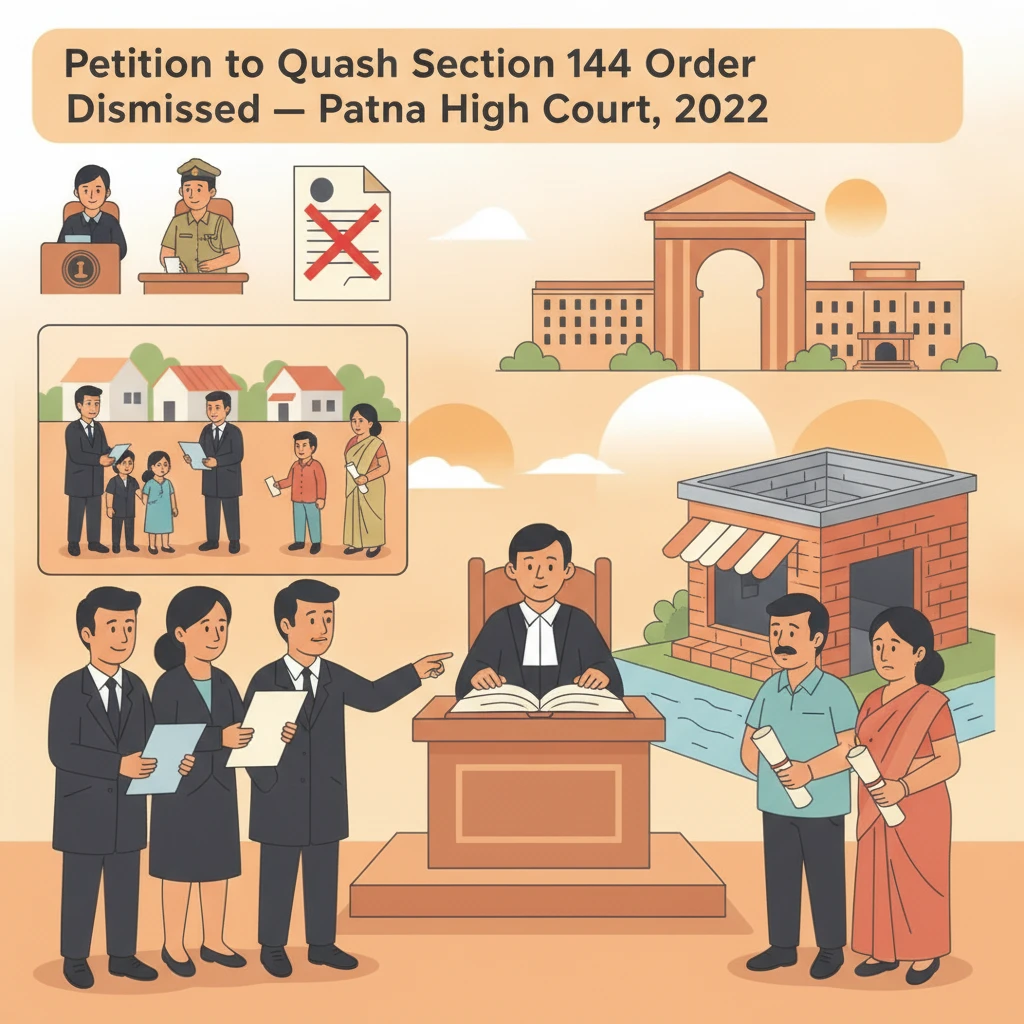
The immediate trigger for the case was an incident on 08.11.2019. On that day, petitioner no. 6 allegedly started constructing a shop on the disputed land. Local residents objected to this construction.
The Circle Officer, Biharsharif, and the Station House Officer (SHO), Bihar Police Station, jointly submitted a report to the Sub-Divisional Magistrate (SDM), Biharsharif. In that report they stated that illegal construction on the disputed land was causing tension in the locality and might lead to an untoward incident.
On the basis of this joint report, the SDM, Opposite Party No. 3, passed an order dated 18.11.2019 in Case No. 1622(M)/2019. He initiated a proceeding under Section 144 of the Code of Criminal Procedure and issued notices to the petitioners, the Circle Officer and the Government Pleader No. 9.
The petitioners said they received the notices late but did file a detailed show cause. In this show cause, they asserted that the disputed land belonged to them and explained their version of the land’s history and their alleged title and possession.
On 16.01.2020, the SDM took up the matter. By that time, sixty days had elapsed from the date of the initial order. In line with Section 144(4) Cr.P.C., which limits the duration of such orders, he dropped the proceeding.
Despite the fact that the proceeding had already been dropped, the petitioners approached the Patna High Court under Section 482 Cr.P.C. They sought to quash both the initiating order dated 18.11.2019 and the dropping order dated 16.01.2020.
Their counsel argued that the land was their private raiyati land and had been wrongly recorded as Gair Majarua Aam Gaddha in the survey khatian. He also contended that the SDM exceeded his jurisdiction by the way he passed the order dated 16.01.2020. Another point made was that repeated use of Section 144 Cr.P.C. over the same land was impermissible.
To support these arguments, the petitioners relied on four reported decisions: Gulam Abbas and others vs. State of U.P. and others (AIR 1981 SC 2198), A.H. Wheeler and Company Pvt. Limited, Muzaffarpur vs. State of Bihar (1988 BLJR 325), Acharya Jagdishwaranand Avadhuta vs. Commissioner of Police, Calcutta and another (AIR 1984 SC 51) and Gopalji Prasad vs. State of Sikkim and others (1981 CRI.L.J. 60).
On the other side, the Additional Public Prosecutor (APP) for the State highlighted the contents of the joint report of the Circle Officer and SHO. He pointed out that they clearly apprehended breach of peace due to construction on the land and recommended action under Section 144 to maintain peace.
The APP stressed that the SDM, after perusing the joint report, found that the construction by the petitioners was causing tension between the locals and the petitioners which could result in breach of peace. Therefore, he initiated proceedings under Section 144 Cr.P.C., which is meant precisely for such situations.
He further pointed out that the petitioners themselves had asked for dropping of the Section 144 proceeding and that the SDM eventually dropped it on 16.01.2020 because sixty days had passed, as required under Section 144(4). Therefore, in the State’s view, nothing survived to be quashed and the issue was already closed.
The APP also drew attention to two important facts. First, the petitioners admitted that in the survey khatian the land is recorded as Gair Majarua Aam Gaddha (public ditch) and they never took any step to get this entry corrected. Second, when Title Suit No. 85 of 2005 was filed by Ashok Kumar against the petitioners over the same land, the State or its representative was not made a party, even though the land stood recorded as public land in the survey khatian. The APP described this as a collusive fight between two private parties that had no legal bearing on the State’s recorded title.
The Patna High Court examined both the SDM’s order initiating the proceeding (dated 18.11.2019) and the order dropping it (dated 16.01.2020). The Court found that the SDM had clearly recorded the relevant facts in his initial order, namely:
• he had considered the joint report of the Circle Officer and the SHO;
• he noted that construction was being carried out by the petitioners on the disputed land;
• he found that this construction was causing tension among the general public, which might lead to a fight;
• to maintain peace in the area, he invoked Section 144 Cr.P.C.
The Court said these recorded facts were sufficient to infer the SDM’s satisfaction and opinion, fulfilling the basic requirements for exercising power under Section 144 Cr.P.C.
The Court then considered the petitioners’ objection that repeated orders under Section 144 over the same land were not permissible. It noted that the previous Section 144 order had been passed in 2005, while the present order was passed in 2019. On this basis, the Court held that it could not be said that the SDM’s 2019 order was a repetitive order in the legal sense.
The judgments cited by the petitioners were also considered one by one. In Gulam Abbas, the Supreme Court dealt with a different situation, namely rights to perform religious rites, and held that an administrative order under Section 144 could be challenged in writ jurisdiction if it violated fundamental rights. The Patna High Court found that this context did not match the present land dispute.
In Acharya Jagdishwaranand Avadhuta, the Supreme Court stated that Section 144 is meant to meet emergencies and cannot be used in a permanent or semi-permanent way. The Patna High Court pointed out that, here, the SDM had dropped the proceeding after the mandatory period under Section 144(4), so there was no misuse.
In A.H. Wheeler, the Patna High Court had held that a Magistrate acting under Section 144 is only to prevent disorder, obstruction, and annoyance and cannot adjudicate title. In the present case, the Court observed that the SDM had not adjudicated title at all; he had merely noted the undisputed position that the land was recorded as Gair Majarua Aam Gaddha, which even the petitioners accepted.
In Gopalji Prasad, the Sikkim High Court held that orders under Section 144 must recite the facts on which the Magistrate’s satisfaction is based. Applying that principle, the Patna High Court held that the SDM’s order of 18.11.2019 did recite such facts—the tension and possible breach of peace due to construction—and therefore satisfied this requirement.
The Court then recalled the Supreme Court’s observations in Anuradha Bhasin vs. Union of India, (2020) 3 SCC 637, where paragraph 124 quotes Babulal Parate vs. State of Maharashtra (AIR 1961 SC 884). The Supreme Court clarified there that Section 144 can be used not only when present danger exists but also when there is apprehension of danger, as long as the Magistrate is satisfied that immediate prevention of certain acts is necessary to counteract danger to public safety.
Using this guidance, the Patna High Court held that the SDM’s action based on apprehended breach of peace was legally valid.
Finally, the Court noted again that the SDM had dropped the proceeding after the 60-day period, as required by law. There was, therefore, no illegality either in initiating or in withdrawing the Section 144 proceeding.
On these reasons, the Court concluded that the orders dated 18.11.2019 and 16.01.2020 suffered from no infirmity. The application under Section 482 Cr.P.C. filed by the petitioners lacked merit and was dismissed.
Why This Judgment Matters
This judgment is important for people involved in local land disputes that create tension in the neighbourhood.
It confirms that authorities like the SDM can use Section 144 Cr.P.C. when there is a real risk of breach of peace, even if the actual violence has not yet occurred. A joint report by local revenue and police officers describing tension can be enough.
The Patna High Court also made it clear that proceedings under Section 144 are temporary. The SDM must follow the 60-day limit, and in this case he did so by dropping the proceeding on time.
For people who believe that their land has been wrongly recorded as public land, the judgment shows that Section 144 is not the tool to settle title. If survey records show land as Gair Majarua Aam, and no steps are taken to correct those records or to involve the State in civil suits, courts will not treat such land as private merely on the basis of past private dealings.
The decision also warns that simply calling a Section 144 order “repetitive” will not work unless the earlier and later orders are close in time and show misuse. A gap of many years, as here between 2005 and 2019, will not support such an argument.
Legal Issues and Answers
Issue: Did the SDM act illegally in initiating proceedings under Section 144 Cr.P.C. on 18.11.2019 regarding the disputed land?
Answer: No. The Patna High Court held that the SDM based his satisfaction on a joint report showing tension and possible breach of peace, satisfying the legal requirements of Section 144.
Issue: Was the SDM’s order dated 16.01.2020, dropping the Section 144 proceeding, beyond his jurisdiction or otherwise bad in law?
Answer: No. The Court held that the SDM correctly dropped the proceeding after the expiry of sixty days in compliance with Section 144(4) Cr.P.C.
Issue: Were the Section 144 proceedings invalid because they were repetitive or used to decide title over the disputed land?
Answer: No. The earlier Section 144 order was in 2005, so the 2019 order was not repetitive. The SDM did not adjudicate title; he only noted the admitted survey entry that the land was recorded as Gair Majarua Aam Gaddha.
Cases Cited by the Court
- Gulam Abbas and others vs. State of U.P. and others, AIR 1981 SC 2198
- Acharya Jagdishwaranand Avadhuta vs. Commissioner of Police, Calcutta and another, AIR 1984 SC 51
- A.H. Wheeler and Company Pvt. Limited, Muzaffarpur vs. State of Bihar, 1988 BLJR 325
- Gopalji Prasad vs. State of Sikkim and others, 1981 CRI.L.J. 60
- Anuradha Bhasin vs. Union of India and others, (2020) 3 SCC 637
- Babulal Parate vs. State of Maharashtra and others, AIR 1961 SC 884 (quoted in Anuradha Bhasin)
Case Details
Case Number: Criminal Miscellaneous No. 18197 of 2021 (arising out of P.S. Case No.- Year-0, Thana-, District-)
Case Title: Abdul Salam & Ors. vs. The State of Bihar & Ors.
Citation: 2022 (3) PLJR 64
Coram: Hon’ble Mr. Justice Rajiv Roy
Advocates:
- For the petitioners: Mr. Raj Kishore Prasad Singh, Advocate; Mr. Bal Bhushan Choudhary, Advocate
- For the State/opposite parties: Mr. Jitendra Kumar Singh, APP
Nature of the Case: Petition under Section 482 of the Code of Criminal Procedure seeking quashing of orders dated 18.11.2019 and 16.01.2020 passed by the Sub-Divisional Magistrate, Biharsharif, under Section 144 Cr.P.C.
Link to Judgment: Full text of Patna High Court judgment
If you found this explanation helpful and wish to stay informed about how legal developments may affect your rights in Bihar, you may consider following Samvida Law Associates for more updates.







