

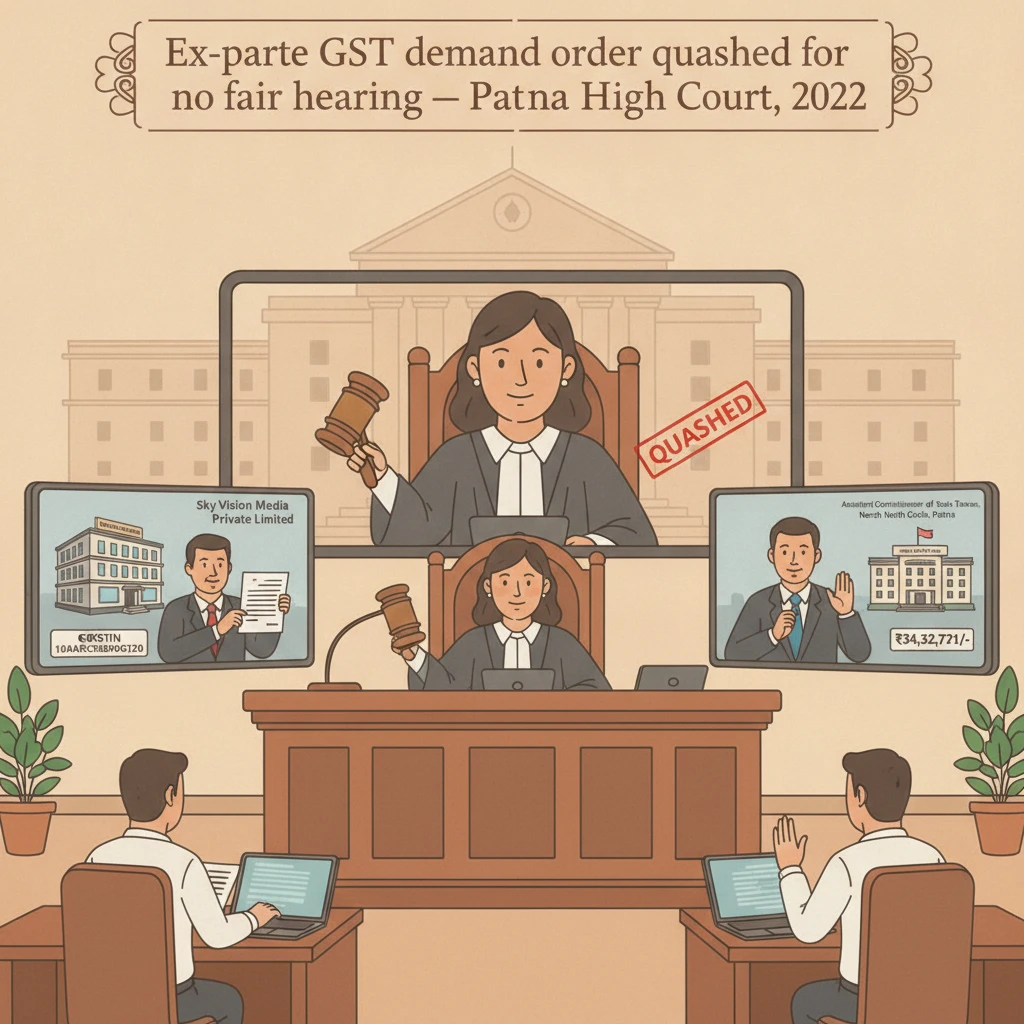
Case Background
The case arose from a tax dispute under the Bihar Goods and Services Tax Act, 2017 for the financial year 2019–20.
The petitioner, Sky Vision Media Private Limited, holds GSTIN 10AARCS6890G1Z0. For this tax period, the Assistant Commissioner of State Taxes, North Circle, Patna, initiated proceedings under Section 73(1) of the BGST Act, 2017.
On 08.02.2021, the Assistant Commissioner passed an ex-parte order against the petitioner. On the same date, a summary of the order was issued in Form GST DRC-07 under Rule 142(5) of the Bihar Goods and Services Tax Rules, 2017.
By this order and summary, a demand of Rs. 34,32,721/- was raised against the petitioner towards tax and penalty.
The petitioner claimed that the order was passed without giving it a fair chance to present its case and that the order did not contain proper reasons. It approached the Patna High Court under its civil writ jurisdiction in CWJC No. 21364 of 2021.
The petitioner requested the Court to quash the ex-parte order and the DRC-07 summary, to declare the order cryptic and against natural justice, and to restrain authorities from taking coercive recovery steps during the pendency of the writ case.
What the Court Examined and Decided
The Division Bench, speaking through the Hon’ble Chief Justice, heard both sides through video conferencing, in view of the Covid-19 pandemic. The Court recorded the presence of counsel for the petitioner and Government Pleader 7 for the State.
The main challenge before the Patna High Court was to the ex-parte order dated 08.02.2021 passed under Section 73(1) of the BGST Act, 2017 and the corresponding summary in Form GST DRC-07 for the tax period 2019–20, raising a demand of Rs. 34,32,721/-.
On behalf of the petitioner, it was alleged (as seen from the reliefs sought) that the order was highly cryptic, misconceived, non-speaking and violative of the principles of natural justice. The petitioner said it was not granted adequate opportunity of hearing, and that the order did not disclose how the tax officer determined the tax and penalty payable.
Significantly, during the hearing, the learned counsel for the Revenue himself stated that he had no objection if the matter was remanded to the Assessing Authority for a fresh decision. He also stated that the case would be decided on merits and that during the pendency of such proceedings, no coercive steps would be taken against the petitioner.
The Court accepted this statement and took it on record. However, the Bench did not stop there. It examined whether, despite the availability of a statutory remedy (like appeal), the High Court could still interfere in writ jurisdiction.
After hearing counsel and perusing the record, the Court formed a considered view that it was not barred from interfering with the impugned order even though other remedies existed. The key test the Court applied was whether, on the face of it (ex facie), the order appeared to be bad in law.
The Court identified two main defects in the impugned order.
First, there was violation of the principles of natural justice. The Court found that no sufficient time was given to the petitioner to represent its case. Fair opportunity of hearing is a basic requirement in tax adjudication, especially when a large monetary demand is raised.
Second, the order was passed ex-parte and did not assign any sufficient reasons. Even from the available record, the Court could not see how the officer had determined the exact amount due and payable by the assessee.
The Bench noted that an ex-parte order passed in violation of natural justice and without reasons carries serious civil consequences for a taxpayer. Therefore, such an order cannot be allowed to stand.
On this short ground alone – violation of natural justice and lack of reasons – the Court decided to dispose of the writ petition in mutually agreeable terms, combining both the petitioner’s grievance and the Revenue’s consent for remand.
First, the Court formally quashed and set aside the impugned order dated 08.02.2021 passed by the Assistant Commissioner of State Taxes, North Circle, Patna in GSTIN 10AARCS6890G1Z0 under Section 73(1) of the BGST Act, 2017, along with the summary order in Form GST DRC-07 dated 08.02.2021.
Second, while giving relief to the petitioner, the Court also balanced the interests of the Revenue. It recorded an undertaking from the petitioner to deposit ten per cent of the amount of the demand raised before the Assessing Officer. This deposit was to be made within four weeks.
The Court made it clear that this ten per cent deposit would be without prejudice to the rights and contentions of both sides, and would be subject to the final order of the Assessing Officer. If it was later found that the deposit was in excess, the excess amount was to be refunded to the petitioner within two months from the date of the fresh order.
Third, the Court addressed the coercive measures allegedly taken in connection with the impugned proceedings. It directed de-freezing or de-attaching of the petitioner’s bank accounts, if they had been attached in relation to this case. This was to be done immediately.
Fourth, the Court fixed a date for the petitioner’s appearance before the Assessing Authority. The petitioner undertook to appear on 28.01.2022 at 10:30 A.M., with a possibility of joining through digital mode.
Fifth, the Court laid down a series of safeguards to ensure a proper fresh adjudication:
The Assessing Authority was directed to decide the case on merits after fully complying with the principles of natural justice. Both sides were to be given an opportunity to place on record all essential documents and materials they considered necessary.
During the pendency of the fresh proceedings, no coercive steps were to be taken against the petitioner. This protection ensured that the company would not face forced recovery until the matter was properly decided afresh.
The Assessing Authority was instructed to pass a fresh order only after giving adequate opportunity to all concerned, including the petitioner. The petitioner, through its counsel, undertook to fully cooperate with the proceedings and not seek unnecessary adjournments.
To prevent undue delay, the Court directed that the Assessing Authority should decide the case on merits expeditiously, preferably within two months from the date the petitioner appears.
Further, the new order was required to be a speaking order, assigning reasons. A copy of this order was to be supplied to the parties.
The Court preserved the parties’ rights to further legal remedies. Liberty was reserved to the petitioner to challenge the fresh order, if required and desired. Similarly, both sides were free to take recourse to other remedies available under law. The Court expressed hope that any such future proceedings would be dealt with in accordance with law and with reasonable dispatch.
The Bench specifically clarified that it had not expressed any opinion on the merits of the tax dispute itself. All issues were left open for the Assessing Authority to decide.
Given the ongoing Covid-19 pandemic at that time, the Court also observed that, if possible, the proceedings should be conducted through digital mode.
With these directions, the writ petition and any interlocutory applications were disposed of. The Court also recorded the undertaking of the respondents’ counsel to communicate this order to the appropriate authority through electronic mode.
Why This Judgment Matters
This judgment is important for taxpayers and small businesses facing GST demands in Bihar.
First, it shows that the Patna High Court will step in when tax orders are passed ex-parte without proper hearing, even if appeal remedies exist under the statute.
Second, the Court has clearly said that a tax order must contain reasons showing how the officer has calculated the demand. A non-speaking order, especially one passed without hearing, cannot be allowed to stand when it causes serious financial consequences.
Third, the judgment balances taxpayer protection with revenue interests. By requiring a ten per cent deposit and then granting full opportunity for fresh adjudication, the Court protects both sides.
For other GST-registered entities, this decision reinforces that they are entitled to adequate time, fair opportunity to place documents, and a reasoned speaking order. If these basic rights are denied, they can seek relief from the High Court.
Legal Issues and Answers
-
Issue: Can the Patna High Court interfere in writ jurisdiction with an ex-parte GST demand order passed under Section 73(1) BGST Act, despite the availability of statutory remedies, when the order appears to violate natural justice and lacks reasons?
Answer: Yes. The Court held that where an order is ex facie bad in law for breach of natural justice and absence of reasons, it can quash such order and remand the matter for fresh decision with full opportunity of hearing. -
Issue: What directions should follow when an ex-parte, non-speaking GST demand order is set aside on grounds of natural justice?
Answer: The Court quashed the order and DRC-07 summary, directed a fresh merit-based decision after adequate hearing, ordered de-freezing of bank accounts, restrained coercive recovery during pendency, recorded a 10% deposit by the taxpayer, and mandated a reasoned speaking order within a time frame.
Cases Cited by the Court
- No prior judgments or case law are expressly cited or relied upon in the text of this judgment.
Case Details
Case Number: Civil Writ Jurisdiction Case No. 21364 of 2021
Case Title: Sky Vision Media Private Limited vs. The State of Bihar & Ors.
Coram: Hon’ble the Chief Justice; Hon’ble Mr. Justice S. Kumar
Citation: 2022(3) PLJR 142
Date of Judgment: 04.01.2022
Advocates:
- For the Petitioner: Mr. Gautam Kumar Kejriwal, Advocate; Mr. Pawan Kumar Singh, Advocate
- For the Respondents: Mr. Vivek Prasad, GP 7
Nature of the Case: Writ petition under Article 226 challenging ex-parte GST assessment order and recovery proceedings.
Link to the Judgment: Click here to read the full judgment of the Patna High Court
If you found this explanation helpful and wish to stay informed about
how legal developments may affect your rights in Bihar,
you may consider following Samvida Law Associates for more updates.







