

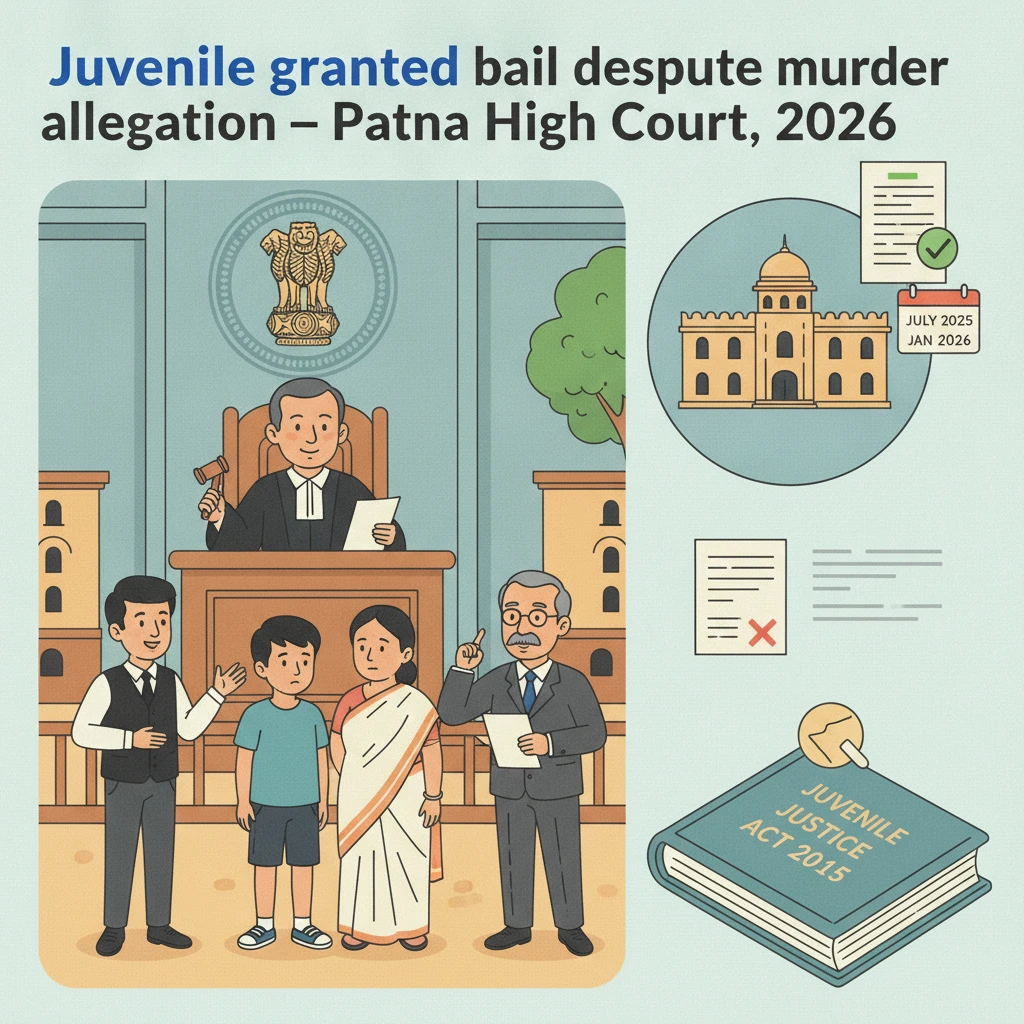
Case Background
This criminal appeal arose from an order of the District and Additional Sessions Judge-I-cum-Special Court, Siwan, functioning as the Children Court in a juvenile enquiry.
The Children Court was dealing with Juvenile Enquiry Trial No. 18 of 2025, which came from Siwan Muffasil P.S. Case No. 539 of 2025. The FIR in that police case was registered on 19.07.2025.
The FIR was lodged by the father of a deceased boy. He alleged that his son had gone to V2 Mall at Siwan Pakdi More to buy clothes with four friends. Later, he was informed by one of those friends that the appellant and four other co-accused had caused his son’s death by stabbing him with a knife.
According to the specific allegation in the FIR, the appellant and three co-accused caught hold of the victim, and one co-accused, Vikash Kumar, stabbed the victim with a knife, causing his death. The case was registered for offences punishable under Sections 103(1), 61(2) and 3(5) of the Bharatiya Nyaya Sanhita, 2023.
The appellant was a juvenile in conflict with law and had been kept in an Observation Home since 22.07.2025. He applied for regular bail before the Children Court.
By order dated 02.01.2026, the Children Court rejected his bail application. It relied on the Social Investigation Report while doing so. Aggrieved by that rejection of bail, the juvenile filed the present Criminal Appeal (SJ) No. 566 of 2026 before the Patna High Court.
What the Court Examined and Decided
The Patna High Court, per Hon’ble Mr. Justice Jitendra Kumar, heard the appeal on 11.05.2026.
Counsel for the appellant argued that the juvenile was innocent and had been falsely implicated. It was stressed that neither the appellant nor his parents or other family members had any criminal antecedents. They were described as peace‑loving people, engaged in their normal vocation or profession, with no involvement in criminal activity.
The defence submitted that the Children Court wrongly rejected the regular bail application by using the Social Investigation Report against the juvenile. According to the appellant, there was nothing in that report to show that his family environment was not suitable for his proper development or reformation at home. The appellant’s counsel also highlighted that the juvenile had no prior criminal record and had already been in the Observation Home since July 2025.
On the other hand, the learned APP for the State opposed the appeal. The State argued that there was no illegality in the order of the Children Court. It was contended that the offence was serious in nature, involving the death of a young boy by stabbing, and therefore the rejection of bail was justified.
Before applying the law to the facts, the High Court undertook a detailed examination of Section 12 of the Juvenile Justice (Care and Protection) Act, 2015. This provision specifically deals with bail to children alleged to be in conflict with law.
Section 12, as quoted in the judgment, clearly states that when a person who is apparently a child is alleged to have committed any offence, whether bailable or non‑bailable, and is apprehended or brought before the Juvenile Justice Board, that person “shall” be released on bail with or without surety or placed under supervision of a probation officer or a fit person. This applies notwithstanding anything contained in the Code of Criminal Procedure or any other law in force.
The Court emphasised the proviso to Section 12(1), which creates only three exceptions where bail can be denied. Bail may be refused if there are reasonable grounds for believing that release is likely to:
(i) bring the child into association with any known criminal, or
(ii) expose the child to moral, physical or psychological danger, or
(iii) defeat the ends of justice.
The Court then surveyed several Supreme Court and High Court decisions applying Section 12. It noted that the Supreme Court in Juvenile in Conflict with Law v. State of Rajasthan, 2024 SCC OnLine SC 5297, held that a juvenile in conflict with law must be released on bail unless the proviso applies, and that courts must record a clear finding when relying on the proviso to deny bail.
In Re-Exploitation of Children in Orphanages in the State of T.N. v. Union of India, (2020) 14 SCC 327, the Supreme Court again clarified that bail can be denied to a juvenile only on the three grounds set out in the proviso, and that, even when bail is refused, the child cannot be kept in jail but must be placed in an Observation Home or place of safety.
The Patna High Court also referred to decisions of various High Courts, including Bombay, Karnataka, Allahabad, Punjab and Haryana, Rajasthan and Uttarakhand. Across these rulings, a consistent line emerged: under Section 12 of the Juvenile Justice Act, the nature and gravity of the alleged offence, or even the age bracket within the definition of child, are not valid grounds by themselves to deny bail to a juvenile.
Citing those authorities, the Court summarised the legal position in clear terms. It held that:
• Section 12 overrides the general bail provisions in the Code of Criminal Procedure and any other law.
• Section 12 applies to all juveniles in conflict with law without any discrimination, including those aged 16–18 years accused of heinous offences and even if they are being tried by a Children Court as adults for trial purposes.
• The seriousness or nature of the alleged offence is not a relevant consideration for bail under Section 12.
• Bail to a juvenile is the rule and refusal is the exception, strictly limited to the three grounds in the proviso.
• “Ends of justice” in the context of the Juvenile Justice Act is different from criminal law generally. It is to be understood in light of the Act’s object, which is reformation, rehabilitation and social reintegration of the child, not punishment.
The Court then turned to the wider scheme and principles of the Juvenile Justice Act, 2015. It quoted the preamble of the Act, which focuses on care, protection, development, treatment, social reintegration, child‑friendly adjudication and rehabilitation in the best interest of children.
It further referred to Section 3 of the Act, which sets out general principles: best interest of the child, safety, positive measures, family responsibility, institutionalisation as a last resort, and repatriation and restoration of the child to the family. The Court highlighted that the family is considered the primary institution for care and protection, and that institutionalisation in Observation or Reformatory Homes is only a step of last resort.
In the Court’s words, the Juvenile Justice Act proceeds on the belief that children are the future of society. Even when they come into conflict with law, the response should be to reform and rehabilitate them, not to punish. A punitive approach towards children in conflict with law is considered self‑destructive for society.
Based on these principles, the Court crystallised its conclusions in a structured summary of legal provisions:
• Every juvenile in conflict with law is entitled to consideration under Section 12, regardless of offence type.
• Detention in an Observation Home is justified only when it truly serves the child’s protection, development and rehabilitation such that release would defeat the ends of justice in the special sense used in the Act.
• Denial of bail must be reasoned and grounded in material on record, especially the Social Investigation Report mandated under Section 15(2). That report must inform the Court not just about the offence, but about the socio‑economic conditions and circumstances in which it was committed, so that an appropriate, reform‑oriented order can be passed.
With this legal framework in place, the Patna High Court examined the facts of the present case. It acknowledged that the appellant was one of the accused, and that the allegation was that he, along with other co‑accused, had caught hold of the victim while another co‑accused stabbed him to death with a knife.
The Court then carefully considered the Social Investigation Report. According to the report, there was nothing to indicate that releasing the appellant on bail would defeat the ends of justice. Neither the appellant nor any of his family members had criminal antecedents, nor was there any report that they were involved in any crime.
The report showed that the appellant’s father is a barber running a shop for his livelihood and maintaining his family. The appellant’s mother is a homemaker, and his brothers are pursuing their studies; one brother is also a barber.
On this basis, the Court found that there was nothing in the Social Investigation Report to suggest that the family environment was unsuitable, or that the juvenile’s release would expose him to moral, physical or psychological danger, or associate him with known criminals. Consequently, the Children Court’s observations in the impugned order were held to be unsupported by the material on record.
In the absence of any of the three statutory grounds under the proviso to Section 12(1), and keeping in view that bail is the rule for juveniles, the Patna High Court held that the impugned order dated 02.01.2026 could not be sustained and was liable to be set aside.
The Court allowed the appeal and directed that the appellant be released on bail on furnishing a bail bond of Rs. 10,000/-. An additional safeguard was imposed: the appellant’s father must file an affidavit undertaking to keep vigil over the appellant’s habits, not allow him to come in contact with any criminal persons, and take care of the appellant’s other developmental needs. The appellant is also required to attend Court whenever required or directed.
The Court ordered that the lower court records be sent back to the Children Court along with a copy of the judgment.
Why This Judgment Matters
This judgment is important for families of children accused in criminal cases, especially in Bihar. It clearly shows that the Patna High Court expects Children Courts and Juvenile Justice Boards to follow Section 12 of the Juvenile Justice Act strictly.
The decision makes it clear that the seriousness of the allegation, even an allegation of murder, cannot by itself be a reason to keep a child in an Observation Home. Bail should be denied only when there is real, concrete material showing risk of association with criminals, danger to the child, or that release would harm the child’s reform and rehabilitation.
The Court also confirms that Social Investigation Reports must be read carefully. These reports are not meant to be a mere formality. They are central to deciding what is in the child’s best interest. Where, as in this case, the report shows a stable, non‑criminal family background, courts should normally lean towards releasing the child to the family with proper safeguards.
For lawyers and trial courts, the judgment offers a clear checklist: consider Section 12, examine the three exceptions, read the Social Investigation Report, and give reasoned findings. For parents of juveniles in conflict with law, it offers reassurance that the law favours rehabilitation at home, and that courts will insist on this approach when the family environment is supportive.
Legal Issues and Answers
-
Issue: Whether a juvenile accused of participating in a fatal stabbing can be denied bail by the Children Court merely on the basis of seriousness of the offence and a general reference to the Social Investigation Report.
Answer: No. The Patna High Court held that under Section 12 of the Juvenile Justice Act, 2015, bail to a juvenile is the rule and refusal is an exception. Seriousness of the offence is not a valid ground. Bail can be denied only if there is material showing that release will associate the child with known criminals, expose the child to moral, physical or psychological danger, or defeat the ends of justice. As the Social Investigation Report showed no such risk in this case, the juvenile was entitled to bail. -
Issue: How should “ends of justice” be understood while deciding bail for juveniles under Section 12 of the Juvenile Justice Act, 2015?
Answer: The Court held that “ends of justice” in this context must be read in line with the object and principles of the Juvenile Justice Act. It is not about punishing the child, but about protection, development, reform and rehabilitation. Detention in an Observation Home can be justified only when it genuinely serves these aims better than release to the family.
Cases Cited by the Court
- Juvenile in Conflict with Law v. State of Rajasthan, 2024 SCC OnLine SC 5297
- In Re-Exploitation of Children in Orphanages in the State of T.N. v. Union of India and Others, (2020) 14 SCC 327
- XYZ v. State of Maharashtra, 2023 SCC OnLine Bom 2790
- Lalu Kumar @ Lal Babu v. State of Bihar, 2019 (6) BLJ 2016
- XXX (accused before the J.J. Board) v. State and Others, MANU/KA/3957/2024 (Karnataka High Court)
- Radhika (Juvenile) v. State of U.P., 2019 SCC OnLine All 4911
- Vishvas v. State of Punjab, MANU/PH/0067/2021
- Gau v. State of Rajasthan, 2025 SCC OnLine Raj 2526
- Master Abhishek (Minor) v. State (Delhi), 2005 VI AD Delhi 18
- Abhishek v. State, 205 CriLJ (NOC) 115 (Delhi)
- Manoj v. State (NCT of Delhi), 2006 CriLJ 4759
- X (Juvenile in conflict with law) v. State of Uttarakhand, 2025 SCC OnLine Utt 157
- Biswajit Kumar Pandey @ Lalu Kumar v. State of Bihar (cited as “Biswajit Kumar Pandey @ Lalu Kumar Case”)
- Nitish Kumar v. State of Bihar (cited as “Nitish Kumar Case”)
- Chandan Kumar Paswan v. State of Bihar (cited as “Chandan Kumar Paswan Case”)
- Rakesh Rai v. State of Bihar (cited as “Rakesh Rai Case”)
- Avnish Kumar v. State of Bihar (cited as “Avnish Kumar case”)
Case Details
Case Number: Criminal Appeal (SJ) No. 566 of 2026; arising out of Siwan Muffasil P.S. Case No. 539 of 2025
Case Title: XXX (Real name withheld) v. The State of Bihar
Citation: 2026(3) PLJR 594
Court: High Court of Judicature at Patna
Coram: Hon’ble Mr. Justice Jitendra Kumar
Date of Judgment: 11.05.2026
Advocates: Mr. Ajay Kumar Tiwary, Advocate for the appellant; Mr. Ramchandra Singh, APP for the State
Nature of the Case: Criminal appeal (single judge) against an order of the Children Court refusing regular bail to a juvenile in conflict with law in a murder case under the Bharatiya Nyaya Sanhita, 2023
Link to the Judgment: Patna High Court Judgment
If you found this explanation helpful and wish to stay informed about how legal developments may affect your rights in Bihar, you may consider following Samvida Law Associates for more updates.







