

Case Background
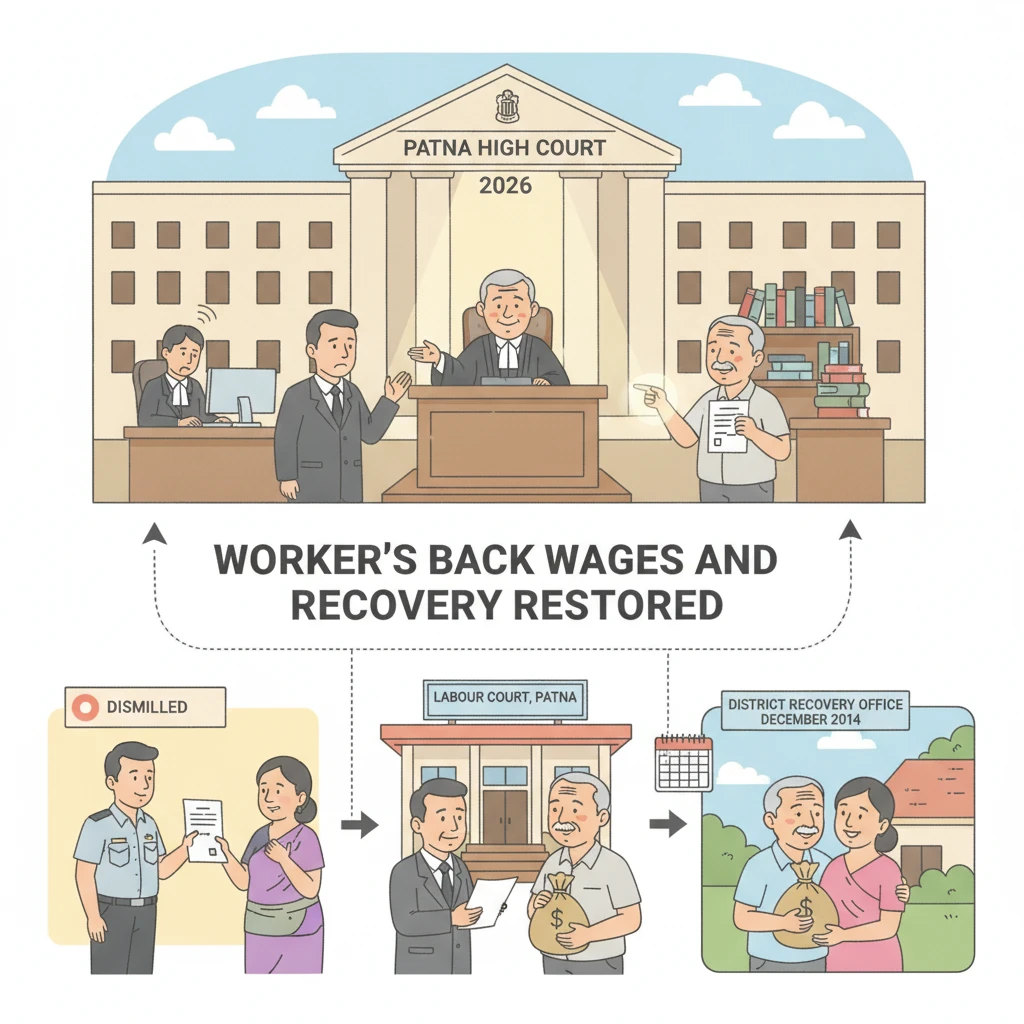
The appellant was working as a conductor with Bihar State Road Transport Corporation at Bankipur Depot, Patna. On 24.01.1978, while on duty on bus no. BHT-8015 (Rupauli–Patna service), a checking squad inspected the vehicle.
According to the Corporation, it was found that he had allegedly collected fare from ten unbooked passengers without issuing tickets. In total, seventeen passengers were said to be unbooked. It was also alleged that he misbehaved with the checking party. A departmental enquiry was held, the charges were treated as proved, and he was dismissed from service on 19.09.1978.
The State Government later referred the industrial dispute to the Labour Court, Patna as Reference Case No. 24 of 1995 under Section 10(1)(c) of the Industrial Disputes Act, 1947. The specific question was whether his termination was proper and justified, and if not, what relief he was entitled to.
After taking oral and documentary evidence from both sides, the Labour Court passed an award on 14.11.2006. It set aside the dismissal order dated 19.09.1978, held that the worker would be deemed to be an employee on the date of dismissal, and directed the Corporation to reinstate him with full back wages and all consequential benefits.
The award was not challenged by the Corporation before the High Court.
The worker then presented the award to the Corporation for implementation. The Corporation claimed that it was facing acute financial crisis. The Administrator suggested that he may be reinstated if he forwent his claim to back wages and consequential benefits. The Corporation says he accepted this suggestion, and on that basis, an order of reinstatement dated 28.12.2007 was issued clearly stating that he would not get any benefit for the non-working period.
The worker joined duty on this basis. About a year later, he moved the Labour Court again, this time under Section 33C(2) of the Industrial Disputes Act, 1947, by filing Misc. Case No. 02 of 2008 for computation of the back wages and consequential benefits due under the 2006 award.
On 19.06.2013, the Labour Court, acting under Section 33C(2), held that he was entitled to Rs. 11,70,990/- towards his back wages for the period from 19.09.1978 to 30.12.2007 instead of the full claim of Rs. 16,90,238/-. The Corporation was directed to pay this amount within three months, failing which interest at 6% per annum would apply.
The Corporation did not pay. The worker retired and, according to his pleadings, was in desperate need of financial assistance. He moved the Deputy Labour Commissioner, Patna Division. On 12.12.2014, the Deputy Labour Commissioner directed the District Certificate Officer, Patna to take steps for recovery of the amount found due.
Certificate Case No. 699 of 2014–15 was started for recovery as a public demand. Notices were issued to the certificate debtor (the Corporation) and warrants and attachment orders were issued on several occasions.
On 18.04.2018, the Divisional Manager of the Corporation wrote to the Certificate Officer requesting recall of the warrant. Acting on this request, the Certificate Officer recalled the warrant without recording that any payment had been made.
The Corporation had already filed C.W.J.C. No. 2592 of 2014 before the High Court to challenge the Labour Court’s Section 33C(2) order dated 19.06.2013. Later, the worker filed C.W.J.C. No. 17753 of 2018 challenging the recall of the warrant in the certificate case.
A learned Single Judge heard both writ petitions together. By common order dated 23.06.2025, the Single Judge allowed the Corporation’s writ (C.W.J.C. No. 2592 of 2014) and dismissed the worker’s writ (C.W.J.C. No. 17753 of 2018). The worker then filed the present Letters Patent Appeals, L.P.A. No. 827 of 2025 and L.P.A. No. 829 of 2025, before the Division Bench of the Patna High Court.
What the Court Examined and Decided
The Division Bench examined first whether the Labour Court’s computation order dated 19.06.2013 under Section 33C(2) could be interfered with when the underlying award dated 14.11.2006 had never been challenged.
The Corporation argued that the worker had voluntarily given up his claim to back wages and consequential benefits when he rejoined service in December 2007. It relied on Order No. 819 dated 28.12.2007 which stated that the break period would not be treated as break in service but that he would not get back wages for that period. It contended that in view of its poor financial condition and this arrangement, the worker could not lawfully approach the Labour Court under Section 33C(2).
The Division Bench asked the Corporation’s counsel to produce any document showing that the worker had formally and knowingly surrendered his right to back wages and other benefits granted by the award. The Corporation could not produce any such document.
The Court then considered the Corporation’s reliance on the principle of “No Work, No Pay”, and its allegation that the worker might have been engaged in alternative employment during the period of dismissal.
The Bench noted that there was no material on record to show that the worker had been gainfully employed anywhere during the long period between dismissal and reinstatement. The Court referred to Supreme Court precedents, particularly Hindustan Tin Works Pvt. Ltd. v. Employees of Hindustan Tin Works Pvt. Ltd., (1979) 2 SCC 80, and Deepali Gundu Surwase v. Kranti Junior Adhyapak Mahavidyalaya (D.Ed.), (2013) 10 SCC 324.
In these cases, the Supreme Court has held that where the dismissal is found illegal and reinstatement is ordered, full back wages with continuity of service is the normal rule. Departure from this rule can be made only if the employer proves circumstances justifying reduction or denial, such as proof of gainful employment during the relevant period.
Quoting these judgments, the Patna High Court emphasised that the purpose of reinstatement is to restore the employee to the position he would have occupied but for the illegal dismissal. It also highlighted that denial of back wages in such situations would indirectly punish the employee and reward the employer for its illegal act.
On the nature of Section 33C(2) proceedings, the Court explained that they are in the nature of execution proceedings. The Labour Court, while acting under Section 33C(2), functions like an executing court which is called upon to compute in money terms the benefits already declared by an award or settlement. It cannot go behind the award or alter it, but it can interpret and implement it where necessary.
The Division Bench relied on State of U.P. v. Brijpal Singh, (2005) 8 SCC 58 and Central Bank of India Ltd. v. P.S. Rajagopalan, AIR 1964 SC 743 to clarify that Section 33C(2) presupposes an existing right, already adjudicated upon or provided for.
It then noted that in the present case, the foundational award dated 14.11.2006 granting reinstatement with full back wages and consequential benefits had never been challenged by the Corporation. What was challenged in C.W.J.C. No. 2592 of 2014 was only the computation order dated 19.06.2013 passed in Misc. Case No. 02 of 2008.
In the Court’s view, the learned Single Judge could not, under the guise of a challenge to the execution-type order under Section 33C(2), grant a relief which effectively nullified the unchallenged award. Such an approach went beyond the scope of the pleadings.
The Court drew support from Bharat Amratlal Kothari v. Dosukhan Samadkhan Sindhi, (2010) 1 SCC 234, and Ranbir Singh v. Executive Engineer, (2011) 15 SCC 453. Those decisions stress that a writ court should not grant relief that has not been specifically prayed for, and that parties are bound by their pleadings. If the Corporation wanted to challenge the 2006 award, it should have done so directly and in time.
Turning to the certificate proceedings, the Division Bench examined the worker’s writ (C.W.J.C. No. 17753 of 2018), where he had challenged the recall of the warrant in Certificate Case No. 699 of 2014–15.
The facts were simple. Pursuant to the order of the Deputy Labour Commissioner dated 12.12.2014, the certificate case was started to recover the amount of Rs. 11,70,990/- as public demand. The Certificate Officer issued warrants and attachment orders against the Corporation.
Without any recorded payment towards the certified amount, the Divisional Manager wrote a letter on 18.04.2018 requesting that the warrant be recalled. Acting on this letter alone, the Certificate Officer recalled the warrant.
The High Court held that this recall was contrary to law. It observed that the Recovery Officer or Certificate Officer exercises significant quasi-judicial powers which must be used strictly in line with the statute. Section 38 of the Bihar and Orissa Public Demands Recovery Act, 1914, was specifically quoted. That provision deals with the arrest and detention of a certificate-debtor, and also contains a proviso that if the amount due and costs of arrest are paid, the officer must immediately release the debtor.
By implication, the Bench held, withdrawal or recall of coercive measures in a certificate case can only follow satisfaction of the debt or other legally recognised grounds. Here, the warrant was recalled without payment. In the Court’s words, this amounted to the Certificate Officer acting “ultra vires his statutory powers” and granting “administrative mercy” to the employer to the clear prejudice of the decree-holder workman.
The Bench also referred to decisions like Hussainbhai, Calicut v. Alath Factory Thezhilali Union, (1978) 4 SCC 257, and Hombe Gowda Educational Trust v. State of Karnataka, (2006) 1 SCC 430, to underline that employers cannot shake off their liability towards workers by financial excuses or make-believe arrangements. Labour law is a charter of human rights at the workplace, and the State and its instrumentalities cannot “play hide and seek” with their employees.
Summing up, the Division Bench found that the Single Judge’s order suffered from perversity and patent illegality because it disturbed an unchallenged Labour Court award and approved the improper recall of the recovery warrant.
The Court therefore allowed both Letters Patent Appeals. It set aside the common order dated 23.06.2025. As a result, the worker’s writ petition C.W.J.C. No. 17753 of 2018 stood allowed, and the Corporation’s writ C.W.J.C. No. 2592 of 2014 was dismissed.
Why This Judgment Matters
This judgment is significant for workers who win reinstatement with back wages before Labour Courts but then face resistance or delay in actual payment.
First, the Patna High Court has made it clear that once a Labour Court award becomes final—because it is not challenged in time—employers cannot later try to undo its effect indirectly by attacking only the execution or computation under Section 33C(2). The base award stands and must be honoured.
Second, the decision reinforces that back wages are normally payable when a workman is illegally dismissed and later reinstated, unless the employer proves that the worker was gainfully employed elsewhere or that there are other strong reasons to reduce back wages. Mere financial hardship of the employer is not enough.
Third, for people trying to recover their dues through certificate proceedings under the Bihar and Orissa Public Demands Recovery Act, 1914, the judgment sends a clear message: recovery officers and certificate officers cannot recall warrants just because a government department or corporation writes a request letter. Warrants can be recalled only in line with the statute, typically after payment or legal satisfaction of the demand.
For retired workers and low-paid employees, this decision shows that the Patna High Court is willing to protect lawful dues and will not permit procedural manoeuvres that defeat an unchallenged Labour Court award.
Legal Issues and Answers
-
Issue: Can the High Court set aside a Labour Court’s Section 33C(2) computation order in a way that nullifies an earlier Labour Court award granting full back wages, when that award itself has not been challenged?
Answer: No. The Division Bench held that in the absence of any challenge to the foundational award dated 14.11.2006, the Single Judge could not disturb its effect by setting aside the Section 33C(2) order. Section 33C(2) proceedings are in the nature of execution, and the award must be enforced as it stands. -
Issue: Was the Certificate Officer justified in recalling the warrant in Certificate Case No. 699 of 2014–15 merely on the basis of a request letter from the Corporation, without payment of the certified amount?
Answer: No. The Court held that the recall was contrary to Section 38 of the Bihar and Orissa Public Demands Recovery Act, 1914. By recalling the warrant without satisfaction of the debt, the Certificate Officer acted beyond his powers and to the detriment of the workman. -
Issue: Could the Corporation rely on the principle of “No Work, No Pay” and alleged alternative employment to deny back wages despite the Labour Court’s award of full back wages?
Answer: No. The Court found no evidence of gainful employment of the worker and reiterated, based on Supreme Court precedent, that full back wages are the normal rule upon reinstatement after illegal dismissal, and the burden to justify any departure lies on the employer.
Cases Cited by the Court
- Hindustan Tin Works Pvt. Ltd. v. Employees of M/s Hindustan Tin Works Pvt. Ltd. & Ors., (1979) 2 SCC 80.
- Deepali Gundu Surwase v. Kranti Junior Adhyapak Mahavidyalaya (D.Ed.) & Ors., (2013) 10 SCC 324.
- Bharat Amratlal Kothari & Anr. v. Dosukhan Samadkhan Sindhi & Ors., (2010) 1 SCC 234.
- Ranbir Singh v. Executive Engineer, (2011) 15 SCC 453.
- State of U.P. & Anr. v. Brijpal Singh, (2005) 8 SCC 58.
- Central Bank of India Ltd. v. P.S. Rajagopalan, AIR 1964 SC 743.
- Hussainbhai, Calicut v. The Alath Factory Thezhilali Union, Kozhikode & Ors., (1978) 4 SCC 257.
- Hombe Gowda Educational Trust & Anr. v. State of Karnataka & Ors., (2006) 1 SCC 430.
Case Details
Case Numbers: Letters Patent Appeal No. 827 of 2025 and Letters Patent Appeal No. 829 of 2025, arising out of C.W.J.C. No. 17753 of 2018 and C.W.J.C. No. 2592 of 2014.
Case Title: Siya Singh v. The State of Bihar & Ors. (in L.P.A. No. 827 of 2025, from C.W.J.C. No. 17753 of 2018); Siya Singh v. The Bihar State Road Transport Corporation & Ors. (in L.P.A. No. 829 of 2025, from C.W.J.C. No. 2592 of 2014).
Court: High Court of Judicature at Patna.
Date of Judgment: 07.05.2026.
Coram: Hon’ble the Chief Justice Sangam Kumar Sahoo and Hon’ble Mr. Justice Harish Kumar.
Citation: 2026(3) PLJR 584.
Nature of the Case: Letters Patent Appeals against a common order passed in two writ petitions under Article 226 of the Constitution of India; issues arising out of an industrial dispute award and its execution through Section 33C(2) and certificate proceedings.
Advocates (L.P.A. No. 827 of 2025): For the appellant: Mr. Raj Shekhar, Advocate. For the State of Bihar: Mr. Yogendra Pd. Sinha, AAG-7 and Mr. Rakesh Ambastha, AC to AAG-7. For Bihar State Road Transport Corporation: Mr. Prabhat Kumar Verma, Senior Advocate and Mr. Jainendra Kumar Sinha, Advocate.
Advocates (L.P.A. No. 829 of 2025): For the appellant: Mr. Raj Shekhar, Advocate. For the State of Bihar: Mr. Yogendra Pd. Sinha, AAG-7 and Mr. Rakesh Ambastha, AC to AAG-7. For Bihar State Road Transport Corporation: Mr. Prabhat Kumar Verma, Senior Advocate and Mr. Lakshmi Kant Tiwary, Advocate.
Key Statutes Involved: Industrial Disputes Act, 1947 (especially Sections 10(1)(c) and 33C(2)); Bihar and Orissa Public Demands Recovery Act, 1914 (especially Section 38).
Official Link to Judgment: Patna High Court judgment link
If you found this explanation helpful and wish to stay informed about how legal developments may affect your rights in Bihar, you may consider following Samvida Law Associates for more updates.







