

Case Background
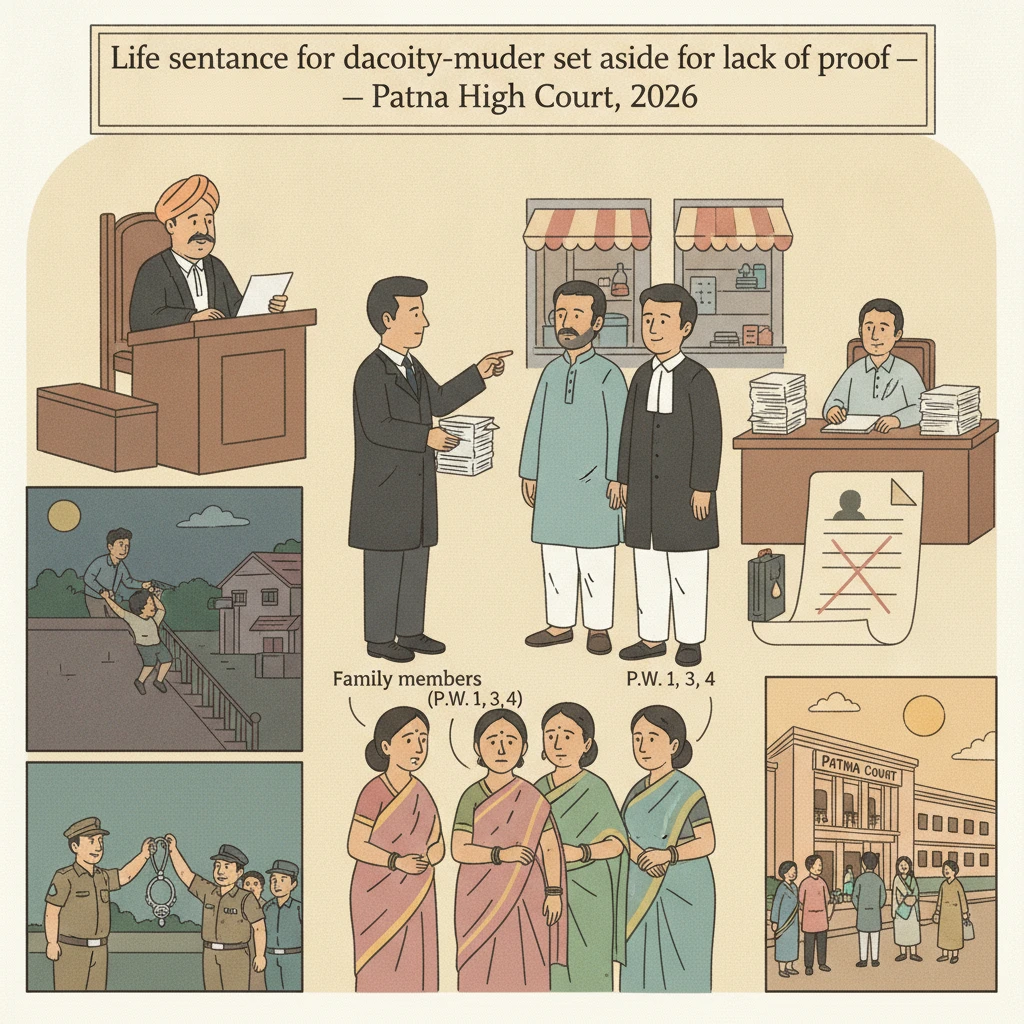
The case arose from a night dacoity and shooting that took place in village Pursanda, under Sikandra Police Station, District Jamui.
According to the prosecution, on the intervening night of 10/11.06.1992, the informant Pramila Devi (not examined in court), wife of P.W. 1 Bhagwan Lal Barnwal, was sleeping on the roof of her house along with her daughter Rekha Kumari.
Around 2:00 a.m., Rekha allegedly woke her mother and pointed out two persons standing nearby. When the informant started weeping, her other daughters Indu Devi (P.W. 3) and Nirmala Devi (P.W. 4) came up to the roof.
The miscreants allegedly dragged Nirmala and Rekha down the stairs, demanding to know where valuables were kept. Out of fear, the informant allegedly handed over keys. The miscreants then opened rooms on the southern and western side and took away goods.
During the incident, Rekha was shot and later died. More miscreants arrived and allegedly carried away three steel boxes and one briefcase. The family raised alarm and, after about one hour, villagers including Muni Mahto (P.W. 5) and Brahmdeo Mahto (P.W. 6) reached the spot.
In her version, the informant said they could not identify the miscreants at that time but would be able to do so if they saw them. She also gave details of the looted items, including sarees, silver ornaments, a gold chain, gold rings and cash of about Rs. 1,000/-, valuing them at around Rs. 30,000/-. Some non-jewellery items were later recovered nearby by villagers.
The FIR was lodged on 11.06.1992 on the basis of the informant’s statement (fardbeyan). It was registered against unknown persons. After investigation, police submitted charge sheet, and on 20.12.1993 the case was committed to the Court of Sessions by the Sub-Divisional Judicial Magistrate, Jamui.
The 1st Additional Sessions Judge, Jamui, in Sessions Trial No. 24(A)/94/154/97, convicted the appellant under Section 396 IPC (dacoity with murder) by judgment dated 27.02.1999 and sentenced him to rigorous imprisonment for life on 09.03.1999.
The appellant then filed this Criminal Appeal (DB) No. 94 of 1999 before the Patna High Court challenging both conviction and sentence.
What the Court Examined and Decided
The Division Bench of the Patna High Court, comprising Hon’ble Mr. Justice Nani Tagia and Hon’ble Mr. Justice Ansul (authoring the oral judgment), heard the appeal and examined in detail how the appellant came to be named and what evidence existed against him.
During trial, the prosecution examined eleven witnesses and produced documentary exhibits such as the inquest report signatures, post-mortem report, witness identification memo, FIR and fardbeyan. The defence examined two witnesses, Daso Pandit (D.W. 1) and Arjun Pandey (D.W. 2).
P.W. 1, Bhagwan Lal Barnwal, the deceased’s father and husband of the informant, deposed that he was not present at the time of occurrence. He returned home on 12.06.1992 and was told by his wife and daughter Nirmala that dacoits had looted the house.
According to him, about ten days later his wife informed him that she had identified four persons as the dacoits: Ameer Lal, Gareeb Lal, the present appellant Krishna Lal, and one Shankar Mahto. P.W. 1 also stated that around seven years earlier he had opened a shop in front of the house of Ameer Lal and Gareeb Lal. They allegedly threatened him that if he did not remove his shop, they would get a dacoity committed in his house. He admitted that he did not inform anyone about this earlier threat.
P.W. 3 Indu Devi, daughter of P.W. 1, claimed that she and Nirmala (P.W. 4) went to the roof during the incident and that accused Shankar Mahto fired at her sister Rekha, causing her death. She also claimed to have identified one silver anklet and, in cross-examination, claimed she could identify the appellant as well.
She explained that she did not initially claim to identify the miscreants because she was weeping, but said she later identified three accused before the Superintendent of Police. She admitted she already knew Shankar Mahto and stated that other miscreants, Gareeb Lal and Ameer Lal, were from their own caste and village and had enmity with her father for four to five years.
P.W. 4 Nirmala Devi similarly stated that she identified the appellant and others, asserting they were from her village and their house was only a few houses away. She also said that no miscreant had covered his face. However, she clearly admitted that there was no light on the roof and no arrangement for light on the stairs.
P.W. 5 Muni Mahto, a neighbour named in the FIR, did not name any accused in his chief examination. He only stated that he heard firing, raised alarm from his house and then went to the house of P.W. 1 along with villagers.
P.W. 6 was tendered for cross-examination only. P.W. 7 supported the FIR and inquest report as a witness. P.W. 8, a seizure list witness, turned hostile. P.W. 9, the doctor, proved the post-mortem report. Since homicidal death was not disputed, his evidence did not materially affect the case on identity of the accused.
P.W. 10, the Block Development Officer, deposed about conducting a Test Identification Parade (TIP) of a silver anklet. P.W. 11, a court clerk, merely identified the informant’s signature on the FIR as a formal witness.
On the defence side, D.W. 1 and D.W. 2 both spoke about prior animosity and business rivalry between P.W. 1 and the appellant. D.W. 1 stated that both had shops in the village and there was rivalry, and that Ameer Lal and Gareeb Lal were brothers of the appellant. D.W. 2 supported the existence of previous enmity between the families.
The prosecution argued that there was no doubt about the homicidal death of Rekha and that some looted materials, including a silver anklet, were recovered and identified in TIP, proving that a dacoity occurred. It was contended that P.W. 1, P.W. 3 and P.W. 4 had clearly and consistently named the accused and that P.W. 3 and P.W. 4 were eye-witnesses with no reason to falsely implicate the appellant.
The defence, however, highlighted several serious weaknesses:
- The FIR was lodged against unknown persons and the informant, in her further statement, never named the appellant.
- P.W. 3 and P.W. 4, in their statements to police under Section 161 CrPC recorded on the date of occurrence, named only one person, Shankar Mahto, as the assailant, not the appellant.
- P.W. 1 also initially referred only to Shankar Mahto. The appellant’s name surfaced for the first time during supervision by the Superintendent of Police on 21.08.1992, about ten days after the occurrence.
- One silver anklet was recovered from the house of Ramchandra Das, maternal uncle of Shankar Mahto, and his confessional statement, according to the defence, gave a different story.
- Neither the informant nor the Investigating Officer (I.O.) were examined in court. As a result, the FIR and fardbeyan were not proved through their maker and the defence could not effectively confront the I.O. with contradictions.
The High Court noted certain key factual aspects as “more or less admitted”:
- The FIR was registered against unknown persons.
- The informant did not name the appellant even in her later statement.
- P.W. 1 admitted that his wife informed him about the appellant’s name only ten days after the occurrence.
- None of P.W. 1, P.W. 3 or P.W. 4 named the appellant in their Section 161 CrPC statements.
- P.W. 3 and P.W. 4 had only named Shankar Mahto during investigation and recovery of the anklet was from the house of Shankar Mahto’s maternal uncle.
- The witnesses themselves admitted that there was no source of light at the place of occurrence.
- They also admitted that the appellant was a neighbour and co-villager and there was prior animosity relating to shops.
On this basis, the Court found it “surprising” that despite knowing the appellant well, and despite serious past enmity, his name did not appear in the FIR, the further statement of the informant, or the initial police statements of the key witnesses. The Court observed that courts do accept night-time identification in suitable circumstances, but here the witnesses themselves accepted that there was no light source.
The Bench drew support from Supreme Court judgments:
In Gayadin v. State of M.P., (2005) 12 SCC 267, the Supreme Court stressed that delayed recording of witnesses’ statements without explanation raises suspicion that such witnesses may be planted, especially in appeals against acquittal.
In Govind Mandavi v. State of Chhattisgarh, 2025 SCC OnLine SC 2731, the Supreme Court held that omission to mention a crucial fact like the name of the accused at the earliest opportunity, followed by later introduction of that name in a delayed statement, appears as manipulation due to prior enmity, and strikes at the root of the prosecution case.
The Patna High Court applied this reasoning to the present case, finding the late naming of the appellant, despite detailed narration of events earlier, to be highly doubtful.
The Court also relied on the principle from Tahsildar Singh v. State of U.P., 1959 SCC OnLine SC 17, that when a witness adds new facts in court which were not stated to police, those contradictions must be put to the I.O. under Sections 145 and 155 of the Evidence Act to impeach credibility. Here, the I.O. was not examined at all. Because of this, the defence could not properly establish contradictions between the witnesses’ police statements and their later evidence in court. The Bench held that non-examination of the I.O., in these particular circumstances where material improvements had been made, caused “grave prejudice” to the appellant and was fatal to the prosecution.
The Court further noted that the informant herself had not been examined, and no reason was given for this omission. Instead, the FIR was formally proved only through a court clerk (P.W. 11). The Bench held that, in such a situation, the fardbeyan could not be treated as a document “worth consideration” for fixing the identity of the accused.
On the issue of identification in darkness, the Court referred to Anjani Singh v. State of U.P., 2026 SCC OnLine SC 9, where the Supreme Court emphasised that where the occurrence takes place in darkness and witnesses consistently state that there was no light, courts should extend the benefit of doubt if identification is doubtful. In the present case, no material was seized or produced to show any light source, and witnesses admitted its absence.
Taking all these factors together—the FIR against unknown persons, delayed and doubtful naming of the appellant, absence of the informant and I.O. from the witness box, prior animosity between parties, lack of reliable identification at night, and recovery pointing rather towards another accused—the High Court concluded that the prosecution had failed to prove the appellant’s guilt beyond reasonable doubt.
The Court therefore held that it had “no option but to acquit the appellant”. The appeal was allowed, the conviction under Section 396 IPC and life sentence were set aside, and the appellant was acquitted of all charges.
The Bench directed that if the appellant was in jail, he should be released forthwith unless required in any other case, and his bail bond liabilities were discharged. The lower court records were ordered to be sent back.
Why This Judgment Matters
This Patna High Court decision is significant for people facing serious criminal allegations based mainly on late and untested identification.
First, it underlines that in cases of grave offences like dacoity with murder under Section 396 IPC, the prosecution must present strong, consistent evidence. It is not enough that a crime clearly occurred; the specific role of each accused must be proved beyond reasonable doubt.
Second, it shows that if witnesses do not name an accused at the earliest opportunity, but introduce the name much later, especially when they knew the person earlier and there was prior enmity, courts will treat such late naming with great suspicion.
Third, the judgment reinforces that non-examination of key witnesses such as the informant and the Investigating Officer can seriously weaken the prosecution case, particularly where contradictions and improvements in statements are alleged. Without the I.O., the defence loses an important tool to test the truth of witness statements.
Fourth, the Court highlights the need to prove the possibility of identification in night incidents. If the prosecution cannot show any source of light and witnesses themselves accept its absence, courts are likely to give the benefit of doubt.
For victims, families and accused persons alike, the ruling shows the importance of fair and careful investigation and the protection offered by criminal law against conviction on doubtful or improved evidence.
Legal Issues and Answers
-
Issue: Whether the prosecution proved beyond reasonable doubt that the appellant participated in the dacoity and murder under Section 396 IPC.
Answer: No. The Patna High Court found the evidence on identification and participation unreliable and acquitted the appellant. -
Issue: Whether delayed naming of the appellant, absence of light, and non-examination of the informant and Investigating Officer could still support the conviction.
Answer: No. The Court held that late introduction of the appellant’s name, admitted lack of light, and failure to examine crucial witnesses created serious doubt and caused grave prejudice, making conviction unsafe. -
Issue: Whether the FIR and fardbeyan, proved only through a court clerk, could be relied upon for fixing identity of the accused.
Answer: No. In absence of the informant’s examination, the Court held that the fardbeyan could not be treated as a document worth consideration for implicating the appellant.
Cases Cited by the Court
- Gayadin v. State of M.P., (2005) 12 SCC 267
- Govind Mandavi v. State of Chhattisgarh, 2025 SCC OnLine SC 2731
- Tahsildar Singh v. State of U.P., 1959 SCC OnLine SC 17
- Anjani Singh v. State of U.P., 2026 SCC OnLine SC 9
Case Details
Case Number: Criminal Appeal (DB) No. 94 of 1999
Case Title: Krishna Lal Barnwal @ Krishna Modi vs. State of Bihar
Court: High Court of Judicature at Patna
Bench: Division Bench
Coram: Hon’ble Mr. Justice Nani Tagia; Hon’ble Mr. Justice Ansul
Date of Patna High Court Judgment: 13.05.2026
Trial Court Details: 1st Additional Sessions Judge, Jamui in Sessions Trial No. 24(A)/94/154/97
Offence Involved: Section 396 of the Indian Penal Code (dacoity with murder)
Outcome in Trial Court: Conviction under Section 396 IPC; life imprisonment (judgment dated 27.02.1999; sentence dated 09.03.1999)
Outcome in Patna High Court: Conviction and sentence set aside; appellant acquitted; release ordered if not required in any other case; bail bond liabilities discharged
Citation: 2026(3) PLJR 557
Advocates: Mr. Shivendra Kr. Sinha for the appellant; Mr. Abhimanyu Sharma for the State
Nature of Case: Criminal appeal (Division Bench) against conviction and sentence in a sessions trial for dacoity with murder
Link to Judgment: Click here to read the full judgment of the Patna High Court
If you found this explanation helpful and wish to stay informed about how legal developments may affect your rights in Bihar, you may consider following Samvida Law Associates for more updates.







