

Case Background
The case arose from enforcement of prohibition law in Bihar.
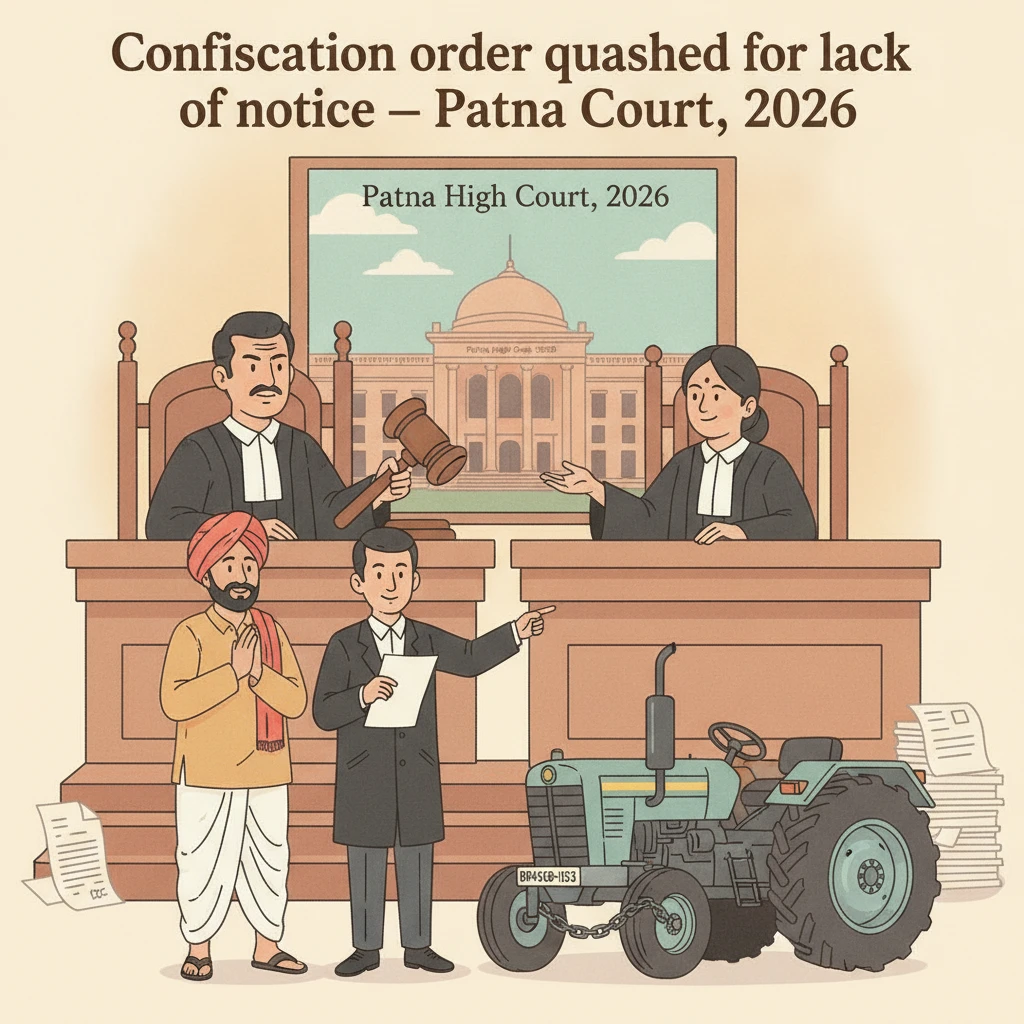
The petitioner is the registered owner of a tractor bearing Registration No. BR45GB-1553, Chassis No. MBNAK48ACPTF04892 and Engine No. CJ.1354/PE004564. He stated that he is engaged in agricultural work and uses the tractor for that purpose.
On 15.12.2023, a police party intercepted this tractor. According to the police, the tractor was being used for transportation of 261 liters of country made liquor. The driver of the tractor was arrested on the spot.
On the basis of the driver’s self-statement, the Sub-Inspector of Police registered Mohania P.S. Case No. 868 of 2023 dated 15.12.2023. This criminal case forms the background for the later confiscation steps.
After the seizure, the petitioner approached the Collector-cum-District Magistrate, Kaimur, who was also functioning as the Confiscating Authority under the Bihar Prohibition and Excise Act and the Bihar Prohibition and Excise Rules, 2021 (as amended up to date).
He filed an application for release of the vehicle under Rule 12A of the Bihar Prohibition and Excise Rules, 2021 (as amended up to date). On this application, the authority called for a report from the Station House Officer of the concerned police station.
In his report, the S.H.O. opposed release of the tractor. Relying on this report and on sub-rule (3) of Rule 12A, the Confiscating Authority rejected the request for release.
At the same time, and without issuing any separate notice for confiscation, the Confiscating Authority passed an order confiscating the tractor. That order was later affirmed by the Appellate Authority and then by the Revisional Authority, namely the Secretary (Prohibition and Excise), Bihar, Patna in Excise Revision Case No. 20/2025 by order dated 24.07.2025.
Aggrieved by the rejection of his revision and by the confiscation of his tractor, the petitioner approached the Patna High Court by filing Civil Writ Jurisdiction Case No. 35 of 2026.
What the Court Examined and Decided
The writ petition was heard by a Division Bench of the Patna High Court comprising Hon’ble Mr. Justice Rajeev Ranjan Prasad and Hon’ble Justice Smt. Soni Shrivastava. The oral judgment was delivered on 12.05.2026 by Hon’ble Mr. Justice Rajeev Ranjan Prasad.
The core complaint of the petitioner was procedural. He did not, at this stage, ask the Court to decide whether the tractor was in fact used for transporting liquor. Instead, he argued that the authorities had taken away his vehicle without following basic legal procedure.
The petitioner’s counsel submitted that the Confiscating Authority had never issued any notice proposing to confiscate the vehicle. No separate opportunity to show cause was given to the petitioner in any confiscation proceeding.
According to the petitioner, he had only filed an application for release of his tractor under Rule 12A of the Rules of 2021 (as amended up to date). While rejecting this application by citing sub-rule (3) of Rule 12A, the Confiscating Authority also went ahead and ordered confiscation of the tractor in the same order.
It was further pointed out that in the counter affidavit filed by the State authorities before the High Court, there was no statement that any show cause notice had in fact been issued to the petitioner in the confiscation matter. This supported the petitioner’s claim that no prior notice was given.
On these facts, the petitioner argued that the confiscation order suffered from a serious procedural defect. The authority could not confiscate his vehicle without first informing him, giving him a chance to reply, and then passing a reasoned order.
On the other side, learned counsel for the State, Mr. Saroj Kumar Sharma, AC to AAG-3, defended the action of the authorities. He submitted that the tractor was found carrying a huge quantity of country made liquor, namely 261 liters. In such a situation, where the vehicle was allegedly used in illegal transportation of liquor, the Confiscating Authority’s decision to confiscate the vehicle should not be interfered with.
The High Court carefully examined the pleadings and the record placed before it. The Bench focused on whether the principles of natural justice had been followed in the confiscation process.
The Court noted that the petitioner had himself approached the Confiscating Authority under Rule 12A of the Rules of 2021 (as amended up to date) asking for release of the vehicle. That application had been rejected with reference to sub-rule (3) of Rule 12A, which permits refusal of release in certain situations.
However, the Court held that once the Confiscating Authority decided the release application, he became functus officio in relation to that application. In simple terms, after passing an order on the release application, his task in that specific matter was over.
Despite this, the Confiscating Authority did not stop there. While dealing with the same application, he went on to consider the question of confiscation and passed a confiscation order without initiating a separate confiscation proceeding.
The High Court found that there was no material to show that any notice to show cause had been issued to the petitioner in relation to confiscation. The Court clearly stated that in a confiscation matter, a notice to show cause is mandatory. Only after such notice is issued, and the petitioner or his authorised representative or counsel is heard, can an appropriate order of confiscation be passed.
Because no such notice was given and no specific hearing in confiscation was held, the Court concluded that the confiscation order violated the principles of natural justice.
Natural justice, in this context, means basic fairness: a person whose property is proposed to be taken away must be informed and allowed to present his side. The Court emphasised that this requirement stands even where the allegations involve serious offences like illegal liquor transportation.
On this reasoning, the Division Bench held that the impugned orders of the Confiscating Authority, the Appellate Authority and the Revisional Authority (Annexures ‘P3’, ‘P4’ and ‘P5’ to the writ petition) were not legally sustainable. All these orders were set aside.
The Court did not direct immediate release or permanent return of the tractor. Instead, it chose to restore the matter back to the stage where the law had gone wrong.
The Bench remitted the matter to the Confiscating Authority with two clear directions.
First, the authority must consider afresh the petitioner’s application for release of the vehicle under Rule 12A. While doing so, the authority has to keep in view the judgment of the Patna High Court in the case of Manjeet Kumar Yadav vs. The State of Bihar and Others in CWJC No. 10126 of 2025. This shows that the Court expected the authority to follow the legal principles already laid down in that earlier case.
The Court further directed that the application for release must be decided within one month from the date the Confiscating Authority receives or is communicated a copy of the High Court’s order. This time-bound direction is important for vehicle owners, because prolonged seizure can cause serious hardship.
Second, regarding the confiscation proceeding itself, the High Court clarified that it would be open to the Confiscating Authority to proceed separately with confiscation. However, this must be done strictly in accordance with law.
The Confiscating Authority must issue a proper notice to the petitioner, calling upon him to submit his response. After giving an appropriate opportunity of hearing to the petitioner or his authorised representative or counsel, the authority must pass a reasoned order in the confiscation matter.
Thus, the Court did not prevent the State from pursuing confiscation, but ensured that it is done only after fair procedure and hearing.
In the result, the writ application was allowed to the extent indicated above. The High Court’s intervention was therefore focused on correcting the procedural illegality without deciding the factual guilt or innocence in the liquor case.
Why This Judgment Matters
This judgment of the Patna High Court is important for vehicle owners whose vehicles are seized under the Bihar Prohibition and Excise law.
The Court has made it clear that even if a vehicle is allegedly used for transporting liquor, the authorities cannot directly confiscate it without following proper steps.
The owner must receive a separate notice in the confiscation proceeding. He must be given a reasonable chance to explain his position and to be heard, either personally or through a lawyer or authorised representative.
The decision also ensures that applications for release of vehicles under Rule 12A are decided promptly and in line with earlier High Court rulings like Manjeet Kumar Yadav’s case.
For ordinary citizens, especially small farmers and transporters whose livelihood depends on their vehicles, this ruling provides an important safeguard. It confirms that the administration cannot bypass basic fairness, even in strict enforcement of prohibition laws.
Legal Issues and Answers
Issue: Can the Confiscating Authority confiscate a seized vehicle without issuing a separate show cause notice and hearing the owner, while deciding an application for release under Rule 12A of the Bihar Prohibition and Excise Rules, 2021 (as amended up to date)?
Answer: No. The Patna High Court held that a specific notice to show cause in the confiscation proceeding and an opportunity of hearing are mandatory. Without this, the confiscation order violates principles of natural justice and is unsustainable.
Issue: What should happen to such defective confiscation orders already affirmed in appeal and revision?
Answer: The Court set aside the confiscation, appellate and revisional orders and remitted the matter to the Confiscating Authority to freshly decide the release application within one month and, if it chooses to proceed with confiscation, to do so separately after issuing notice and granting hearing.
Cases Cited by the Court
- The Court directed the Confiscating Authority to keep in view the judgment in Manjeet Kumar Yadav vs. The State of Bihar and Others, CWJC No. 10126 of 2025 while deciding the release application.
Case Details
Case Number: Civil Writ Jurisdiction Case No. 35 of 2026
Case Title: Raju Kumar Yadav @ Raju Yadav vs. The State of Bihar & Others
Citation: 2026 (3) PLJR 555
Court: High Court of Judicature at Patna
Coram: Hon’ble Mr. Justice Rajeev Ranjan Prasad and Hon’ble Justice Smt. Soni Shrivastava
Date of Judgment: 12.05.2026
Advocates: Mr. Aquaib Khan, Advocate for the petitioner; Mr. Saroj Kumar Sharma, AC to AAG-3 for the State; Mr. Saurav Kumar Verma, Advocate for the State
Nature of the Case: Writ petition challenging confiscation of vehicle and related appellate and revisional orders under Bihar Prohibition and Excise law
Relevant Statutory Provision: Rule 12A of the Bihar Prohibition and Excise Rules, 2021 (as amended up to date), including sub-rule (3)
Link to Judgment: Click here to read the full judgment of the Patna High Court
If you found this explanation helpful and wish to stay informed about
how legal developments may affect your rights in Bihar,
you may consider following Samvida Law Associates for more updates.







