

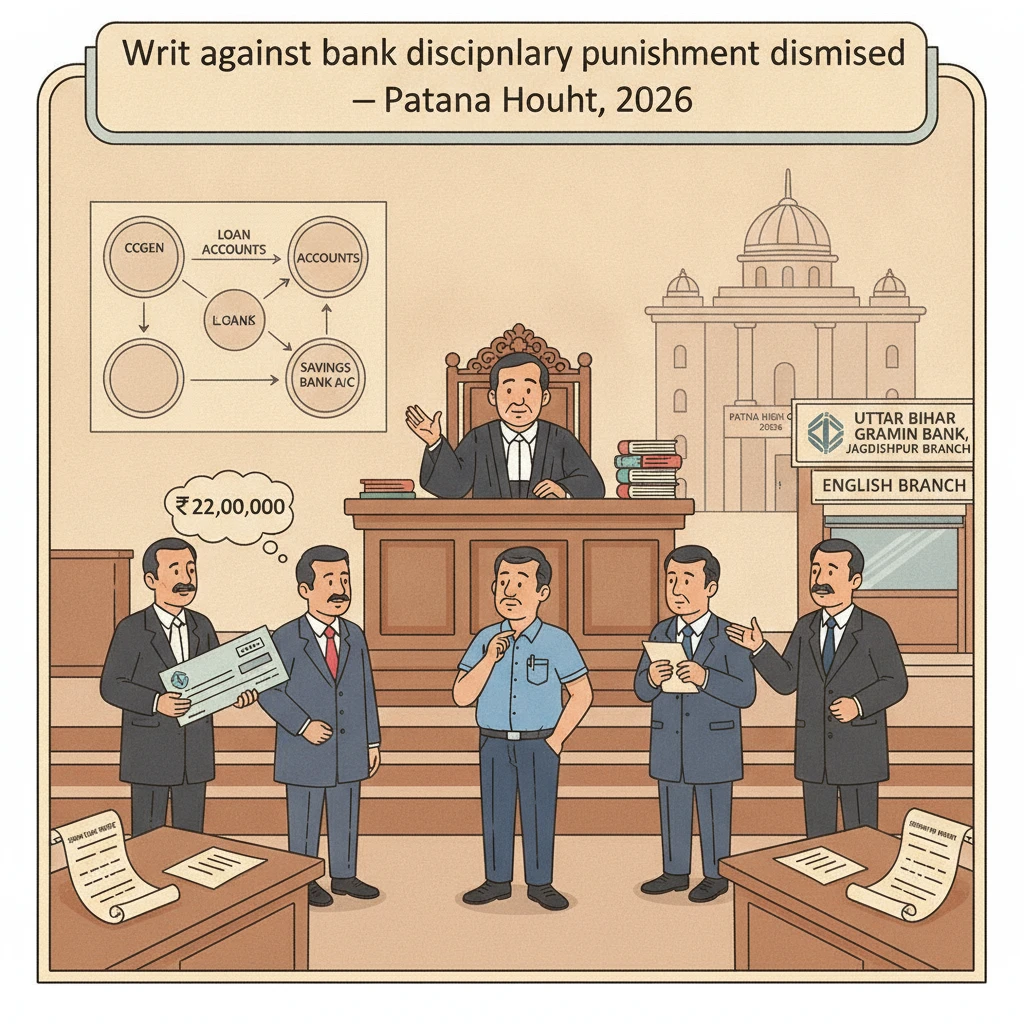
The Court upheld the bank’s decision, finding serious negligence causing Rs. 22 lakh loss.
All arguments about bias, malafide and violation of natural justice were rejected.
The writ petition was dismissed and the punishment order remains in force.
Case Background
The case arose from disciplinary action taken by Uttar Bihar Gramin Bank against one of its officers, who had joined the bank as a Scale-I Officer on 27.03.1989. Over the years he worked in different branches and, in January 2016, he was promoted as a Scale-II Officer and posted as Branch Manager at Jagdishpur Branch, Nautan Block, West Champaran, under the Bettiah Regional Office.
While serving as Branch Manager at Jagdishpur Branch, a transaction involving four CCGEN loan accounts of another branch (English Branch under Regional Office, Motihari) took place. A cheque issued through the CCGEN system in favour of a firm was deposited in a savings bank account at Jagdishpur Branch (Account No. 1002221010002592). The petitioner, as Branch Manager, credited Rs. 22,00,000 from these CCGEN loan accounts to that savings account.
The Regional Manager, Motihari, issued a show cause notice dated 30.04.2020 (Letter No. RO MOT/13/2020-21/REC/119) alleging that the petitioner failed to check the past transaction history of the borrowers in the four CCGEN accounts and allowed a Rs. 22 lakh transaction from accounts which did not belong to his branch. The petitioner replied on 30.05.2020, denying wrongdoing and explaining the circumstances.
Dissatisfied with the explanation, the bank served a Memorandum of Charge on 17.08.2020 (Letter No. HO/DAD/13/20-21/137), again directing the petitioner to submit his reply. He responded on 31.08.2020 and denied the charges.
A departmental enquiry was then initiated. By Letter No. 161 dated 02.09.2020, the bank appointed an Enquiry Officer and a Presenting Officer. Enquiry sittings were held, documents were produced by both sides, and written briefs were submitted. The Enquiry Officer ultimately held all the charges proved and submitted his report to the Disciplinary Authority on 15.02.2021.
On 12.03.2021, the Disciplinary Authority passed an order (Letter No. HO/DAD/13/20-21/985 372) imposing the major penalty of reduction to the initial stage of the time scale of pay till retirement under Regulation 39(1)(b)(i) of Uttar Bihar Gramin Bank (Officers & Employees) Service Regulations, 2010, read with the 2013 Amendment.
The petitioner filed a statutory appeal on 20.04.2021 before the Chairman-cum-Appellate Authority, Uttar Bihar Gramin Bank. The Appellate Authority, by order dated 28.09.2021 (Letter No. HO/DAD/14/21-22/149), dismissed the appeal and upheld the punishment.
Challenging both these orders, the petitioner approached the Patna High Court in Civil Writ Jurisdiction Case No. 547 of 2022. Meanwhile, he had already superannuated from service on 31.01.2021.
What the Court Examined and Decided
The Patna High Court, through Hon’ble Mr. Justice Ritesh Kumar, examined whether the disciplinary and appellate orders suffered from legal infirmities, violation of natural justice, or non-application of mind, and whether the punishment was arbitrary or disproportionate.
The petitioner’s counsel argued that the enquiry was biased and defective. According to him, the Enquiry Officer did not properly verify and examine the evidence and ignored the defence taken in the replies and written brief. He claimed that the charges were held proved without any legal material and that the Disciplinary Authority failed to consider the written brief and defence submitted on 28.01.2021 before imposing punishment.
The petitioner further submitted that:
- He acted as per banking norms and practice in a core banking system (CBS) environment by crediting the cheque amount from CCGEN accounts of English Branch to the customer’s savings account at Jagdishpur Branch.
- There was no specific circular or instruction prohibiting collection of such cheques.
- If the CCGEN account was tending towards NPA, it was the duty of the Branch Manager of the English Branch to freeze or disable the account; the lapse, if any, lay there, not with him.
- No mala fide intention, pecuniary gain, or disastrous result attributable to him was established; therefore his act could at best be a procedural lapse, not misconduct.
- The Presenting Officer’s written brief was not supplied to him and even defence documents were not given, causing prejudice.
- The Appellate Authority rejected his appeal without considering his detailed grounds, showing a predetermined and targeted approach.
The petitioner relied on earlier judgments including Ramendra Prasad Gauro v. Chairman, Uttar Bihar Gramin Bank (single judge and LPA decisions) and decisions in Hassan Muzahid and Rani Laxmi Bai Kshetriya Gramin Bank, which stress that Disciplinary and Appellate Authorities must consider the employee’s reply to the enquiry report and give reasons. He argued that, similarly, in his case the authorities had ignored his defence.
On the other hand, the respondent-bank’s counsel gave a very different picture. He submitted that the petitioner’s act had caused financial loss of Rs. 22 lakhs plus interest to the bank, and that the conduct showed deliberate negligence.
The bank pointed out that:
- The four CCGEN loan accounts belonged to English Branch, not Jagdishpur Branch. The petitioner knew this, yet allowed a Rs. 22 lakh transfer from those accounts, debiting the loan accounts and crediting Savings Account No. 1002221010002592 at his branch.
- The limits in those loan accounts were sanctioned against MMDC accounts kept as primary security, so misuse of those limits directly affected the bank’s security.
- The petitioner failed to notice that the average minimum balance in the savings account since September 2011 was not more than Rs. 9,000 and that, in the last six years, there was only a single transaction before the sudden Rs. 22 lakh credit. Despite these red flags, he allowed the transaction.
- The customer withdrew the entire amount in three instalments, effectively causing the bank a loss.
The bank emphasised that the petitioner had been given full opportunity in the departmental proceedings. The enquiry ran over eight sittings; the Presenting Officer produced 17 documents; the defence produced 21 exhibits; the Presenting Officer’s written brief was served on the petitioner; and the petitioner himself submitted his written brief on 28.01.2021. The Enquiry Officer considered all this material and concluded that the charges were proved. His report was given to the petitioner, who filed his response on 21.02.2021. Only thereafter did the Disciplinary Authority pass the punishment order.
The bank also relied on several Supreme Court decisions: State Bank of India v. Bela Bagchi, Regional Manager, U.P. SRTC v. Hotilal, and TNCS Corporation Ltd. v. K. Meerabai. These judgments underline that bank officers handle public money, must maintain the highest integrity, and that acting beyond authority or causing loss of confidence is itself serious misconduct. Courts should not lightly interfere with punishment in such cases and sympathy cannot override loss of confidence.
After hearing both sides and going through the records, the Patna High Court focused on a few key questions:
First, was there any real violation of natural justice in the enquiry? The Court found that the petitioner was given full opportunity to defend himself. He received the charge sheet, was allowed to file replies, participated in eight enquiry sittings, produced defence documents, received the Presenting Officer’s brief and the Enquiry Officer’s report, and filed his own written submissions. The Court specifically noted that the defence statement/brief and enquiry report were provided to him. Therefore, the allegation that the Presenting Officer’s brief was not supplied was held to be incorrect.
Second, did the Disciplinary Authority ignore the defence and act mechanically? The Court contrasted this case with the earlier Ramendra Prasad Gauro line of cases cited by the petitioner, where punishment orders were passed without considering the employee’s reply. Here, however, the Court held that the Disciplinary Authority had considered all aspects before imposing punishment. Hence those precedents did not help the petitioner.
Third, was the charge itself trivial or unsupported by evidence? The Court held that the petitioner clearly failed in his basic duty. The cheques related to accounts of another branch. It was his responsibility, as Branch Manager of Jagdishpur Branch, to verify with English Branch the status of the CCGEN accounts before allowing such a large debit.
The Court observed that in banking practice, when cheques of high denomination are presented, it is standard procedure to verify with the concerned customer or branch before authorising clearance. The petitioner did not do so. He also did not examine the past transaction history of the CCGEN accounts from his own branch system. Nor did he pay attention to the abnormal pattern in the savings account: a balance of around Rs. 9,000 since 2011 and only one transaction in the last six years, followed suddenly by a Rs. 22 lakh credit.
Because of this negligence, the bank suffered a loss of Rs. 22 lakhs plus interest. The Court stressed that a bank officer is expected to maintain a higher degree of honesty and integrity and to protect the bank’s interest. The very discipline of a bank depends on each officer acting within his authority; acting beyond one’s authority itself amounts to misconduct.
Fourth, should the Court interfere with the punishment? Relying on the Supreme Court precedents cited by the bank, the Court held that the charge was serious, not casual in nature. The resultant loss and, more importantly, the loss of confidence justified strict action. The Court noted that for employees dealing with public money, misconduct has to be dealt with an “iron hand” and there is little room for judicial sympathy regarding punishment.
In light of these findings, the Court concluded that there was no ground to interfere with either the Disciplinary Authority’s order dated 12.03.2021 or the Appellate Authority’s order dated 28.09.2021. The writ petition was therefore dismissed.
Why This Judgment Matters
This judgment has important lessons for bank officers and other employees handling public or institutional funds. The Patna High Court made it clear that failing to follow basic verification steps for large transactions can be treated as serious misconduct, even if the officer claims good faith or absence of personal gain.
The Court also underlined that in a departmental enquiry, what matters is whether the employee was given a fair chance to defend himself. If the record shows that the delinquent officer received the charges, attended hearings, produced documents, and replied to the enquiry report, the Court will not lightly accept allegations of violation of natural justice.
For employees hoping that courts will soften or reduce disciplinary penalties, this decision is a reminder that, especially in the banking sector, courts rely heavily on the employer’s assessment of loss of confidence. The amount involved is less important than the nature of the breach and the role of the employee.
Finally, the judgment distinguishes cases where punishment orders are set aside for non-speaking reasons. Here, because the authorities had considered the defence and followed procedure, prior judgments granting relief in other disciplinary cases were held not applicable.
Legal Issues and Answers
Issue: Did the departmental enquiry and punishment imposed on the bank officer violate principles of natural justice or suffer from non-application of mind?
Answer: No. The Court held that the petitioner was given full opportunity to defend himself, the enquiry procedure was proper, and both disciplinary and appellate authorities considered the materials before imposing and affirming punishment.
Issue: Was the officer’s conduct in allowing a Rs. 22 lakh transaction from loan accounts of another branch, without verification, too minor or technical to amount to misconduct?
Answer: No. The Court found that the failure to verify past transactions and account status, leading to Rs. 22 lakh loss, was serious negligence and misconduct, especially given the higher standards of honesty and care expected from bank officers.
Issue: Should the High Court, in writ jurisdiction, interfere with the quantum of punishment imposed by the bank?
Answer: No. Relying on Supreme Court precedents, the Court held that in cases involving financial loss and loss of confidence in officers dealing with public money, interference with punishment is not warranted unless it is shockingly disproportionate, which it was not in this case.
Cases Cited by the Court
- C.W.J.C. No. 17012 of 2014, Ramendra Prasad Gauro v. Chairman, Uttar Bihar Gramin Bank (Patna High Court, Single Judge)
- L.P.A. No. 1434 of 2018, The Chairman, Uttar Bihar Gramin Bank & Others v. Ramendra Prasad Gauro (Patna High Court, Division Bench)
- Hassan Muzahid v. Bihar State Electricity Board & Others, 2015 (4) PLJR (HC)
- Chairman, Disciplinary Authority, Rani Laxmi Bai Kshetriya Gramin Bank v. Jagdish Sharan Varshney & Others (Supreme Court)
- State Bank of India & Others v. Bela Bagchi & Others, (2005) 7 SCC 435
- Regional Manager, U.P. SRTC & Others v. Hotilal & Another, (2003) 3 SCC 605
- TNCS Corporation Ltd. & Others v. K. Meerabai, (2006) 2 SCC 235
- Decision reported in (2018) 3 PLJR 543 (Allahabad Bank disciplinary matter, Division Bench of Patna High Court)
Case Details
Case Number: Civil Writ Jurisdiction Case No. 547 of 2022
Case Title: Bhola Mahto v. The Chairman, Uttar Bihar Gramin Bank & Others
Court: High Court of Judicature at Patna
Coram: Hon’ble Mr. Justice Ritesh Kumar
Date of Judgment: 06.04.2026
Citation: 2026 (3) PLJR 335
Advocates:
- For the Petitioner: Mr. Satish Chandra Mishra, Advocate
- For the Respondents (Uttar Bihar Gramin Bank): Mr. Prabhakar Jha, Advocate
Nature of the Case: Writ petition under civil writ jurisdiction challenging disciplinary punishment and appellate order of a bank employee.
Link to Full Judgment: Click here to read the complete judgment of the Patna High Court
If you found this explanation helpful and wish to stay informed about
how legal developments may affect your rights in Bihar,
you may consider following Samvida Law Associates for more updates.







