

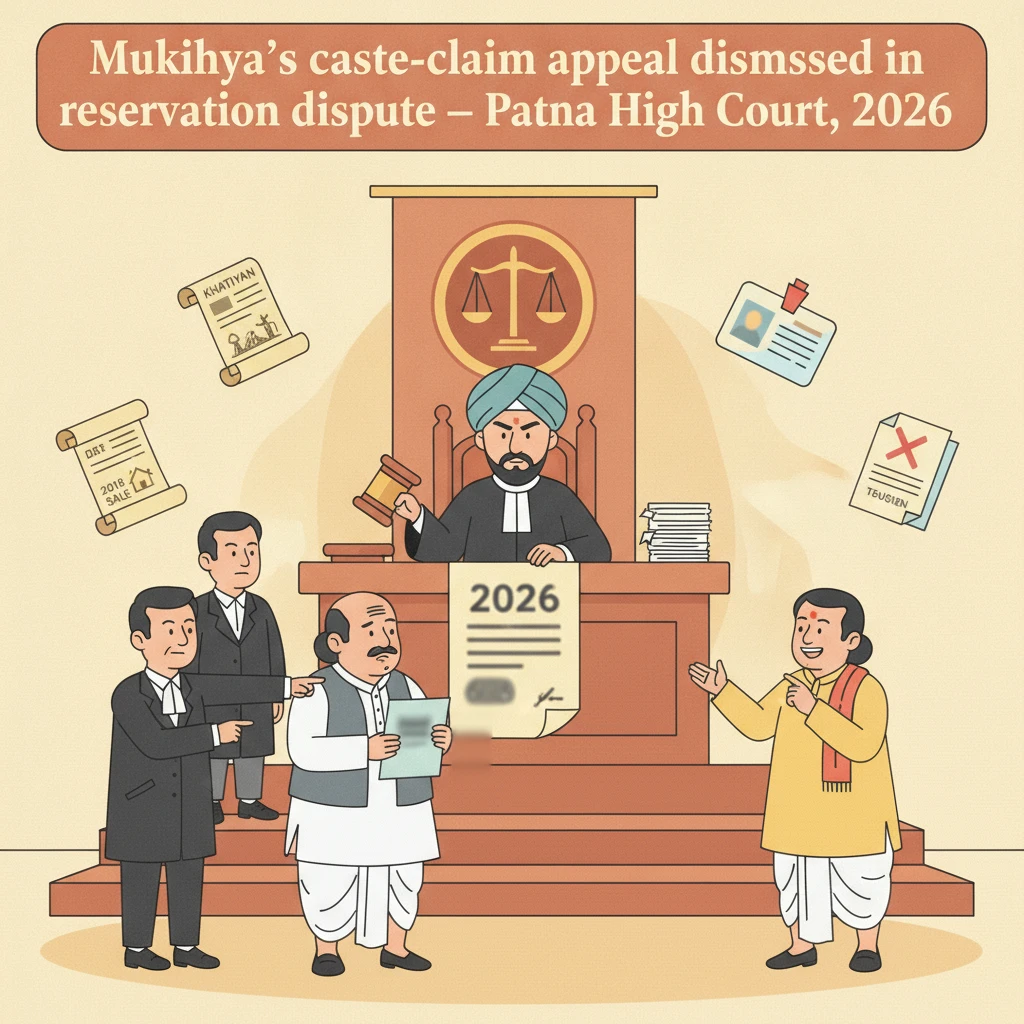
The Court upheld the finding that he belongs to Koeri (Kushwaha) caste and not Dangi (Extremely Backward Class).
It also approved the State Election Commission’s step of sending the dispute to the Caste Scrutiny Committee.
The appeal was dismissed and all related applications were closed.
Case Background
The appellant was elected in 2021 as Mukhiya of Gram Panchayat Raj, Bagahi Baghambarpur, Block Bairiya, West Champaran. He contested from a seat reserved for Extremely Backward Class (EBC) candidates.
After the election, respondent no. 4 lodged a complaint under Section 136(2) of the Bihar Panchayat Raj Act, 2006. The complaint alleged that the appellant did not belong to the Extremely Backward Class and therefore was not entitled to contest from an EBC seat.
This complaint was registered as Case No. 72 of 2021 before the State Election Commission (Panchayat). The appellant appeared in that case, filed a written statement, denied the allegations, and claimed that the documents produced by the complainant were fabricated.
On considering the matter, the State Election Commission did not itself decide the caste dispute. By order dated 15.07.2022, it referred the question of the appellant’s caste status to the Caste Scrutiny Committee of the General Administration Department.
Feeling aggrieved by this reference order, the appellant filed Civil Writ Jurisdiction Case No. 14258 of 2022 before the Patna High Court. In that writ, he challenged, among other things, the jurisdiction of the State Election Commission to refer the matter.
While the writ petition was still pending, the Caste Scrutiny Committee continued its enquiry. After enquiry, it passed an order dated 12.01.2023, holding that the appellant belongs to Koeri (Kushwaha) caste, not Dangi caste. The appellant then also challenged this order of the Caste Scrutiny Committee within the same writ proceeding.
On 09.08.2023, the learned Single Judge dismissed the writ petition. The Single Judge upheld both the reference made by the State Election Commission and the finding of the Caste Scrutiny Committee. Against this decision, the appellant filed the present intra-court appeal, being Letters Patent Appeal No. 1001 of 2023.
What the Court Examined and Decided
The Division Bench, consisting of Hon’ble Mr. Justice Sudhir Singh and Hon’ble Mr. Justice Shailendra Singh, heard the appeal. The core question before the Bench was narrow: whether the Single Judge’s judgment dated 09.08.2023 needed interference in intra-court appeal.
The Bench first noted that the Single Judge had conducted a detailed examination of the documents, especially the caste-related records. The Single Judge had relied mainly on revenue records, land sale deeds, and reports of official enquiries.
The Single Judge had observed that “Dangi” caste was incorporated as a separate caste in 1995 and was not carved out of Kushwaha/Koeri. This was supported by Gazette notification and was also pointed out by counsel for respondent no. 4.
Further, as per letter no. 673 dated 08.03.2011 issued by the General Administration Department, land revenue records are treated as the foremost document for issuing caste certificates. Only when such records are not available, can other documents and local enquiries be relied on.
In the appellant’s case, it was an admitted position that his ancestor, Bhagelu Mahato, was described as Koeri (Kushwaha) in the “khatiyan” (land revenue record). This was a foundational document.
Additionally, the Single Judge recorded that the appellant himself had purchased land in 2018 by describing his caste as Koeri. The Caste Scrutiny Committee had also noted that a cousin of the appellant, Santosh Kumar, a government teacher of the same village and Panchayat, held a caste certificate showing him as Koeri (OBC).
The Caste Scrutiny Committee had before it the revenue records, the 2018 land purchase deed, the genealogy provided by the Sarpanch showing the relationship with late Bhagelu Mahato, the cousin’s Koeri certificate, and the CID enquiry report. The Committee concluded, by memo no. 863 dated 12.01.2023, that the appellant belonged to Koeri (Kushwaha) caste and not Dangi caste.
The Single Judge therefore held that these were “unimpeachable” pieces of evidence. Against them, the appellant mainly relied on a letter dated 06.04.2011 issued by a Joint Secretary and sent to the District Magistrate, Munger, with a copy to the Commissioner, Munger Division. That letter, according to the Single Judge, was district specific, person specific, and in any case directed further enquiry by the Circle Officer. It could not override the strong documentary evidence and subsequent enquiry.
The Single Judge summarised the key factual points as: the ancestor shown as Koeri in khatiyan; the appellant’s own 2018 land purchase describing him as Koeri; the GAD letter treating revenue records as crucial; the genealogy linking the appellant to Bhagelu Mahato; the distinct caste status of Dangi and Koeri; the CID report; and the final opinion of the Caste Scrutiny Committee that the appellant did not belong to Dangi caste.
On this basis, the Single Judge remarked that the appellant could not “change colours like the Chameleons”, being Koeri (OBC) in 2018 for land purchase and then Dangi (EBC) in 2021 for contesting a reserved election.
Arguments in Appeal
In the Letters Patent Appeal, counsel for the appellant argued that the State Election Commission had no jurisdiction to refer the matter to the General Administration Department by its order dated 15.07.2022. He relied on the Full Bench decision in Rajani Kumari & Ors. v. State Election Commission & Ors., 2019 (4) PLJR 673, to say that disputed caste questions must be decided by a competent fact-finding authority, and suggested that the Commission’s action went beyond this.
He further submitted that the Caste Scrutiny Committee’s finding that the appellant is Koeri (Kushwaha) was arbitrary and perverse. According to him, it went against binding instructions of the General Administration Department, especially the Joint Secretary’s letter dated 06.04.2011 and later reiterations, which allegedly allowed Dangi certificates even when revenue records showed Koeri, based on local enquiry.
The appellant also stressed that he had already been issued caste certificates in 2016 and 2021 after due enquiry by the competent authorities, and there was no recorded defect in those enquiries. On this basis, he questioned how the Caste Scrutiny Committee could now reach a contrary conclusion.
Another major grievance raised was alleged violation of natural justice. The appellant claimed that the Committee refused his request for adjournment on medical grounds relating to his counsel, thus denying an effective hearing. He also contended that his documents were rejected without proper reasons and that the Committee relied on forged or disputed materials.
Opposing the appeal, counsel for the respondents argued that the caste status of the appellant had already been closely examined at State level and that the State Level Caste Scrutiny Committee was the competent authority. Its decision, they said, did not warrant interference.
The respondents further pointed out that the appellant had described himself as Koeri (Kushwaha) at different times for official and transactional purposes and then claimed to be Dangi for election benefit. They stated that ample opportunity of hearing had been given and that principles of natural justice were followed.
Reasoning of the Division Bench
The Division Bench treated the appeal as involving only a limited scrutiny over the Single Judge’s findings. It found that the Single Judge had correctly appreciated the evidence.
First, the Bench agreed that the land revenue record (khatiyan) showing the ancestor as Koeri (Kushwaha) was a foundational document. Being contemporaneous and maintained in the regular course of official work, it carried a presumption of correctness. The Bench found no reason to doubt its evidentiary value.
Secondly, the Bench underlined the appellant’s 2018 land transaction, where he himself declared his caste as Koeri. This voluntary and official declaration was considered highly significant. The appellant had not been able to explain why he declared himself Koeri at that time and Dangi later for election purposes.
The Court accepted the Single Judge’s adverse inference on this inconsistency, noting that a person cannot “oscillate between two caste identities” to derive benefit. Doing so would damage the reservation system and fairness in public administration.
Thirdly, regarding the GAD instructions relied upon by the appellant, the Bench agreed with the Single Judge that they cannot be used to justify shifting stands. Those instructions were meant to assist in genuine identification where records were unclear, not to override clear and consistent documentary evidence or to legalise contradictory declarations.
Fourthly, on jurisdiction, the Bench clarified that the State Election Commission itself had not decided the caste of the appellant. It had merely forwarded the matter to the competent Caste Scrutiny Committee. Thus, the reliance on the Full Bench decision in Rajani Kumari was found to be misconceived rather than supporting the appellant.
The Division Bench noted that the Caste Scrutiny Committee had considered “all relevant materials”, including revenue records, the appellant’s own declarations, and the enquiry report from the competent authority. It then reached a categorical finding that the appellant belongs to Koeri (Kushwaha) caste. The Bench saw no legal infirmity in this process.
Use of Supreme Court Precedents
The Court also relied on principles laid down by the Supreme Court regarding benefits obtained on false or doubtful caste claims and inconsistent stands in litigation.
In R. Vishwanatha Pillai v. State of Kerala, (2004) 2 SCC 105, the Supreme Court had held that if a person secures an appointment on the basis of a false caste certificate, the appointment is void from the beginning and such a person cannot retain the benefits or claim protection under Article 311 of the Constitution. The Patna High Court extracted the key passages to underline that no one can keep benefits gained through fraudulent or invalid caste claims.
The Court also referred to Union of India v. N. Murugesan, (2022) 2 SCC 25, where the Supreme Court discussed the doctrine of “approbate and reprobate”. The principle is that a party cannot accept and reject the same thing, cannot “blow hot and cold”, and cannot enjoy benefits under a transaction while challenging it at the same time. This doctrine reflects fairness and is a form of estoppel based on conduct.
Applying these principles, the Division Bench held that the appellant, having taken inconsistent stands regarding his caste status at different times, could not be allowed to derive benefit from such conduct.
In conclusion, the Court held that the appellant’s claim was “wholly unsustainable in the eyes of law”. The findings of the Single Judge did not require any interference. The Letters Patent Appeal was dismissed, and all pending applications were also disposed of.
Why This Judgment Matters
This decision is important for Panchayat elections and for anyone contesting from reserved seats in Bihar. It shows that courts will look closely at long-term records, like khatiyan and old land deeds, when deciding caste disputes.
The judgment warns that a candidate cannot change caste description according to convenience, for example describing themselves as one caste in property records and another for election or reservation benefit. Such inconsistency can lead to loss of office and legal proceedings.
The case also clarifies that the State Election Commission can, and should, send doubtful caste claims to the Caste Scrutiny Committee instead of deciding them on its own. The Patna High Court treated this as a proper way to follow the law laid down by the Full Bench in Rajani Kumari.
For ordinary citizens, especially those genuinely belonging to reserved categories, the ruling reassures that the system will act against people who misuse reservation benefits on doubtful caste claims, protecting the seats meant for them.
Legal Issues and Answers
Issue: Can the State Election Commission refer a candidate’s disputed caste status to the Caste Scrutiny Committee instead of deciding it itself?
Answer: Yes. The Court held that the Commission did not determine caste but only forwarded the dispute to the competent Caste Scrutiny Committee, which is permissible.
Issue: Was the finding of the Caste Scrutiny Committee that the appellant belongs to Koeri (Kushwaha) caste, and not Dangi (EBC), arbitrary or perverse?
Answer: No. The Court found that the Committee relied on strong revenue records, the appellant’s own past declaration, enquiry reports and other materials, and its conclusion could not be faulted.
Issue: Can a candidate rely on inconsistent caste claims at different times to retain benefits from a reserved seat?
Answer: No. Applying Supreme Court rulings, the Court held that a litigant cannot take inconsistent stands and cannot keep benefits obtained on a false or doubtful caste claim.
Cases Cited by the Court
- R. Vishwanatha Pillai v. State of Kerala, (2004) 2 SCC 105
- Ishwar Dayal Sah v. State of Bihar, 1987 Lab IC 390 : 1987 BBCJ 48 (Pat)
- Union of India v. N. Murugesan, (2022) 2 SCC 25
- Rajani Kumari & Ors. v. State Election Commission & Ors., 2019 (4) PLJR 673 (Full Bench, referred to)
Case Details
Case Number: Letters Patent Appeal No. 1001 of 2023 in Civil Writ Jurisdiction Case No. 14258 of 2022
Case Title: Manoj Prasad v. The State Election Commission (Panchayat) & Ors.
Coram: Hon’ble Mr. Justice Sudhir Singh, Hon’ble Mr. Justice Shailendra Singh
Citation: 2026 (3) PLJR 373
Advocates:
- For the appellant: Mr. S.B.K. Manglam, Advocate; Mr. Awnish Kumar, Advocate; Mr. Vikash Kumar Singh, Advocate
- For the State: Mr. Saroj Kumar Sharma, AC to AAG-3
- For the State Election Commission: Mr. Ravi Ranjan, Advocate; Mr. Girish Kumar, Advocate
- For private respondent no. 4: Mr. Santosh Bharti, Advocate; Mr. Apurva Kumar, Advocate
Nature of the Case: Intra-court appeal (Letters Patent Appeal) against dismissal of writ petition arising from complaint under Section 136(2) of the Bihar Panchayat Raj Act, 2006 regarding caste-based disqualification from a reserved Panchayat seat.
Date of Judgment: 22.04.2026
Link to Judgment: Click here to view the official Patna High Court judgment
If you found this explanation helpful and wish to stay informed about
how legal developments may affect your rights in Bihar,
you may consider following Samvida Law Associates for more updates.







