

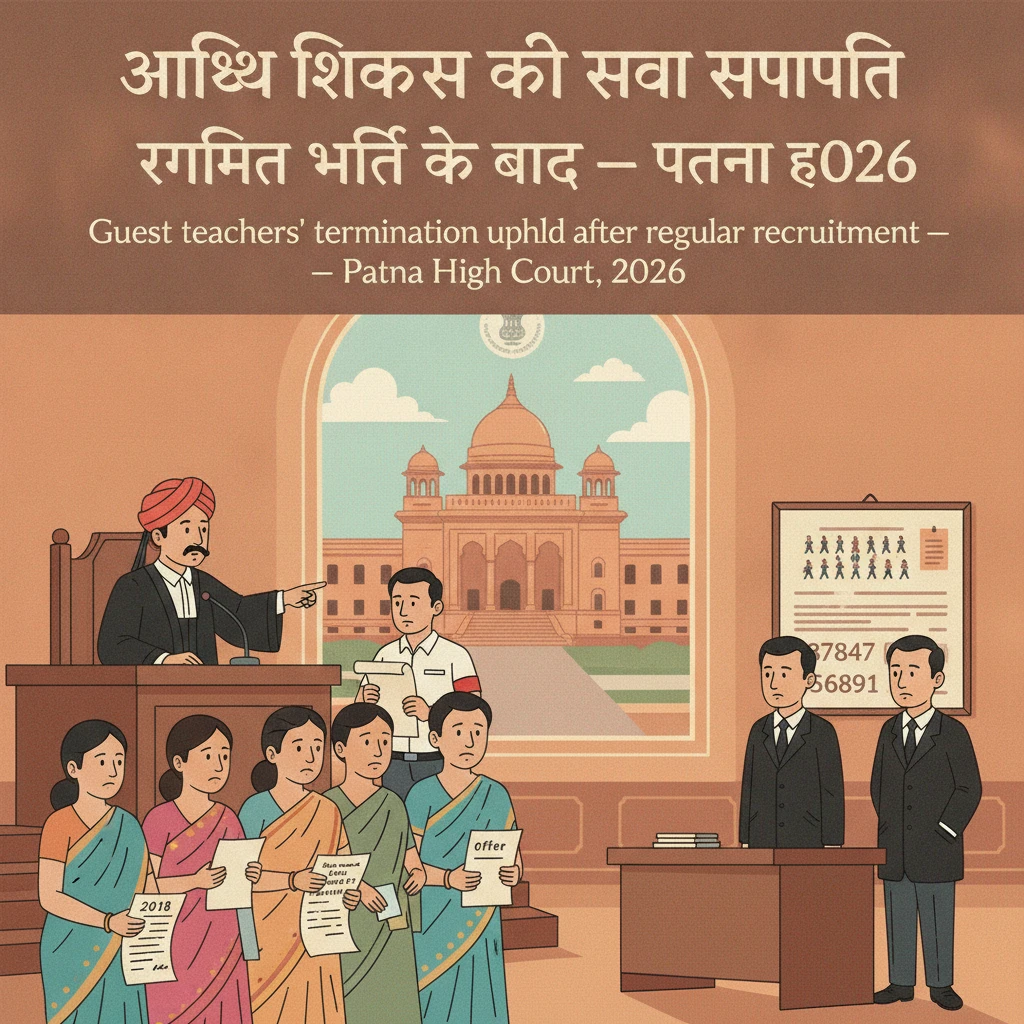
Case Background
The Education Department of Bihar issued Resolution No. 51 dated 25.01.2018. It noted that many posts of Assistant Teachers in subjects like English, Mathematics, Physics, Chemistry, Zoology and Botany were vacant in Government, Government Aided and Up‑graded secondary schools under the Rashtriya Madhyamik Siksha Abhiyan.
To ensure students’ classes were not affected, the Government decided to hire “Guest Teachers” on a fixed honorarium. The resolution identified 4257 sanctioned vacant posts and laid down qualifications, reservation rules, and payment terms (Rs. 1,000 per working day, up to 25 days or Rs. 25,000 per month).
Crucially, Clause 3 and Clause 5 of this resolution made it clear that services of guest teachers would be taken “till the teachers are appointed” in these schools, and that guest teachers would “continue to work till a teacher is appointed for the school”.
Pursuant to this resolution, the authorities advertised the posts and appointed guest teachers. The writ petitioners and many intervenor respondents were appointed as guest teachers after this process and worked in different schools from 2018 to 2024. Their performance was not alleged to be unsatisfactory.
Later, large‑scale regular recruitment of teachers was conducted. The State placed on record that 37,847 teachers for Secondary classes and 56,891 teachers for Senior Secondary classes, totalling 94,738 posts, were filled up through regular selection processes and the appointees started discharging their duties.
In this backdrop, the Director, Secondary Education, issued Letter No. 325 dated 30.03.2024. This letter directed all District Education Officers that services of guest teachers, engaged under Resolution No. 51 dated 25.01.2018, should not be taken from 01.04.2024 in State Higher Secondary Schools.
Some guest teachers, including the present writ petitioners, felt that this letter effectively terminated their services without notice, despite their years of service and their expectation to continue till 60 years of age. They filed Civil Writ Jurisdiction Case No. 1003 of 2025 before a Single Judge of the Patna High Court challenging Letter No. 325 dated 30.03.2024.
On 27.01.2025, the learned Single Judge allowed the writ petition. The Single Judge held that an executive letter could not override the Government notification dated 08.02.2018, which had been issued with the Governor’s approval, and therefore the impugned letter could not stand. The authorities were directed to rectify their action and pass reasoned orders after giving due opportunity of hearing to all affected persons.
Aggrieved, the State of Bihar and its officers filed the present Letters Patent Appeal (L.P.A. No. 238 of 2025) under Clause X of the Letters Patent. An interim order dated 20.08.2025 stayed the Single Judge’s direction, noting that only four writ petitioners had filed the case but the order had implications for more than 4,000 guest teachers.
Intervenor respondents (guest teachers) 5 to 255 approached the Supreme Court against the interim order, but their Special Leave Petition (C) No. 34609 of 2025 was dismissed on 28.11.2025. The Supreme Court left them at liberty to seek discharge of the interim order before the High Court. They then moved for impleadment in the LPA, and by order dated 12.12.2025 they were added as party respondents.
What the Court Examined and Decided
The Division Bench (Hon’ble the Chief Justice and Hon’ble Mr. Justice Harish Kumar, judgment authored by Justice Harish Kumar) focused on the nature of guest teachers’ engagement and the legal effect of Resolution No. 51 dated 25.01.2018 and the subsequent departmental letter dated 30.03.2024.
The Advocate General argued that the appointment of all guest teachers, including the writ petitioners and intervenors, was strictly under the 2018 resolution, which clearly stated in Clause 5 that guest teachers would continue “till a teacher is appointed for the school”. Their engagement was thus a “stop gap arrangement” until regular recruitment.
He further submitted that after regular recruitment of 94,738 teachers on sanctioned posts, including for the very subjects taught by guest teachers, there was no need to continue with guest teachers. Hence, Letter No. 325 dated 30.03.2024 simply implemented the original terms of their engagement.
The State highlighted that earlier, some guest teachers had filed C.W.J.C. No. 8563 of 2022 challenging Clause 5 of Resolution No. 51 dated 25.01.2018. They had sought a declaration that the clause was ultra vires and had asked for continuation up to 60 years of age, similar to other teachers under the Bihar District Board and Municipal Teachers’ Rules, 2006. A Division Bench in that case (Anulata Kumari & Ors. Vs. The State of Bihar & Ors.) had already held that guest teachers were appointed only as a temporary interim arrangement and that their claim for regularisation or treatment as regular teachers was “wholly misconceived”.
The Advocate General contended that the Single Judge’s order in C.W.J.C. No. 1003 of 2025 went against this binding Division Bench ruling and, therefore, could not be sustained.
On the other side, counsel for the writ petitioners and the intervenor guest teachers argued that:
- They had been appointed through a proper process against sanctioned posts and had been working continuously since 2018.
- The Government had, by its own notification dated 08.02.2018 (issued under Articles 166/162 of the Constitution), decided to engage guest teachers, and any decision terminating them must follow due process and principles of natural justice.
- Letter No. 325 dated 30.03.2024 amounted to unilateral termination without any notice or hearing and thus violated natural justice.
- They claimed that it was not demonstrated that regular teachers were appointed in all the posts on which they were actually working, and that some posts remained vacant.
- They relied on Supreme Court judgments in Jaggo Vs. Union of India, Vinod Kumar & Ors. Vs. Union of India & Ors., Shripal Vs. Nagar Nigam, Ghaziabad and Bhola Nath Vs. The State of Jharkhand & Ors., to argue that long‑serving temporary workers should not be arbitrarily terminated and that the reality of employment over time should matter.
The Division Bench first examined Resolution No. 51 dated 25.01.2018 in detail. It recorded that the resolution:
- Was specifically to address non‑availability of assistant teachers by hiring guest teachers on a fixed honorarium.
- Stated that services of guest teachers would be taken against sanctioned posts, following reservation rosters.
- Defined required qualifications and higher qualifications for certain subjects where eligible candidates were not available.
- Allowed the Ad‑hoc Committee of a school, with District Education Officer’s approval, to relieve a guest teacher whose performance was unsatisfactory.
- In Clause 3 and Clause 5, clearly limited guest teachers to the period “till the teachers are appointed” and “till a teacher is appointed for the school”.
The Court also referred to the offer letters produced as Annexure‑P/2 series to the writ petition. These letters showed that the petitioners and intervenors were invited to serve as guest teachers, and their service conditions were expressly governed by the 25.01.2018 resolution.
From this, the Bench concluded that a guest teacher is a person with teacher’s eligibility engaged on a part‑time, temporary, or contract basis, without permanent tenure, and paid a fixed honorarium or daily rate. Such persons cannot claim regularisation as a matter of right in the absence of a specific rule.
The Court accepted that, since guest teachers were selected against sanctioned posts through advertisement, they could not be replaced by another set of guest teachers without justification. However, their continuation was always conditional on no regular recruitment being made.
The State’s undisputed stand, as noted by the Bench, was that 94,738 regular teachers had been appointed following due process and were posted in different Higher Secondary Schools. The Director’s letter dated 30.03.2024, instructing that guest teachers’ services should not be taken from 01.04.2024, merely implemented the original condition that their engagement would last only till regular appointments were made.
On the argument that termination without individual notice violated natural justice, the Court drew an important distinction. It held that not every discontinuation of a temporary arrangement amounts to punitive termination requiring a show‑cause notice or personal hearing. Here:
- The decision was not based on any misconduct or adverse finding against individual guest teachers.
- The guest teachers knew from the outset, through Clause 5 of the resolution and their offer letters, that their services were temporary and subject to regular recruitment.
- A large number of guest teachers (more than 4,000) were involved, and the action was the direct result of a policy decision applied uniformly.
In such situations, the Court held, the principles of natural justice need not be applied in a rigid way. It is sufficient if information is given in terms of the scheme; individual hearings for each case are not required.
As to the Supreme Court decisions relied upon by the Single Judge and the guest teachers, the Division Bench explained that those cases dealt mainly with misuse of temporary or contractual arrangements and situations where long service created a different factual context. In the present case, however, the guest teachers had accepted their engagement “with open eyes” on a clear condition: their services would be taken only till regular appointments were made.
The Bench also reminded that the Constitution Bench decision in Secretary, State of Karnataka & Ors. Vs. Umadevi & Others (2006) 4 SCC 1 governs such situations. Umadevi held that contractual, daily wage or casual employment ends in terms of the contract, and continuation beyond the initial term does not, by itself, confer a right to absorption or regularisation, particularly where the initial appointment was not made under the regular recruitment procedure.
Referring again to Anulata Kumari (C.W.J.C. No. 8563 of 2022), the Court stressed that a coordinate Division Bench had already held that guest teachers’ claim to be treated as regular till retirement age was misconceived. That judgment had neither been challenged before a higher court nor reviewed. Therefore, the Single Judge, by effectively granting protection to guest teachers and insisting on individual hearings, acted contrary to binding precedent.
The Bench concluded that allowing guest teachers to continue even after regular appointments would be unfair to other eligible candidates who did not apply for guest‑teacher posts precisely because those posts were advertised as temporary, stop‑gap arrangements. Continuing guest teachers beyond that point was described as a “fraud upon the other eligible candidates”.
In the result, the Division Bench held that:
- Letter No. 325 dated 30.03.2024 was in conformity with Resolution No. 51 dated 25.01.2018.
- The State’s decision not to retain guest teachers after regular recruitment was bona fide and legally valid.
- The Single Judge’s direction to issue reasoned orders after giving individual hearings to all affected guest teachers was perverse and unsustainable.
Accordingly, the Court set aside the Single Judge’s judgment dated 27.01.2025 in C.W.J.C. No. 1003 of 2025, dismissed the writ petition, and allowed the Letters Patent Appeal. No order as to costs was made.
Why This Judgment Matters
This judgment is significant for thousands of guest teachers engaged in Bihar’s Government, Government Aided and Up‑graded Higher Secondary Schools under the 2018 resolution. It makes clear that their engagement was purely temporary and strictly linked to the vacancy situation.
Once regular teachers are appointed through a proper selection process, guest teachers cannot insist on continuation, absorption, or regularisation merely because they have worked for several years or performed duties similar to regular teachers. Their legal rights are determined by the written terms of engagement, not by expectations based on long service.
The Patna High Court also underlines that, where a large‑scale policy decision is taken to discontinue a temporary arrangement because its purpose is over, authorities are not required to conduct individual hearings for every affected person, provided the original terms were clear and no punitive stigma is attached.
For policy‑makers, this judgment reinforces that stop‑gap hiring must be transparently structured. For job‑seekers, especially in Bihar’s education sector, it is a caution that guest or contractual appointments based on explicit “till regular appointment” clauses cannot later be claimed as stepping stones to permanent jobs.
Legal Issues and Answers
Issue: Can guest teachers engaged under Resolution No. 51 dated 25.01.2018 insist on continuation or regularisation after regular teachers are appointed on the same sanctioned posts?
Answer: No. Their engagement was a stop‑gap arrangement “till a teacher is appointed for the school”. Once regular recruitment is completed, the State is entitled to discontinue their services.
Issue: Was the Director’s Letter No. 325 dated 30.03.2024, stopping engagement of guest teachers from 01.04.2024, invalid for overriding the earlier Government notification and for not giving individual hearings?
Answer: No. The letter was in conformity with Resolution No. 51 dated 25.01.2018. Discontinuation of such temporary engagement following regular recruitment does not require individual show‑cause notices or hearings.
Issue: Did the Single Judge act correctly in setting aside Letter No. 325 and directing the State to hear all affected guest teachers and pass reasoned orders?
Answer: No. The Division Bench held that the Single Judge’s order was contrary to an earlier binding Division Bench decision (Anulata Kumari case) and therefore perverse; it was set aside and the writ petition was dismissed.
Cases Cited by the Court
Secretary, State of Karnataka and Ors. Vs. Umadevi and Others, (2006) 4 SCC 1.
Anulata Kumari & Ors. Vs. The State of Bihar & Ors., C.W.J.C. No. 8563 of 2022 (Patna High Court).
The Single Judge and parties also referred to Jaggo Vs. Union of India, 2024 SCC OnLine SC 3826; Vinod Kumar and Ors. Etc. Vs. Union of India & Ors., (2024) 9 SCC 327; Shripal Vs. Nagar Nigam, Ghaziabad, 2025 SCC OnLine SC 221; Bhola Nath Vs. The State of Jharkhand & Ors., 2026 (2) PLJR 129 (SC), which the Division Bench held not applicable on the present facts.
Case Details
Case Number: Letters Patent Appeal No. 238 of 2025 in Civil Writ Jurisdiction Case No. 1003 of 2025
Case Title: The State of Bihar & Ors. vs. Rajesh Kumar Singh & Ors.
Court: High Court of Judicature at Patna
Coram: Hon’ble the Chief Justice; Hon’ble Mr. Justice Harish Kumar
Date of Judgment: 05.05.2026
Citation: 2026 (3) PLJR 379
Advocates:
- For the Appellants (State of Bihar and officials): Mr. P. K. Shahi, Advocate General; Mr. Anjani Kumar, AAG‑4; Mr. Sanjay Kumar (AC to AAG‑4).
- For Respondent Nos. 1 to 4 (original writ petitioners): Mr. D. K. Sinha, Senior Advocate; Mr. Purushottam Kumar Jha, Advocate.
- For Respondent Nos. 5 to 255 (intervenor guest teachers): Mr. Pawan Kumar, Advocate; Mr. Lalit Kumar, Advocate; Mr. Dhirendra Singh, Advocate; Mr. Manish Kumar No. 13, Advocate; Mr. Rohit Kumar, Advocate; Mrs. Nitu Kumari, Advocate; Mrs. Shreya, Advocate.
Nature of the Case: Letters Patent Appeal (intra‑court appeal) against the judgment of a Single Judge in a writ petition under Article 226 of the Constitution of India, concerning discontinuation of guest teachers in higher secondary schools.
Link to Full Judgment: Patna High Court Judgment – LPA No. 238 of 2025
If you found this explanation helpful and wish to stay informed about
how legal developments may affect your rights in Bihar,
you may consider following Samvida Law Associates for more updates.







