

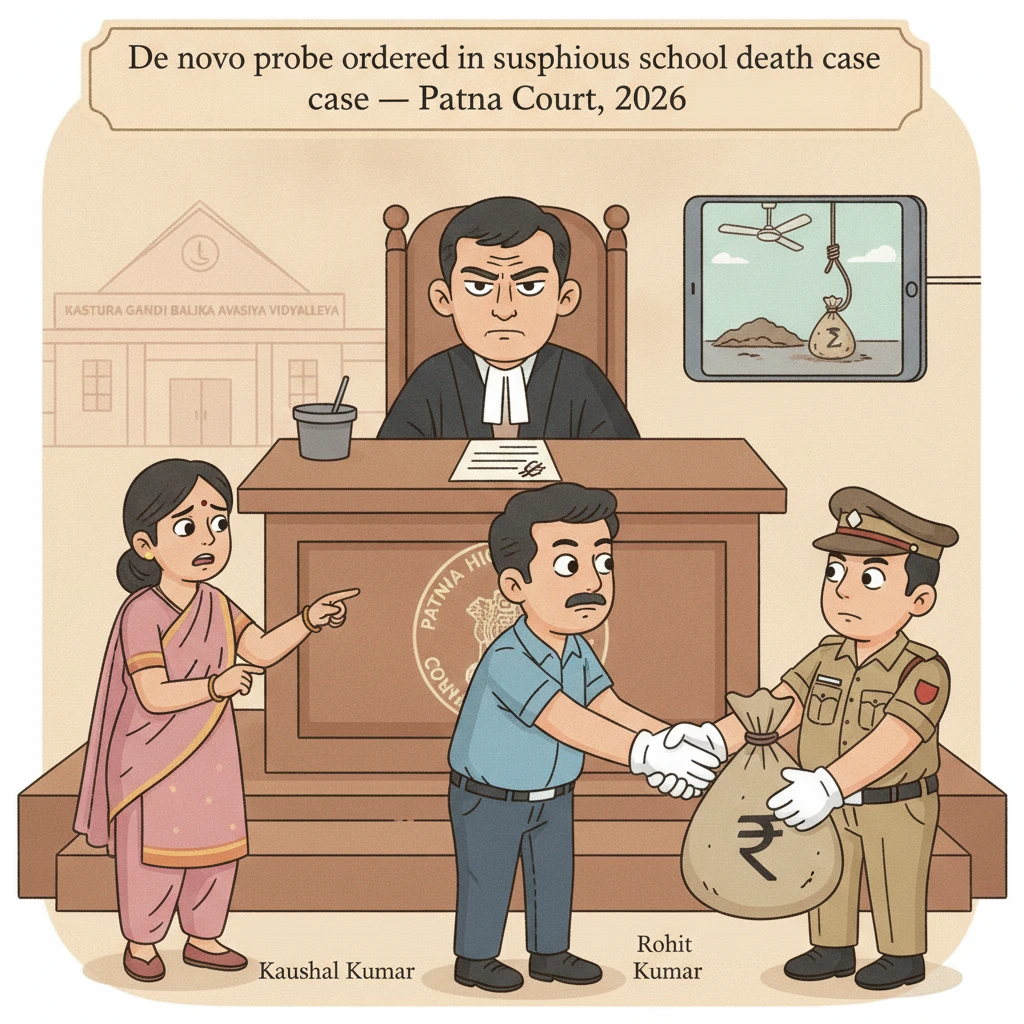
Case Background
The case arises from the death of a woman warden of Kasturba Gandhi Balika Avasiya Vidyalaya at Muzaffara in Begusarai district on 04.04.2021. She was the mother of the petitioner, a young woman named in the record as the informant.
On the morning of 04.04.2021, the deceased left her home for the residential girls’ school, stating she would return by evening. Around 2:00 p.m., the petitioner received a phone call informing her that her mother had died by suicide in the school premises.
When the petitioner reached the school with her family members, she saw her mother’s dead body lying on the floor. Local people and police later showed her photographs in which the deceased appeared to be in a sitting position, with a noose around her neck, the rope tied to a ceiling fan, and her body covered with dirt and dust.
The family performed the last rites. On the very next day, 05.04.2021, the petitioner approached Birpur Police Station to register an FIR in relation to the death. Birpur P.S. Case No. 49 of 2021 dated 05.04.2021 was registered under Section 302 of the Indian Penal Code.
According to the petitioner, she initially tried to lodge an FIR naming two neighbours, Kaushal Kumar and Rohit Kumar, as accused. She alleges that the Station House Officer refused to record their names, telling her that since she was not present at the time of occurrence, she could not name any person.
She states that she was told the FIR would be registered only if she gave a written complaint in the manner dictated by the S.H.O. A new complaint was then drafted by a scribe, Prabhakar Kumar, as per the S.H.O.’s directions and signed by her. That complaint became the basis of the FIR, in which, according to her, the suspect names did not appear.
The petitioner further alleges that about three years prior to the incident, Kaushal Kumar and Rohit Kumar had taken Rs. 15,00,000/- from her mother for transfer of a piece of land, but neither transferred the land nor returned the money. A panchayati was held, and they allegedly promised to return the money on 04.04.2021, the very day on which the warden was found dead in the school under suspicious circumstances.
After investigation, the police submitted a final form/closure report on 31.10.2021, treating the case as one of suicide and not murder. Dissatisfied, the petitioner filed a protest petition on 07.06.2021, which was treated as a complaint and registered as Complaint Case No. 211114 of 2022 before the Judicial Magistrate, 1st Class, Begusarai.
The Magistrate examined the complainant on oath under Section 200 CrPC and recorded four inquiry witnesses under Section 202 CrPC. On 09.04.2025, the Magistrate dismissed the complaint under Section 203 CrPC, holding that there was no sufficient ground to proceed against the named accused for an offence under Section 302 IPC.
The petitioner then approached the Patna High Court through the present criminal writ petition, seeking transfer of the investigation to the CBI or a Special Investigation Team (SIT), a de novo investigation into Birpur P.S. Case No. 49 of 2021, and later, through an interlocutory application, setting aside of the Magistrate’s order dated 09.04.2025.
What the Court Examined and Decided
The Patna High Court, exercising its criminal writ jurisdiction, focused both on the quality of the police investigation and the Magistrate’s decision rejecting the protest complaint.
The petitioner’s counsel argued that from the very start, the local police had acted to protect the two suspected neighbours because of their political, social and economic influence. As evidence of this, he pointed to the refusal to name them in the FIR despite repeated requests.
He submitted that the police had assured the petitioner that after preliminary inquiry the suspects would be added, but this never happened. Instead, the investigation was allegedly directed only to support a suicide narrative, ignoring the possibility of murder or abetment of suicide.
The petitioner had repeatedly approached higher authorities. She sent an e‑mail dated 10.04.2021 to the Director General of Police and other senior officers, and a letter dated 16.04.2021 to the Superintendent of Police, Begusarai, detailing her grievances and seeking proper investigation.
Her counsel also attacked the way the police handled key facts, especially around the school’s CCTV footage and the conduct of the school peon, Ajit Kumar Bablu. According to him, the peon’s statements were inconsistent and not thoroughly tested.
He pointed out that the peon, in one statement, said the deceased had asked him to come to the school by noon and had informed him of her visit, but elsewhere said that on the date of occurrence she did not inform him as she usually did. The peon also claimed he reached at 12:30 p.m., but the CCTV system appears to have been switched on only at 01:45 p.m., and at 01:53 p.m. he is seen running towards the gate calling people.
The petitioner argued that there was no clarity about where the peon was between 12:30 p.m. and 01:53 p.m., and that the investigating officer had not probed why the CCTV cameras, which were functioning earlier, remained off for almost five and a half hours.
On the money angle, the petitioner’s case was that Kaushal Kumar had taken Rs. 15,00,000/- from her mother but neither returned it nor transferred the land. A panchayati promise to repay on 04.04.2021, followed by the sudden death that same day, in her view made serious suspicion inevitable.
She further alleged that the investigating officer did not even record the statement of Kaushal Kumar, and that Rohit Kumar, instead of being treated as a suspect, was made a prosecution witness. According to her, this showed bias and a coloured investigation.
On the other side, respondents 3 and 4, the Superintendent of Police and the Station House Officer, supported the police version through a counter affidavit. They stated that postmortem was conducted at Sadar Hospital, Begusarai, and the doctor opined that death was due to asphyxia as a result of hanging. They detailed steps taken during investigation.
According to the counter affidavit, CCTV footage revealed that the deceased entered the school gate at 07:55 hours, closed it at 07:56, and switched off the CCTV cameras at 07:57:41 from a switch in the school office. The cameras became operational again at 13:24 hours, and at 13:32 hours the peon was seen going out and calling people. This, they said, suggested that the deceased herself had switched off the cameras.
The police obtained Call Detail Records and Customer Acquisition Forms for the deceased’s phone and for the peon’s phone. Records showed calls between them and tower locations at places mentioned in the affidavit. They also obtained tower locations of numbers attributed to Kaushal Kumar and relied on these to state that he was not present at the place of occurrence.
The counter affidavit claimed that witnesses described Kaushal Kumar as someone who had helped the deceased, that there was a family-type relationship between them, and that the deceased was in financial crisis and had earlier attempted suicide. Based on CCTV, tower locations and witnesses, the police claimed that Kaushal was not at the scene and that no case made out his involvement in murder.
Before deciding, a Co-ordinate Bench of the Patna High Court had, on 07.03.2024, sought an expert opinion from the Head of the Department, Forensic Medicine and Toxicology, Patna Medical College and Hospital (PMCH). The Court asked whether death could be caused by hanging in the manner shown in the photographs of the deceased.
The forensic expert, by letter dated 08.04.2024, opined in favour of the possibility of such death. He described the case as one of “partial hanging”, usually suicidal in nature, where some part of the body touches the ground and the constricting force is largely the weight of the head, and bodies can be in sitting or other postures.
Although this opinion tended towards suicide, the High Court emphasised that medical opinion alone cannot conclusively settle whether a death is suicidal or homicidal. The Court then surveyed several Supreme Court precedents on the power of constitutional courts to order reinvestigation, de novo investigation, or transfer to an independent agency like the CBI even after a closure report or charge-sheet.
From decisions such as Rubabbuddin Sheikh, State of West Bengal v. Committee for Protection of Democratic Rights, Subrata Chattoraj, Mithilesh Kumar Singh, Pooja Pal and Neetu Kumar Nagaich, the Court distilled the principles that:
- fair investigation is part of the right to life under Article 21 for both accused and victims;
- High Courts can direct fresh or de novo investigation, or transfer to CBI, even after a police report is filed and even during trial, but such power is exceptional;
- this power should be used where investigation appears biased, perfunctory, or incapable of unearthing the truth, and where non‑interference could lead to miscarriage of justice.
The Court then applied these principles to the facts at hand. It noted that suspected accused persons were not named in the FIR allegedly on the insistence of the S.H.O. More importantly, the Court recorded that from the case diary it appeared that the investigating officer had not recorded the statement of one of the suspected accused.
The Court stressed that in an unnatural death that appears to be suicide, it is imperative for the investigating officer to conclusively establish suicide. In this case, there was no suicide note and no verifiable psychological history of suicidal tendencies supported by independent witnesses.
The only indication of a prior suicidal act was a statement by Rohit Kumar that he had once seen the deceased trying to pour kerosene on herself. The Court found this inadequate because Rohit himself was one of the suspected accused, and his brother Kaushal was also alleged to be involved in the money dispute. A bald statement from such a person could not, in the Court’s view, conclusively establish suicidal tendency.
The Court commented that the investigation, from the very beginning, appeared to proceed on the presumption that the deceased had committed suicide, rather than neutrally exploring all possibilities. Investigation must be fact-finding and truth-seeking. A myopic approach, the Court said, would be a gross miscarriage of justice.
Regarding the medical and forensic material, the Court acknowledged that the inquest report, postmortem at Sadar Hospital and the special PMCH opinion all pointed towards hanging and tended to support suicide. But it underlined that medico‑legal opinion is corroborative, not substantive, and cannot be the sole basis for an “inescapable conclusion”, especially where several suspicious circumstances exist.
One such suspicious feature was the CCTV record. Cameras at the school were functioning until the time they were switched off around 07:18–07:57 hours and were switched on again only at 13:24 hours, close to the time the body was found. The Court considered this five‑and‑a‑half‑hour gap significant. It found that the investigation had not adequately explored whether the scene of crime might have been staged or whether there was abetment.
The Court also noted that although the investigating officer had collected CDR and CAF records, he had not recorded the statement of Kaushal Kumar. It observed that the police appeared to have proceeded with a preconceived presumption of suicide, without holistically probing all angles, including the financial transaction of Rs. 15,00,000/- and the tension between the deceased’s family and the alleged borrowers.
In this situation, the Court concluded that the investigation lacked completeness and neutrality. It held that to bring the “actual and whole truth” to light, the death deserved to be reinvestigated.
Accordingly, the Court quashed the closure report (Closure Report No. 179 of 2021 dated 31.10.2021) filed in Birpur P.S. Case No. 49 of 2021. It then directed that the investigation be conducted de novo by Sri Vikas Vaibhav, Inspector General of Police, Bihar.
The Inspector General was directed to commence the fresh investigation forthwith and given liberty to constitute his own team. All police officers of Begusarai district were directed to extend full cooperation. The Court mandated that the investigation be holistic and comprehensive and in accordance with law.
Since the Court ordered reinvestigation, it also quashed and set aside the Magistrate’s order dated 09.04.2025 dismissing Complaint Case No. 211114 of 2022 under Section 203 CrPC. It clarified that it was expressing no opinion on the merits of the case or on the correctness of materials collected earlier. Finally, it directed that a copy of the judgment be sent to the Director General of Police, Bihar and the Superintendent of Police, Begusarai for compliance.
Why This Judgment Matters
This judgment is important for families who lose loved ones in suspicious circumstances and feel that the local police have closed the case too quickly as suicide.
The Patna High Court has shown that even after a closure report is filed and a Magistrate has dismissed a protest complaint, the High Court can still step in under its writ jurisdiction. If the Court finds that investigation was one‑sided or incomplete, it can quash the closure report and direct a de novo investigation.
The decision underlines that medical reports and expert opinions, though important, are not the final word. Where there are suspicious facts—like a large unexplained money transaction, influential neighbours, inconsistent witness statements, or CCTV being switched off for crucial hours—the police must examine these issues thoroughly.
The Court also emphasised that in an unnatural death, simply labelling it as suicide on the strength of postmortem findings is not enough. The investigating officer must collect reliable material to rule out homicide or abetment.
For victims’ families in Bihar and elsewhere, the judgment reinforces that they have a right to demand fair and proper investigation. If local authorities appear biased or negligent, they can approach the Patna High Court to seek judicial oversight and, in rare cases, a fresh investigation by a higher‑level officer or independent agency.
Legal Issues and Answers
-
Issue: Can the Patna High Court order a de novo investigation and set aside a closure report in an FIR alleging murder, even after a Magistrate has dismissed a related complaint case under Section 203 CrPC?
Answer: Yes. Relying on Supreme Court precedents, the Court held that it has constitutional power to quash a closure report and direct fresh investigation where the existing investigation appears one‑sided, incomplete or incapable of bringing out the whole truth. The Court exercised this power, quashed Closure Report No. 179 of 2021 and ordered a de novo investigation by the Inspector General of Police, Bihar, also setting aside the Magistrate’s order dated 09.04.2025. -
Issue: Are postmortem and expert medico‑legal opinions alone sufficient to conclusively establish that an unnatural death is suicide, so as to shut out further investigation into possible homicide or abetment?
Answer: No. The Court held that medico‑legal opinions have corroborative value but are not substantive proof by themselves. In the presence of suspicious surrounding circumstances—such as a large disputed money transaction, switching off of CCTV cameras during crucial hours, and failure to record statements of key suspects—treating the death as suicide solely on medical opinion would be inconsistent with the constitutional requirement of a fair and proper investigation. -
Issue: Does a victim’s family have a right to demand investigation by a specific agency like the CBI in every such case?
Answer: No. The Court clarified that while victims are entitled to a fair, impartial and effective investigation, they do not have a vested right to insist on a particular agency. Transfer to CBI or another special agency is an exceptional power, to be used sparingly where the facts so demand. In this case, the Court did not transfer the case to CBI, but instead entrusted de novo investigation to a senior state police officer, the Inspector General of Police, Bihar.
Cases Cited by the Court
- Rubabbuddin Sheikh v. State of Gujarat & Ors., (2010) 2 SCC 200
- State of West Bengal & Ors. v. Committee for Protection of Democratic Rights, West Bengal & Ors., (2010) 3 SCC 571
- Subrata Chattoraj v. Union of India & Ors., (2014) 8 SCC 768
- Mithilesh Kumar Singh v. State of Rajasthan & Ors., (2015) 9 SCC 795
- Pooja Pal v. Union of India & Ors., (2016) 3 SCC 135
- Neetu Kumar Nagaich v. State of Rajasthan & Ors., (2020) 16 SCC 777
- Kashmeri Devi v. Delhi Administration, 1988 Supp SCC 482 (referred within Neetu Kumar Nagaich)
- Babubhai v. State of Gujarat, (2010) 12 SCC 254 (referred within Neetu Kumar Nagaich)
- Dharam Pal v. State of Haryana, (2016) 4 SCC 160 (referred within Neetu Kumar Nagaich)
- Zahira Habibulla H. Sheikh v. State of Gujarat, (2004) 4 SCC 158 (referred in Pooja Pal)
- Karnel Singh v. State of M.P., (1995) 5 SCC 518 (referred in Pooja Pal)
- Ram Bihari Yadav v. State of Bihar, (1998) 4 SCC 517 (referred in Pooja Pal)
- Gudalure M.J. Cherian v. Union of India, (1992) 1 SCC 397 (referred in Pooja Pal)
- Punjab and Haryana High Court Bar Association v. State of Punjab, (1994) 1 SCC 616 (referred in Pooja Pal)
Case Details
Case Number: Criminal Writ Jurisdiction Case No. 259 of 2022; arising out of Birpur P.S. Case No. 49 of 2021, District Begusarai
Case Title: Tezaswini Kumari v. The State of Bihar & Ors.
Citation: 2026(3) PLJR 478
Court: High Court of Judicature at Patna
Bench / Coram: Hon’ble Mr. Justice Sandeep Kumar
Date of Judgment: 08.04.2026
Parties:
Petitioner: Tezaswini Kumari, daughter of the deceased Rinku Kumari
Respondents:
- The State of Bihar through its Director General of Police, Patna, Bihar
- The Senior Superintendent of Police, Begusarai, Bihar
- The Superintendent of Police, Begusarai, Bihar
- The Station House Officer, Birpur Police Station, Begusarai, Bihar
Advocates:
- For the Petitioner: Mr. Akash Keshav, Advocate; Ms. Akansha Malviya, Advocate; Mr. Vishal Kumar Singh, Advocate; Mr. Shashwat Anand Shukla, Advocate; Mr. Pushkar Pushp, Advocate
- For the Respondents: Mr. Prabhat Kumar Verma, AAG-3; Mr. Suman Kumar Jha, A.C. to AAG-3
Nature of the Case: Criminal writ petition seeking transfer of investigation of an FIR under Section 302 IPC to CBI or SIT, and de novo investigation; subsequently also challenging dismissal of protest complaint under Section 203 CrPC. The Court ordered de novo investigation by the Inspector General of Police, Bihar, and set aside both the closure report and the Magistrate’s order.
Link to Judgment: Patna High Court Judgment in CR WJC No. 259 of 2022
If you found this explanation helpful and wish to stay informed about
how legal developments may affect your rights in Bihar,
you may consider following Samvida Law Associates for more updates.







