

Case Background
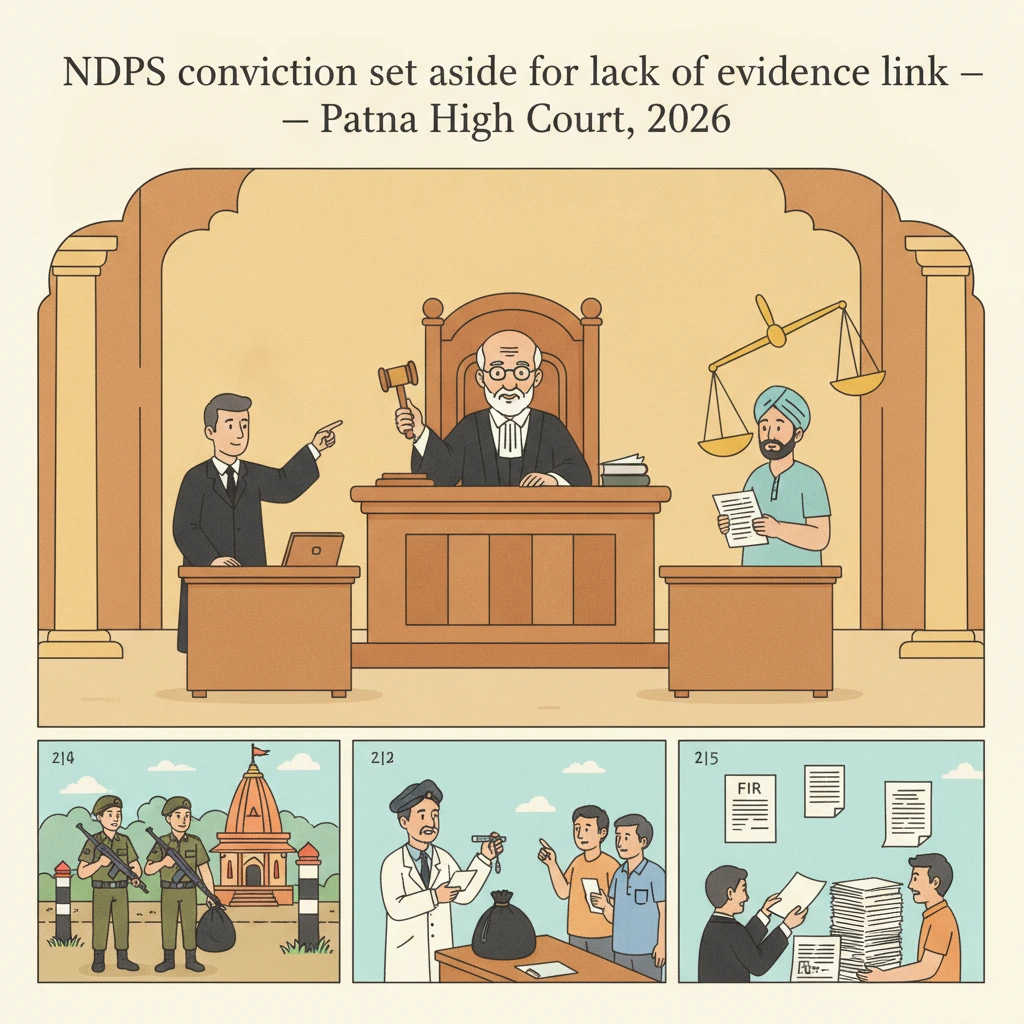
This case arose from patrolling duty conducted by Sashastra Seema Bal (SSB) jawans near the Indo–Nepal border under Sonbarsa Police Station, District Sitamarhi.
According to the prosecution, on 30.11.1998 at about 10:30 A.M., an SSB team was patrolling near Pillar Nos. 325 to 326/11 at Mangwa Bazar, close to the Nepal border. They noticed one person carrying a black bag who, on being challenged, allegedly tried to run towards Pillar No. 326/32 but was caught near Hanuman Temple.
On interrogation, he disclosed his name as Yogendra Sah. In the presence of two independent witnesses, his bag was searched. The SSB camp doctor allegedly tested the recovered substance with a narcotics testing kit and opined that it was ganja. The total weight was said to be 8.5 kilograms. The accused could not show any valid papers, so the substance was seized and a seizure list was prepared.
On the basis of the written statement of the informant, Sonbarsa P.S. Case No. 136 of 2009 was registered under Section 20(b)(ii)(B) of the Narcotic Drugs and Psychotropic Substances Act (NDPS Act). After investigation, police submitted charge-sheet, cognizance was taken, and the case was committed to the Sessions Court as G.R. No. 3297 of 2009 / T.R. No. 07 of 2013.
The learned 1st Additional Sessions Judge-cum-Special Judge, Sitamarhi convicted the accused under Section 20(b)(ii)(B) NDPS Act by judgment dated 12.09.2013 and sentenced him on 16.09.2013 to rigorous imprisonment for four years and a fine of Rs. 20,000/-, with an additional one year’s rigorous imprisonment in default of payment of fine.
Aggrieved, the accused filed Criminal Appeal (SJ) No. 2 of 2014 before the Patna High Court under Section 374(2) of the Code of Criminal Procedure. The appeal was heard by Hon’ble Mr. Justice Purnendu Singh, who delivered the judgment on 20.04.2026.
What the Court Examined and Decided
The core question before the Patna High Court was whether the conviction under Section 20(b)(ii)(B) of the NDPS Act could stand when there were serious doubts about the seizure, the handling of the alleged ganja, and the supporting evidence.
On behalf of the appellant, counsel argued that the prosecution had not proved its case beyond reasonable doubt. He pointed out contradictions between the informant (P.W. 1) and the Company Commander (P.W. 6) about where and how the ganja was weighed and sealed. While P.W. 1 suggested that seizure was completed at the spot in the presence of independent witnesses, P.W. 6 stated in cross-examination that the ganja was weighed and sealed later at the police station.
Counsel further submitted that both seizure witnesses, P.W. 8 and P.W. 10, did not support the prosecution. They stated that their signatures were taken on blank papers and that they did not see any actual recovery. It was also argued that mandatory NDPS safeguards regarding search and seizure were not properly followed.
A major point highlighted was that the Forensic Science Laboratory (F.S.L.) report had initially not been received, yet the trial court still proceeded. Later, although an F.S.L. report (Exhibit 8) was exhibited, the defence stressed that the seized contraband had already been destroyed according to the Malkhana in-charge (P.W. 11), and the actual seized substance was never produced in court. Therefore, the defence had no opportunity to verify whether what was sent to F.S.L. was truly what was seized from the accused.
The State, through the learned APP, supported the conviction and argued that the trial court had properly relied on the evidence and exhibits to convict the appellant.
The High Court examined the entire lower court record, including oral and documentary evidence. Eleven witnesses had been examined by the prosecution.
P.W. 1, the informant, deposed that during patrolling he noticed a suspicious person coming from the Nepal side. On being challenged, the person tried to flee but was caught. P.W. 1 stated that 5 kg of ganja was recovered from the accused’s bag and 3½ kg from his jacket. The Company Commander was informed, documents were prepared, and the accused and seized article were taken to the company office and later handed to Sonbarsa Police Station. His cross-examination did not bring out any major inconsistency.
P.Ws. 2 to 5 were SSB personnel who broadly supported P.W. 1 regarding patrolling, apprehension of the accused, and recovery of ganja from his possession. Their cross-examinations did not substantially damage the prosecution story.
P.W. 6, the Company Commander, testified that he reached the spot on receiving information, found a suspicious person apprehended by the patrolling party, and confirmed that the seized ganja was brought to the camp and documents were prepared. He proved several documents: the narcotics expert’s certificate (Exhibit 1), recovery memo (Exhibit 2), application for institution of case (Exhibit 3), seizure memo (Exhibit 4), apprehension memo (Exhibit 5), and related signatures (Exhibit 6). In cross-examination, however, he said that the ganja was weighed at the police station and sealed there in his presence, which conflicted with the prosecution version that seizure was completed at the spot in presence of independent witnesses.
P.W. 7, the Investigating Officer, stated that after registration of the case on 25.12.2009, he inspected the place of occurrence near the Indo–Nepal border between Malangwa (Nepal) and Sonbarsa, recorded statements, produced the seized ganja before the Special Judge, and sent it to the F.S.L. for examination. He admitted in cross-examination that the ganja was initially in open condition and was sealed only after being produced before the court.
P.W. 8 and P.W. 10 were cited as independent seizure witnesses. P.W. 8 accepted his signature on the seizure list but clearly said that no recovery took place in his presence. P.W. 10 admitted that SSB personnel took his signatures on seizure and apprehension memos, but he did not know their contents. Both essentially refused to support the prosecution version of recovery and seizure at the spot.
P.W. 9, a formal witness, proved the handwriting and signature of the informant on the written application (Exhibit 9), but also stated in cross-examination that he had signed on plain paper at the police’s instruction.
P.W. 11, the Malkhana In-charge, proved Malkhana Register entries (Exhibit 11) showing deposit of 8.5 kg ganja in Sonbarsa P.S. Case No. 136/09 and relevant signatures. His evidence established that some substance described as 8.5 kg ganja had been deposited in the police Malkhana, but it also emerged that the seized material had already been destroyed.
After considering this evidence, the High Court turned to Section 20 of the NDPS Act, which prescribes punishment for contravention relating to cannabis. The Court reiterated that although the NDPS Act places a reverse burden on the accused, the prosecution must first firmly establish foundational facts by reliable evidence. Only then does the burden shift to the accused. Mere registration of an NDPS case does not by itself shift this burden.
The Court stressed that in strict and harsh statutes like the NDPS Act, evidence relating to search, seizure and recovery must be scrutinised carefully. If the prosecution fails to prove its case beyond reasonable doubt, the accused is entitled to benefit of doubt.
The Patna High Court noted that almost all witnesses supporting the seizure were official SSB witnesses. Independent seizure witnesses had not supported the case and their signatures appeared to have been taken on blank papers or documents whose contents they did not know. There was, therefore, a “complete absence of reliable independent evidence” regarding recovery.
Critically, the alleged ganja was never produced before the trial court or marked as a material exhibit. No plausible explanation was given for this non-production. Because of this, there was no clear link between the seized substance and the samples tested by the F.S.L. Even though an F.S.L. report existed, the Court held that by itself it could not conclusively prove either that recovery actually took place from the accused or that the seized material was ganja.
To support this view, the Court relied on the Supreme Court decision in Gorakh Nath Prasad v. State of Bihar, (2018) 2 SCC 305. In that case, the Supreme Court held that when independent seizure witnesses turned hostile and seized material was not produced as an exhibit, a mere F.S.L. report could not confirm seizure or the nature of the substance. Non-production of the seized material was considered “fatal” to the prosecution. The Supreme Court also referred to its earlier judgments in Jitendra v. State of M.P. and Ashok v. State of M.P., where it was held that it is unsafe to rely only on police testimony without production of seized narcotics in court.
Applying these principles, the Patna High Court found that the prosecution case rested mainly on official witnesses, lacked credible independent corroboration, and failed to produce the seized material. Taking all these defects together, the Court concluded that serious doubt surrounded the alleged recovery and the chain of custody of the material said to be ganja.
The Court therefore held that the prosecution had failed to prove the charge under Section 20(b)(ii)(B) of the NDPS Act beyond reasonable doubt. The appellant was entitled to benefit of this doubt.
Accordingly, the appeal was allowed. The judgment of conviction dated 12.09.2013 and sentence dated 16.09.2013 passed by the 1st Additional Sessions Judge-cum-Special Judge, Sitamarhi in G.R. No. 3297 of 2009 / T.R. No. 07 of 2013, arising from Sonbarsa P.S. Case No. 136 of 2009, was set aside. The appellant was acquitted of all charges. Since he was already on bail, he was discharged from his bail bond, and any fine deposited was ordered to be refunded. The High Court also directed that the lower court records, along with a copy of this judgment, be sent back to the District Court.
Why This Judgment Matters
This judgment of the Patna High Court is important for anyone facing a case under the NDPS Act, particularly for alleged possession of ganja.
The Court has made it clear that the police and border forces must strictly follow legal procedure when they claim to recover narcotic substances. It is not enough to say that ganja was seized and to produce only official witnesses and a laboratory report.
The actual seized material must be produced in court and treated as a material exhibit. There must be a clear chain from the recovery at the spot, to storage in the Malkhana, to sending samples to the F.S.L. If independent witnesses do not support the seizure, and the seized material is not produced, the prosecution case becomes weak.
For ordinary citizens, this judgment shows that even in strict laws like the NDPS Act, courts will insist on reliable evidence. If there are serious doubts, the accused is entitled to be acquitted. For investigating agencies, it is a reminder that shortcuts in procedure—such as taking signatures on blank papers or failing to safely preserve seized articles—can lead to failure of the case.
Legal Issues and Answers
Issue: Whether the prosecution proved beyond reasonable doubt that 8.5 kg of ganja was lawfully seized from the appellant, justifying his conviction under Section 20(b)(ii)(B) of the NDPS Act.
Answer: No. The Patna High Court held that non-production of the seized ganja as a material exhibit, lack of reliable independent witnesses, contradictions about seizure and sealing, and absence of clear link between the seized material and the F.S.L. report created serious doubt. The appellant was given benefit of doubt and acquitted.
Cases Cited by the Court
Gorakh Nath Prasad v. State of Bihar, (2018) 2 SCC 305.
Jitendra v. State of M.P., (2004) 10 SCC 562 : 2004 SCC (Cri) 2028.
Ashok v. State of M.P., (2011) 5 SCC 123 : (2011) 2 SCC (Cri) 547.
Case Details
Case Number: Criminal Appeal (SJ) No. 2 of 2014; arising out of Sonbarsa P.S. Case No. 136 of 2009; G.R. No. 3297 of 2009 / T.R. No. 07 of 2013.
Case Title: Yogendra Sah v. The State of Bihar.
Citation: 2026 (3) PLJR 400.
Coram: Hon’ble Mr. Justice Purnendu Singh.
Advocates: Mr. Ashok Kumar Jha, Advocate for the appellant; Mr. Abhay Kumar, APP for the State.
Nature of the Case: Criminal appeal under Section 374(2) Cr.P.C. against conviction and sentence under Section 20(b)(ii)(B) of the NDPS Act.
Link to Judgment: Click here to read the full Patna High Court judgment
If you found this explanation helpful and wish to stay informed about
how legal developments may affect your rights in Bihar,
you may consider following Samvida Law Associates for more updates.







