

Case Background
This case arose from a dispute between a retired central government employee and the Union of India regarding recovery of alleged excess salary and benefits.
The respondent had worked under the Ministry of Labour and Employment. During his service, he was granted financial upgradations under the Assured Career Progression (ACP) and Modified Assured Career Progression (MACP) schemes.
At the time of granting these benefits, his grade pay was fixed at higher levels than what was later claimed to be his lawful entitlement. According to the Union of India, this happened because of incorrect fixation of grade pay when ACP and MACP were given.
The employee retired, but he alleged that his full retiral dues were not released for three years after his superannuation. He claimed that he repeatedly requested payment, but without success.
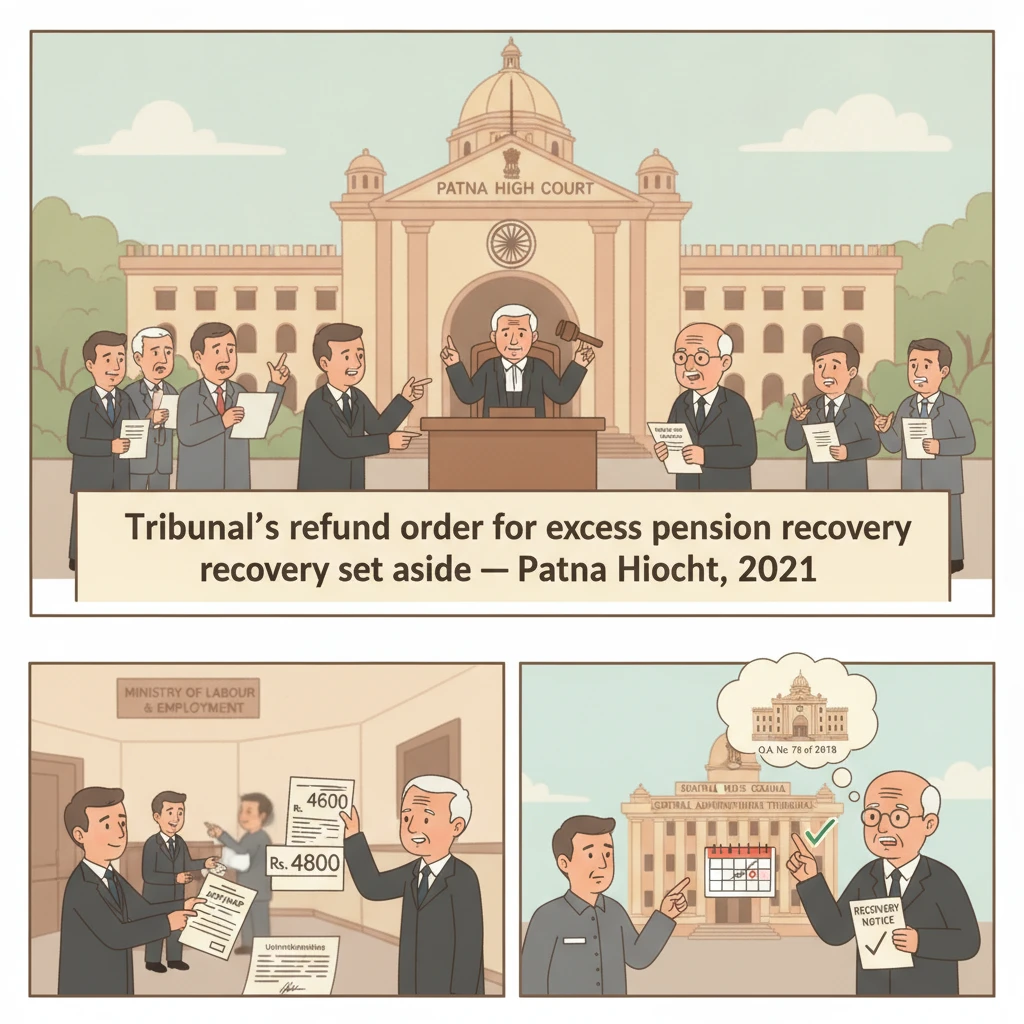
He approached the Central Administrative Tribunal, Patna Bench, by filing O.A. No. 78 of 2018. In that case he sought directions for payment of cash equivalent of earned leave, group insurance, and medical allowance at the rate of Rs.500 per month, all with 12% interest for delay. He also complained that recovery had been made from his dues without any notice and without any allegation of fraud or misrepresentation on his part.
The Union of India filed a written statement before the Tribunal. It stated that excess payment had been made to the employee because he was wrongly allowed grade pay of Rs.4600 instead of Rs.4200 on first ACP, Rs.4800 instead of Rs.4600 on second ACP, and Rs.5400 instead of Rs.4800 on MACP, ignoring the earlier ACP benefit from Rs.2800 to Rs.4200. The department claimed that it was entitled to recover the excess amount.
The Tribunal relied on the Supreme Court judgment in State of Punjab v. Rafiq Masih (White Washer) and others, (2015) 4 SCC 334. Holding that the employee was not at fault and had not misled the department, the Tribunal directed the authorities to refund all amounts recovered from his retiral dues within three months.
Aggrieved, the Union of India and its officials filed the present writ application, Civil Writ Jurisdiction Case No.12844 of 2021, before the Patna High Court under Article 226 of the Constitution of India. They challenged the Tribunal’s order dated 17.01.2020.
What the Court Examined and Decided
The Division Bench of the Patna High Court, comprising Hon’ble Mr. Justice Chakradhari Sharan Singh and Hon’ble Mr. Justice Madhuresh Prasad, heard the writ petition and delivered an oral judgment on 20.12.2021.
The key question before the Court was whether, in light of the employee’s written undertaking, the authorities could legally recover the excess amount paid to him due to wrong pay fixation, or whether such recovery was barred by the Supreme Court’s judgment in Rafiq Masih.
The Union of India argued that the Tribunal had ignored a crucial document: an undertaking signed by the employee at the time of fixation of ACP/MACP benefits. The wording of the undertaking was reproduced in the High Court’s judgment.
In this undertaking, the employee clearly stated that any excess payment made because of incorrect pay fixation, or any excess detected later due to discrepancies, would be refunded by him to the Government, either by adjustment against future payments or otherwise.
The Central Government Counsel submitted that, since the employee had voluntarily agreed to refund any excess payment, he could not later object when recovery was actually made. For this proposition, the Union of India relied on the Supreme Court judgment in High Court of Punjab & Haryana v. Jagdev Singh, (2016) 14 SCC 267.
In Jagdev Singh, the Supreme Court held that where an employee has given such an undertaking at the time of opting for a revised pay scale, he is bound by that promise and cannot resist recovery of overpayment later detected.
On the other hand, the employee’s counsel supported the Tribunal’s decision. He argued that the Tribunal had correctly applied Rafiq Masih, which protects certain categories of employees from recovery of excess payment when they were not at fault and when recovery would cause hardship. He emphasized the respondent’s advanced age and the hardship faced after retirement.
The employee’s counsel also cited two other decisions. First, a Division Bench judgment of the Patna High Court in Shobha Kant Mishra v. Union of India & Ors., 2021 (4) BLJ 423, where the Court restrained a bank from making further recovery of excess payment, even though an undertaking had been given. Second, a Division Bench decision of the Telangana High Court in Union of India v. A. Sreedhar, AIRONLINE 2020 TEL 213, where the Court similarly restrained recovery of amounts admittedly paid in excess.
He urged that, since there was no allegation of fraud or misrepresentation by the employee in the present case, the High Court should not disturb the Tribunal’s order directing refund of the recovered sums. Otherwise, the retired employee would face “serious undue hardship”.
The Patna High Court carefully examined the pleadings and facts. The Court noted that it was not disputed that the employee had been paid in excess of his legal entitlement due to incorrect pay fixation at the time of granting ACP/MACP benefits. It was also undisputed that the excess amount had already been recovered by the authorities.
Most importantly, the Court highlighted that there was no dispute regarding the existence or content of the undertaking signed by the respondent. This undertaking, in the Court’s view, had a decisive impact on the legal position.
The Bench then turned to the Supreme Court decision in Jagdev Singh. It quoted paragraph 11 of that judgment, where the Supreme Court stated that the normal protection against recovery (as recognised in Rafiq Masih) would not apply where the employee had been clearly informed that any excess would be recoverable and had furnished an undertaking to that effect while opting for revised pay. In such a situation, the employee is bound by the undertaking.
Applying this reasoning to the present facts, the Patna High Court held that the case fell squarely within the rule of Jagdev Singh. Because the respondent had signed a clear promise to refund any excess amount resulting from incorrect fixation, he could not later claim the protection of Rafiq Masih to avoid recovery of the overpayment.
The Court then dealt with the Division Bench judgment in Shobha Kant Mishra of the Patna High Court. It distinguished that case on facts. In Shobha Kant Mishra, the excess amount had been wrongly credited into the petitioner’s bank account by the bank itself. When the bank moved to recover that sum, the Court, seeking to balance equities, restrained any further recovery but specifically held that the amount already recovered from the petitioner’s monthly pension would not be refunded.
Thus, Shobha Kant Mishra did not support the respondent’s claim for refund of the amount already recovered from him in the present case. Rather, the earlier Division Bench had also refused to order refund of recovered sums.
After considering the arguments and precedents, the Patna High Court concluded that the Tribunal’s direction to refund the recovered amount was legally unsustainable. The Tribunal had applied Rafiq Masih without considering the binding effect of the employee’s undertaking and the principle laid down in Jagdev Singh.
Consequently, the Court set aside the Tribunal’s order dated 17.01.2020 in O.A. No. OA/050/00078/2018. The writ application filed by the Union of India was allowed. The Court did not pass any order as to costs.
As a result, the recovery of excess payments already made from the respondent’s retiral dues stands upheld, and there is no direction now for refund of those sums.
Why This Judgment Matters
This judgment is important for retired and serving government employees who have received financial upgradations under ACP or MACP, or who have opted for revised pay scales.
The Patna High Court has made it clear that if an employee has given a written undertaking to refund any excess payment that may later be detected, then that employee can be legally bound by that promise. In such cases, the usual protection against recovery of excess amounts, based on financial hardship and absence of fault, may not be available.
The decision also clarifies that reliefs like those given in earlier cases, where courts stopped further recovery or refused to allow recovery at all, depend heavily on the specific facts. Where excess money was simply credited by mistake without any such undertaking, courts may balance equities differently. But where there is a clear undertaking, the authorities may recover the excess without being forced to refund amounts already adjusted.
For employees, this ruling is a reminder to carefully read and understand any declaration or undertaking they sign at the time of pay revision or grant of benefits. For departments, it underlines the importance of maintaining clear records of such undertakings when correcting pay fixation or making recoveries.
Legal Issues and Answers
-
Issue: Can a retired government employee, who has signed an undertaking to refund any excess payment arising from incorrect pay fixation, claim protection under the Supreme Court’s decision in Rafiq Masih to stop or reverse recovery of that excess amount?
Answer: No. The Patna High Court held that, in such circumstances, the Supreme Court’s ruling in Jagdev Singh applies, and the employee is bound by the undertaking. The recovery of excess payment already made from the retiral dues was therefore valid, and the Tribunal’s direction to refund that amount was set aside.
Cases Cited by the Court
- State of Punjab v. Rafiq Masih (White Washer) and others, (2015) 4 SCC 334
- High Court of Punjab & Haryana v. Jagdev Singh, (2016) 14 SCC 267
- Shobha Kant Mishra v. Union of India & Ors., 2021 (4) BLJ 423
- Union of India v. A. Sreedhar, AIRONLINE 2020 TEL 213 (referred to in argument)
Case Details
Case Number: Civil Writ Jurisdiction Case No.12844 of 2021
Case Title: The Union of India & Ors. v. Sri Bijoy Kumar
Coram: Hon’ble Mr. Justice Chakradhari Sharan Singh and Hon’ble Mr. Justice Madhuresh Prasad
Citation: 2022(2) PLJR 235
Advocates: For the petitioners (Union of India and officials): Mr. Pradeep Kumar, C.G.C.; Mr. Kumar Sachin, C.G.C. For the respondent (retired employee): Mr. Prince Kumar Mishra, Advocate.
Date of Judgment: 20-12-2021
Nature of the Case: Writ petition under Article 226 of the Constitution of India challenging an order dated 17.01.2020 passed by the Central Administrative Tribunal, Patna Bench, in O.A. No. 78 of 2018.
Impugned Order: CAT Patna Bench order directing refund of amounts recovered from retiral dues of the employee on account of excess payment due to wrong pay fixation.
Final Outcome: Writ petition allowed; Tribunal’s order dated 17.01.2020 set aside; no order as to costs.
Link to Judgment: View original judgment on Patna High Court website
If you found this explanation helpful and wish to stay informed about
how legal developments may affect your rights in Bihar,
you may consider following Samvida Law Associates for more updates.







