

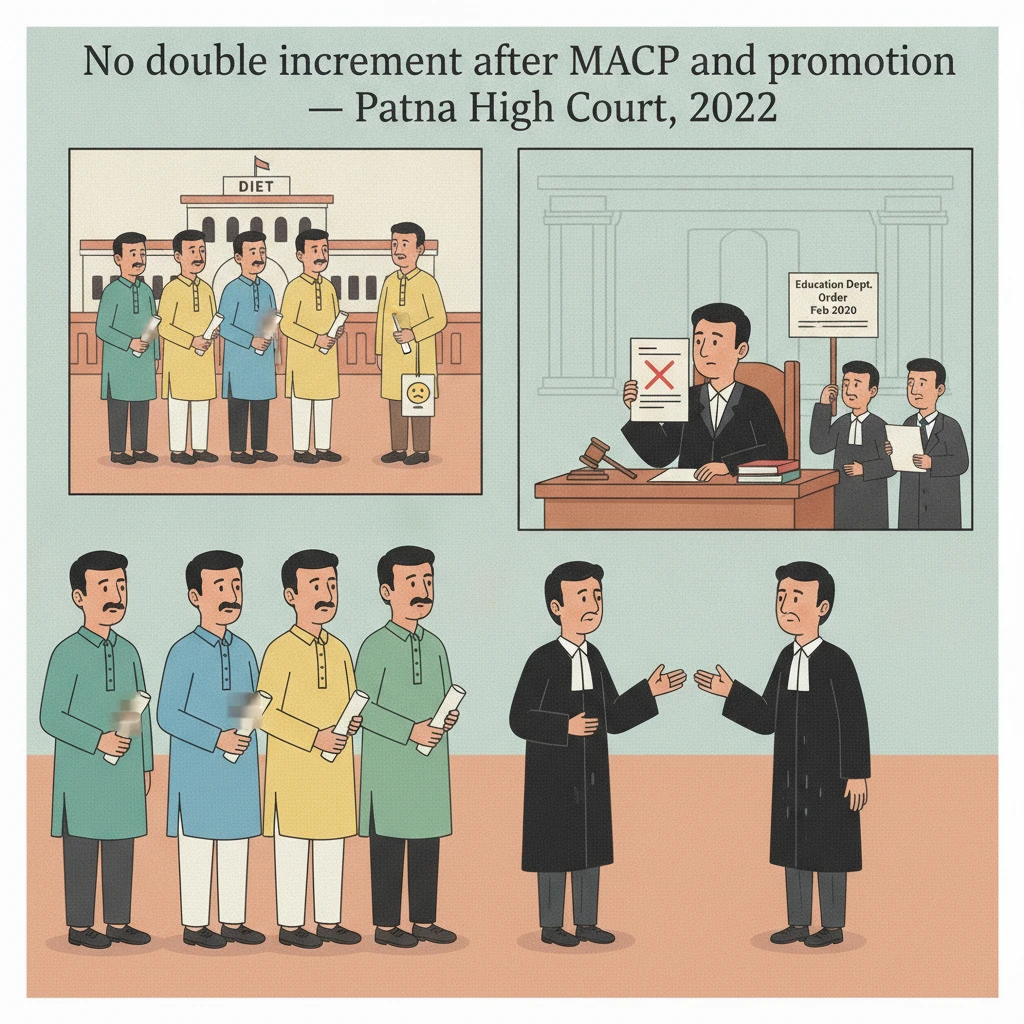
Case Background
The petitioners were government school teachers in Bihar. They were initially appointed between 1991 and 1995 as Assistant Teachers in the Lower Subordinate Education Service Cadre.
At the time of their appointment, they drew the trained pay scale of Rs. 1200-1800. Later, the State of Bihar introduced the Assured Career Progression Scheme Rules, 2003, commonly called the 2003 ACP Scheme.
Under the 2003 ACP Scheme, an employee who completed 12 years of service on a post without promotion became entitled to the pay scale of a higher post. On that basis, the petitioners were granted the higher pay scale of Rs. 5500-9000.
Subsequently, the State modified this policy and brought in the Modified Assured Career Progression Scheme, 2010 (MACP). Under MACP, financial upgradations were to be given on completion of 10, 20 and 30 years of service.
When the petitioners completed 20 years of service, they received the second time bound promotion pay scale under MACP. Their pay was fixed in the scale of Rs. 9300-34800 with grade pay of Rs. 4800. This benefit was granted from 2011 for petitioner numbers 1 to 6, and from 2015 for petitioner number 7.
Later, all petitioners received regular promotions. They were promoted from Assistant Teacher to Lecturer by orders dated 20 November 2015 and 30 June 2016. The promotional post of Lecturer carried the pay scale of Rs. 9300-34800 with grade pay of Rs. 4200.
After these regular promotions, the authorities again fixed the petitioners’ pay and gave them a 3% increment treating it as a promotional benefit under Fundamental Rule 22(1)(a)(1). Thus, the petitioners effectively received an increment when they got the MACP scale and another increment when they were promoted, even though both scales were in the same pay band.
Later, some other similarly placed teachers approached the Patna High Court for similar monetary benefits. On their petition, the Court directed the Education Department to examine the issue.
After examination, the Education Department, Government of Bihar, passed an order on 3 February 2020. The State concluded that a 3% increment (treated as one increment) could not be granted twice to employees who had already received MACP benefits and were then promoted in the same pay band. The Department ordered fresh pay fixation and recovery of excess amounts from all such employees, including the present petitioners.
Aggrieved by this order, the petitioners approached the Patna High Court under its civil writ jurisdiction in CWJC No. 4791 of 2020.
What the Court Examined and Decided
The Patna High Court, through Hon’ble Mr. Justice Sanjeev Prakash Sharma, identified the core question: how to interpret Fundamental Rule 22(1) read with the State Government’s circular regarding the grant of increments when an employee, who already has MACP benefits, is later promoted.
The petitioners’ counsel argued that Rule F.R. 22(1) applies whenever a person is promoted to a higher post. According to them, on regular promotion, the initial pay in the time scale of the higher post must be fixed at the stage next above the notional pay that is arrived at by increasing the pay of the lower post by one increment.
They relied on the method explained in the State’s own circular and submitted that, on the date of promotion in 2015, the petitioners were drawing pay in the pay band of Rs. 9300-34800 with grade pay Rs. 4800 under MACP.
On that date, the promotion was from Assistant Teacher to Lecturer. The petitioners’ stand was that since they were being promoted to a higher post, Rule 22(1)(a)(1) should give them an additional 3% benefit (one increment) over and above the MACP benefit they had already received on completion of 20 years of service.
They contended that the State’s decision of 3 February 2020, which withdrew this additional increment and ordered recovery, was contrary to Rule 22(1)(a)(1) and therefore liable to be quashed. They also submitted that there was no occasion to pass a “general order of recovery” against persons who had not individually approached the Government.
On the other hand, the State’s counsel took the Court through the MACP provisions. The relevant portion, quoted in Hindi in the judgment, clarified how MACP increments are to be given and what happens when a person, after getting MACP, later receives regular promotion.
The MACP text, as extracted, states in essence that at the time of financial upgradation, the same benefit of pay fixation will be given as in regular promotion—3% increment on the total of pay band and grade pay. However, if at the time of MACP the grade pay approved is the same as the grade pay of the regular promotion post, then on regular promotion there will be no fresh pay fixation.
The provision further explains that in such a case, on regular promotion, the employee will only get the difference between the two grade pays if the promotional post has a higher grade pay. If both MACP and promotion carry the same grade pay, the employee will not receive any additional pay increase, only the grade pay difference where applicable.
Based on this, the State argued that since regular promotion had not been granted earlier, the increment and higher scale were given at the time of MACP as a substitute for promotion due to stagnation. Once regular promotion is subsequently granted but in the same pay scale, the benefit already granted continues, and there is no right to an additional promotional increment.
The State’s position was straightforward: an employee cannot be allowed to draw promotional pay benefit twice when MACP already gave him the financial advantage of the promotional scale.
The Court then examined Rule 22(1)(a)(1). It noted that the language of this rule is “unambiguous and clear.” The key words are “by increasing his pay in respect of the lower post held by him regularly by increment at the stage at which such pay has accrued.”
According to the Court, this wording shows that the rule looks at the pay attached to the lower post, not at higher pay that has been given merely to deal with stagnation. The higher pay under MACP is actually the pay scale of the promotional post granted in lieu of promotion.
The Court explained that MACP is granted in place of promotion, and after MACP, if actual promotion is later given, the employee simply continues in the same pay scale. The Court also clarified the only situation where an additional benefit may arise: if the MACP scale is still lower than the scale of the higher post on promotion, then the employee would be entitled to further upgradation.
However, if the pay scale under MACP and the pay scale of the promotional post are identical, there is no justification to grant a second increment. In fact, once MACP is granted, the employee already starts receiving the pay that would normally attach to the promotional post. Later promotion only changes the designation and nature of duties, not the pay scale.
In such cases, on promotion, the employee gets the usual annual increment in that scale but not an additional 3% promotional increment on top of the MACP benefit. The Court noted that the Bihar Government’s explanation in its order and circular is consistent with this logic and, importantly, that this restriction is clearly written into the MACP scheme itself.
The Court therefore held that additional increments cannot be granted on regular promotion to someone who has already been granted MACP where both carry the same pay scale. On this reasoning, the impugned order of 3 February 2020, which stopped the second increment and directed recovery, did not suffer from any legal infirmity.
Accordingly, the Court found no ground to interfere. It held that the writ petition was devoid of merit and dismissed it.
The Court then dealt with the issue of recovery. Earlier, during the pendency of the case, the Court had stayed the recovery of the excess amount paid to the petitioners. After upholding the State’s order, the Court considered whether this stay should continue.
The Court took note that the petitioners held posts above Class IV and Class III and therefore were not in the lowest income bracket. It held that in such a situation there was no reason to stop the State from recovering the overpaid amount.
The petitioners had referred to the Supreme Court decision in State of Punjab v. Rafiq Masih, (2014) 8 SCC 883, which restricts recovery of excess payments from certain categories of employees. The Patna High Court categorically held that the law in Rafiq Masih did not apply to the present case.
However, taking into account the economic hardships during the Covid-19 pandemic, the Court gave limited relief on the manner of recovery. It directed that the recovered amount should be realised in ten equal instalments. This was to ensure that the petitioners did not face severe financial strain.
Why This Judgment Matters
This judgment is important for government employees in Bihar, especially teachers and others who receive MACP benefits and later get regular promotions.
It clarifies that if the pay scale under MACP and the pay scale of the subsequent promotional post are the same, an employee cannot claim a second 3% increment just because of the promotion. MACP already functions as a financial substitute for promotion.
The judgment also confirms the State Government’s power to correct pay fixation and recover excess salary paid, even where employees had been drawing that pay for some time, as long as the case does not fall within the protective categories identified in Rafiq Masih.
For employees, the ruling sends a clear message: double benefits on the same pay scale, first under MACP and then again on promotion, will not be allowed. Pay fixation will follow the MACP rules and Fundamental Rules as interpreted by the Court.
For administration, especially the Education Department, the decision supports the 3 February 2020 policy decision and enables uniform application across all similarly placed staff.
Legal Issues and Answers
-
Issue: Can a government employee who has already received a 3% increment and higher pay scale under MACP claim another 3% increment on regular promotion when both MACP and promotional posts have the same pay scale?
Answer: No. The Patna High Court held that when the MACP scale and the promotional scale are the same, Rule F.R. 22(1)(a)(1) does not permit a second promotional increment. MACP is in lieu of promotion, and the employee cannot draw promotional pay benefit twice. -
Issue: Was the State Government’s order dated 3 February 2020, directing withdrawal of the second increment and recovery of excess payment, legally valid?
Answer: Yes. The Court upheld the order, finding it consistent with Rule 22(1)(a)(1) and the MACP scheme. It refused to interfere and dismissed the writ petition. -
Issue: Should recovery of excess payments be barred by the Supreme Court’s decision in State of Punjab v. Rafiq Masih (2014) 8 SCC 883?
Answer: No. The Court held that Rafiq Masih did not apply in this case, as the petitioners held posts above Class III and IV and there was no ground to prevent recovery, though it allowed repayment in ten instalments due to Covid-19 conditions.
Cases Cited by the Court
- State of Punjab v. Rafiq Masih, (2014) 8 SCC 883 – cited to clarify that its protective principles did not apply to bar recovery in this case.
Case Details
Case Number: Civil Writ Jurisdiction Case No. 4791 of 2020
Case Title: Kishor Kumar & Ors. v. The State of Bihar & Ors.
Citation: 2022(2) PLJR 166
Court: High Court of Judicature at Patna
Coram: Hon’ble Mr. Justice Sanjeev Prakash Sharma
Date of Judgment: 21-03-2022
Advocates:
- For the petitioners: Mr. Nikhil Kumar Agrawal, Advocate; Ms. Aditi Hansaria, Advocate
- For the respondents (State of Bihar): Ms. Binita Singh, SC 28; Mr. Nishant Kumar Jha, AC to SC 28
Nature of the Case: Writ petition challenging State Government order on MACP-related pay fixation, promotional increment and recovery of excess salary.
Impugned Order: Education Department, Government of Bihar, order dated 03-02-2020 concerning withdrawal of additional 3% increment and recovery.
Link to the Judgment: Patna High Court Judgment
If you found this explanation helpful and wish to stay informed about
how legal developments may affect your rights in Bihar,
you may consider following Samvida Law Associates for more updates.







