

Case Background
This case arose from a long-running family dispute over ancestral land in village Muktapur, Police Station Kalyanpur, District Samastipur.
The common ancestor of both sides, Late Chulhai Raut, died in 1951. He left behind three sons – Ram Saran Raut, Ram Lakhan Raut and Pyare Raut, all of whom have since died. The present respondent is one of the three sons of Late Ram Saran Raut. The present petitioner is the only son of Late Ram Lakhan Raut. The heirs of Late Pyare Raut have not been made parties in the title suit.
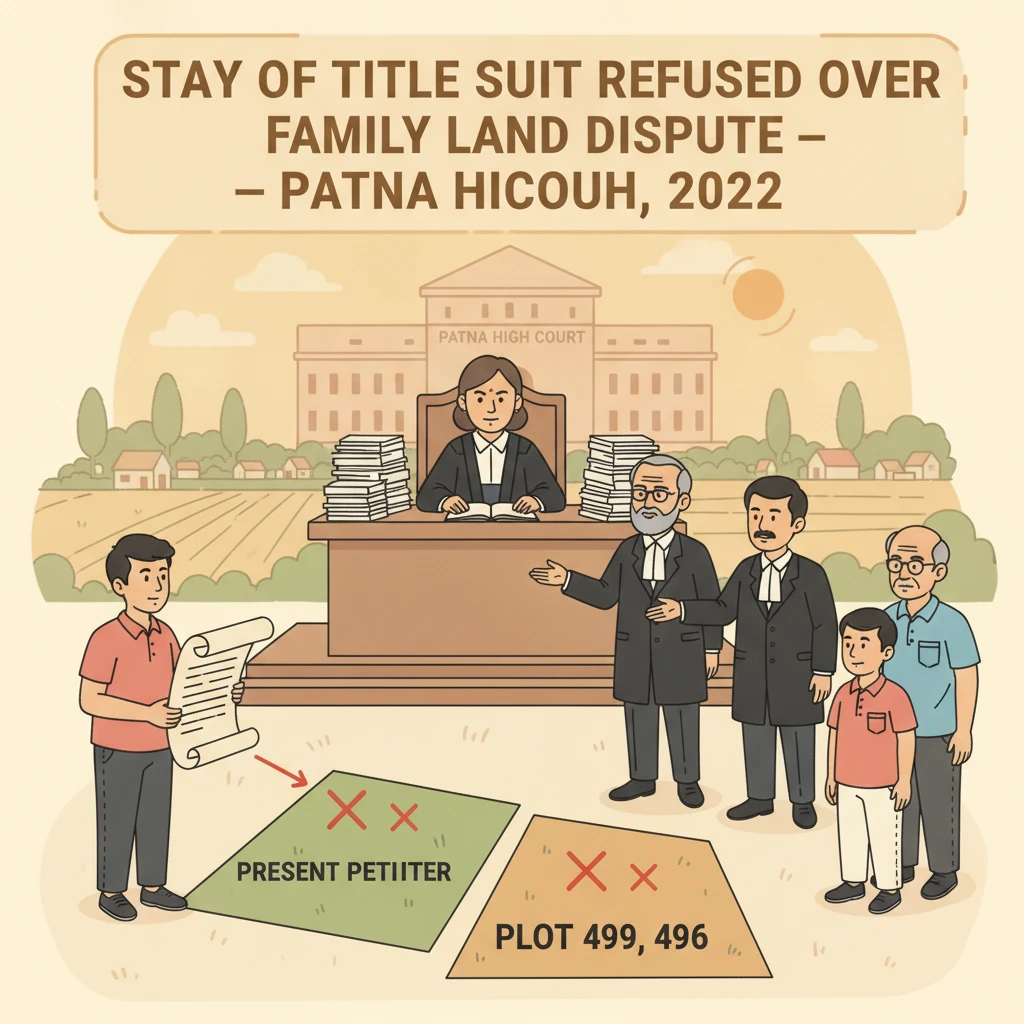
In 2001, the respondent first filed Title Suit No. 78 of 2001. In that suit, he sought declaration of his title and recovery of possession over plot nos. 499 and 496, measuring in total 2 Kattha 1 Dhur. The present petitioner was the sole defendant in that title suit.
In Title Suit No. 78 of 2001, written statement was filed, issues were framed, witnesses were examined and documents were produced. The case had reached the last stage of hearing. However, on 07.04.2009, the trial court returned the plaint for want of pecuniary jurisdiction. The plaintiff was required to file the suit before a court of competent pecuniary jurisdiction.
Separately, in 2005, the present petitioner along with his sons filed Partition Suit No. 24 of 2005. They sought partition of joint family property (described in Schedule-I to that plaint) and claimed a one-third share in it. The respondent, his sons and the heirs of Late Pyare Raut were made defendants in that partition suit.
The land in dispute in the later title suit was included in Schedule-I of Partition Suit No. 24 of 2005. Along with this land, other properties were also included as joint family property said to have been acquired by Late Chulhai Raut in his name.
After the plaint in Title Suit No. 78 of 2001 was returned, the respondent filed a fresh suit – Title Suit No. 141 of 2009 – in the court of the Sub-Judge, Samastipur, for the same suit property and with the same reliefs as the earlier title suit.
On 18.12.2020, the learned Sub-Judge V, Samastipur, ordered that Title Suit No. 141 of 2009 would be tried afresh (denovo). In the same order, he rejected the application filed by the present petitioner under Section 10 of the Code of Civil Procedure (CPC), which sought stay of the title suit on the ground that the partition suit was already pending.
Aggrieved by this refusal to stay the later title suit, the defendant in the title suit (petitioner here) moved the Patna High Court by way of Civil Miscellaneous No. 358 of 2021, seeking to quash the order dated 26.06.2021 of the Sub-Judge V, Samastipur in Title Suit No. 141 of 2009.
What the Court Examined and Decided
The Patna High Court, through Hon’ble Mr. Justice Nawneet Kumar Pandey, examined whether the trial court was wrong in refusing to stay the later title suit under Section 10 CPC. This provision deals with situations where two suits involving the same matter are pending in courts of concurrent jurisdiction.
The petitioner’s stand was straightforward. He argued that:
First, the properties in dispute in Title Suit No. 141 of 2009 were also part of the subject-matter of Partition Suit No. 24 of 2005. Both suits, according to him, covered the same ancestral properties.
Second, the parties in both suits were either the same or were claiming under the same common ancestor, namely Late Chulhai Raut. Therefore, the issues in both suits were said to be directly and substantially the same.
Third, in such circumstances, the petitioner contended that Section 10 CPC made it mandatory to stay the later suit. He submitted that the title suit ought to have been halted until the partition suit was decided, to avoid conflicting decisions and multiplicity of proceedings.
The High Court accepted one part of the factual position as “an admitted fact”: the subject-matter of Title Suit No. 141 of 2009 was also part of the subject-matter of Partition Suit No. 24 of 2005. However, the Court noted a crucial distinction.
The partition suit covered a wider range of properties. Besides the lands which were the subject of the title suit, other properties were also included as part of the joint family estate in the partition suit. Thus, while there was some overlap, the entire set of properties involved in both suits was not the same.
On this basis, the Court held that one could not infer that “the matter in issue was directly and substantially involved in both the cases.” This phrase is central to Section 10 CPC. The Court emphasised that the mere fact of some common property did not automatically mean that the whole matter in issue in both suits was identical.
The respondent’s counsel supported the trial court’s order and relied on earlier decisions of the Patna High Court, which in turn had followed the Supreme Court. Two specific Patna High Court decisions were cited:
2013 (3) PLJR 782, Rajesh Kumar Choudhary & others vs. Pradeep Kumar Choudhary & others; and 2016 (4) PLJR 507, Sampatti Devi & others vs. Lalita Devi & others.
In Rajesh Kumar Choudhary, a coordinate Bench of the Patna High Court had relied upon the Supreme Court’s judgment in (2005) 2 SCC 256, National Institute of Mental Health & Neuro Sciences vs. C. Parameshwara. The High Court in that earlier case had laid down the principles governing Section 10 CPC.
The judgment quoted paragraph 8 of the Supreme Court’s decision. In that paragraph, the Supreme Court had explained that the object of Section 10 is to prevent courts of concurrent jurisdiction from simultaneously trying two parallel suits between the same parties, in respect of the same matter in issue.
The Supreme Court further held that the “fundamental test” for Section 10 is whether, once the earlier suit is finally decided, that decision would operate as res judicata in the later suit. The Court also clarified that Section 10 applies only where the whole of the subject-matter in both suits is identical.
To put it in simple terms, the key question is: are both suits about the same core dispute, on the same properties, between the same parties, and asking for the same kind of relief? Only then does Section 10 block the later suit.
The words “the matter in issue is directly and substantially in issue” are important. As explained by the Supreme Court and followed by the Patna High Court, these words are used to distinguish the main dispute in a case from points which are only incidental or side issues. Section 10 applies only when the main dispute in both suits is identical.
The coordinate Bench in Sampatti Devi reiterated the same principle. It held that Section 10 would apply only if there is identity of the matter in issue in both suits, meaning that the whole subject-matter in both proceedings is identical. In that case too, the Court found that such identity did not exist.
Applying these settled principles, the Patna High Court in the present matter carefully examined the overlap between the partition suit and the title suit.
The Court acknowledged that the land described in the title suit was also part of the schedule of properties in the partition suit. However, since the partition suit included “some other properties” as well, the entire properties in dispute in both suits were not identical.
Because of this, the Court concluded that it could not be said that the matter in issue was directly and substantially the same in both suits. The partition suit concerned the division of the whole joint family property among co-sharers, while the title suit focused on declaration of title and possession with respect to specific plots.
In view of the legal test laid down by the Supreme Court and followed in earlier Patna High Court decisions, Section 10 CPC was therefore not attracted. The Sub-Judge, Samastipur, had correctly refused to stay the later title suit.
The High Court held that the impugned order dated 26.06.2021 did not warrant interference. Accordingly, Civil Miscellaneous No. 358 of 2021 was dismissed. As a result, Title Suit No. 141 of 2009 will proceed before the trial court.
Why This Judgment Matters
This judgment is significant for families involved in ancestral land disputes where multiple civil cases are pending. It makes clear that just because two suits involve some common land or common parties does not automatically mean one case must stop.
For Section 10 CPC to apply, the entire subject-matter of both suits must be the same, and the main dispute must be identical. If one suit is broader, such as a partition of all joint family properties, and the other focuses only on specific plots or different reliefs, the court may allow both cases to continue.
Practically, this means that litigants cannot always rely on Section 10 CPC to delay a later suit simply by pointing out overlap in property or parties. Courts will compare the scope and nature of both suits before deciding whether to stay one of them.
For people in Bihar dealing with similar family land issues, the ruling from the Patna High Court highlights the importance of the exact relief claimed and the full list of properties in each case.
Legal Issues and Answers
-
Issue: Whether Title Suit No. 141 of 2009, a later suit for declaration of title and recovery of possession over certain plots, should be stayed under Section 10 CPC because Partition Suit No. 24 of 2005 concerning joint family properties was already pending.
Answer: No. The Patna High Court held that Section 10 CPC did not apply, because although the land in the title suit was included in the partition suit, the entire properties in dispute in both suits were not identical and the matter in issue was therefore not directly and substantially the same.
Cases Cited by the Court
- (2005) 2 SCC 256, National Institute of Mental Health & Neuro Sciences vs. C. Parameshwara
- 2013 (3) PLJR 782, Rajesh Kumar Choudhary & others vs. Pradeep Kumar Choudhary & others
- 2016 (4) PLJR 507, Sampatti Devi & others vs. Lalita Devi & others
Case Details
Case Number: Civil Miscellaneous Jurisdiction No. 358 of 2021
Case Title: Lakshaman Ray @ Laxman Yadav vs. Ram Bilash Yadav
Coram: Hon’ble Mr. Justice Nawneet Kumar Pandey
Citation: 2022 (2) PLJR 149
Advocates: For the petitioner – Mr. Bijay Bhushan Prasad, Ms. Nisha Singh, Ms. Sadhna Suman; For the respondent – Mr. Manoj Kumar No. 1
Nature of the Case: Civil miscellaneous petition challenging order refusing stay under Section 10 of the Code of Civil Procedure in a pending title suit.
Date of High Court Judgment: 03.03.2022
Link to the Judgment: Patna High Court Judgment in C. Misc. No. 358 of 2021
If you found this explanation helpful and wish to stay informed about
how legal developments may affect your rights in Bihar,
you may consider following Samvida Law Associates for more updates.







