

Case Background
The petitioner was working as a Blue Printer in the office of the Superintending Engineer, Public Health Engineering Department (PHED), who is respondent no. 2 in the case.
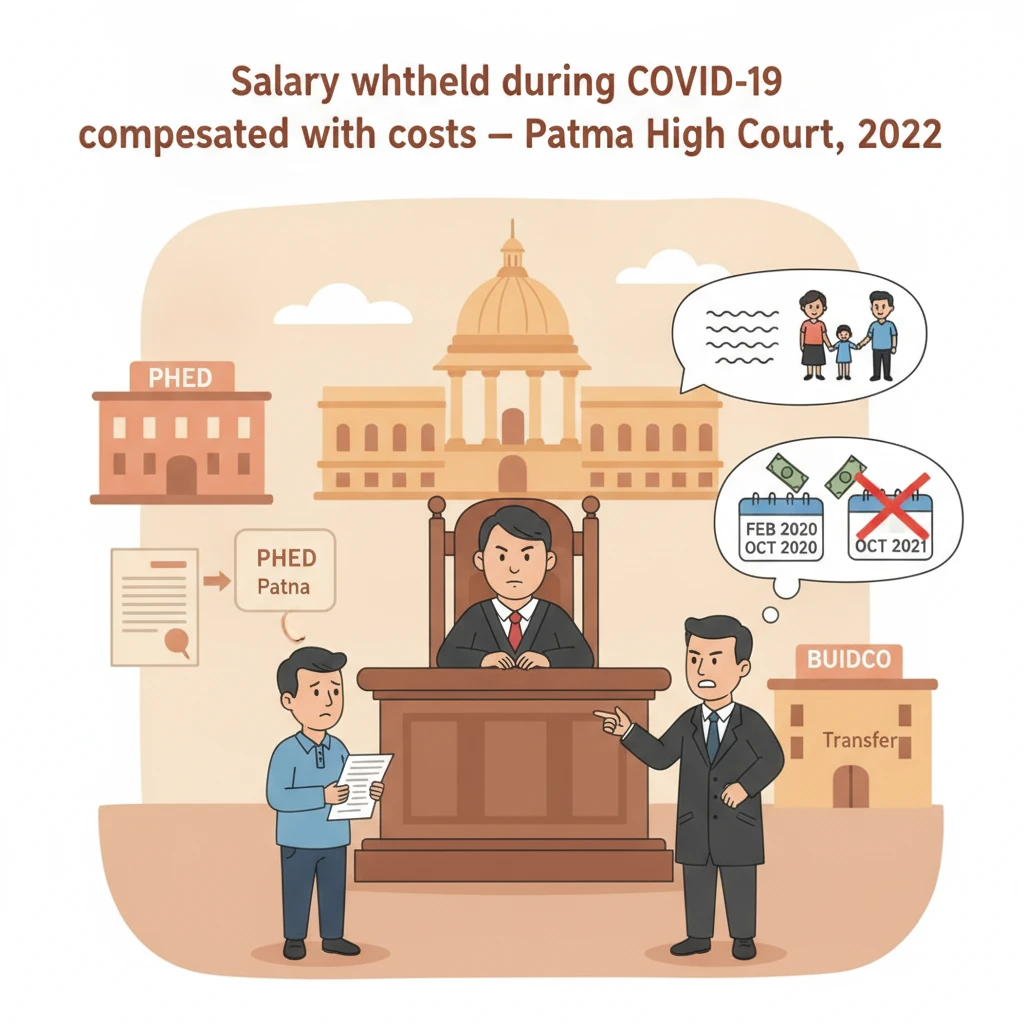
According to the writ petition, his salary was not paid from February 2020 onwards. This period includes the early and difficult months of the COVID-19 pandemic.
During this time, an office order no. 124 dated 22.04.2020 was issued by the General Manager (Admin), Bihar Urban Infrastructure Development Co. Ltd. (BUIDCO), who is respondent no. 3. By this order, the petitioner was transferred from the office of respondent no. 2 to the office of the Executive Engineer (Mechanical), Work Division, Malahi Pakri, Kankarbagh, Patna.
Feeling aggrieved by non-payment of salary and difficulties relating to his transfer, the petitioner filed Civil Writ Jurisdiction Case No. 9669 of 2020 before the Patna High Court.
He also filed interlocutory applications in the same case, but the Court recorded that these interim applications were not related to the issue of salary payment, which was the main subject of the petition. Therefore, those interlocutory applications were disposed of, with liberty to the petitioner to file a fresh petition if needed.
What the Court Examined and Decided
The main reliefs sought by the petitioner were threefold.
First, he sought a writ of mandamus directing the respondents to pay his salary from February 2020 “up-till-now” while working as a Blue Printer in the office of the Superintending Engineer, PHED (respondent no. 2).
Second, he asked for a direction to the respondents, particularly respondent no. 2, to issue a relieving letter so that he could join the office of the Executive Engineer (Mechanical), Work Division, Malahi Pakri, Kankarbagh, Patna. This was in compliance with office order no. 124 dated 22.04.2020 issued by respondent no. 3, which transferred him from the office of respondent no. 2 to the office of the Executive Engineer (Mechanical).
Third, he requested any other reliefs that the Court considered appropriate in law.
While the writ petition was pending, the situation changed in a crucial way. The Court noted from the records that the petitioner’s main grievance regarding non-payment of salary had already been redressed by the department during the pendency of the case.
The arrears of salary for the period February 2020 to April 2020 were paid in October 2020. The arrears for the period May 2020 to January 2021 were paid later, in October 2021.
Thus, by the time the matter came up for final consideration on 21.03.2022, there was no surviving dispute about actual payment of salary. The amounts due had been released in two instalments.
The Court still carefully examined how and why the salary had been withheld for such a long period.
The judgment records that the petitioner was a Class-IV employee. The Court observed that his salary had been “unnecessarily” not disbursed, and that too during the COVID-19 pandemic period.
The Court further observed that because of this withholding of salary, the petitioner was compelled to approach the High Court for relief. On perusal of the records, the Court found it evident that “for no reason, the petitioner’s salary have been with-held.”
On the other side, learned counsel for the State, on instructions, submitted a justification for the department’s conduct. He stated that the petitioner had disobeyed the order of transfer that had been issued.
This meant the State was trying to link the salary stoppage to the alleged disobedience of transfer directions, suggesting that non-payment might have been a way to react to the employee’s conduct.
The Court did not accept this approach.
Justice P. B. Bajanthri stated that if the petitioner had in fact disobeyed a transfer order, then the concerned authority was expected to follow the proper legal route. The department should have taken appropriate action in accordance with the applicable disciplinary rules.
The Court made it clear that withholding arrears of salary was not the correct or lawful method to deal with alleged disobedience of transfer. In other words, if an employee does not follow a transfer order, the employer may start disciplinary proceedings, but cannot simply stop paying salary without following due process.
After noting that the entire salary arrears had been released during the pendency of the writ petition, the Court turned to the question of costs.
The Court found that the petitioner had been forced to come to the High Court because his salary was wrongly withheld, and he had to wait many months before he was paid.
Considering these facts and circumstances, the Court held that the petitioner was entitled to litigation costs. These costs were quantified at Rs. 25,000 (Rupees Twenty Five Thousand).
The Court directed that the cost should be paid by the concerned department to the petitioner within a period of three months from the date of receipt of the order.
Because the main grievance had already been redressed and the Court had awarded costs, no further directions were considered necessary. Accordingly, the writ petition was disposed of.
The Court did not expressly record any separate ruling on the request for a relieving letter, and there is nothing in the judgment text that shows a specific direction on that point. The focus of the final order is on the wrongful withholding of salary and the award of litigation costs.
Why This Judgment Matters
This judgment is important for government employees, especially lower-paid Class-IV staff, whose salaries are sometimes stopped without clear legal process.
The Patna High Court clearly stated that even if an employee is accused of disobeying a transfer order, the department must use proper disciplinary procedures. It cannot punish the employee indirectly by stopping salary or arrears.
The Court also took note of the special hardship caused by withholding salary during the COVID-19 pandemic. For a Class-IV employee, even a short delay in salary can cause severe financial stress. In this case, the delay lasted for many months.
By awarding Rs. 25,000 as litigation cost, the Court sent a signal that departments may have to pay from their own budget when they act unfairly and force employees to litigate just to receive their lawful wages.
For ordinary workers, this decision gives some reassurance that the Patna High Court will not ignore unjustified non-payment of salary, particularly where no formal disciplinary proceedings are initiated.
Legal Issues and Answers
-
Issue: Can a government department withhold the salary and arrears of a Class-IV employee on the ground that he allegedly disobeyed a transfer order, without following disciplinary rules?
Answer: No. The Patna High Court held that if the employee had disobeyed the order of transfer, the department should have taken appropriate action under the disciplinary rules, and not withheld arrears of salary. The Court found no reason on record for withholding salary and awarded costs to the employee. -
Issue: What relief remains when salary arrears are paid during the pendency of a writ petition?
Answer: Where the main grievance is redressed during the case, the writ petition may be disposed of, but the Court can still grant litigation costs if the employee was unjustly forced to approach the Court. In this case, costs of Rs. 25,000 were awarded.
Cases Cited by the Court
- No previous judgments or case law have been cited or relied upon in the text of this decision.
Case Details
Case Number: Civil Writ Jurisdiction Case No. 9669 of 2020
Case Title: Ravi Kumar v. The State of Bihar & Ors.
Coram: Hon’ble Mr. Justice P. B. Bajanthri
Citation: 2022(2) PLJR 128
Advocates: Mr. Prakash Kumar for the petitioner; Mr. Lalit Kishore (Advocate General) for the respondents
Nature of the Case: Writ petition (Civil) seeking mandamus for payment of salary and related directions
Link to the Judgment: Click here to read the full judgment of the Patna High Court
If you found this explanation helpful and wish to stay informed about
how legal developments may affect your rights in Bihar,
you may consider following Samvida Law Associates for more updates.







