

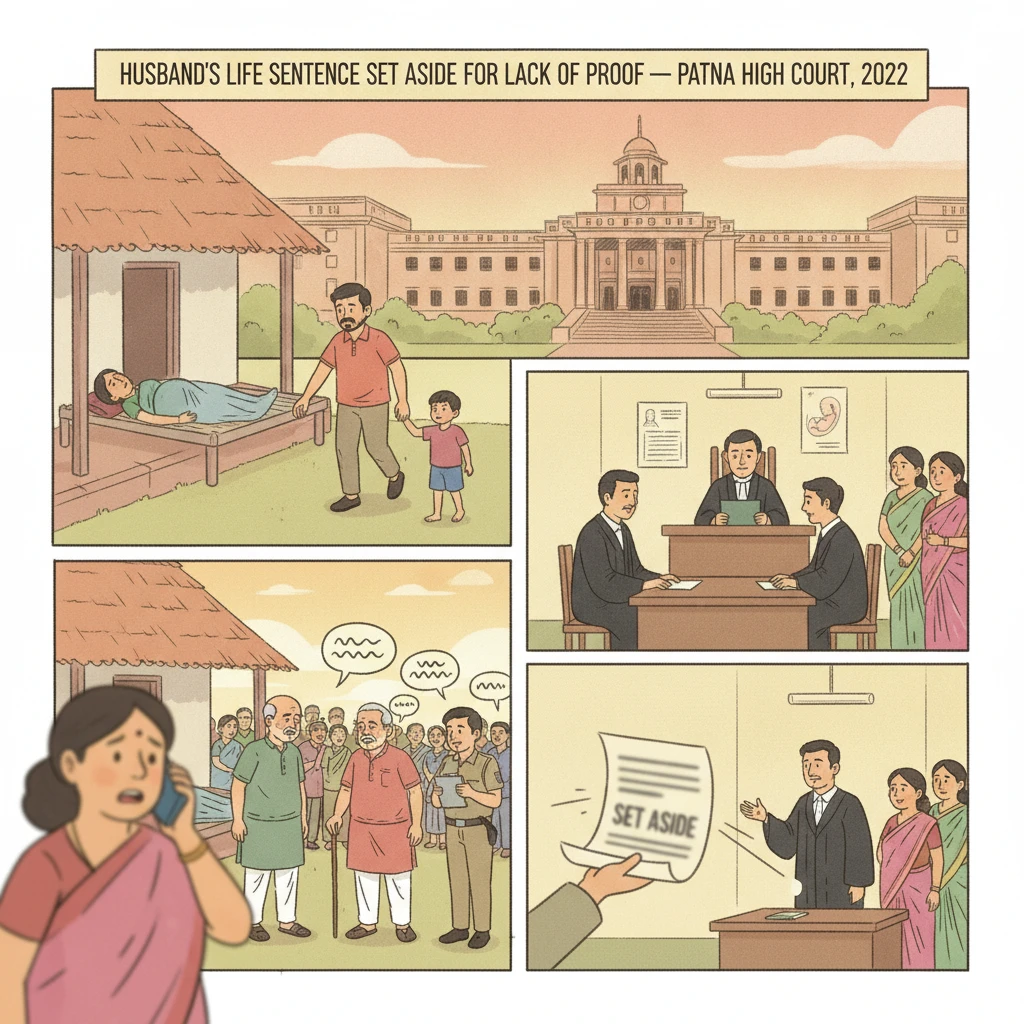
Case Background
The case arose from Kharagpur P.S. Case No. 40 of 2011, Munger district. The FIR was registered on 15.02.2011 under Section 302 of the Indian Penal Code after the death of a married woman at village Dariyapur.
The prosecution story came from the fardbeyan of the victim’s grandfather, Md. Mannan Sah (P.W. 10). He stated that his grand-daughter, Sajda Khatoon, had been married to the appellant, Md. Ziarul, about eight years before the occurrence according to Muslim rites and customs.
According to him, the couple initially lived happily for about four years. Thereafter disputes arose between them, which were said to have been compromised through panchayati.
On 14.02.2011, the victim’s maternal aunt, Rukhsana Khatoon (P.W. 2), who resided in the same village, informed the grandfather that his grand-daughter had died. On receiving this information, the informant went to village Dariyapur along with Md. Israil (not examined), Aziz Sah (not examined) and Md. Maneer (P.W. 5).
The informant claimed that co-villagers told him that his pregnant grand-daughter had been killed by her husband at about 4:00 A.M. on 14.02.2011 by strangulation and that the appellant fled after the incident with his six-year-old son. He also asserted that earlier disputes formed the background for the alleged killing.
The fardbeyan was recorded by P.S.I. Md. Mozammil (not examined) on 15.02.2011 at about 12:30 P.M. at village Dariyapur. A formal FIR was then drawn up and investigation started.
On completion of investigation, police submitted charge-sheet against the appellant for the offence under Section 302 IPC. The case was committed to the Court of Sessions and registered as Sessions Trial No. 554 of 2011 before the 1st Additional Sessions Judge, Munger.
The charge under Section 302 IPC was read over and explained to the accused. He pleaded not guilty and claimed false implication, asserting that the occurrence did not take place in the manner alleged.
By judgment dated 11.12.2013, the Trial Court convicted the appellant for murder under Section 302 IPC. By a separate order dated 12.12.2013, it sentenced him to imprisonment for life and a fine of Rs. 5000/-, with 15 days’ further imprisonment in default of payment of fine.
The appellant challenged these findings in Criminal Appeal (DB) No. 25 of 2014 before the Patna High Court.
What the Court Examined and Decided
The Division Bench of the Patna High Court, comprising Hon’ble Mr. Justice A.M. Badar and Hon’ble Mr. Justice Sunil Kumar Panwar, heard the appeal. The judgment was authored by Hon’ble Mr. Justice Sunil Kumar Panwar and delivered on 04.04.2022.
The central question before the Court was whether the prosecution had proved, beyond reasonable doubt, that the appellant had murdered his wife.
Counsel for the appellant argued that almost all prosecution witnesses were not eye-witnesses. They only stated that they had heard that the appellant killed his wife and had seen the dead body lying in the verandah of his house. Their evidence, being hearsay, could not be relied on for conviction.
The defence also pointed to the medical evidence. The doctor (P.W. 4) who conducted the post-mortem had, during cross-examination, stated that the injuries observed could have been caused by a fall on the ground. The defence suggested that the victim died due to falling from a ladder.
It was further argued that the prosecution must stand on its own legs and prove the case beyond reasonable doubt, either by direct or reliable circumstantial evidence. In this case, there was neither direct evidence nor a complete chain of circumstances to show that the appellant throttled the deceased.
The State’s counsel accepted that there was no direct eyewitness. However, she contended that the circumstances taken together formed a chain indicating that the appellant had committed the murder in the manner alleged.
The Court then closely examined the evidence of the eleven prosecution witnesses.
P.W. 1, a co-villager, was an independent witness but only identified his signature on the inquest report (Ext-1). He clearly stated he had no personal knowledge of the occurrence and had only heard about it.
P.W. 2, the maternal aunt of the deceased, lived in the same village and had informed the informant about the death. In cross-examination, she denied explaining the manner of the death. The Court observed that though she was a close relative and could have been a star witness, her evidence showed she was not an eye-witness and merely repeated what she had heard.
P.W. 3, the victim’s father, deposed that on reaching the place of occurrence he saw his daughter’s dead body with blood oozing from her nose and a mark on her neck. He suspected she had been throttled. He also stated that his relationship with his son-in-law had not been cordial for the last 3–4 years and that this might be the reason for the killing. However, he admitted he was not an eye-witness.
P.W. 5, P.W. 6, P.W. 7, P.W. 8, P.W. 9 and P.W. 11 were all relatives of the deceased. The Court noted that their statements about the incident were based only on hearsay; none had seen the assault.
P.W. 10, the informant and grandfather, was treated as the “star witness” of the prosecution. He deposed that he came to know of his grand-daughter’s death through a mobile call. When he reached the matrimonial home at village Dariyapur, he saw her dead body lying in the verandah. He admitted that he was not an eye-witness.
P.W. 4, Dr. Vijay Kumar, conducted the post-mortem and found three abrasions with bruises on the left side of the neck, open mouth with tongue protruded and clenched between the teeth, and a gravid uterus of 16–20 weeks with a male foetus. He opined that the cause of death was vasovagal attack due to throttling and that the death had occurred within 24 hours prior to the examination.
However, in cross-examination the doctor clarified that both injuries were simple in nature and might have been caused by falling on the earth. This cross-examination introduced a possible alternative cause of injuries consistent with an accidental fall.
Importantly, the Investigating Officer was not examined at the trial, despite efforts by the Trial Court. The High Court observed that non-examination of the I.O. had prejudiced the defence. The defence could not test the fairness of the investigation or seek clarifications on crucial aspects like the exact place of occurrence, seizure of materials, or presence of the accused.
The High Court acknowledged that the death of the deceased was unnatural. It also noted that all prosecution witnesses were interested or related witnesses and not eye-witnesses. Their evidence was entirely based on what they had heard from others.
The Trial Court had itself accepted that there was no direct evidence and convicted the appellant solely on circumstantial evidence, namely: the dead body was found in the house of the accused; the deceased had antemortem injuries; and the accused was not present at the place just after the occurrence.
The High Court then reminded itself of the settled law on conviction based on circumstantial evidence. The circumstances relied upon must be firmly established, must unerringly point towards the guilt of the accused, and must form a complete chain leaving no reasonable doubt that the crime was committed by the accused and no one else. The circumstances must be consistent only with the guilt of the accused and inconsistent with his innocence.
The Court examined whether the prosecution had produced such a complete chain. The witnesses had said that the couple used to quarrel over trivial matters and that a panchayati was once held. But there was no clear, consistent evidence as to the nature, timing, or seriousness of these conflicts.
The Bench further stressed that under criminal law, the prosecution has to rely on its own strength and cannot depend on supposed weaknesses in the defence. Section 106 of the Indian Evidence Act, which deals with facts especially within the knowledge of a person, does not apply unless the prosecution first discharges its initial burden of establishing a prima facie case of guilt.
In this case, there was no evidence that the appellant was seen at or near the scene of occurrence before, during, or after the incident. The place of occurrence was easily accessible to the public. Evidence about the appellant’s presence there was totally absent.
Therefore, the Court held that there was no prima facie evidence against the appellant, and Section 106 of the Evidence Act could not be invoked to ask him to explain how his wife died. The Bench specifically stated that mere absconding of the accused could not by itself form the fulcrum of a guilty mind in murder cases.
After carefully considering all evidence and submissions, the High Court concluded that the prosecution had “miserably failed” to prove and establish the charge under Section 302 IPC beyond reasonable doubt.
Consequently, the appeal was allowed. The judgment of conviction dated 11.12.2013 and order of sentence dated 12.12.2013 of the 1st Additional Sessions Judge, Munger, in Sessions Trial No. 554 of 2011 were quashed and set aside.
The appellant was acquitted of the offence punishable under Section 302 IPC and directed to be set free forthwith. As he was in jail, the Court ordered that he be released immediately, if not required in any other case.
Why This Judgment Matters
This judgment highlights how strictly the Patna High Court applies the rule that criminal guilt must be proved beyond reasonable doubt.
Where there is no eyewitness, and only loose, hearsay statements from relatives, courts cannot presume that the husband is guilty just because the wife died in his house or because the couple had quarrels.
The ruling also shows the importance of medical and investigative evidence. Here, the doctor’s admission that the injuries could be caused by a fall, and the failure to examine the Investigating Officer, created serious gaps in the prosecution story.
For families of victims, the case underlines that suspicion, strained relations, and village gossip cannot by themselves secure a conviction. For accused persons, it confirms that courts will not uphold a life sentence unless the evidence forms a clear and unbroken chain pointing only towards their guilt.
Legal Issues and Answers
Issue: Did the prosecution prove beyond reasonable doubt that the appellant murdered his wife under Section 302 IPC, based on circumstantial evidence and hearsay testimony?
Answer: No. The Patna High Court held that all key witnesses were hearsay, the medical evidence allowed an alternative explanation, the Investigating Officer was not examined, and the circumstances did not form a complete chain pointing only to the appellant’s guilt. The conviction was therefore set aside and the appellant was acquitted.
Issue: Could Section 106 of the Indian Evidence Act be invoked to draw an adverse inference against the husband because the death occurred in his house and he was absent afterward?
Answer: No. The Court held that Section 106 does not apply unless the prosecution first establishes a prima facie case. In the absence of evidence about the appellant’s presence at or near the time of occurrence, and with the place of occurrence being accessible to the public, no such initial burden was discharged, and mere absconding could not prove guilt.
Cases Cited by the Court
- The judgment does not refer to or rely on any specific earlier case law by name or citation.
Case Details
Case Number: Criminal Appeal (DB) No. 25 of 2014; arising out of Kharagpur P.S. Case No. 40 of 2011; Sessions Trial No. 554 of 2011
Case Title: Md. Ziarul v. The State of Bihar
Court: High Court of Judicature at Patna
Coram: Hon’ble Mr. Justice A. M. Badar; Hon’ble Mr. Justice Sunil Kumar Panwar
Date of High Court Judgment: 04.04.2022
Trial Court Judgment and Sentence: Judgment of conviction dated 11.12.2013 and order of sentence dated 12.12.2013 by the 1st Additional Sessions Judge, Munger
Offence Alleged: Section 302 of the Indian Penal Code (murder)
Citation: 2022 (2) PLJR 477
Advocates: For the appellant – Mr. Abdul Manan, Advocate; Mr. Binay Kumar, Advocate. For the State – Ms. Shashi Bala Verma, APP.
Nature of the Case: Criminal appeal (Division Bench) against conviction and sentence for murder passed by the Sessions Court.
Final Outcome: Appeal allowed; conviction and life sentence under Section 302 IPC set aside; appellant acquitted and ordered to be released forthwith, if not wanted in any other case.
Link to Judgment: Click here to read the full judgment of the Patna High Court
If you found this explanation helpful and wish to stay informed about
how legal developments may affect your rights in Bihar,
you may consider following Samvida Law Associates for more updates.







