

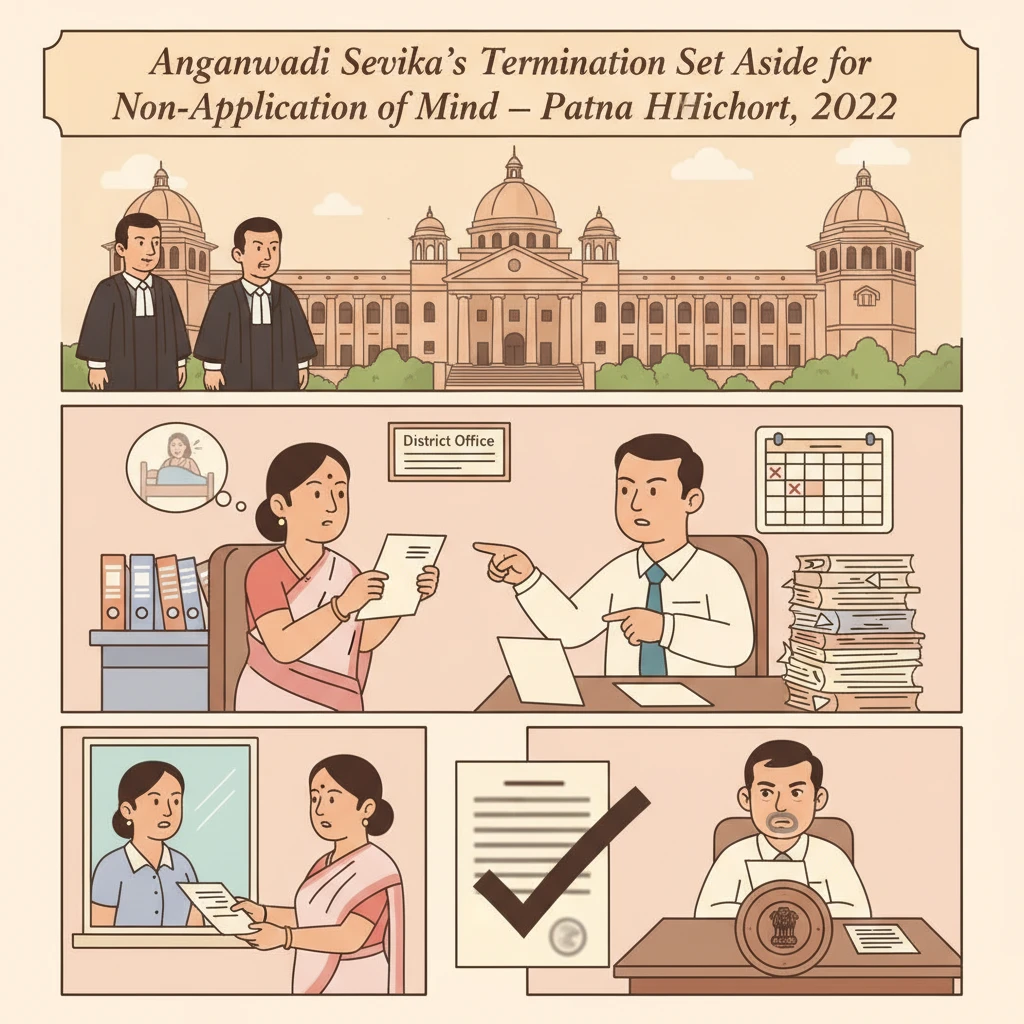
Case Background
The petitioner was appointed as an Anganwari Sevika at Anganwari Centre, Aura (124), District Gaya, in the year 1988 under the Integrated Child Development Services (ICDS) scheme.
Many years later, the official respondents conducted inspections of her Anganwadi centre. In the year 2015, during inspection, the petitioner was found absent. As a result, a warning was issued to her.
Again, on 27.04.2016 and 14.09.2016, inspections were carried out and the petitioner was again found absent. For these instances, the authorities issued further warnings. On 27.04.2016, an additional penalty was imposed by denying her 15 days’ honorarium.
On a subsequent inspection, the petitioner once more remained absent. The inspecting authority noticed this absence and a notice dated 18.01.2017 was issued to her. The petitioner submitted her written explanation, stating that the Sahayika was suffering from stomach illness.
Despite this explanation, the concerned authority (respondent no. 4, District Programme Officer, Gaya) cancelled her selection and terminated her services as Anganwari Sevika by order dated 01.03.2017, issued through Memo of the same date.
The petitioner filed an appeal against this termination order. The appellate authority (respondent no. 3, District Magistrate, Gaya) dismissed the appeal and affirmed the termination by order dated 15.12.2019, communicated through Memo No. 669 dated 03.02.2020.
Aggrieved by both the termination order and the appellate order, the petitioner approached the Patna High Court in Civil Writ Jurisdiction Case No. 2161 of 2021, seeking quashing of these orders and restoration of her position.
What the Court Examined and Decided
The matter was heard by the Hon’ble Mr. Justice P. B. Bajanthri. The Court first noted the reliefs sought by the petitioner. She asked the Court to quash the appellate order dated 15.12.2019 (Memo No. 669 dated 03.02.2020) by which the District Magistrate, Gaya, had affirmed the District Programme Officer’s decision. She also sought setting aside of the original order dated 01.03.2017 by which her selection as Anganwari Sevika of Anganbari Centre, Aura, District Gaya was cancelled.
The petitioner’s counsel argued that she had been serving as Anganwari Sevika since 1988 and had put in long years of service. According to her, on the dates of inspections when she was found absent, it was beyond her control because of illness. She had reiterated this reason in her reply to the show cause notice dated 18.01.2017.
Her counsel submitted that the authority failed to consider this explanation properly. If the authority wanted to reject her claim of illness, it should have directed her to furnish a medical certificate to verify whether the illness was genuine or not.
It was also submitted on behalf of the petitioner that where termination is based on allegations, an enquiry is required, whether the person is a regular employee or a temporary worker. Counsel referred to the principle laid down by the Supreme Court (Apex Court) that some form of enquiry is necessary before taking such punitive action.
On the other hand, the State’s counsel resisted the petition. He pointed out that the petitioner had remained absent on three occasions during the years 2015 and 2016 and that these instances had already been taken note of by the department. Warnings were issued and on one instance 15 days of honorarium had been deducted.
The State’s counsel argued that the petitioner’s explanation was considered before passing the termination order dated 01.03.2017 and that there was no infirmity in either the termination order or the appellate order dated 15.12.2019.
After hearing both sides, the Court identified the undisputed facts. The petitioner had indeed been appointed in 1988. During 2015 and 2016, she was found absent on three occasions. For these, she had been punished through warnings, and in one case by withholding 15 days of honorarium.
The crucial question before the Court related to the last incident of absence, which led to the show cause notice dated 18.01.2017 and the ultimate termination on 01.03.2017. The petitioner had claimed that the Sahayika was suffering from stomach illness, which explained the absence on the inspection date.
The Court carefully examined the termination order dated 01.03.2017. It observed that there was no discussion in that order regarding the genuineness of the petitioner’s stated illness on the date she remained absent, read together with the inspection report.
The Court held that if the authority doubted the illness of the Sahayika, it should have asked the petitioner to produce a medical certificate. This would have allowed the authority to verify whether the illness was genuine.
Because the authority failed to do so, and did not even record any reasoned finding on whether her explanation was acceptable, the Court concluded that there was non-application of mind in considering her explanation and in passing the termination order dated 01.03.2017.
The Court regarded this non-application of mind as serious enough to grant relief. It held that the petitioner had made out a prima facie case for interference with the impugned orders.
Consequently, the Court set aside both the original termination order dated 01.03.2017 and the appellate order dated 15.12.2019 which had affirmed the termination.
Regarding the relief to be granted, the Court directed the concerned authority to reinstate the petitioner forthwith. This means she is to be restored to her position as Anganwari Sevika.
However, the Court made it clear that the petitioner would not be entitled to arrears of salary for the period during which her services had been dispensed with, i.e., from 01.03.2017 till the date of the judgment. In other words, for those years she would not receive back wages.
The Court nonetheless directed that whatever remaining service benefits the petitioner is entitled to shall be extended to her from the date of reinstatement. Thus, while she loses full back wages, she regains her job and continues to earn service benefits going forward.
With these directions, the Patna High Court allowed the writ petition and disposed of the matter.
Why This Judgment Matters
This judgment is important for Anganwadi workers and other similarly placed scheme workers in Bihar.
First, it shows that even where a worker has faced repeated warnings for absence, the authorities must still fairly consider any explanation given for a later incident before ordering termination.
Second, the Patna High Court has highlighted that if an authority doubts a worker’s claim of illness, it cannot simply ignore it. It should ask for supporting documents like a medical certificate and then apply its mind to whether the explanation is genuine.
Third, the case underlines that dismissal from service cannot be done mechanically. Orders must show that the authority has looked into the worker’s defence and given reasons for rejecting it.
Finally, for long-serving workers, the judgment offers some protection. While the Court did not grant back wages, it ensured that the worker was reinstated and allowed to continue receiving service benefits in future.
Legal Issues and Answers
- Issue: Whether the termination of an Anganwari Sevika for absence, without properly considering her explanation of illness, is valid.
Answer: No. The Patna High Court held that the authority failed to apply its mind to the petitioner’s explanation and did not seek medical proof if it doubted her illness. This non-application of mind rendered the termination and appellate orders unsustainable, and they were set aside. - Issue: What relief should be granted when termination is set aside for such non-application of mind.
Answer: The Court directed reinstatement of the petitioner forthwith, but denied arrears of salary for the period from 01.03.2017 till the date of judgment. She is, however, entitled to remaining service benefits from the date of reinstatement.
Cases Cited by the Court
- The judgment refers generally to the principle laid down by the Apex Court that enquiry is warranted if termination is based on allegations, even for temporary employees. No specific case names or citations are mentioned in the text of this judgment.
Case Details
Case Number: Civil Writ Jurisdiction Case No. 2161 of 2021
Case Title: Kamla Devi vs. The State of Bihar & Ors.
Citation: 2022 (2) PLJR 460
Court: High Court of Judicature at Patna
Coram: Hon’ble Mr. Justice P. B. Bajanthri
Date of Judgment: 31.03.2022
For the Petitioner: Mr. Rakesh Singh
For the Respondents: Mr. Prashant Pratap, GP-2
Nature of the Case: Writ petition challenging cancellation of selection and termination of an Anganwari Sevika and the affirming appellate order.
Impugned Orders: Order dated 01.03.2017 passed by respondent no. 4 (District Programme Officer, Gaya) cancelling the petitioner’s selection as Anganbari Sevika; Order dated 15.12.2019 passed by respondent no. 3 (District Magistrate, Gaya), communicated vide Memo No. 669 dated 03.02.2020, affirming the termination.
Link to Judgment: View full judgment on Patna High Court website
If you found this explanation helpful and wish to stay informed about
how legal developments may affect your rights in Bihar,
you may consider following Samvida Law Associates for more updates.







